Solana Transaction Routing: 4 Solutions Compared
Solana Transaction Routing: 4 Solutions Compared
From Stake-Weighted Quality of Service (SWQoS) to MEV Protection: Discover how Quicknode's Solana sendTransaction options give you control over transaction speed, success rates, and protection.

March 19, 2025 — 5 min read
On Solana, with its high throughput and short block times, milliseconds matter. Whether a transaction succeeds or fails, and whether you catch a market opportunity or miss it, often comes down to how fast your transactions reach validators.
Quicknode offers several ways to submit Solana transactions, each built for different needs, from the Core RPC API to enterprise-grade Stake-Weighted Quality of Service (SWQoS). To land transactions consistently, pick the right routing strategy for your use case and tune your priority fees and compute units. Every piece has to work together to get transactions through quickly and give you an edge.
In this post, we compare the sendTransaction options on Quicknode and help you pick the best one for your use case. For tips on tuning your transactions, see this documentation.
Let's get started.
Understanding Solana Transaction Routing: The Basics
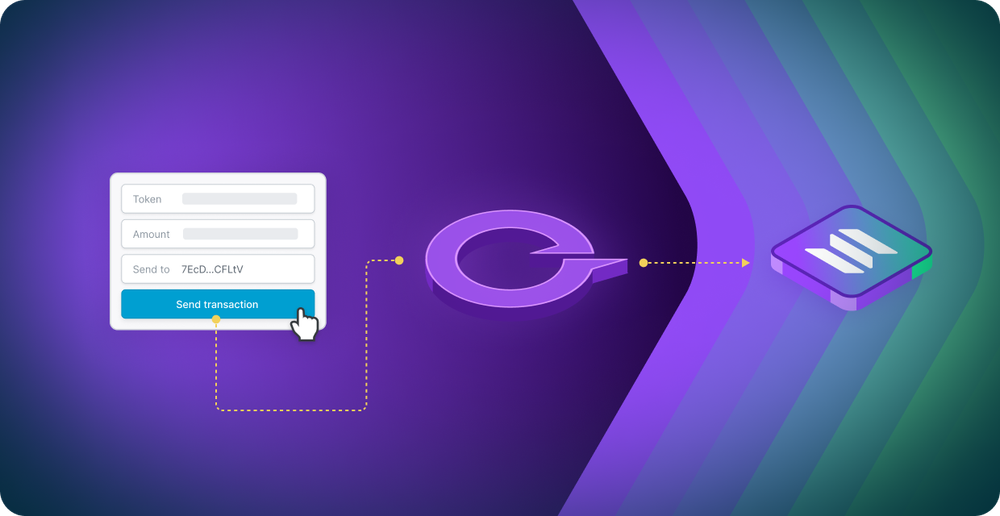
The Solana sendTransaction RPC method submits signed transactions to the network. But the path your transaction takes has a big effect on how fast it confirms and whether it succeeds. Quicknode handles this routing for you by default. It also offers advanced tools and add-ons that give you control over how your transactions reach the network.
Quicknode's sendTransaction Options Compared
Quicknode offers four ways to route your Solana transactions. Each has its own strengths, and you can switch between them without changing your code.
const connection = new Connection('YOUR_QUICKNODE_ENDPOINT');
const txid = await connection.sendTransaction(transaction);
At a Glance:
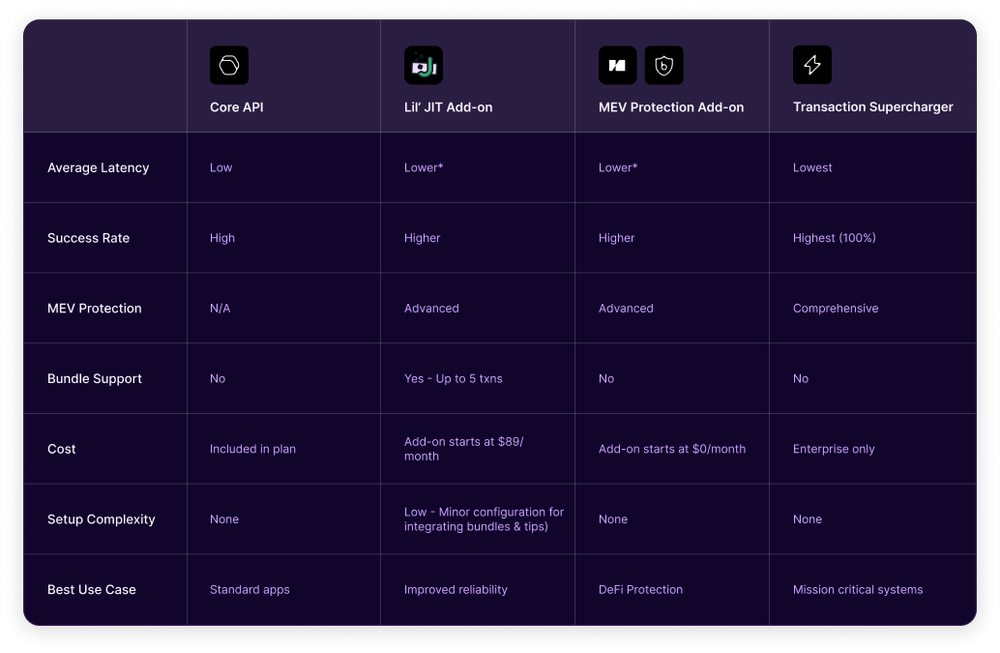
*When the slot leader runs the Jito client, transactions go straight to that validator. When the leader runs a different client, transactions go to the next leader running Jito.
Let’s take a closer look at each ⬇️
1. Core API sendTransaction (SWQoS*)
The standard sendTransaction RPC method in our Core API sends transactions reliably through Quicknode's global infrastructure. Our tuned node setup spreads your transaction across the Solana network efficiently.
*Stake-Weighted Quality of Service (SWQoS) is used when you follow the best practices in Quicknode's Solana transaction guidelines.
Best for: General-purpose apps, development environments, and standard dApp operations that need steady, reliable performance without special requirements.
Documentation: sendTransaction
2. JITO Add-on sendTransaction
The Lil' JIT Marketplace add-on proxies the Solana sendTransaction RPC method and forwards your transaction straight to the next Jito validator leader. By default, it sends the transaction with MEV protection.
Transactions are prioritized by tip, with a minimum tip of 1,000 lamports. You can also bundle transactions so they run in order, all or nothing.
Best for: Apps that need higher transaction success rates, complex bundles, and the ability to adjust to market-driven tips. It fits cases where certain execution is worth paying variable tips, like arbitrage. It also fits when you need to send up to 5 transactions that run in order, all or nothing (a bundle).
Documentation: sendBundle, sendTransaction
Guide: What are Jito Bundles and How to Use Them?
3. MEV Protection sendTransaction
Our MEV Protection add-ons (Merkle) protect against Maximal Extractable Value attacks. They route your transactions through protected channels that shield them from front-running and sandwich attacks.
Best for: DeFi apps, trading platforms, and any system where protecting transaction order is critical to protecting user value.
Marketplace Add-on: Solana MEV Protection & Recovery
Guide: What is MEV (Maximum Extractable Value) and How to Protect Your Transactions on Solana
4. Transaction Supercharger (SWQoS)
Our enterprise-grade Transaction Supercharger add-on uses Stake-Weighted Quality of Service (SWQoS) over dedicated staked connections. It delivers the highest inclusion rates and lowest latency available on Solana. Transactions route through our network of high-stake validators for top performance on critical operations.
Best for: High-frequency trading, institutional finance apps, and enterprise systems where certain, low-latency execution is a must.
Contact our team to learn more about Transaction Supercharger
Choosing the Right sendTransaction Method
When choosing how to submit transactions, consider:
Application Criticality: How important is guaranteed execution for your use case?
Timing Sensitivity: Does your application require the absolute lowest latency?
MEV Concerns: Are your transactions susceptible to front-running or sandwich attacks?
Budget Considerations: What performance improvements justify additional investment?
For most developers, our Core API performs well for standard apps. As your needs get more specialized, especially for financial apps, trading platforms, or high-value transactions, our advanced options give you performance gains that directly affect your bottom line.
Getting Started with Advanced Transaction Routing
Ready to tune your Solana transactions? Here's how to start:
Core API: Available immediately with any Quicknode plan (Sign up free here).
LIL’ JIT: Enable through the Quicknode Marketplace or your Quicknode dashboard.
MEV Protection: Add via Marketplace (Solana MEV Protection & Recovery) or your Quicknode dashboard.
Transaction Supercharger: Contact our enterprise team for qualification and setup.
Once you enable an add-on, your endpoint routes sendTransaction requests using that option. Each routing method works on its own, and you can't turn on more than one per endpoint. Choose the one that best fits your use case. If you need more than one method, set up a separate endpoint for each.
That's it. Also do everything you can on the client side to improve landing rates. See our documentation for how to tune compute and priority fees.
Scale with Quicknode
As Solana grows, tuning transactions will matter more for developers building competitive apps. Quicknode's tiered routing options let you pick the performance level you need, from standard apps to critical trading systems.
With Transaction Supercharger at the top of our sendTransaction options, Quicknode keeps your apps performing at their best as network conditions change.
Ready to supercharge your Solana transactions? Log in to your Quicknode dashboard to explore our sendTransaction options further, or contact our enterprise team to learn more about Transaction Supercharger.
About Quicknode
Founded in 2017, Quicknode deploys institutional-grade blockchain infrastructure for developers and enterprises. With 99.99% uptime and support for 76+ chains, teams build and scale onchain applications without compromise.
Stay updated
The latest engineering insights, product updates, and web3 news delivered straight to your inbox.