Application de rapport Ethereum
The Ethereum Transaction Report app fetches and analyzes Ethereum transactions for a given address using Quicknode's Blockbook API, providing detailed reports within a specified date range.



Introduction
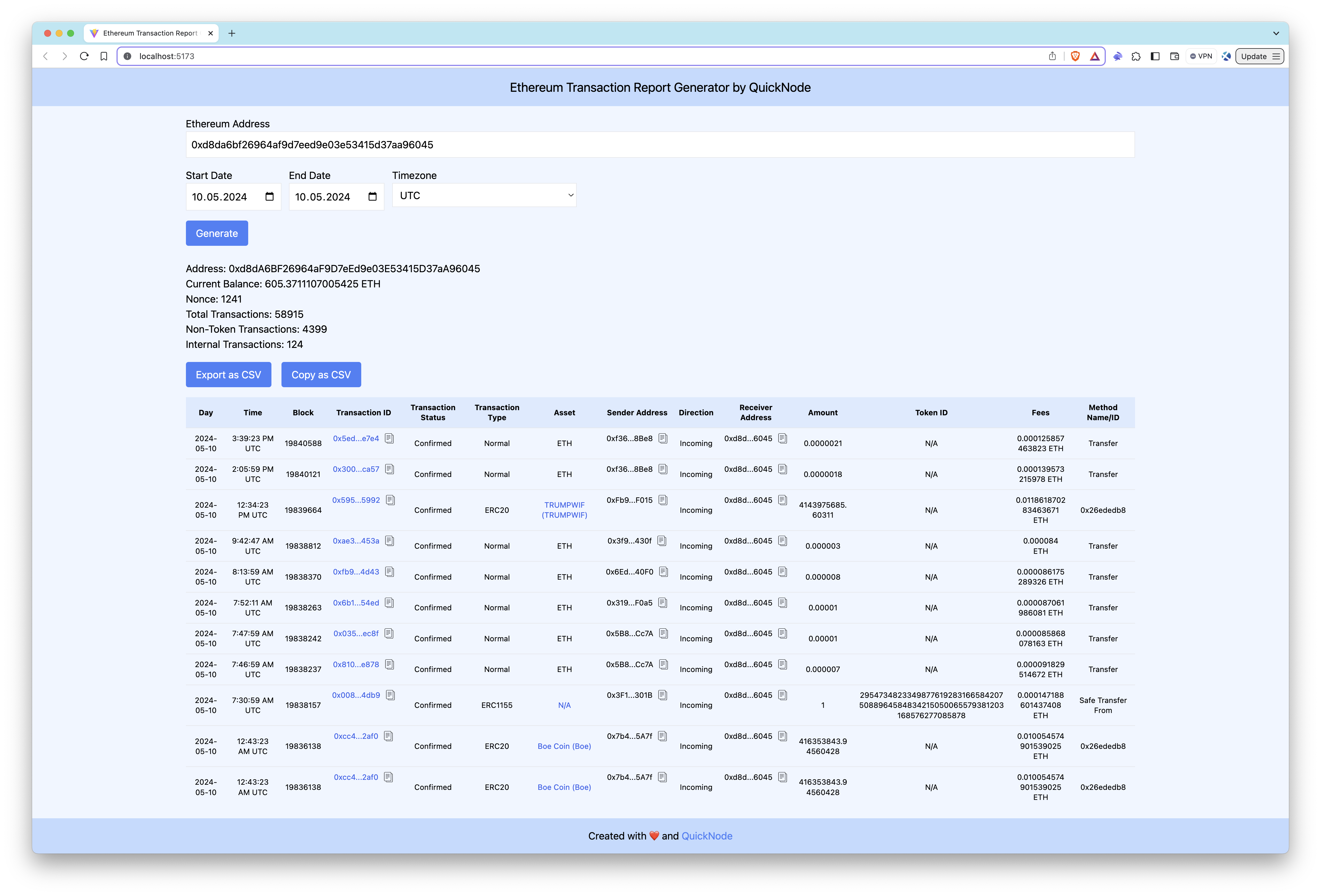
This application fetches and analyzes Ethereum transactions for a given address using Quicknode's Blockbook API, providing detailed reports within a specified date range. It identifies transaction direction (incoming or outgoing), confirmation status, and token transfers across ERC-20, ERC-721, and ERC-1155 assets. Users can filter by transaction type (normal, internal, or token) and date range, with support for time zone selection. Additionally, it offers a wallet summary with balance, nonce, and transaction counts.
For an in-depth guide on how to build this app, refer to our comprehensive guide on Quicknode
Pile technologique
- Frontend Framework/Library: React
- Language: TypeScript
- Build Tool/Development Server: Vite
Caractéristiques
- Transaction Direction: Identifies whether transactions are incoming or outgoing.
- Confirmation Status: Determines whether transactions are confirmed.
- Token Transfers: Includes details for ERC-20, ERC-721, and ERC-1155 token transfers.
- Transaction Filtering: Detects normal, internal and token transactions.
- Date Range Filtering: Generates reports for transactions within a specified date range.
- Time Zone Selection: Performs date filtering according to the selected timezone.
- CSV Support: Ability to export or copy results as a CSV file.
- Wallet Summary: Displays a summary of the wallet address, including current balance, nonce, total transactions, non-token transactions, and internal transactions.
Pour commencer
Conditions préalables
Pour utiliser cette application, vous aurez besoin de :
- Node.js installed on your system.
- A Quicknode account with access to the paid Blockbook API.
- Un éditeur de code ou un IDE (par exemple, VS Code)
- TypeScript and ts-node
Run the commands below to install TypeScript and ts-node globally to have TypeScript available across all projects.
npm install -g typescript ts-node
Prérequis d'installation
- Clonez le dépôt sur votre ordinateur local :
git clone https://github.com/quiknode-labs/qn-guide-examples.git
- Accédez au répertoire du projet :
cd sample-dapps/ethereum-transaction-report-generator
- Installez les dépendances nécessaires :
npm installer
Configuration des variables d'environnement
Renommer .env.example à .env and replace the YOUR_QUICKNODE_ETHEREUM_ENDPOINT_URL placeholder with your Quicknode Ethereum endpoint with Blockbook access.
VITE_QUICKNODE_ENDPOINT = "YOUR_QUICKNODE_ETHEREUM_ENDPOINT_URL"
Please note that while we utilize
dotenvfor environment variable management, sensitive information like endpoints can still be visible on the frontend. This configuration is not recommended for production environments as-is.
Exécution de l'application
Lancez le serveur de développement :
npm exécuter en mode développement
Open http://localhost:5173/ with your browser to see the application.
Utilisation de l'application
- Input an Ethereum wallet address.
- (Optional) Select date range and time zone.
- Press
Generate. - (Optional) Export or copy results as CSV.
The Ethereum Transaction Report Generator application will query the Ethereum blockchain for the wallet's transactions, filter these transactions data and calculate additional variables. Lastly, the app display results.
Aperçu
Conclusion
Quicknode's Blockbook API facilitates the creation of detailed Ethereum transaction reports for developers and businesses alike. While this application covers the fundamentals, there's a vast scope for customization and extended functionalities. Whether for audit purposes, regulatory compliance, or market analysis, Blockbook streamlines the process of extracting blockchain data.
To discover more about how Quicknode assists auditing firms and individuals in extracting this type of data from blockchains, please contact us; we're eager to engage with you!
- Créer une branche du dépôt
- Créer une branche de fonctionnalité :git checkout -b feature/amazing-feature
- Validez vos modifications :git commit -m "Ajout d'une fonctionnalité géniale"
- Publiez votre branche :git push origin feature/amazing-feature
- Créez une demande de fusion.