
12 min read
Overview
The phrase "tokenized RWAs" tends to suggest something exotic: a bespoke chain, a proprietary API, a permissioned system that requires special access. It's easy to assume the integration will look nothing like everyday EVM (Ethereum Virtual Machine) development.
Robinhood Chain inverts that assumption. It's a permissionless, EVM-compatible Layer 2 that's built on Arbitrum Orbit, settles to Ethereum, and pays gas in ETH. Stock Tokens on it are ERC-20 contracts, so the wallet code, ABI (Application Binary Interface) decoding, event indexing, and RPC (Remote Procedure Call) calls you already rely on carry over unchanged. The interesting part isn't a new interface. It's what happens when an asset class that trades on an exchange calendar becomes a token a smart contract can hold.
- Robinhood Chain is a permissionless, EVM-compatible Layer 2 built on Arbitrum Orbit (a framework for launching chains that run Arbitrum's Nitro stack and settle to Ethereum), using ETH as its native gas token
- Mainnet is live with chain ID
4663, and testnet is chain ID46630, so any Ethereum tool that accepts a chain ID and an RPC endpoint works without protocol-level changes - Stock Tokens are standard ERC-20 contracts that provide economic exposure to underlying ETPs (exchange-traded products), which means
balanceOf,totalSupply, andTransferbehave exactly as they do for any other token, and any contract that handles ERC-20s can handle them - Confirmation happens in two stages: a fast soft confirmation from the sequencer (the service that orders transactions), then hard finality once the batch posts to Ethereum and reaches L1 finality, roughly 13 minutes later. The 7-day challenge period applies only to bridge withdrawals, not to transaction finality
- Public RPC endpoints suit wallet setup and quick tests, while production traffic should use a dedicated Robinhood Chain RPC endpoint for archive data, higher rate limits, and WebSocket subscriptions
What You Will Learn
- What Robinhood Chain is, and where it sits relative to Ethereum and the wider Arbitrum ecosystem
- How the sequencer, batching, and settlement pipeline shape transaction confirmation and finality
- What Stock Tokens are at the contract level, and what "composable" actually buys you
- How to connect to Robinhood Chain RPC, including chain IDs, network parameters, and when a public endpoint stops being enough
- Which Ethereum habits carry over unchanged, and which ones need adjusting on an Orbit chain
What You Will Need
- Basic familiarity with the EVM, ERC-20 tokens, and JSON-RPC. You won't need to write any Solidity for this guide
- A Quicknode account to create a Robinhood Chain endpoint (the free tier is enough to follow along)
- Node.js v20.6 or higher if you want to run the connection snippet
What Problem Does Robinhood Chain Solve?
To understand why a chain like this exists, consider three things you cannot do when an asset lives only inside a traditional brokerage system:
- Read a position without permission. Brokerage data sits behind a permissioned API with keys, quotas, and terms of use. Onchain, balances are public state, and any client with an RPC endpoint can read them without asking anyone.
- Compose the asset with other code. An equity in a brokerage account has no interface that other programs can call. A smart contract cannot post it as collateral, an automated market maker cannot pool it, and an escrow cannot hold it.
- Interact outside market hours. An exchange has an opening bell, a closing bell, weekends, and holidays. Software that wants to settle a transfer at 3 a.m. on a Sunday has nothing to talk to.
All three are variations of the same constraint: the asset is locked inside a closed system with no programmable surface. Representing it as a token on a public chain removes that constraint, because a token contract exposes a standard interface, keeps its state publicly readable, and has no concept of a trading calendar.
Robinhood Chain addresses this by being an EVM Layer 2 rather than a special-purpose system, so the entire existing Ethereum toolchain applies from day one.
What is Robinhood Chain?
Robinhood Chain is an Ethereum Layer 2 blockchain built with Arbitrum Orbit and aimed at onchain financial infrastructure and tokenized real-world assets. It executes transactions on its own network, then posts transaction data and state commitments to Ethereum, which serves as the settlement and data availability layer (the place where the chain publishes transaction data so anyone can reconstruct its state).
Three properties matter most:
- It's permissionless. Anyone can deploy a contract, read state, or send a transaction. You don't need an allowlist, a partnership, or a Robinhood account to build against it. (One compliance caveat: the sequencer screens out transactions associated with sanctioned addresses.)
- It's fully EVM-compatible. Solidity contracts compile and deploy unchanged. Hardhat, Foundry, Remix, viem, ethers.js, and web3.py all work by pointing them at a Robinhood Chain RPC endpoint.
- You pay gas in ETH. There's no separate gas token to acquire or manage, which removes an entire category of onboarding friction.
Here's where the chain sits in the stack:
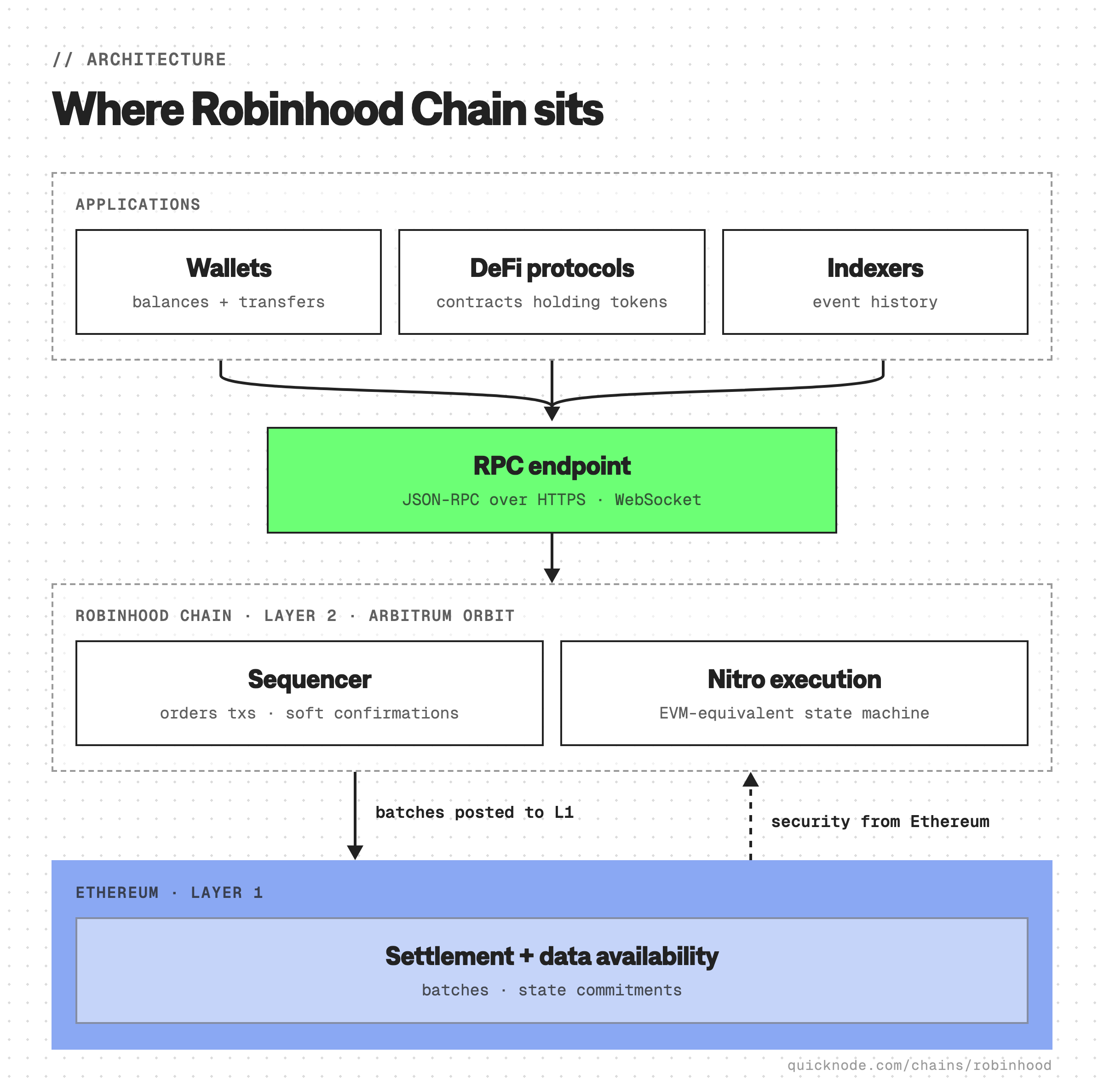
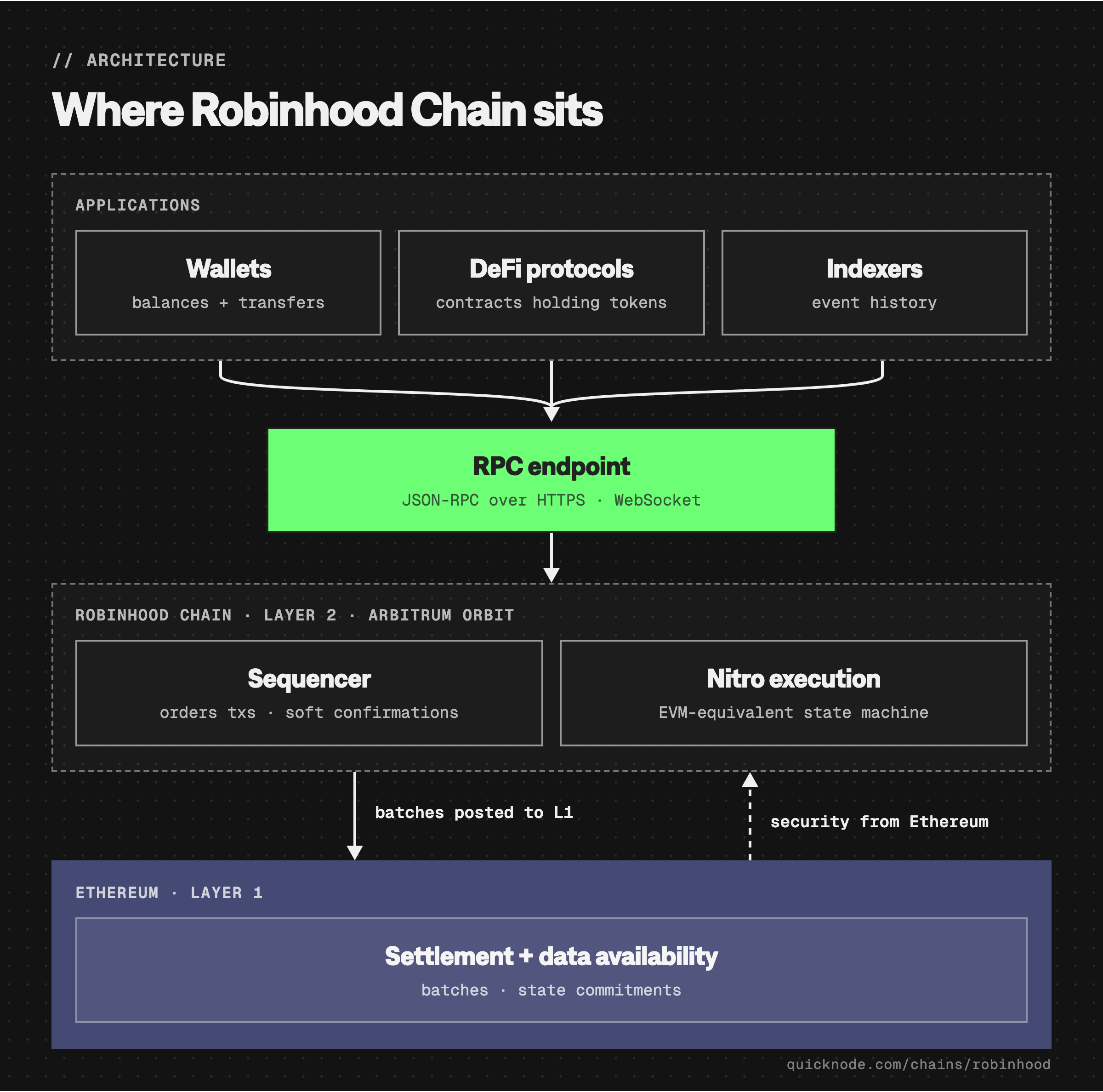
The practical consequence is that Robinhood Chain doesn't ask you to trust it the way a standalone chain would. It anchors its state to Ethereum, and the security assumptions are the familiar Orbit and Nitro ones rather than something novel.
Network Parameters
These are the values you need for wallet configuration, chain definitions in viem or wagmi, and anything else that takes network settings:
| Parameter | Mainnet | Testnet |
|---|---|---|
| Chain ID | 4663 | 46630 |
| Native currency | ETH | ETH |
| Public RPC | https://rpc.mainnet.chain.robinhood.com | https://rpc.testnet.chain.robinhood.com |
| Sequencer feed (WebSocket) | wss://feed.mainnet.chain.robinhood.com | wss://feed.testnet.chain.robinhood.com |
| Block explorer | robinhoodchain.blockscout.com | explorer.testnet.chain.robinhood.com |
| Stack | Arbitrum Orbit (Nitro) | Arbitrum Orbit (Nitro) |
The public RPC endpoints above are shared and rate limited. Robinhood documents them for wallet connectivity, quick tests, and getting started rather than for production traffic. The sequencer feed streams ordered transactions in real time and is mainly useful to node operators; most applications only need the RPC endpoints. See Connect to Robinhood Chain for the production path.
How Robinhood Chain Works
Transactions on Robinhood Chain confirm in two stages: a fast soft confirmation from the sequencer, then hard finality once the batch containing the transaction reaches finality on Ethereum. Understanding that pipeline is what separates "I can read a balance" from "I can safely move value."
When you submit a transaction, it goes to the sequencer, which is responsible for ordering. The sequencer accepts the transaction, assigns it a position, and returns a receipt quickly. That receipt is a soft confirmation: the sequencer has promised an ordering, and in practice that promise holds, but Ethereum hasn't seen the transaction yet. Later, the sequencer compresses many transactions into a batch and posts it to Ethereum, which fixes the ordering on L1. Once that batch reaches Ethereum finality, roughly 13 minutes after posting, the transaction has hard finality, backed by Ethereum's own security. Here's the full lifecycle:
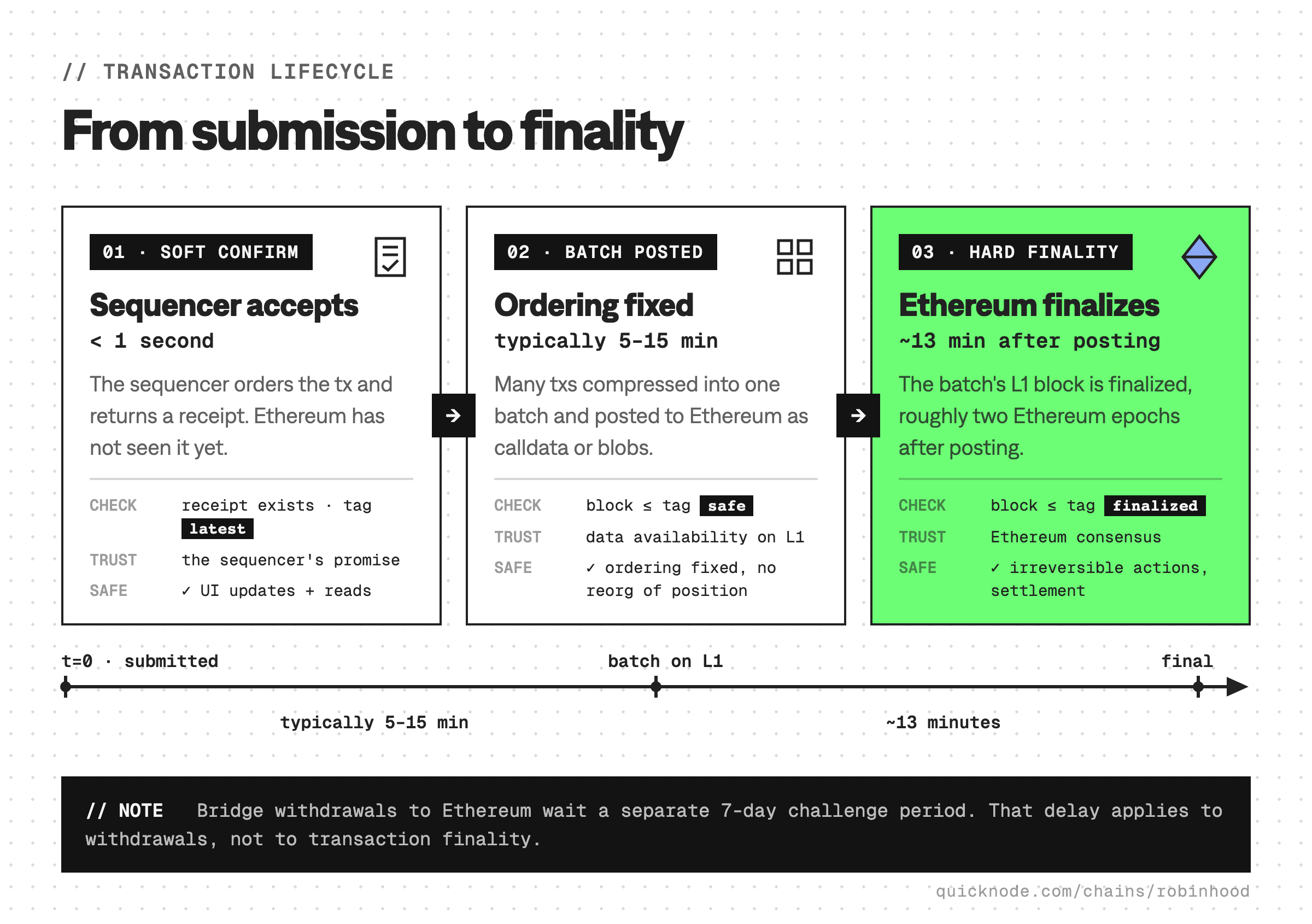
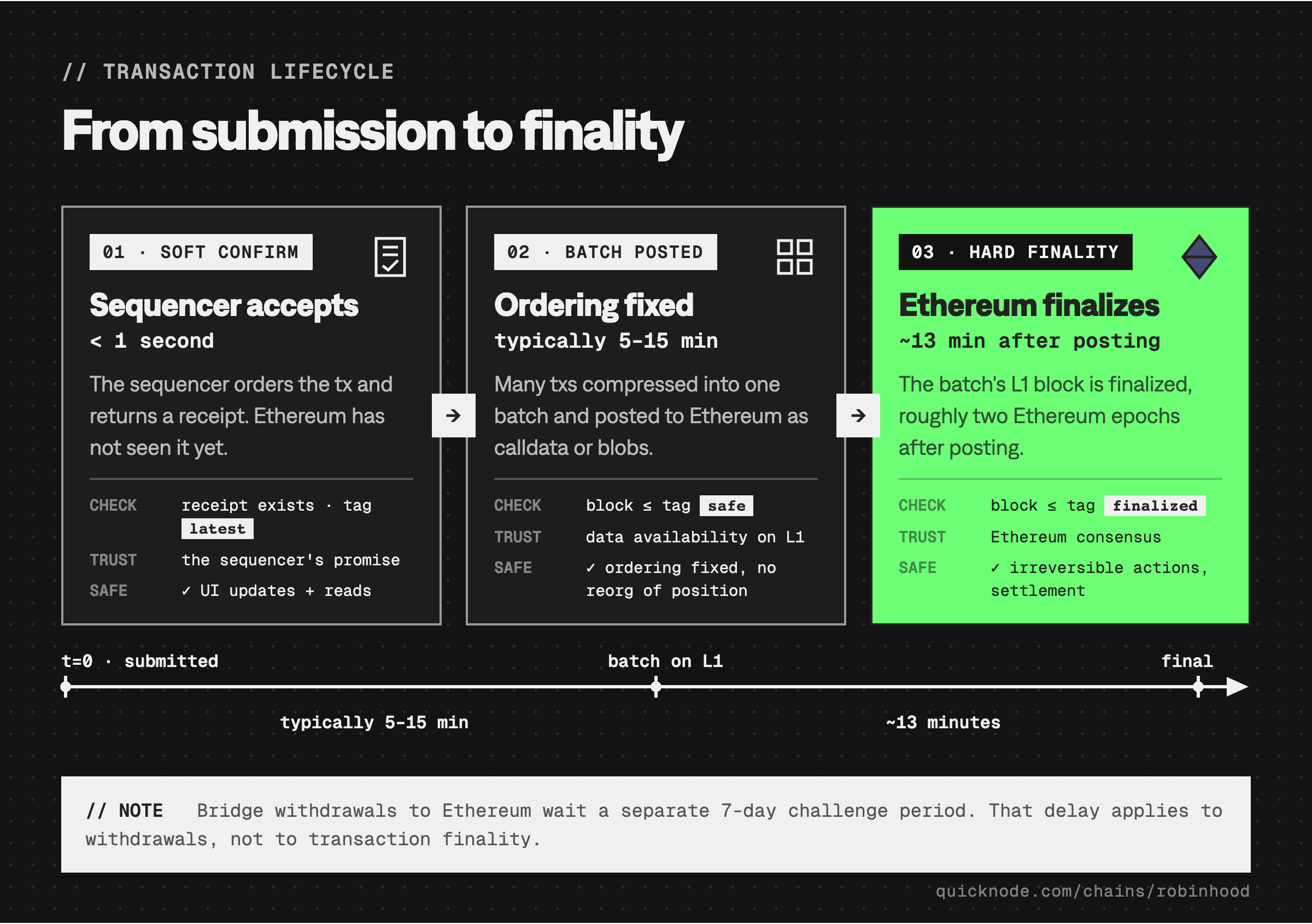
Each stage is observable over RPC, so you don't need to track batches yourself. A non-null eth_getTransactionReceipt means the transaction is soft confirmed. The safe block tag returns the newest block whose batch has been posted to Ethereum, which in practice runs about 5 to 15 minutes behind latest (measured against the live mainnet tags; Robinhood's docs commit only to "minutes"). The finalized tag returns the newest block backed by full Ethereum finality. Pass either tag to eth_getBlockByNumber and compare against your transaction's block number to build confirmation logic.
The design guidance that falls out of this is straightforward. Use soft confirmations to keep an interface responsive, because making a user wait on L1 finality for a balance refresh is a poor experience. Reserve hard finality for anything you cannot undo: crediting an external account, releasing custody, settling against an offchain ledger.
Don't treat a soft confirmation as settlement in accounting or custody logic. Reorganizations at the L2 level are rare but possible before the sequencer posts a batch, and any system that treats a sequencer receipt as final is carrying risk it probably hasn't priced. Also keep finality separate from bridging in your mental model: moving assets from Robinhood Chain back to Ethereum through the canonical bridge waits out a 7-day challenge period required by Arbitrum's fraud-proof system. That delay applies to bridge withdrawals, not to transaction finality.
Why Arbitrum Orbit Matters Here
Orbit lets a chain inherit the Nitro execution environment and Ethereum settlement while keeping control over its own throughput, fee policy, and configuration. For a network aimed at financial infrastructure, that combination is the point: predictable low-cost execution for high transaction counts, without inventing a new security model or asking developers to learn a new virtual machine.
It also means the surrounding knowledge transfers: Arbitrum's documentation on gas, precompiles, and finality largely applies, and engineers who have built on Arbitrum One will recognize almost everything here.
What Are Stock Tokens?
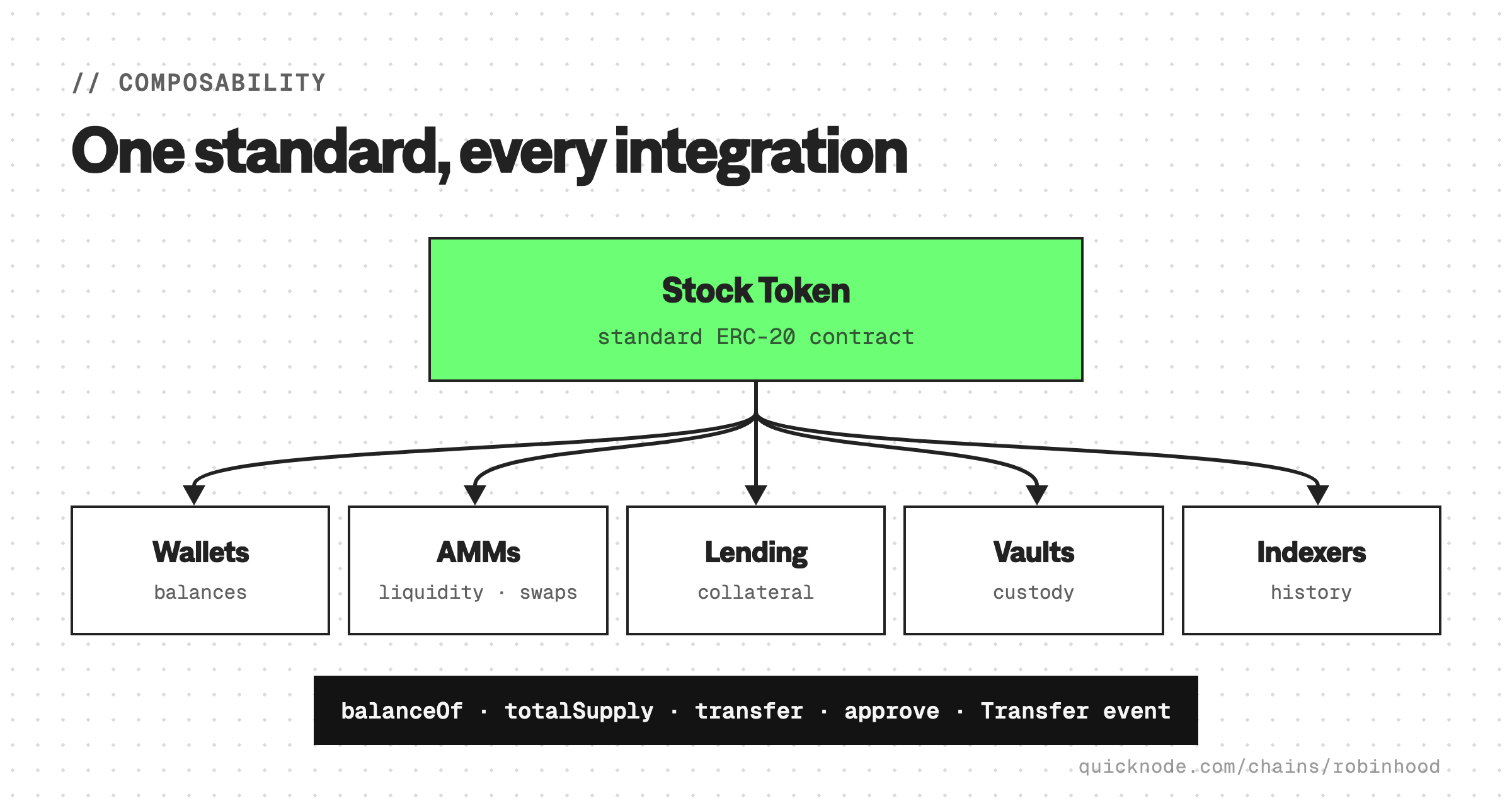
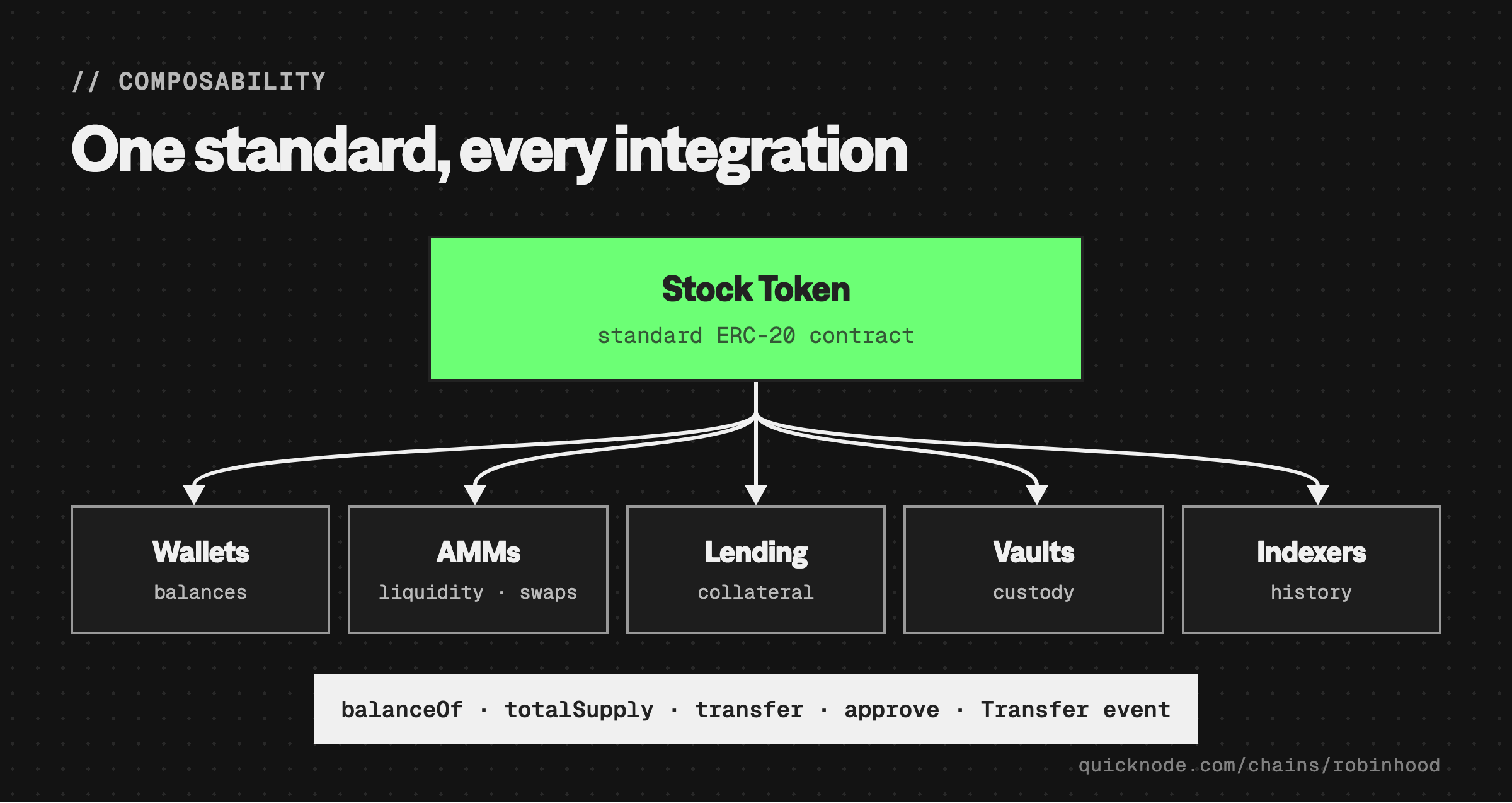
Legally, a Stock Token is a debt instrument, not a share. Robinhood Assets (Jersey) Limited issues each one to provide economic exposure to an underlying ETP (exchange-traded product): holding the token means exposure to that product's performance, not ownership of it, and it carries no rights in the underlying security or against that security's issuer. Technically, a Stock Token is a standard ERC-20 contract, and at the code level there's nothing unusual about it: it has a name, a symbol, a decimals value, a totalSupply, per-address balances, and it emits a Transfer event when balances move.
That ordinariness is the feature. Because a Stock Token is just an ERC-20:
- Any wallet that renders ERC-20 balances can display it
- Any contract that accepts ERC-20s (an automated market maker, a lending market, an escrow, a vault) can hold it with no special handling
- Any indexer that decodes
Transferevents can reconstruct its full history - The read path is
balanceOfandtotalSupply, exactly as it would be for any other token
The genuinely new property is temporal, and it's a feature rather than a caveat. Equities trade on an exchange calendar, while a token contract has no concept of weekends, holidays, or closing bells, and it will process a transfer whenever a transaction arrives. Robinhood Chain is built around this: Stock Tokens are self-custodied and accessible around the clock, and each one has a live Chainlink price feed onchain, so your contracts can read a current price directly instead of caring what time it is in New York. The issuer manages the relationship to the underlying market, which leaves you building against an always-on asset with an always-on price.
The issuer defines the legal and economic relationship between a Stock Token and its underlying asset; the token standard does not. This guide covers technical mechanics only. For questions about backing, corporate actions, eligibility, or jurisdiction, consult Robinhood's official documentation.
Connect to Robinhood Chain
Because Robinhood Chain speaks standard Ethereum JSON-RPC, connecting is a configuration exercise rather than an integration project. You need a chain ID and an endpoint, and existing tooling handles the rest.
Quicknode provides managed Robinhood Chain endpoints for mainnet and testnet, with archive data on both (an archive endpoint retains full historical state, not just recent blocks, which any analytics or accounting workload eventually needs). To create one, sign in to the Quicknode dashboard, create an endpoint, then select Robinhood Chain and your network. You'll get an HTTPS endpoint and a WebSocket endpoint.
Create the project directory and install the dependencies from the command line. tsx runs TypeScript directly with no build step:
mkdir robinhood-chain-connect && cd robinhood-chain-connect
npm init -y
npm install viem
npm install -D tsx
npm pkg set type=module
Create a .env file in the project root with your endpoint URL:
QUICKNODE_ENDPOINT=https://your-endpoint-name.robinhood-mainnet.quiknode.pro/your-token/
viem ships built-in Robinhood Chain definitions as of v2.55.0: robinhood for mainnet and robinhoodTestnet for testnet, both exported from viem/chains. Import the chain and pass your Quicknode endpoint as the transport (without an explicit transport, viem falls back to the rate-limited public RPC baked into the definition). Create connect.ts:
import { createPublicClient, http } from "viem";
import { robinhood } from "viem/chains";

const RPC_URL = process.env.QUICKNODE_ENDPOINT;
if (!RPC_URL) {
  throw new Error("Set QUICKNODE_ENDPOINT in your .env file before running.");
}

const client = createPublicClient({
  chain: robinhood,
  transport: http(RPC_URL),
});

async function main() {
  try {
    const [chainId, blockNumber, gasPrice] = await Promise.all([
      client.getChainId(),
      client.getBlockNumber(),
      client.getGasPrice(),
    ]);

    console.log(`Chain ID:     ${chainId}`);
    console.log(`Block number: ${blockNumber}`);
    console.log(`Gas price:    ${gasPrice} wei`);
  } catch (error) {
    console.error("Failed to read from Robinhood Chain:", (error as Error).message);
  }
}

main();
Run it:
npx tsx --env-file=.env connect.ts
You should see output confirming you're talking to mainnet:
Chain ID:     4663
Block number: 29494184
Gas price:    29510000 wei
If the chain ID comes back as 4663, your configuration is correct and every other Ethereum library will behave the same way. The block number will be higher than the value above by the time you run it, and the gas price (denominated in wei, the smallest unit of ETH) will move with network conditions.
On viem versions earlier than 2.55.0, the built-in definitions aren't available. Either update viem or define the chain yourself with defineChain using the values from the Network Parameters table.
When a Public Endpoint Stops Being Enough
The public RPC is genuinely useful for adding the network to a wallet, checking a balance, or confirming a contract address. It becomes a constraint once you're doing real work, for a few specific reasons:
- Rate limits. Shared endpoints throttle aggressively, and a backfill (re-reading historical blocks to build a dataset) or a busy frontend will hit that ceiling.
- Archive data. Reading historical state requires an archive endpoint.
- WebSocket subscriptions. Long-lived
eth_subscribeconnections need an endpoint that holds them open reliably. - Log query depth. Large
eth_getLogsranges are usually the first thing a shared endpoint refuses.
Robinhood's own documentation points production workloads to dedicated providers for these reasons, and Quicknode is one of the providers it names in its connection guide.
Robinhood Chain vs Ethereum at a Glance
Most Ethereum knowledge transfers directly. A few things need adjustment, and knowing which is which saves debugging time:
| Area | Ethereum | Robinhood Chain |
|---|---|---|
| Solidity and bytecode | Standard EVM | Unchanged. Contracts compile and deploy as-is |
| Client libraries and frameworks | viem, ethers.js, Hardhat, Foundry | Identical, given the chain ID and an endpoint |
| Gas token | ETH | ETH |
| Gas accounting | Execution gas only | Adds an L1 data component, so fees track Ethereum calldata costs (the transaction data posted to L1) |
| Finality | About 13 minutes (two epochs) | Soft confirmation in under a second; hard finality when the batch reaches Ethereum finality |
| Transaction ordering | Priority fees can reorder pending transactions | First come, first served. Raising your fee does not move you ahead of transactions already queued |
| Contract size limit | 24 KB | 96 KB |
| Precompiles | Standard set | Adds Arbitrum precompiles (built-in contracts at fixed addresses), such as ArbGasInfo and NodeInterface |
| Block timing | Regular 12-second slots | Sub-second and irregular. Don't assume fixed intervals |
block.number in Solidity | The chain's own height | An estimate of the Ethereum L1 block number, updated periodically. Read arbBlockNumber() on the ArbSys precompile for actual L2 height |
The last two rows cause the most real bugs. Code that assumes a steady block cadence, or that treats block.number as the chain's own height or as a clock, works acceptably on Ethereum mainnet and misbehaves here. Use block.timestamp when you need time, and ArbSys when you need L2 block height.
One clarification that saves confusion: this quirk applies only to the block.number global that Solidity code reads inside a contract. The RPC layer is unaffected. eth_blockNumber and the blockNumber field in transaction receipts and logs always report L2 height, and receipts on Robinhood Chain include a separate l1BlockNumber field carrying the L1 estimate, so a single receipt shows both values side by side. You can see this in any response from eth_getBlockReceipts.
Gas deserves a similar caution. eth_estimateGas is still the right tool, but gas accounting differs from Ethereum because of the L1 data component, and gasleft() behaves differently inside contracts. Avoid hardcoding gas values that were tuned for Ethereum, and re-estimate rather than reuse.
Conclusion
You now have an accurate mental model of Robinhood Chain: an Arbitrum Orbit Layer 2 that settles to Ethereum, pays gas in ETH, runs unmodified EVM bytecode, and exposes Stock Tokens as ordinary ERC-20 contracts. The architecture is deliberately unsurprising, which is exactly what makes it quick to build on. Your existing tooling, ABI knowledge, and indexing patterns all apply, the parts that need care (finality staging and ordering semantics) are now visible to you rather than lurking, and Stock Tokens give you an always-on asset with an always-on onchain price. Point a client at the chain and read something real.
Next Steps
- Read Stock Token Data on Robinhood Chain to query token metadata, supply, and balances with viem
- Track Stock Token Activity with Streams to monitor transfers and swap activity in real time without polling
- Run a Robinhood Chain Full Node if you want to operate your own infrastructure
- Robinhood RPC documentation for the full list of supported JSON-RPC and Debug API methods
- Robinhood Chain official documentation for network status and protocol-level detail
Frequently Asked Questions
What is Robinhood Chain?
Robinhood Chain is a permissionless, EVM-compatible Ethereum Layer 2 built on Arbitrum Orbit. Mainnet is live, with a public testnet also available. It executes transactions on its own network and posts data and state commitments to Ethereum for settlement and data availability. It uses ETH as its native gas token and targets onchain financial infrastructure, including tokenized real-world assets such as Stock Tokens.
What is the Robinhood Chain RPC endpoint and chain ID?
Robinhood Chain mainnet uses chain ID 4663 and testnet uses chain ID 46630. The public mainnet RPC is https://rpc.mainnet.chain.robinhood.com and the public testnet RPC is https://rpc.testnet.chain.robinhood.com. Both are shared and rate limited, so they suit wallet connectivity and testing rather than production. For production traffic, higher rate limits, archive data, and WebSocket subscriptions, use a dedicated Robinhood Chain RPC endpoint from a provider such as Quicknode.
Which RPC providers support Robinhood Chain?
Robinhood Chain offers a shared public RPC endpoint for wallet connectivity and quick tests, and Robinhood's official documentation lists dedicated RPC providers, including Quicknode, for production workloads. A dedicated Robinhood Chain RPC provider adds higher rate limits, archive data, WebSocket subscriptions, and deeper log queries. Quicknode provides managed Robinhood Chain endpoints for both mainnet and testnet with archive access on each, on a globally distributed network that serves 500B+ requests per month at 99.99% uptime.
How do I add Robinhood Chain to MetaMask?
Add a custom network in MetaMask with chain ID 4663, an RPC URL (the public https://rpc.mainnet.chain.robinhood.com or your own dedicated endpoint), currency symbol ETH, and block explorer https://robinhoodchain.blockscout.com. For testnet, use chain ID 46630, https://rpc.testnet.chain.robinhood.com, and https://explorer.testnet.chain.robinhood.com.
Do Ethereum development tools work on Robinhood Chain?
Yes. Because Robinhood Chain is fully EVM-compatible and exposes the standard Ethereum JSON-RPC interface, Solidity contracts deploy without modification, and Hardhat, Foundry, Remix, viem, ethers.js, and web3.py all work by pointing them at a Robinhood Chain endpoint with the correct chain ID. You don't need any protocol-level changes.
What are Stock Tokens on Robinhood Chain?
Stock Tokens are debt instruments that Robinhood Assets (Jersey) Limited issues as standard ERC-20 contracts on Robinhood Chain. Holding one gives economic exposure to an underlying ETP (exchange-traded product), not ownership of it or any rights in the underlying security. Because they follow the ERC-20 standard, they expose name, symbol, decimals, totalSupply, and balanceOf, and they emit Transfer events, so any wallet, smart contract, or indexer that handles ERC-20 tokens can handle them without special logic.
How is finality different on Robinhood Chain compared to Ethereum?
Finality has two stages. The sequencer accepts and orders a transaction and returns a receipt within moments, which is a soft confirmation suitable for updating a user interface. Hard finality arrives once the sequencer posts the transaction to Ethereum in a compressed batch and that batch reaches Ethereum finality, roughly 13 minutes after posting. Use soft confirmations for responsiveness, and wait for hard finality before any irreversible action. Separately, moving assets back to Ethereum through the canonical bridge involves a 7-day challenge period, which applies to bridge withdrawals rather than to transaction finality.
How does Robinhood Chain differ from Arbitrum One?
Both run the Arbitrum Nitro stack and settle to Ethereum, so the execution environment and developer experience are nearly identical. The differences are that Robinhood Chain is a separate Orbit chain with its own chain ID, sequencer, block history, explorer, and contract deployments, and its configuration and ecosystem are oriented toward onchain financial infrastructure and tokenized assets. Contracts deployed on Arbitrum One do not exist on Robinhood Chain unless you deploy them there separately.