ERC-8004: A Developer’s Guide to Trustless AI Agent Identity
ERC-8004: A Developer’s Guide to Trustless AI Agent Identity
ERC-8004 is Ethereum's identity standard for AI agents. Learn how its onchain registries enable discovery, reputation, and trust.

4 de março de 2026 — 7 minutos de leitura

AI agents aren’t headline-worthy anymore just because they can act. That part is becoming expected.
Today, an AI agent can call APIs, communicate with other agents, access tools, make payments, and coordinate workflows.
Em muitos aspetos, já se comportam como trabalhadores digitais.
Mas não existe uma forma padronizada de os identificar, verificar quem são ou definir o que estão autorizados a fazer.
O ERC-8004 é a resposta Ethereum a essa questão e este artigo explica o que é, como funciona e se está pronto para ser levado a sério.
Identity Crisis of the Agent Economy
Today, when an AI agent makes payments or interacts with an API, there's no verifiable and standard way to answer:
Who is this agent and who deployed this agent?
Tem um histórico de transações ou uma reputação?
Que permissões ou funções tem?
Por outro lado, ao longo de décadas, os seres humanos criaram identidades portáteis para transportar consigo a confiança, a reputação e a responsabilidade.
Identidades legais, licenças, histórico de crédito, demonstrações financeiras e muito mais.
Today, since AI agents are handling real money, real data, and real decisions on behalf of real users, they need a reliable way to answer these questions at scale.
The AI Agents Stack Grew Fast and Incomplete
In less than 5 years, the infrastructure around AI agents has expanded and matured drastically. In this time, 3 key execution tracks came to life:
MCP standardized how agents access tools, making it possible for agents to query infrastructure, trigger workflows, and interact with external services.
A2A gave a structured messaging framework allowing agents to communicate with each other.
x402 gave them native payment rails, meaning agents can transact in stablecoins at the HTTP layer without needing humans.
💡Descubra o que é x402 é e como funciona
Each protocol solved its specific problem well and today, execution is no longer a major headache for AI agents.
No entanto, cada um deles depara-se muito rapidamente com um obstáculo relacionado com a identidade ou a reputação.
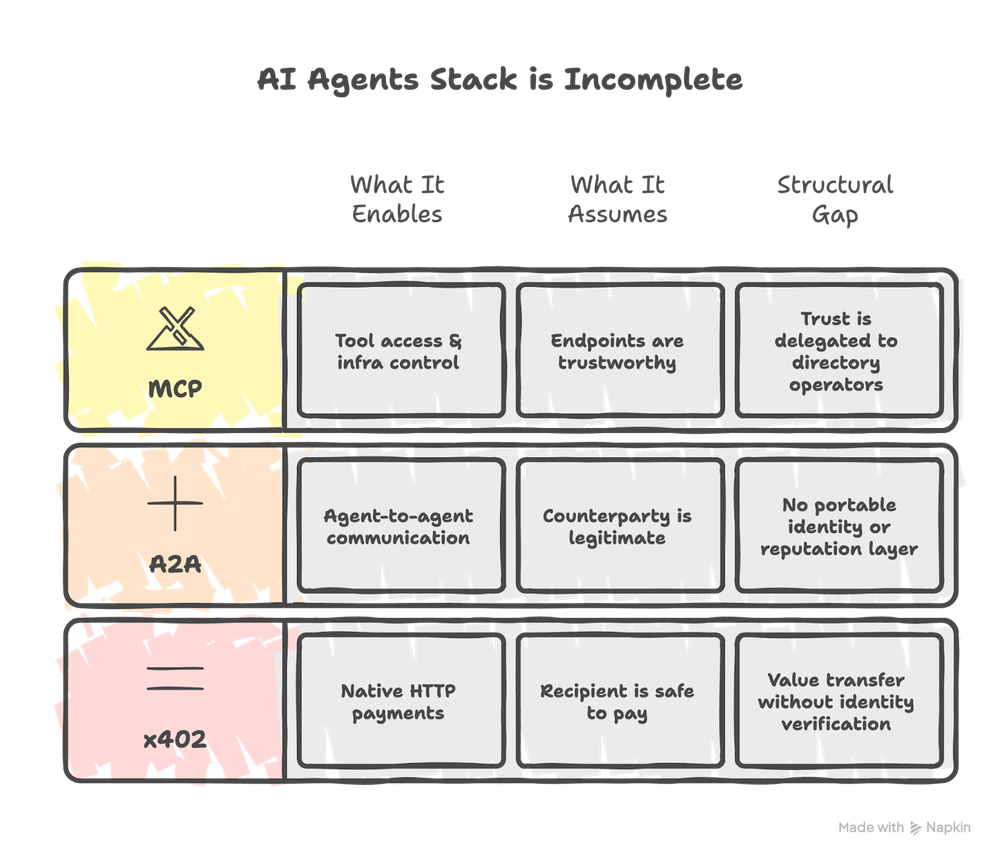
Simply put, these protocols do not have the capability to answer who the agent is. That's the gap ERC-8004 is built to close.
O que é, na verdade, a norma ERC-8004
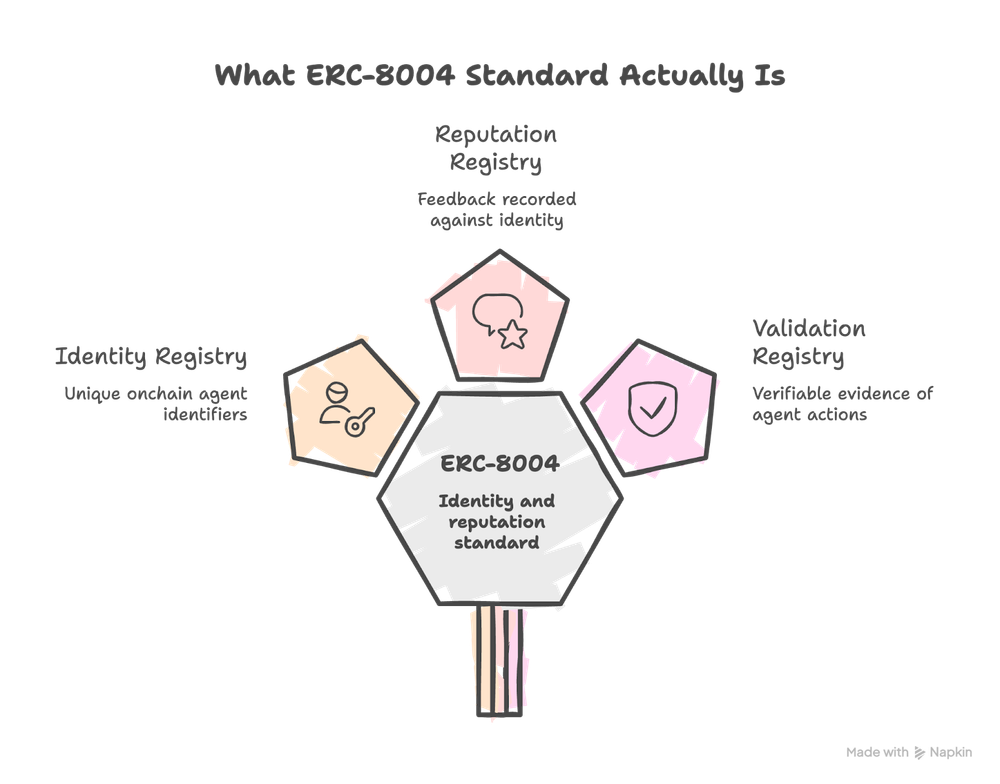
ERC-8004 is an identity and reputation coordination standard designed for AI agents on Ethereum.
A proposta para esta norma foi elaborada por Marco De Rossi (MetaMask), Davide Crapis (Ethereum ), Jordan Ellis (Google) e Erik Reppel (Coinbase).
The ERC-8004 standard introduces 3 onchain registries:
1. Registo de Identidades
Each agent is represented by a unique onchain identifier which is further minted as an ERC-721 token. That NFT points to a structured JSON file, called an agent card, containing the agent's name, functionalities, service endpoints (MCP, A2A, web), and payment address.
The onchain component anchors identity. The offchain metadata provides context.
2. Registo de Reputação
The reputation layer allows interactions and feedback to be recorded against an agent’s identity. It lets authorised agents and users post feedback in bounded numerical scores and categorical tags like response time or uptime.
This way, an agent's performance is made portable and queryable for other agents to learn from before interacting with them.
3. Registo de Validação
This registry is a standardized mechanism for recording verifiable evidence that an agent:
Concluiu uma tarefa
Produziu um resultado correto ou aceitável
Cumpriu as restrições ou garantias predefinidas
Remember: this registry only defines how validation results are recorded, not which validation method to be used. Therefore, the registry is designed to support multiple validation strategies from social consensus to crypto-economic slashing.
É, no entanto, importante referir que este registo ainda não está concluído. Até ser implementado como infraestrutura, o registo de validação constitui um espaço de conceção.
Together, these three registries create a neutral coordination layer: a way to discover agents > inspect their track record > and verify claims.
A partir daqui, surge a pergunta óbvia: por que não utilizar, em vez disso, os sistemas de identificação já existentes?
Em que medida o ERC-8004 difere do OAuth, dos DIDs e do ENS
Se o problema é a identidade, por que não utilizar o que já existe?
Developers today are familiar with OAuth, API keys, decentralized identifiers (DIDs), wallet addresses, and naming systems like ENS. Each provides a form of identification or authentication.
Por que construir algo novo?
Resposta simples: Porque o ERC-8004 não resolve o mesmo problema.
Aqui está uma tabela resumida para compreender o objetivo destes sistemas e por que razão o ERC-8004 é necessário.
OAuth | DIDs (Identidades Descentralizadas) | ENS | ERC-8004 | |
|---|---|---|---|---|
Qual é o objetivo? | User authorization for applications | Identificadores descentralizados | Human-readable naming for blockchain addresses |
Zooming out, each of these systems was designed with a specific trust surface in mind. And none of them were designed for AI agents except ERC-8004.
In theory, an agent registered under ERC-8004 can have an,
O nome ENS como seu identificador legível por humanos,
DID for user-facing interactions, and
ERC-8004 specifically for agent-to-agent discovery and trust.
Desta forma, o ERC-8004 trata os outros métodos como primitivas combináveis no âmbito da sua camada de identidade.
💡Bónus: Leia o nosso guia completo sobre domínios ENS para empresas
Agora, como é que a descoberta do ERC-8004 funciona, na prática, no mundo real?
Como o ERC-8004 funciona realmente de ponta a ponta (sem código)
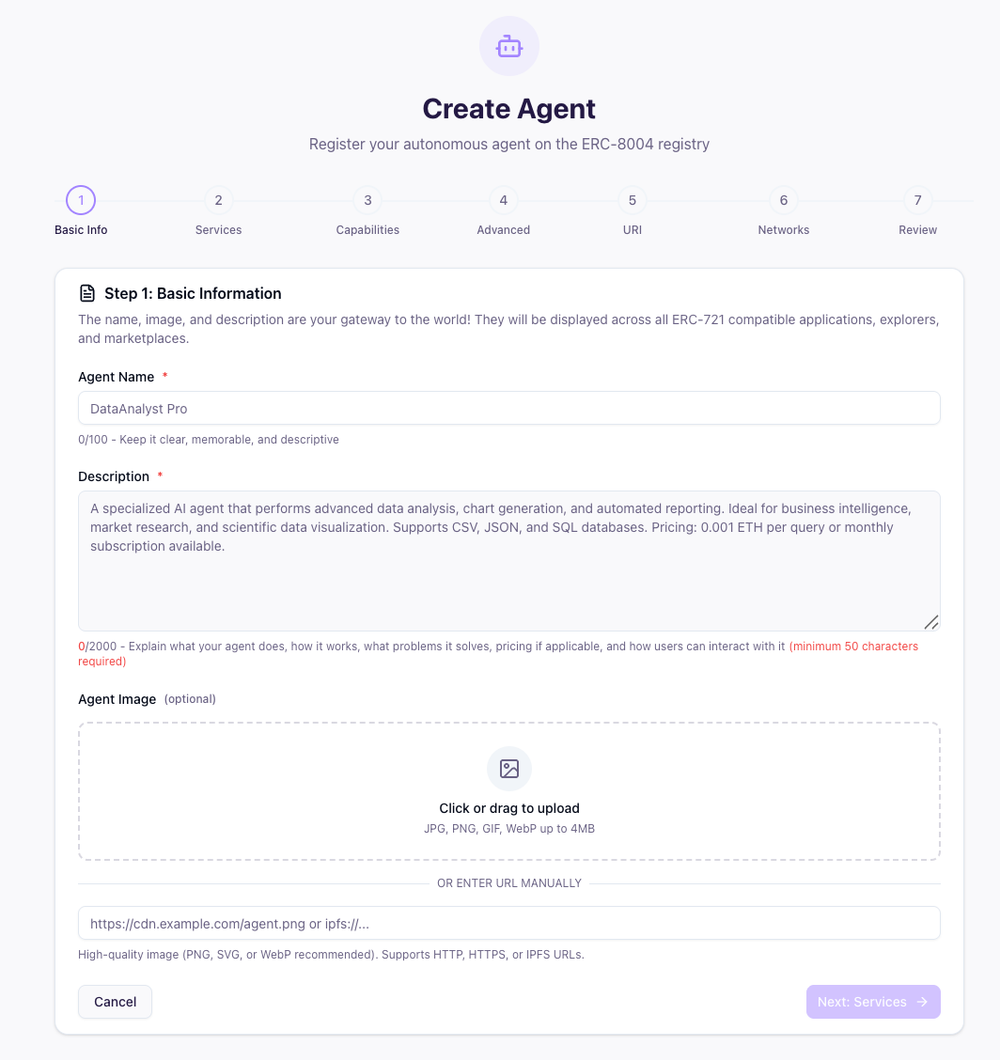
Passo 1: Registar-se
A developer deploys an agent and registers it in the Identity Registry.
The agent receives an onchain identity with associated metadata describing its capabilities, exposed endpoints, and payment details.
Fonte: https://www.8004scan.io
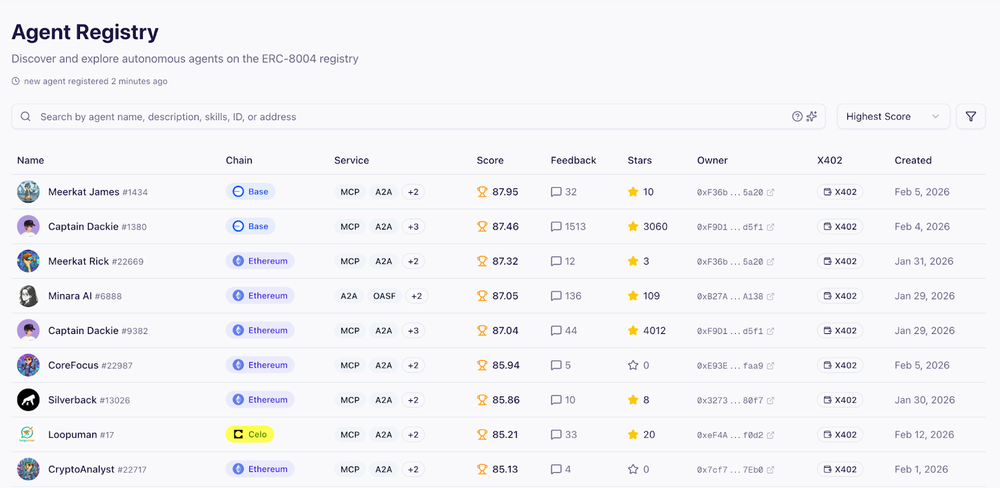
Passo 2: Descobrir
Another agent or developer can now query the registry directly or via third-party indexers to discover agents using indexed metadata, capabilities, or available reputation signals.
Fonte: https://www.8004scan.io
Passo 3: Avaliar
Before interacting, the querying agent inspects the candidate’s Reputation Registry history, including prior outcomes, attestations, and linked evidence.
It decides whether the agent’s track record meets its risk threshold.
Passo 4: Interagir
If acceptable, the agent connects using the advertised interface (MCP, A2A, or HTTP) and executes the task.
Passo 5: Pagar e registar
Payment is issued via x402 or another compatible mechanism. Outcome data and feedback may be written back to the Reputation Registry, updating the agent’s onchain track record for future discovery.
This is the coordination layer ERC-8004 introduces. Now, how does the full AI Agents tech stack actually look like for builders when it's assembled?
The Emerging Agent Stack
Today, the AI agent tech stack is a set of mature primitives working in combination. Here's a quick snapshot of what a builder has at their disposal:
Camada | Protocolo | Função |
|---|---|---|
Identidade e Confiança | ERC-8004 | Who is this agent, what has it done, can it be verified |
Pagamentos | Transferência de valores nativos na camada HTTP, sem intermediários | |
Acesso às ferramentas |
Each layer makes the others more useful for AI agents.
An agent can discover another agent via ERC-8004.
It can pay that agent viax402.
Pode invocar serviços através de pontos finais compatíveis com o MCP.
💡Dica rápida: Aprenda a criar servidores MCP na Solana para integração com LLM
O valor aumenta quando as camadas se interligam.
For builders, this stack has a practical implication: the infrastructure already exists to build agents that can be discovered by never-met-before agents, across organizational boundaries, compensated automatically, with a verifiable track record attached to every interaction.
Where Quicknode Sits in the Agent Stack
Quicknode está a alimentar camadas fundamentais desta pilha.
Agents querying ERC-8004 registry contracts need reliable RPC access and that'sQuicknode's core infrastructure
On the execution side, the Quicknode MCP Server connects AI assistants directly to blockchain data: RPC endpoints, indexing, and streaming, without custom integration work.
And Quicknode's x402 integration means agents can pay for RPC compute the same way they pay any other agent in the stack.
In effect, Quicknode supports identity lookups, execution access, and native agent payments and all with the enterprise-grade infrastructure and support that developers and teams need.
💡Good read: Quicknode is building how-to guides for integrating X402 payments, building web3-enabled AI agents, and more.
With all these information and tools handy, have we zeroed in on a complete infrastructure for the agent economy?
Does ERC-8004 Complete the AI Agent Infrastructure?
Não totalmente. Ainda não.
See, the agent economy will need a robust trust layer. The only open question, right now, is who defines it. There are two directions:
Criá-lo agora como um padrão aberto, ou
Esperar que as grandes empresas tecnológicas, com os seus diretórios centralizados, decidam sobre o acesso e os incentivos para todos.
O ERC-8004 é a primeira tentativa séria no que diz respeito à primeira opção: uma norma sem restrições de acesso, auditada e apoiada por instituições, que não é controlada por nenhuma entidade em particular.
It establishes the coordination surface where trust can emerge and thereby lays the groundwork for an open agent economy.
Sobre a Quicknode
Fundada em 2017, a Quicknode disponibiliza infraestrutura de blockchain de nível institucional para programadores e empresas. Com um tempo de atividade de 99,99% e suporte para mais de 80 chains, as equipas desenvolvem e expandem aplicações on-chain sem comprometer a qualidade.
Fique por dentro das novidades
As principais novidades de engenharia, atualizações de produtos e notícias de Web3 diretamente na sua caixa de entrada.