
75 minutos de lectura
Resumen
Si te interesa crear un contrato NFT capaz de acuñar varios tokens a la vez, quizá te interese considerar la implementación ERC721A. En esta guía aprenderás en qué consiste la implementación ERC721A y cómo desplegar y acuñar NFT desde un contrato ERC721A utilizando Hardhat.
Tus funciones
- Más información sobre la implementación del ERC721A
- Implementar y probar un contrato ERC721A con Hardhat
- Crea varios NFT en una sola transacción utilizando el contrato ERC721A
Lo que necesitarás
- Conocimientos intermedios de Solidity y las cadenas de bloques EVM.
- Node.js y npm están instalados.
- Experiencia con Hardhat.
- Un nodo de Polygon en Bombay (puedes obtener acceso gratuito a uno de Quicknode aquí).
- Acceso a tu clave privada y a los tokens de la red de pruebas de MATIC (puedes conseguir algunos en el «faucet» de Quicknode).
¿Qué es ERC721A?
Para comprender mejor la implementación del ERC721A, primero debemos hacer un breve repaso del estándar ERC-721.
El estándar ERC-721 describe cómo crear tokens no fungibles (NFT) en cadenas de bloques compatibles con EVM. El estándar ERC-721 proporciona una interfaz para los NFT y contiene un conjunto de reglas que facilitan el trabajo con ellos. Para obtener más información sobre el ERC-721, consulta esta guía de Quicknode.
Un aspecto clave del estándar ERC-721 es que no admite de forma nativa la acuñación de varios NFT en una sola transacción. Aquí es donde entra en juego la implementación ERC721A. La implementación ERC721A fue creada por Azuki, y su objetivo principal es permitir la acuñación de varios NFT en una sola transacción de forma eficiente en cuanto al gas. Con esta implementación, los usuarios ahorrarán en comisiones de gas a largo plazo si acuñan más de un token a la vez. Puedes consultar el ahorro estimado de gas en la sección «Mediciones» de la página de implementación de ERC721A.
Establecer una conexión con tu RPC de Quicknode
Para crear e implementar un contrato inteligente ERC721A, primero necesitaremos una conexión RPC a la red de pruebas Polygon Mumbai. Si lo prefieres, puedes ejecutar tu propio nodo de Polygon siguiendo las instrucciones de la página «Ejecutar un nodo completo» de la documentación de Polygon. Sin embargo, esto puede resultar complicado de gestionar en ocasiones y es posible que no esté tan bien optimizado como nos gustaría. En su lugar, puedes crear fácilmente una cuenta gratuita en Quicknode aquí y tener acceso a más de 20 blockchains. La infraestructura de Quicknode está optimizada para la latencia y la redundancia, lo que la hace hasta ocho veces más rápida que la de la competencia.
Haz clic en el botón «Crear un punto final» y selecciona la cadena Polygon; a continuación, selecciona la red de pruebas de Mumbai. Una vez que tu punto final esté listo, ten a mano la URL del proveedor HTTP, ya que la necesitarás en la siguiente sección.
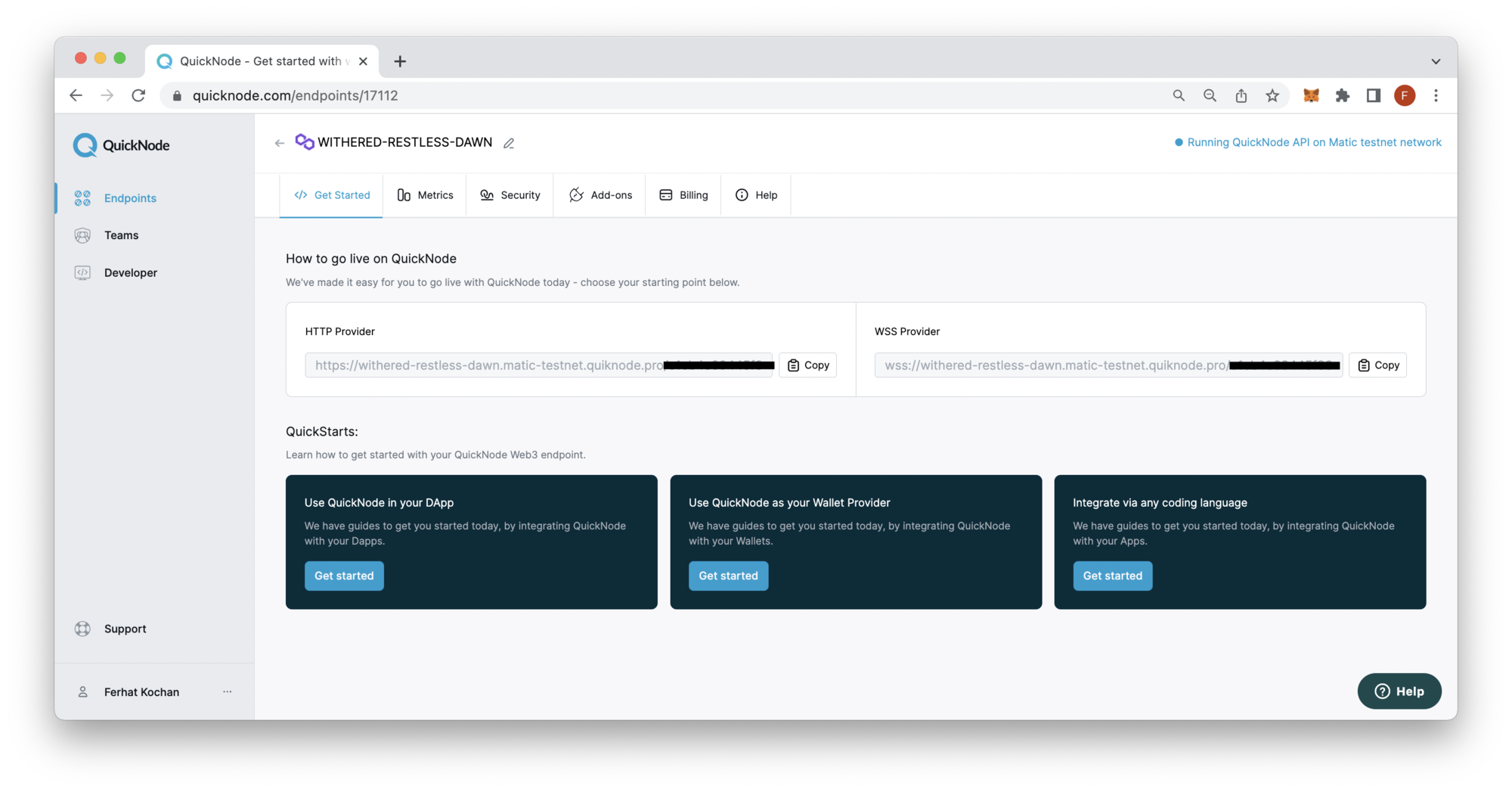
A continuación, dirígete al grifo de Quicknode para obtener algunos tokens MATIC de la red de pruebas.
Creación e implementación del contrato ERC721A
Ahora que ya disponemos de nuestro RPC de Quicknode, de los tokens MATIC de Testnet y de una mejor comprensión de en qué consiste la implementación de ERC721A, pasemos a crear e implementar el contrato ERC721A.
En tu terminal, ejecuta los siguientes comandos para crear el directorio del proyecto e instalar las dependencias necesarias:
mkdir implementación-de-erc721a
cd implementación-de-erc721a
npx hardhat && npm i dotenv
Cuando aparezcan las indicaciones para la configuración de Hardhat, pulsa Intro (sí) en cada una de ellas.
Una vez instalado Hardhat, ejecuta el siguiente comando en tu directorio «contracts »:
echo > BatchNFTs.sol
echo > ERC721A.sol
echo > Ownable.sol
mkdir interfaces && cd interfaces
echo > IERC721A.sol
cd ..
mkdir utils && cd utils
echo > Context.sol
cd ../../
echo > .env
Esto creará las carpetas y los archivos que necesitaremos para crear nuestro contrato ERC721A (es decir, BatchNFTs.sol)
A continuación, abre el directorio del proyecto en un editor de código (nosotros utilizamos VSCode) y añade el siguiente código a BatchNFTs.sol:
// SPDX-License-Identifier: MIT
pragma solidity ^0.8.13;

import "./ERC721A.sol";
import "./Ownable.sol";

contract BatchNFTs is Ownable, ERC721A {

    uint256 public constant MAX_SUPPLY = 100;
    uint256 public constant PRICE_PER_TOKEN = 0.01 ether;
    uint256 public immutable START_TIME;
    bool public mintPaused;
    string private _baseTokenURI;

    constructor(uint256 _startTime, bool _paused) ERC721A("ERC721A Token", "721AT") {
        START_TIME = _startTime;
        mintPaused = _paused;
    }

    function mint(address to, uint256 quantity) external payable {
        require(!mintPaused, "Mint is paused");
        require(block.timestamp >= START_TIME, "Sale not started");
        require(_totalMinted() + quantity <= MAX_SUPPLY, "Max Supply Hit");
        require(msg.value >= quantity * PRICE_PER_TOKEN, "Insufficient Funds");
        _mint(to, quantity);
    }

    function withdraw() external onlyOwner {
        (bool success, ) = msg.sender.call{value: address(this).balance}("");
        require(success, "Transfer Failed");
    }

    function setBaseURI(string calldata baseURI) external onlyOwner {
        _baseTokenURI = baseURI;
    }

    function _baseURI() internal view override returns (string memory) {
        return _baseTokenURI;
    }

    function pauseMint(bool _paused) external onlyOwner {
        require(!mintPaused, "Contract paused.");
        mintPaused = _paused;
    }
}
Repasemos el código.
- Líneas 1-2: Define el pragma de licencia y versión.
- Líneas 4-5: Contratos de importación que heredará nuestro contrato NFT. En este caso, estamos importando ERC721A.sol de Chiru Labs y Ownable.sol de OpenZeppelin.
- Línea 7: Declara el nombre del contrato (por ejemplo, BatchNFTs) y los contratos de los que hereda (por ejemplo, 721A y Ownable).
- Líneas 9-13: Se declaran las variables de estado del contrato NFT. En este caso, se declaran el suministro de tokens, el precio de los tokens, la hora de inicio de la acuñación, una variable booleana que representa el estado de la acuñación (por ejemplo, «activa» o «en pausa») y el URI de los metadatos.
- Líneas 15-18: Declara un constructor en el que definimos el nombre y el símbolo del token ERC721A (por ejemplo, ERC721A Token, ERC72AT). Además, define los valores de entrada para las variables START_TIME y mintPaused, tal y como se requiere para el despliegue.
- Líneas 20-26: Se declara una función pública `mint`. Hay cuatro comprobaciones `require` antes de que se ejecute la función interna `_mint`. Echa un vistazo al mensaje de error de cada instrucción `require` para obtener más información. La última línea de código es la función `_mint`, que toma una dirección como primer argumento y una cantidad como segundo argumento.
- Líneas 28-31: Se declara una función «withdraw». Esta función solo está disponible para el propietario del contrato mediante el modificador «onlyOwner». La función permite al propietario del contrato retirar fondos. Ten en cuenta que, como alternativa, puedes añadir lógica a la función «mint» para enviar los fondos, en lugar de tener que llamar a la función «withdraw» y pagar el gas.
- Líneas 33-35: Define la función `setBaseURI`, que actúa como URL base para los metadatos de nuestros NFT. Echa un vistazo a esta guía sobre tokens ERC721 para saber cómo configurar los metadatos de los NFT. Esta función solo está disponible para el propietario del contrato, al heredar el modificador `onlyOwner`.
- Líneas 37-39: Devuelve el baseURI establecido actualmente en el contrato.
- Líneas 41-44: Define una función «pauseMint» que actúa como parada de emergencia. Solo está disponible para el propietario del contrato, al heredar el modificador «onlyOwner».
- Línea 45: Establece el cierre (es decir, }) del contrato NFT.
Ahora, añade la lógica del código a cada archivo de Solidity.
En ERC721A.sol, añade el siguiente código:
// SPDX-License-Identifier: MIT
// ERC721A Contracts v4.2.3
// Creator: Chiru Labs
pragma solidity ^0.8.4;
import './interfaces/IERC721A.sol';
/**
* @dev Interface of ERC721 token receiver.
*/
interface ERC721A__IERC721Receiver {
function onERC721Received(
address operator,
address from,
uint256 tokenId,
bytes calldata data
) external returns (bytes4);
}
/**
* @title ERC721A
*
* @dev Implementation of the [ERC721](https://eips.ethereum.org/EIPS/eip-721)
* Non-Fungible Token Standard, including the Metadata extension.
* Optimized for lower gas during batch mints.
*
* Token IDs are minted in sequential order (e.g. 0, 1, 2, 3, ...)
* starting from `_startTokenId()`.
*
* Assumptions:
*
* - An owner cannot have more than 2**64 - 1 (max value of uint64) of supply.
* - The maximum token ID cannot exceed 2**256 - 1 (max value of uint256).
*/
contract ERC721A is IERC721A {
// Bypass for a `--via-ir` bug (https://github.com/chiru-labs/ERC721A/pull/364).
struct TokenApprovalRef {
address value;
}
// =============================================================
// CONSTANTS
// =============================================================
// Mask of an entry in packed address data.
uint256 private constant _BITMASK_ADDRESS_DATA_ENTRY = (1 << 64) - 1;
// The bit position of `numberMinted` in packed address data.
uint256 private constant _BITPOS_NUMBER_MINTED = 64;
// The bit position of `numberBurned` in packed address data.
uint256 private constant _BITPOS_NUMBER_BURNED = 128;
// The bit position of `aux` in packed address data.
uint256 private constant _BITPOS_AUX = 192;
// Mask of all 256 bits in packed address data except the 64 bits for `aux`.
uint256 private constant _BITMASK_AUX_COMPLEMENT = (1 << 192) - 1;
// The bit position of `startTimestamp` in packed ownership.
uint256 private constant _BITPOS_START_TIMESTAMP = 160;
// The bit mask of the `burned` bit in packed ownership.
uint256 private constant _BITMASK_BURNED = 1 << 224;
// The bit position of the `nextInitialized` bit in packed ownership.
uint256 private constant _BITPOS_NEXT_INITIALIZED = 225;
// The bit mask of the `nextInitialized` bit in packed ownership.
uint256 private constant _BITMASK_NEXT_INITIALIZED = 1 << 225;
// The bit position of `extraData` in packed ownership.
uint256 private constant _BITPOS_EXTRA_DATA = 232;
// Mask of all 256 bits in a packed ownership except the 24 bits for `extraData`.
uint256 private constant _BITMASK_EXTRA_DATA_COMPLEMENT = (1 << 232) - 1;
// The mask of the lower 160 bits for addresses.
uint256 private constant _BITMASK_ADDRESS = (1 << 160) - 1;
// The maximum `quantity` that can be minted with {_mintERC2309}.
// This limit is to prevent overflows on the address data entries.
// For a limit of 5000, a total of 3.689e15 calls to {_mintERC2309}
// is required to cause an overflow, which is unrealistic.
uint256 private constant _MAX_MINT_ERC2309_QUANTITY_LIMIT = 5000;
// The `Transfer` event signature is given by:
// `keccak256(bytes("Transfer(address,address,uint256)"))`.
bytes32 private constant _TRANSFER_EVENT_SIGNATURE =
0xddf252ad1be2c89b69c2b068fc378daa952ba7f163c4a11628f55a4df523b3ef;
// =============================================================
// STORAGE
// =============================================================
// The next token ID to be minted.
uint256 private _currentIndex;
// The number of tokens burned.
uint256 private _burnCounter;
// Token name
string private _name;
// Token symbol
string private _symbol;
// Mapping from token ID to ownership details
// An empty struct value does not necessarily mean the token is unowned.
// See {_packedOwnershipOf} implementation for details.
//
// Bits Layout:
// - [0..159] `addr`
// - [160..223] `startTimestamp`
// - [224] `burned`
// - [225] `nextInitialized`
// - [232..255] `extraData`
mapping(uint256 => uint256) private _packedOwnerships;
// Mapping owner address to address data.
//
// Bits Layout:
// - [0..63] `balance`
// - [64..127] `numberMinted`
// - [128..191] `numberBurned`
// - [192..255] `aux`
mapping(address => uint256) private _packedAddressData;
// Mapping from token ID to approved address.
mapping(uint256 => TokenApprovalRef) private _tokenApprovals;
// Mapping from owner to operator approvals
mapping(address => mapping(address => bool)) private _operatorApprovals;
// =============================================================
// CONSTRUCTOR
// =============================================================
constructor(string memory name_, string memory symbol_) {
_name = name_;
_symbol = symbol_;
_currentIndex = _startTokenId();
}
// =============================================================
// TOKEN COUNTING OPERATIONS
// =============================================================
/**
* @dev Returns the starting token ID.
* To change the starting token ID, please override this function.
*/
function _startTokenId() internal view virtual returns (uint256) {
return 0;
}
/**
* @dev Returns the next token ID to be minted.
*/
function _nextTokenId() internal view virtual returns (uint256) {
return _currentIndex;
}
/**
* @dev Returns the total number of tokens in existence.
* Burned tokens will reduce the count.
* To get the total number of tokens minted, please see {_totalMinted}.
*/
function totalSupply() public view virtual override returns (uint256) {
// Counter underflow is impossible as _burnCounter cannot be incremented
// more than `_currentIndex - _startTokenId()` times.
unchecked {
return _currentIndex - _burnCounter - _startTokenId();
}
}
/**
* @dev Returns the total amount of tokens minted in the contract.
*/
function _totalMinted() internal view virtual returns (uint256) {
// Counter underflow is impossible as `_currentIndex` does not decrement,
// and it is initialized to `_startTokenId()`.
unchecked {
return _currentIndex - _startTokenId();
}
}
/**
* @dev Returns the total number of tokens burned.
*/
function _totalBurned() internal view virtual returns (uint256) {
return _burnCounter;
}
// =============================================================
// ADDRESS DATA OPERATIONS
// =============================================================
/**
* @dev Returns the number of tokens in `owner`'s account.
*/
function balanceOf(address owner) public view virtual override returns (uint256) {
if (owner == address(0)) revert BalanceQueryForZeroAddress();
return _packedAddressData[owner] & _BITMASK_ADDRESS_DATA_ENTRY;
}
/**
* Returns the number of tokens minted by `owner`.
*/
function _numberMinted(address owner) internal view returns (uint256) {
return (_packedAddressData[owner] >> _BITPOS_NUMBER_MINTED) & _BITMASK_ADDRESS_DATA_ENTRY;
}
/**
* Returns the number of tokens burned by or on behalf of `owner`.
*/
function _numberBurned(address owner) internal view returns (uint256) {
return (_packedAddressData[owner] >> _BITPOS_NUMBER_BURNED) & _BITMASK_ADDRESS_DATA_ENTRY;
}
/**
* Returns the auxiliary data for `owner`. (e.g. number of whitelist mint slots used).
*/
function _getAux(address owner) internal view returns (uint64) {
return uint64(_packedAddressData[owner] >> _BITPOS_AUX);
}
/**
* Sets the auxiliary data for `owner`. (e.g. number of whitelist mint slots used).
* If there are multiple variables, please pack them into a uint64.
*/
function _setAux(address owner, uint64 aux) internal virtual {
uint256 packed = _packedAddressData[owner];
uint256 auxCasted;
// Cast `aux` with assembly to avoid redundant masking.
assembly {
auxCasted := aux
}
packed = (packed & _BITMASK_AUX_COMPLEMENT) | (auxCasted << _BITPOS_AUX);
_packedAddressData[owner] = packed;
}
// =============================================================
// IERC165
// =============================================================
/**
* @dev Returns true if this contract implements the interface defined by
* `interfaceId`. See the corresponding
* [EIP section](https://eips.ethereum.org/EIPS/eip-165#how-interfaces-are-identified)
* to learn more about how these ids are created.
*
* This function call must use less than 30000 gas.
*/
function supportsInterface(bytes4 interfaceId) public view virtual override returns (bool) {
// The interface IDs are constants representing the first 4 bytes
// of the XOR of all function selectors in the interface.
// See: [ERC165](https://eips.ethereum.org/EIPS/eip-165)
// (e.g. `bytes4(i.functionA.selector ^ i.functionB.selector ^ ...)`)
return
interfaceId == 0x01ffc9a7 || // ERC165 interface ID for ERC165.
interfaceId == 0x80ac58cd || // ERC165 interface ID for ERC721.
interfaceId == 0x5b5e139f; // ERC165 interface ID for ERC721Metadata.
}
// =============================================================
// IERC721Metadata
// =============================================================
/**
* @dev Returns the token collection name.
*/
function name() public view virtual override returns (string memory) {
return _name;
}
/**
* @dev Returns the token collection symbol.
*/
function symbol() public view virtual override returns (string memory) {
return _symbol;
}
/**
* @dev Returns the Uniform Resource Identifier (URI) for `tokenId` token.
*/
function tokenURI(uint256 tokenId) public view virtual override returns (string memory) {
if (!_exists(tokenId)) revert URIQueryForNonexistentToken();
string memory baseURI = _baseURI();
return bytes(baseURI).length != 0 ? string(abi.encodePacked(baseURI, _toString(tokenId))) : '';
}
/**
* @dev Base URI for computing {tokenURI}. If set, the resulting URI for each
* token will be the concatenation of the `baseURI` and the `tokenId`. Empty
* by default, it can be overridden in child contracts.
*/
function _baseURI() internal view virtual returns (string memory) {
return '';
}
// =============================================================
// OWNERSHIPS OPERATIONS
// =============================================================
/**
* @dev Returns the owner of the `tokenId` token.
*
* Requirements:
*
* - `tokenId` must exist.
*/
function ownerOf(uint256 tokenId) public view virtual override returns (address) {
return address(uint160(_packedOwnershipOf(tokenId)));
}
/**
* @dev Gas spent here starts off proportional to the maximum mint batch size.
* It gradually moves to O(1) as tokens get transferred around over time.
*/
function _ownershipOf(uint256 tokenId) internal view virtual returns (TokenOwnership memory) {
return _unpackedOwnership(_packedOwnershipOf(tokenId));
}
/**
* @dev Returns the unpacked `TokenOwnership` struct at `index`.
*/
function _ownershipAt(uint256 index) internal view virtual returns (TokenOwnership memory) {
return _unpackedOwnership(_packedOwnerships[index]);
}
/**
* @dev Initializes the ownership slot minted at `index` for efficiency purposes.
*/
function _initializeOwnershipAt(uint256 index) internal virtual {
if (_packedOwnerships[index] == 0) {
_packedOwnerships[index] = _packedOwnershipOf(index);
}
}
/**
* Returns the packed ownership data of `tokenId`.
*/
function _packedOwnershipOf(uint256 tokenId) private view returns (uint256) {
uint256 curr = tokenId;
unchecked {
if (_startTokenId() <= curr)
if (curr < _currentIndex) {
uint256 packed = _packedOwnerships[curr];
// If not burned.
if (packed & _BITMASK_BURNED == 0) {
// Invariant:
// There will always be an initialized ownership slot
// (i.e. `ownership.addr != address(0) && ownership.burned == false`)
// before an unintialized ownership slot
// (i.e. `ownership.addr == address(0) && ownership.burned == false`)
// Hence, `curr` will not underflow.
//
// We can directly compare the packed value.
// If the address is zero, packed will be zero.
while (packed == 0) {
packed = _packedOwnerships[--curr];
}
return packed;
}
}
}
revert OwnerQueryForNonexistentToken();
}
/**
* @dev Returns the unpacked `TokenOwnership` struct from `packed`.
*/
function _unpackedOwnership(uint256 packed) private pure returns (TokenOwnership memory ownership) {
ownership.addr = address(uint160(packed));
ownership.startTimestamp = uint64(packed >> _BITPOS_START_TIMESTAMP);
ownership.burned = packed & _BITMASK_BURNED != 0;
ownership.extraData = uint24(packed >> _BITPOS_EXTRA_DATA);
}
/**
* @dev Packs ownership data into a single uint256.
*/
function _packOwnershipData(address owner, uint256 flags) private view returns (uint256 result) {
assembly {
// Mask `owner` to the lower 160 bits, in case the upper bits somehow aren't clean.
owner := and(owner, _BITMASK_ADDRESS)
// `owner | (block.timestamp << _BITPOS_START_TIMESTAMP) | flags`.
result := or(owner, or(shl(_BITPOS_START_TIMESTAMP, timestamp()), flags))
}
}
/**
* @dev Returns the `nextInitialized` flag set if `quantity` equals 1.
*/
function _nextInitializedFlag(uint256 quantity) private pure returns (uint256 result) {
// For branchless setting of the `nextInitialized` flag.
assembly {
// `(quantity == 1) << _BITPOS_NEXT_INITIALIZED`.
result := shl(_BITPOS_NEXT_INITIALIZED, eq(quantity, 1))
}
}
// =============================================================
// APPROVAL OPERATIONS
// =============================================================
/**
* @dev Gives permission to `to` to transfer `tokenId` token to another account.
* The approval is cleared when the token is transferred.
*
* Only a single account can be approved at a time, so approving the
* zero address clears previous approvals.
*
* Requirements:
*
* - The caller must own the token or be an approved operator.
* - `tokenId` must exist.
*
* Emits an {Approval} event.
*/
function approve(address to, uint256 tokenId) public payable virtual override {
address owner = ownerOf(tokenId);
if (_msgSenderERC721A() != owner)
if (!isApprovedForAll(owner, _msgSenderERC721A())) {
revert ApprovalCallerNotOwnerNorApproved();
}
_tokenApprovals[tokenId].value = to;
emit Approval(owner, to, tokenId);
}
/**
* @dev Returns the account approved for `tokenId` token.
*
* Requirements:
*
* - `tokenId` must exist.
*/
function getApproved(uint256 tokenId) public view virtual override returns (address) {
if (!_exists(tokenId)) revert ApprovalQueryForNonexistentToken();
return _tokenApprovals[tokenId].value;
}
/**
* @dev Approve or remove `operator` as an operator for the caller.
* Operators can call {transferFrom} or {safeTransferFrom}
* for any token owned by the caller.
*
* Requirements:
*
* - The `operator` cannot be the caller.
*
* Emits an {ApprovalForAll} event.
*/
function setApprovalForAll(address operator, bool approved) public virtual override {
_operatorApprovals[_msgSenderERC721A()][operator] = approved;
emit ApprovalForAll(_msgSenderERC721A(), operator, approved);
}
/**
* @dev Returns if the `operator` is allowed to manage all of the assets of `owner`.
*
* See {setApprovalForAll}.
*/
function isApprovedForAll(address owner, address operator) public view virtual override returns (bool) {
return _operatorApprovals[owner][operator];
}
/**
* @dev Returns whether `tokenId` exists.
*
* Tokens can be managed by their owner or approved accounts via {approve} or {setApprovalForAll}.
*
* Tokens start existing when they are minted. See {_mint}.
*/
function _exists(uint256 tokenId) internal view virtual returns (bool) {
return
_startTokenId() <= tokenId &&
tokenId < _currentIndex && // If within bounds,
_packedOwnerships[tokenId] & _BITMASK_BURNED == 0; // and not burned.
}
/**
* @dev Returns whether `msgSender` is equal to `approvedAddress` or `owner`.
*/
function _isSenderApprovedOrOwner(
address approvedAddress,
address owner,
address msgSender
) private pure returns (bool result) {
assembly {
// Mask `owner` to the lower 160 bits, in case the upper bits somehow aren't clean.
owner := and(owner, _BITMASK_ADDRESS)
// Mask `msgSender` to the lower 160 bits, in case the upper bits somehow aren't clean.
msgSender := and(msgSender, _BITMASK_ADDRESS)
// `msgSender == owner || msgSender == approvedAddress`.
result := or(eq(msgSender, owner), eq(msgSender, approvedAddress))
}
}
/**
* @dev Returns the storage slot and value for the approved address of `tokenId`.
*/
function _getApprovedSlotAndAddress(uint256 tokenId)
private
view
returns (uint256 approvedAddressSlot, address approvedAddress)
{
TokenApprovalRef storage tokenApproval = _tokenApprovals[tokenId];
// The following is equivalent to `approvedAddress = _tokenApprovals[tokenId].value`.
assembly {
approvedAddressSlot := tokenApproval.slot
approvedAddress := sload(approvedAddressSlot)
}
}
// =============================================================
// TRANSFER OPERATIONS
// =============================================================
/**
* @dev Transfers `tokenId` from `from` to `to`.
*
* Requirements:
*
* - `from` cannot be the zero address.
* - `to` cannot be the zero address.
* - `tokenId` token must be owned by `from`.
* - If the caller is not `from`, it must be approved to move this token
* by either {approve} or {setApprovalForAll}.
*
* Emits a {Transfer} event.
*/
function transferFrom(
address from,
address to,
uint256 tokenId
) public payable virtual override {
uint256 prevOwnershipPacked = _packedOwnershipOf(tokenId);
if (address(uint160(prevOwnershipPacked)) != from) revert TransferFromIncorrectOwner();
(uint256 approvedAddressSlot, address approvedAddress) = _getApprovedSlotAndAddress(tokenId);
// The nested ifs save around 20+ gas over a compound boolean condition.
if (!_isSenderApprovedOrOwner(approvedAddress, from, _msgSenderERC721A()))
if (!isApprovedForAll(from, _msgSenderERC721A())) revert TransferCallerNotOwnerNorApproved();
if (to == address(0)) revert TransferToZeroAddress();
_beforeTokenTransfers(from, to, tokenId, 1);
// Clear approvals from the previous owner.
assembly {
if approvedAddress {
// This is equivalent to `delete _tokenApprovals[tokenId]`.
sstore(approvedAddressSlot, 0)
}
}
// Underflow of the sender's balance is impossible because we check for
// ownership above and the recipient's balance can't realistically overflow.
// Counter overflow is incredibly unrealistic as `tokenId` would have to be 2**256.
unchecked {
// We can directly increment and decrement the balances.
--_packedAddressData[from]; // Updates: `balance -= 1`.
++_packedAddressData[to]; // Updates: `balance += 1`.
// Updates:
// - `address` to the next owner.
// - `startTimestamp` to the timestamp of transfering.
// - `burned` to `false`.
// - `nextInitialized` to `true`.
_packedOwnerships[tokenId] = _packOwnershipData(
to,
_BITMASK_NEXT_INITIALIZED | _nextExtraData(from, to, prevOwnershipPacked)
);
// If the next slot may not have been initialized (i.e. `nextInitialized == false`) .
if (prevOwnershipPacked & _BITMASK_NEXT_INITIALIZED == 0) {
uint256 nextTokenId = tokenId + 1;
// If the next slot's address is zero and not burned (i.e. packed value is zero).
if (_packedOwnerships[nextTokenId] == 0) {
// If the next slot is within bounds.
if (nextTokenId != _currentIndex) {
// Initialize the next slot to maintain correctness for `ownerOf(tokenId + 1)`.
_packedOwnerships[nextTokenId] = prevOwnershipPacked;
}
}
}
}
emit Transfer(from, to, tokenId);
_afterTokenTransfers(from, to, tokenId, 1);
}
/**
* @dev Equivalent to `safeTransferFrom(from, to, tokenId, '')`.
*/
function safeTransferFrom(
address from,
address to,
uint256 tokenId
) public payable virtual override {
safeTransferFrom(from, to, tokenId, '');
}
/**
* @dev Safely transfers `tokenId` token from `from` to `to`.
*
* Requirements:
*
* - `from` cannot be the zero address.
* - `to` cannot be the zero address.
* - `tokenId` token must exist and be owned by `from`.
* - If the caller is not `from`, it must be approved to move this token
* by either {approve} or {setApprovalForAll}.
* - If `to` refers to a smart contract, it must implement
* {IERC721Receiver-onERC721Received}, which is called upon a safe transfer.
*
* Emits a {Transfer} event.
*/
function safeTransferFrom(
address from,
address to,
uint256 tokenId,
bytes memory _data
) public payable virtual override {
transferFrom(from, to, tokenId);
if (to.code.length != 0)
if (!_checkContractOnERC721Received(from, to, tokenId, _data)) {
revert TransferToNonERC721ReceiverImplementer();
}
}
/**
* @dev Hook that is called before a set of serially-ordered token IDs
* are about to be transferred. This includes minting.
* And also called before burning one token.
*
* `startTokenId` - the first token ID to be transferred.
* `quantity` - the amount to be transferred.
*
* Calling conditions:
*
* - When `from` and `to` are both non-zero, `from`'s `tokenId` will be
* transferred to `to`.
* - When `from` is zero, `tokenId` will be minted for `to`.
* - When `to` is zero, `tokenId` will be burned by `from`.
* - `from` and `to` are never both zero.
*/
function _beforeTokenTransfers(
address from,
address to,
uint256 startTokenId,
uint256 quantity
) internal virtual {}
/**
* @dev Hook that is called after a set of serially-ordered token IDs
* have been transferred. This includes minting.
* And also called after one token has been burned.
*
* `startTokenId` - the first token ID to be transferred.
* `quantity` - the amount to be transferred.
*
* Calling conditions:
*
* - When `from` and `to` are both non-zero, `from`'s `tokenId` has been
* transferred to `to`.
* - When `from` is zero, `tokenId` has been minted for `to`.
* - When `to` is zero, `tokenId` has been burned by `from`.
* - `from` and `to` are never both zero.
*/
function _afterTokenTransfers(
address from,
address to,
uint256 startTokenId,
uint256 quantity
) internal virtual {}
/**
* @dev Private function to invoke {IERC721Receiver-onERC721Received} on a target contract.
*
* `from` - Previous owner of the given token ID.
* `to` - Target address that will receive the token.
* `tokenId` - Token ID to be transferred.
* `_data` - Optional data to send along with the call.
*
* Returns whether the call correctly returned the expected magic value.
*/
function _checkContractOnERC721Received(
address from,
address to,
uint256 tokenId,
bytes memory _data
) private returns (bool) {
try ERC721A__IERC721Receiver(to).onERC721Received(_msgSenderERC721A(), from, tokenId, _data) returns (
bytes4 retval
) {
return retval == ERC721A__IERC721Receiver(to).onERC721Received.selector;
} catch (bytes memory reason) {
if (reason.length == 0) {
revert TransferToNonERC721ReceiverImplementer();
} else {
assembly {
revert(add(32, reason), mload(reason))
}
}
}
}
// =============================================================
// MINT OPERATIONS
// =============================================================
/**
* @dev Mints `quantity` tokens and transfers them to `to`.
*
* Requirements:
*
* - `to` cannot be the zero address.
* - `quantity` must be greater than 0.
*
* Emits a {Transfer} event for each mint.
*/
function _mint(address to, uint256 quantity) internal virtual {
uint256 startTokenId = _currentIndex;
if (quantity == 0) revert MintZeroQuantity();
_beforeTokenTransfers(address(0), to, startTokenId, quantity);
// Overflows are incredibly unrealistic.
// `balance` and `numberMinted` have a maximum limit of 2**64.
// `tokenId` has a maximum limit of 2**256.
unchecked {
// Updates:
// - `balance += quantity`.
// - `numberMinted += quantity`.
//
// We can directly add to the `balance` and `numberMinted`.
_packedAddressData[to] += quantity * ((1 << _BITPOS_NUMBER_MINTED) | 1);
// Updates:
// - `address` to the owner.
// - `startTimestamp` to the timestamp of minting.
// - `burned` to `false`.
// - `nextInitialized` to `quantity == 1`.
_packedOwnerships[startTokenId] = _packOwnershipData(
to,
_nextInitializedFlag(quantity) | _nextExtraData(address(0), to, 0)
);
uint256 toMasked;
uint256 end = startTokenId + quantity;
// Use assembly to loop and emit the `Transfer` event for gas savings.
// The duplicated `log4` removes an extra check and reduces stack juggling.
// The assembly, together with the surrounding Solidity code, have been
// delicately arranged to nudge the compiler into producing optimized opcodes.
assembly {
// Mask `to` to the lower 160 bits, in case the upper bits somehow aren't clean.
toMasked := and(to, _BITMASK_ADDRESS)
// Emit the `Transfer` event.
log4(
0, // Start of data (0, since no data).
0, // End of data (0, since no data).
_TRANSFER_EVENT_SIGNATURE, // Signature.
0, // `address(0)`.
toMasked, // `to`.
startTokenId // `tokenId`.
)
// The `iszero(eq(,))` check ensures that large values of `quantity`
// that overflows uint256 will make the loop run out of gas.
// The compiler will optimize the `iszero` away for performance.
for {
let tokenId := add(startTokenId, 1)
} iszero(eq(tokenId, end)) {
tokenId := add(tokenId, 1)
} {
// Emit the `Transfer` event. Similar to above.
log4(0, 0, _TRANSFER_EVENT_SIGNATURE, 0, toMasked, tokenId)
}
}
if (toMasked == 0) revert MintToZeroAddress();
_currentIndex = end;
}
_afterTokenTransfers(address(0), to, startTokenId, quantity);
}
/**
* @dev Mints `quantity` tokens and transfers them to `to`.
*
* This function is intended for efficient minting only during contract creation.
*
* It emits only one {ConsecutiveTransfer} as defined in
* [ERC2309](https://eips.ethereum.org/EIPS/eip-2309),
* instead of a sequence of {Transfer} event(s).
*
* Calling this function outside of contract creation WILL make your contract
* non-compliant with the ERC721 standard.
* For full ERC721 compliance, substituting ERC721 {Transfer} event(s) with the ERC2309
* {ConsecutiveTransfer} event is only permissible during contract creation.
*
* Requirements:
*
* - `to` cannot be the zero address.
* - `quantity` must be greater than 0.
*
* Emits a {ConsecutiveTransfer} event.
*/
function _mintERC2309(address to, uint256 quantity) internal virtual {
uint256 startTokenId = _currentIndex;
if (to == address(0)) revert MintToZeroAddress();
if (quantity == 0) revert MintZeroQuantity();
if (quantity > _MAX_MINT_ERC2309_QUANTITY_LIMIT) revert MintERC2309QuantityExceedsLimit();
_beforeTokenTransfers(address(0), to, startTokenId, quantity);
// Overflows are unrealistic due to the above check for `quantity` to be below the limit.
unchecked {
// Updates:
// - `balance += quantity`.
// - `numberMinted += quantity`.
//
// We can directly add to the `balance` and `numberMinted`.
_packedAddressData[to] += quantity * ((1 << _BITPOS_NUMBER_MINTED) | 1);
// Updates:
// - `address` to the owner.
// - `startTimestamp` to the timestamp of minting.
// - `burned` to `false`.
// - `nextInitialized` to `quantity == 1`.
_packedOwnerships[startTokenId] = _packOwnershipData(
to,
_nextInitializedFlag(quantity) | _nextExtraData(address(0), to, 0)
);
emit ConsecutiveTransfer(startTokenId, startTokenId + quantity - 1, address(0), to);
_currentIndex = startTokenId + quantity;
}
_afterTokenTransfers(address(0), to, startTokenId, quantity);
}
/**
* @dev Safely mints `quantity` tokens and transfers them to `to`.
*
* Requirements:
*
* - If `to` refers to a smart contract, it must implement
* {IERC721Receiver-onERC721Received}, which is called for each safe transfer.
* - `quantity` must be greater than 0.
*
* See {_mint}.
*
* Emits a {Transfer} event for each mint.
*/
function _safeMint(
address to,
uint256 quantity,
bytes memory _data
) internal virtual {
_mint(to, quantity);
unchecked {
if (to.code.length != 0) {
uint256 end = _currentIndex;
uint256 index = end - quantity;
do {
if (!_checkContractOnERC721Received(address(0), to, index++, _data)) {
revert TransferToNonERC721ReceiverImplementer();
}
} while (index < end);
// Reentrancy protection.
if (_currentIndex != end) revert();
}
}
}
/**
* @dev Equivalent to `_safeMint(to, quantity, '')`.
*/
function _safeMint(address to, uint256 quantity) internal virtual {
_safeMint(to, quantity, '');
}
// =============================================================
// BURN OPERATIONS
// =============================================================
/**
* @dev Equivalent to `_burn(tokenId, false)`.
*/
function _burn(uint256 tokenId) internal virtual {
_burn(tokenId, false);
}
/**
* @dev Destroys `tokenId`.
* The approval is cleared when the token is burned.
*
* Requirements:
*
* - `tokenId` must exist.
*
* Emits a {Transfer} event.
*/
function _burn(uint256 tokenId, bool approvalCheck) internal virtual {
uint256 prevOwnershipPacked = _packedOwnershipOf(tokenId);
address from = address(uint160(prevOwnershipPacked));
(uint256 approvedAddressSlot, address approvedAddress) = _getApprovedSlotAndAddress(tokenId);
if (approvalCheck) {
// The nested ifs save around 20+ gas over a compound boolean condition.
if (!_isSenderApprovedOrOwner(approvedAddress, from, _msgSenderERC721A()))
if (!isApprovedForAll(from, _msgSenderERC721A())) revert TransferCallerNotOwnerNorApproved();
}
_beforeTokenTransfers(from, address(0), tokenId, 1);
// Clear approvals from the previous owner.
assembly {
if approvedAddress {
// This is equivalent to `delete _tokenApprovals[tokenId]`.
sstore(approvedAddressSlot, 0)
}
}
// Underflow of the sender's balance is impossible because we check for
// ownership above and the recipient's balance can't realistically overflow.
// Counter overflow is incredibly unrealistic as `tokenId` would have to be 2**256.
unchecked {
// Updates:
// - `balance -= 1`.
// - `numberBurned += 1`.
//
// We can directly decrement the balance, and increment the number burned.
// This is equivalent to `packed -= 1; packed += 1 << _BITPOS_NUMBER_BURNED;`.
_packedAddressData[from] += (1 << _BITPOS_NUMBER_BURNED) - 1;
// Updates:
// - `address` to the last owner.
// - `startTimestamp` to the timestamp of burning.
// - `burned` to `true`.
// - `nextInitialized` to `true`.
_packedOwnerships[tokenId] = _packOwnershipData(
from,
(_BITMASK_BURNED | _BITMASK_NEXT_INITIALIZED) | _nextExtraData(from, address(0), prevOwnershipPacked)
);
// If the next slot may not have been initialized (i.e. `nextInitialized == false`) .
if (prevOwnershipPacked & _BITMASK_NEXT_INITIALIZED == 0) {
uint256 nextTokenId = tokenId + 1;
// If the next slot's address is zero and not burned (i.e. packed value is zero).
if (_packedOwnerships[nextTokenId] == 0) {
// If the next slot is within bounds.
if (nextTokenId != _currentIndex) {
// Initialize the next slot to maintain correctness for `ownerOf(tokenId + 1)`.
_packedOwnerships[nextTokenId] = prevOwnershipPacked;
}
}
}
}
emit Transfer(from, address(0), tokenId);
_afterTokenTransfers(from, address(0), tokenId, 1);
// Overflow not possible, as _burnCounter cannot be exceed _currentIndex times.
unchecked {
_burnCounter++;
}
}
// =============================================================
// EXTRA DATA OPERATIONS
// =============================================================
/**
* @dev Directly sets the extra data for the ownership data `index`.
*/
function _setExtraDataAt(uint256 index, uint24 extraData) internal virtual {
uint256 packed = _packedOwnerships[index];
if (packed == 0) revert OwnershipNotInitializedForExtraData();
uint256 extraDataCasted;
// Cast `extraData` with assembly to avoid redundant masking.
assembly {
extraDataCasted := extraData
}
packed = (packed & _BITMASK_EXTRA_DATA_COMPLEMENT) | (extraDataCasted << _BITPOS_EXTRA_DATA);
_packedOwnerships[index] = packed;
}
/**
* @dev Called during each token transfer to set the 24bit `extraData` field.
* Intended to be overridden by the cosumer contract.
*
* `previousExtraData` - the value of `extraData` before transfer.
*
* Calling conditions:
*
* - When `from` and `to` are both non-zero, `from`'s `tokenId` will be
* transferred to `to`.
* - When `from` is zero, `tokenId` will be minted for `to`.
* - When `to` is zero, `tokenId` will be burned by `from`.
* - `from` and `to` are never both zero.
*/
function _extraData(
address from,
address to,
uint24 previousExtraData
) internal view virtual returns (uint24) {}
/**
* @dev Returns the next extra data for the packed ownership data.
* The returned result is shifted into position.
*/
function _nextExtraData(
address from,
address to,
uint256 prevOwnershipPacked
) private view returns (uint256) {
uint24 extraData = uint24(prevOwnershipPacked >> _BITPOS_EXTRA_DATA);
return uint256(_extraData(from, to, extraData)) << _BITPOS_EXTRA_DATA;
}
// =============================================================
// OTHER OPERATIONS
// =============================================================
/**
* @dev Returns the message sender (defaults to `msg.sender`).
*
* If you are writing GSN compatible contracts, you need to override this function.
*/
function _msgSenderERC721A() internal view virtual returns (address) {
return msg.sender;
}
/**
* @dev Converts a uint256 to its ASCII string decimal representation.
*/
function _toString(uint256 value) internal pure virtual returns (string memory str) {
assembly {
// The maximum value of a uint256 contains 78 digits (1 byte per digit), but
// we allocate 0xa0 bytes to keep the free memory pointer 32-byte word aligned.
// We will need 1 word for the trailing zeros padding, 1 word for the length,
// and 3 words for a maximum of 78 digits. Total: 5 * 0x20 = 0xa0.
let m := add(mload(0x40), 0xa0)
// Update the free memory pointer to allocate.
mstore(0x40, m)
// Assign the `str` to the end.
str := sub(m, 0x20)
// Zeroize the slot after the string.
mstore(str, 0)
// Cache the end of the memory to calculate the length later.
let end := str
// We write the string from rightmost digit to leftmost digit.
// The following is essentially a do-while loop that also handles the zero case.
// prettier-ignore
for { let temp := value } 1 {} {
str := sub(str, 1)
// Write the character to the pointer.
// The ASCII index of the '0' character is 48.
mstore8(str, add(48, mod(temp, 10)))
// Keep dividing `temp` until zero.
temp := div(temp, 10)
// prettier-ignore
if iszero(temp) { break }
}
let length := sub(end, str)
// Move the pointer 32 bytes leftwards to make room for the length.
str := sub(str, 0x20)
// Store the length.
mstore(str, length)
}
}
}
En Ownable.sol, añade el siguiente código:
// SPDX-License-Identifier: MIT
// OpenZeppelin Contracts (last updated v4.7.0) (access/Ownable.sol)

pragma solidity ^0.8.0;

import "./utils/Context.sol";

/**
 * @dev Contract module which provides a basic access control mechanism, where
 * there is an account (an owner) that can be granted exclusive access to
 * specific functions.
 *
 * By default, the owner account will be the one that deploys the contract. This
 * can later be changed with {transferOwnership}.
 *
 * This module is used through inheritance. It will make available the modifier
 * `onlyOwner`, which can be applied to your functions to restrict their use to
 * the owner.
 */
abstract contract Ownable is Context {
    address private _owner;

    event OwnershipTransferred(address indexed previousOwner, address indexed newOwner);

    /**
     * @dev Initializes the contract setting the deployer as the initial owner.
     */
    constructor() {
        _transferOwnership(_msgSender());
    }

    /**
     * @dev Throws if called by any account other than the owner.
     */
    modifier onlyOwner() {
        _checkOwner();
        _;
    }

    /**
     * @dev Returns the address of the current owner.
     */
    function owner() public view virtual returns (address) {
        return _owner;
    }

    /**
     * @dev Throws if the sender is not the owner.
     */
    function _checkOwner() internal view virtual {
        require(owner() == _msgSender(), "Ownable: caller is not the owner");
    }

    /**
     * @dev Leaves the contract without owner. It will not be possible to call
     * `onlyOwner` functions anymore. Can only be called by the current owner.
     *
     * NOTE: Renouncing ownership will leave the contract without an owner,
     * thereby removing any functionality that is only available to the owner.
     */
    function renounceOwnership() public virtual onlyOwner {
        _transferOwnership(address(0));
    }

    /**
     * @dev Transfers ownership of the contract to a new account (`newOwner`).
     * Can only be called by the current owner.
     */
    function transferOwnership(address newOwner) public virtual onlyOwner {
        require(newOwner != address(0), "Ownable: new owner is the zero address");
        _transferOwnership(newOwner);
    }

    /**
     * @dev Transfers ownership of the contract to a new account (`newOwner`).
     * Internal function without access restriction.
     */
    function _transferOwnership(address newOwner) internal virtual {
        address oldOwner = _owner;
        _owner = newOwner;
        emit OwnershipTransferred(oldOwner, newOwner);
    }
}
En el archivo interfaces/IERC721A.sol, añade el siguiente código:
// SPDX-License-Identifier: MIT
// ERC721A Contracts v4.2.3
// Creator: Chiru Labs

pragma solidity ^0.8.4;

/**
 * @dev Interface of ERC721A.
 */
interface IERC721A {
    /**
     * The caller must own the token or be an approved operator.
     */
    error ApprovalCallerNotOwnerNorApproved();

    /**
     * The token does not exist.
     */
    error ApprovalQueryForNonexistentToken();

    /**
     * Cannot query the balance for the zero address.
     */
    error BalanceQueryForZeroAddress();

    /**
     * Cannot mint to the zero address.
     */
    error MintToZeroAddress();

    /**
     * The quantity of tokens minted must be more than zero.
     */
    error MintZeroQuantity();

    /**
     * The token does not exist.
     */
    error OwnerQueryForNonexistentToken();

    /**
     * The caller must own the token or be an approved operator.
     */
    error TransferCallerNotOwnerNorApproved();

    /**
     * The token must be owned by `from`.
     */
    error TransferFromIncorrectOwner();

    /**
     * Cannot safely transfer to a contract that does not implement the
     * ERC721Receiver interface.
     */
    error TransferToNonERC721ReceiverImplementer();

    /**
     * Cannot transfer to the zero address.
     */
    error TransferToZeroAddress();

    /**
     * The token does not exist.
     */
    error URIQueryForNonexistentToken();

    /**
     * The `quantity` minted with ERC2309 exceeds the safety limit.
     */
    error MintERC2309QuantityExceedsLimit();

    /**
     * The `extraData` cannot be set on an unintialized ownership slot.
     */
    error OwnershipNotInitializedForExtraData();

    // =============================================================
    //                            STRUCTS
    // =============================================================

    struct TokenOwnership {
        // The address of the owner.
        address addr;
        // Stores the start time of ownership with minimal overhead for tokenomics.
        uint64 startTimestamp;
        // Whether the token has been burned.
        bool burned;
        // Arbitrary data similar to `startTimestamp` that can be set via {_extraData}.
        uint24 extraData;
    }

    // =============================================================
    //                         TOKEN COUNTERS
    // =============================================================

    /**
     * @dev Returns the total number of tokens in existence.
     * Burned tokens will reduce the count.
     * To get the total number of tokens minted, please see {_totalMinted}.
     */
    function totalSupply() external view returns (uint256);

    // =============================================================
    //                            IERC165
    // =============================================================

    /**
     * @dev Returns true if this contract implements the interface defined by
     * `interfaceId`. See the corresponding
     * [EIP section](https://eips.ethereum.org/EIPS/eip-165#how-interfaces-are-identified)
     * to learn more about how these ids are created.
     *
     * This function call must use less than 30000 gas.
     */
    function supportsInterface(bytes4 interfaceId) external view returns (bool);

    // =============================================================
    //                            IERC721
    // =============================================================

    /**
     * @dev Emitted when `tokenId` token is transferred from `from` to `to`.
     */
    event Transfer(address indexed from, address indexed to, uint256 indexed tokenId);

    /**
     * @dev Emitted when `owner` enables `approved` to manage the `tokenId` token.
     */
    event Approval(address indexed owner, address indexed approved, uint256 indexed tokenId);

    /**
     * @dev Emitted when `owner` enables or disables
     * (`approved`) `operator` to manage all of its assets.
     */
    event ApprovalForAll(address indexed owner, address indexed operator, bool approved);

    /**
     * @dev Returns the number of tokens in `owner`'s account.
     */
    function balanceOf(address owner) external view returns (uint256 balance);

    /**
     * @dev Returns the owner of the `tokenId` token.
     *
     * Requirements:
     *
     * - `tokenId` must exist.
     */
    function ownerOf(uint256 tokenId) external view returns (address owner);

    /**
     * @dev Safely transfers `tokenId` token from `from` to `to`,
     * checking first that contract recipients are aware of the ERC721 protocol
     * to prevent tokens from being forever locked.
     *
     * Requirements:
     *
     * - `from` cannot be the zero address.
     * - `to` cannot be the zero address.
     * - `tokenId` token must exist and be owned by `from`.
     * - If the caller is not `from`, it must be have been allowed to move
     * this token by either {approve} or {setApprovalForAll}.
     * - If `to` refers to a smart contract, it must implement
     * {IERC721Receiver-onERC721Received}, which is called upon a safe transfer.
     *
     * Emits a {Transfer} event.
     */
    function safeTransferFrom(
        address from,
        address to,
        uint256 tokenId,
        bytes calldata data
    ) external payable;

    /**
     * @dev Equivalent to `safeTransferFrom(from, to, tokenId, '')`.
     */
    function safeTransferFrom(
        address from,
        address to,
        uint256 tokenId
    ) external payable;

    /**
     * @dev Transfers `tokenId` from `from` to `to`.
     *
     * WARNING: Usage of this method is discouraged, use {safeTransferFrom}
     * whenever possible.
     *
     * Requirements:
     *
     * - `from` cannot be the zero address.
     * - `to` cannot be the zero address.
     * - `tokenId` token must be owned by `from`.
     * - If the caller is not `from`, it must be approved to move this token
     * by either {approve} or {setApprovalForAll}.
     *
     * Emits a {Transfer} event.
     */
    function transferFrom(
        address from,
        address to,
        uint256 tokenId
    ) external payable;

    /**
     * @dev Gives permission to `to` to transfer `tokenId` token to another account.
     * The approval is cleared when the token is transferred.
     *
     * Only a single account can be approved at a time, so approving the
     * zero address clears previous approvals.
     *
     * Requirements:
     *
     * - The caller must own the token or be an approved operator.
     * - `tokenId` must exist.
     *
     * Emits an {Approval} event.
     */
    function approve(address to, uint256 tokenId) external payable;

    /**
     * @dev Approve or remove `operator` as an operator for the caller.
     * Operators can call {transferFrom} or {safeTransferFrom}
     * for any token owned by the caller.
     *
     * Requirements:
     *
     * - The `operator` cannot be the caller.
     *
     * Emits an {ApprovalForAll} event.
     */
    function setApprovalForAll(address operator, bool _approved) external;

    /**
     * @dev Returns the account approved for `tokenId` token.
     *
     * Requirements:
     *
     * - `tokenId` must exist.
     */
    function getApproved(uint256 tokenId) external view returns (address operator);

    /**
     * @dev Returns if the `operator` is allowed to manage all of the assets of `owner`.
     *
     * See {setApprovalForAll}.
     */
    function isApprovedForAll(address owner, address operator) external view returns (bool);

    // =============================================================
    //                        IERC721Metadata
    // =============================================================

    /**
     * @dev Returns the token collection name.
     */
    function name() external view returns (string memory);

    /**
     * @dev Returns the token collection symbol.
     */
    function symbol() external view returns (string memory);

    /**
     * @dev Returns the Uniform Resource Identifier (URI) for `tokenId` token.
     */
    function tokenURI(uint256 tokenId) external view returns (string memory);

    // =============================================================
    //                           IERC2309
    // =============================================================

    /**
     * @dev Emitted when tokens in `fromTokenId` to `toTokenId`
     * (inclusive) is transferred from `from` to `to`, as defined in the
     * [ERC2309](https://eips.ethereum.org/EIPS/eip-2309) standard.
     *
     * See {_mintERC2309} for more details.
     */
    event ConsecutiveTransfer(uint256 indexed fromTokenId, uint256 toTokenId, address indexed from, address indexed to);
}
Por último, añade el siguiente código a utils/Context.sol:
// SPDX-License-Identifier: MIT
// OpenZeppelin Contracts v4.4.1 (utils/Context.sol)

pragma solidity ^0.8.0;

/**
 * @dev Provides information about the current execution context, including the
 * sender of the transaction and its data. While these are generally available
 * via msg.sender and msg.data, they should not be accessed in such a direct
 * manner, since when dealing with meta-transactions the account sending and
 * paying for execution may not be the actual sender (as far as an application
 * is concerned).
 *
 * This contract is only required for intermediate, library-like contracts.
 */
abstract contract Context {
    function _msgSender() internal view virtual returns (address) {
        return msg.sender;
    }

    function _msgData() internal view virtual returns (bytes calldata) {
        return msg.data;
    }
}
Ahora que los archivos de Solidity ya están configurados, vamos a compilar los contratos (es decir, convertir el código Solidity en código máquina; echa un vistazo a esta guía «¿Qué es la EVM?» para obtener más información).
Una vez que te encuentres en el directorio raíz de tu proyecto, ejecuta el siguiente comando en la terminal:
npx hardhat compile
Deberías ver un resultado similar a este:
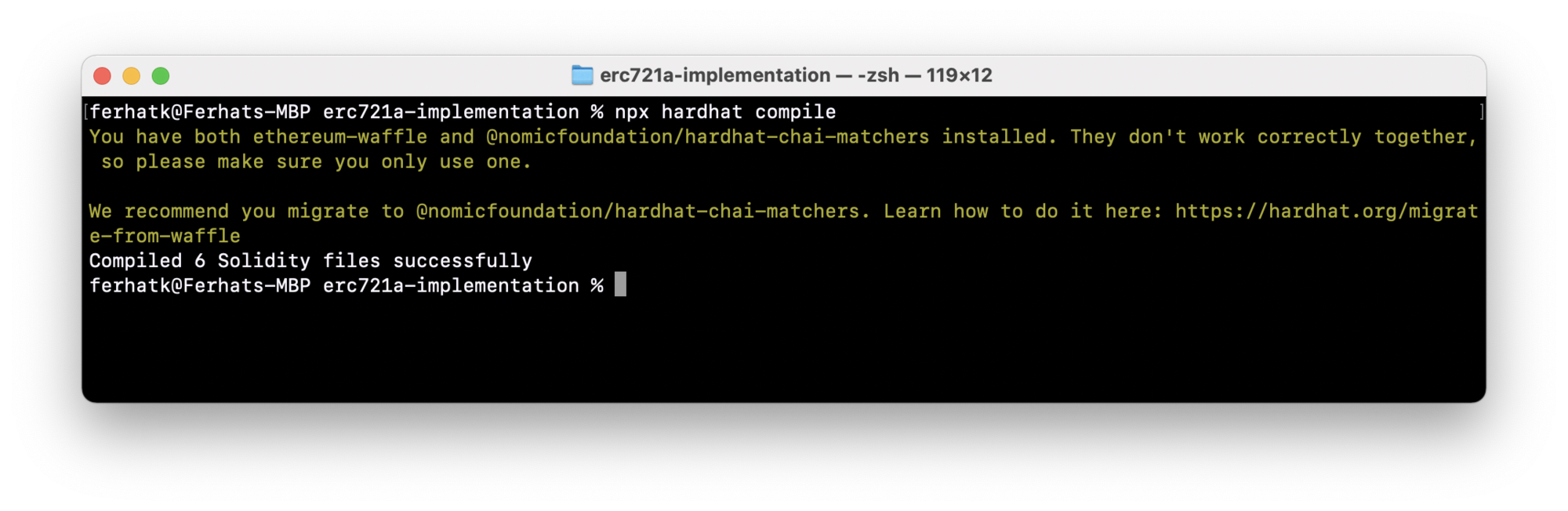
Ahora tendremos que configurar el script de implementación de Hardhat (scripts/deploy.js) y nuestra configuración de Hardhat (hardhat.config.js).
En primer lugar, crearemos un script para implementar el contrato. En el directorio «scripts», edita el contenido del archivo «deploy.js» para incluir la siguiente lógica de código:
const hre = require("hardhat");

async function main() {

  const latestBlock = await hre.ethers.provider.getBlock("latest")
  //const add100BlocksToCurrent = latestBlock.timestamp + 1000;

  const BatchNFTs = await hre.ethers.getContractFactory("BatchNFTs");
  const batchNFTs = await BatchNFTs.deploy(latestBlock.timestamp, false);

  await batchNFTs.deployed(latestBlock.timestamp);

  console.log(
    `Deploy ERC721A contract and schedule mint to open on block ${latestBlock.timestamp}`,
    `Deployed to https://mumbai.polygonscan.com/address/${batchNFTs.address}`
  );
}

main().catch((error) => {
  console.error(error);
  process.exitCode = 1;
});
Repasemos el código.
- Línea 1: Importa la dependencia «hardhat».
- Línea 3: Declara una función asíncrona llamada «main».
- Línea 5: Recupera el último bloque utilizando Ethers.js y la clave PRIVATE_KEY que definiremos más adelante en el archivo .env.
- Línea 6: Puedes eliminar el comentario de esta línea para utilizar una hora de inicio futura.
- Línea 8: Crea una instancia del contrato BatchNFTs tal y como se describe en la interfaz y en el código de inicialización (initcode).
- Línea 9: Implementa el contrato BatchNFTs.
- Línea 11: Define la función de devolución de llamada una vez que se haya desplegado el contrato.
- Líneas 13-17: Define instrucciones de impresión que muestren la dirección del contrato y la hora de inicio de la acuñación de NFT.
- Líneas 19-22: Declara la función principal y asigna una función de llamada de retorno para detectar errores.
A continuación, abre el archivo hardhat.config.js y actualiza su contenido para incluir el siguiente código:
require("@nomicfoundation/hardhat-toolbox");
require("dotenv").config();

/** @type import('hardhat/config').HardhatUserConfig */
module.exports = {
  solidity: {
    version: "0.8.17",
    settings: {
      optimizer: {
        enabled: true,
        runs: 200
      }
    }
  },
  networks: {
    hardhat: {
    },
    mumbai: {
      url: process.env.RPC_URL,
      accounts: [process.env.PRIVATE_KEY]
    }
  },
};
A continuación, en tu archivo .env, añade la URL de tu proveedor HTTP y la clave privada con el siguiente formato:
RPC_URL=TU_URL_HTTP_DE_QUICKNODE
CLAVE_PRIVADA=TU_CLAVE_PRIVADA
No te olvides de guardar el archivo.
Ahora que ya están configurados todo el código del contrato, los scripts y los archivos de entorno, podemos pasar a implementar el contrato ERC721A. En este momento, la cuenta que estés utilizando para implementar el contrato debería tener algunos tokens MATIC de la red de pruebas.
Una vez completadas con éxito todas las secciones anteriores, ejecuta el siguiente comando para implementar el contrato en la red de pruebas de Mumbai.
npx hardhat run --network mumbai scripts/deploy.js
Ten en cuenta que también puedes sustituir «mumbai» en el comando anterior por «localhost» para realizar pruebas en un entorno local. Lo mejor sería que también ejecutaras «npx hardhat node» en tu terminal para iniciar un servidor JSON-RPC basado en Hardhat Network.
Deberías ver el siguiente resultado en tu terminal:
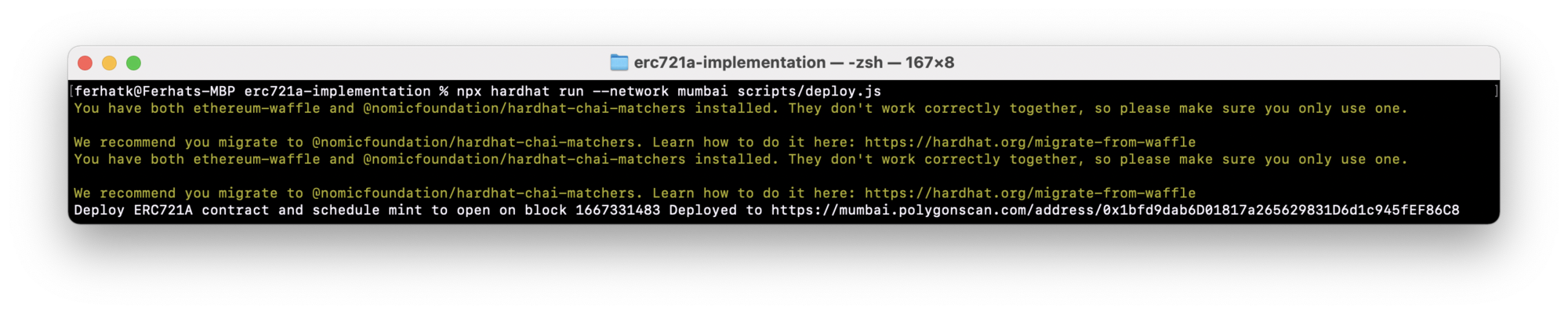
Puedes copiar y pegar la URL para ver la transacción en Polygonscan
Si quieres verificar el código fuente de tu contrato en un explorador de bloques, echa un vistazo a la API de PolygonScan y a esta referencia de Hardhat.
Creación masiva de NFT mediante el contrato ERC721A
Una vez desplegado nuestro contrato ERC721A, ya podemos probar la función de acuñación por lotes del contrato.
En el directorio «scripts» de tu proyecto, crea un archivo llamado «mint.js» y añade el siguiente código:
const hre = require("hardhat");

async function main() {

    const contractAddress = "BATCHNFTS_CONTRACT_ADDRESS";
    const recieverAddress = "RECEIVER_ADDRESS"
    const batchNFTs = await hre.ethers.getContractAt("BatchNFTs", contractAddress);

    const mintTokens = await batchNFTs.mint(recieverAddress, 3, { value: ethers.utils.parseEther("0.03") });
    console.log(`Transaction Hash: https://mumbai.polygonscan.com/tx/${mintTokens.hash}`);
}

main().catch((error) => {
  console.error(error);
  process.exitCode = 1;
});
Asegúrate de sustituir los marcadores de posición YOUR_CONTRACT_ADDRESS y RECEIVER_ADDRESS por la dirección de tu contrato inteligente y la dirección del destinatario.
Repasemos el código.
- Línea 1: Importar la dependencia Hardhat
- Línea 3: Declarar la función «main » asíncrona
- Líneas 5-6: Declara la dirección de nuestro contrato y la dirección del destinatario
- Línea 7: Declara una instancia de nuestro contrato con Ethers.js introduciendo la representación del contrato y la dirección pública.
- Línea 9: Llamamos a la función «mint», en la que solicitamos 3 NFT para la dirección del destinatario y le pasamos 0,03 MATIC (es decir, 0,01 MATIC por cada NFT).
- Línea 10: Mostrar el hash de la transacción
- Líneas 13-16: Declara la función principal y añade una función de devolución de llamada adicional para detectar errores
El momento que tanto has estado esperando. Para acuñar NFT desde el contrato que has desplegado, ejecuta el siguiente comando:
npx hardhat run --network mumbai scripts/mint.js
Ten en cuenta que debes tener al menos 0,03 MATIC, ya que cada acuñación cuesta 0,01 MATIC. Puedes conseguir MATIC adicionales de la red de pruebas a través del grifo de Quicknode o del grifo de Polygon.
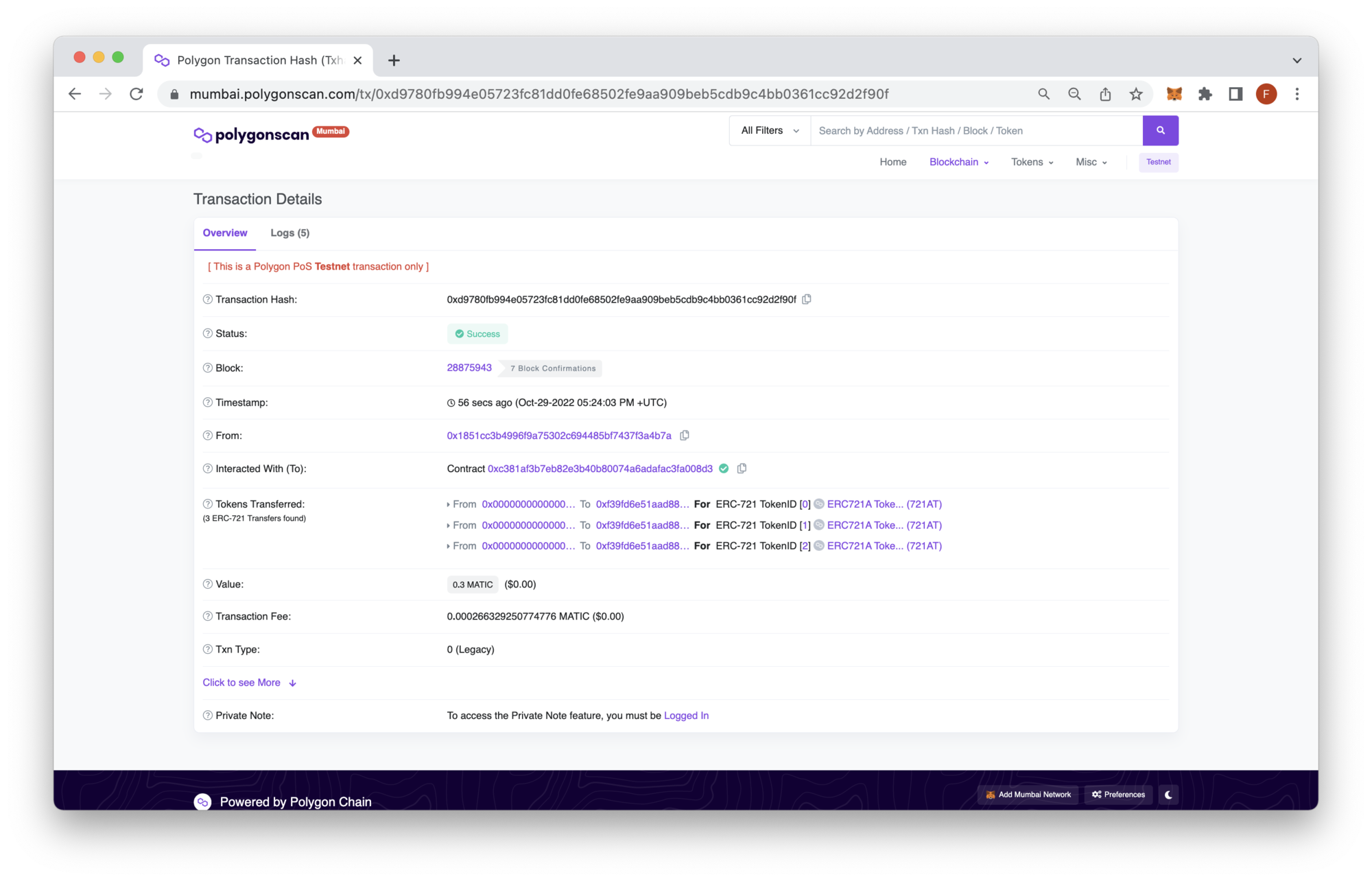
La transacción podría tardar unos minutos en procesarse. No obstante, una vez completada, el resultado debería ser similar a este:
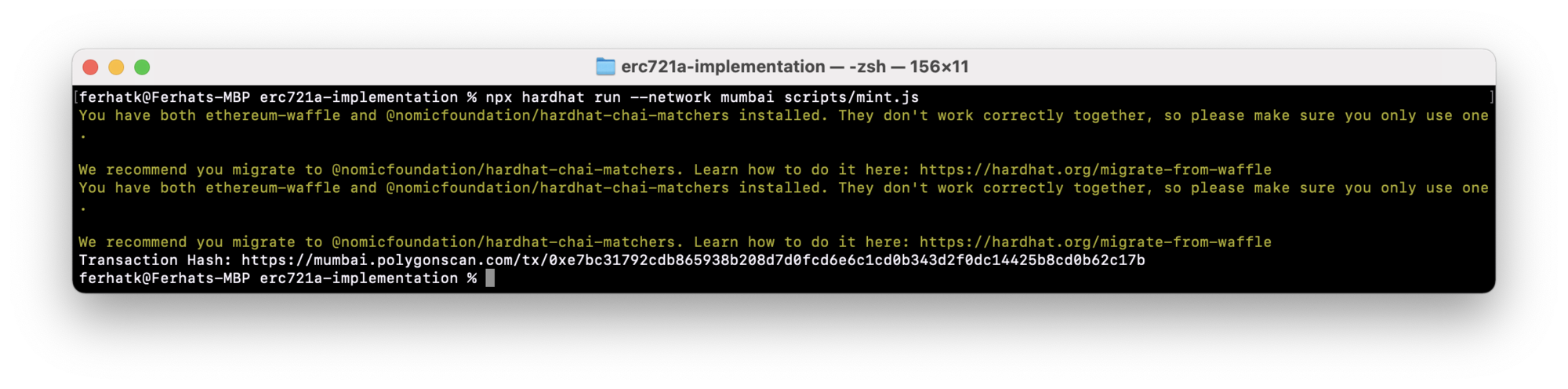
Puedes acceder a Polygonscan para ver la transacción a partir de la cual se acuñaron tus NFT.
Si tienes curiosidad por saber cómo configurar los metadatos de tus NFT, echa un vistazo a otras guías nuestras, como «Cómo crear y desplegar un NFT ERC721» y «Cómo crear y desplegar un NFT ERC1155».
Descarga el código completo de este repositorio de GitHub.
Referencias
Reflexiones finales
¡Enhorabuena! Ahora ya sabes cómo crear, implementar y acuñar varios NFT en una sola transacción utilizando la implementación ERC721A.
Únete a nuestro Discord si tienes alguna duda, o ponte en contacto con nosotros a través de Twitter.
¡Nos encanta recibir comentarios!
Si tienes algún comentario o pregunta sobre esta guía, háznoslo saber. ¡Nos encantaría saber tu opinión!