AI agents are everywhere today. McDonald's support bot, coding assistants, and seemingly every startup pitch in the last two years.
Yet ask ten builders, or read ten articles ranking on page one of Google, and there will be ten different answers to "what is an AI agent?" and "how do AI agents actually work?".
Why so? Universally, there's no exact definition. Yet everyone is convinced that everyone needs AI agents and that building one is easy.
This piece breaks AI agents down to their atoms: what they actually are, how autonomy works, where blockchain fits, and how each piece of the stack works together.
What are AI Agents, Actually?
AI agents are software that observes its environment, uses reasoning and memory to decide what to do, and takes actions autonomously to achieve a goal.
Every AI agent is built around four fundamental components:
Goal: Defines the objective the agent is trying to accomplish.
Observe: Gathers information from its environment through user input, APIs, databases, browsers, or other data sources.
Reason: Uses model, memory, and available context to decide what should happen next.
Act: Uses tools to initiate actions like send a request, write a file, execute code, make a transaction, or trigger another system.
The goal sets the direction. Observe > Reason > Act forms the loop that continues until the goal is achieved or the agent reaches a stopping condition.
The ability to act is what matters here. Without it, reasoning stays inside the model, which brings us to a huge confusion present online: agents vs models.
AI Agents vs LLM Models
An LLM provides the reasoning engine inside many AI agents. The "agent" emerges when reasoning is connected to memory, tools, workflows, and execution.
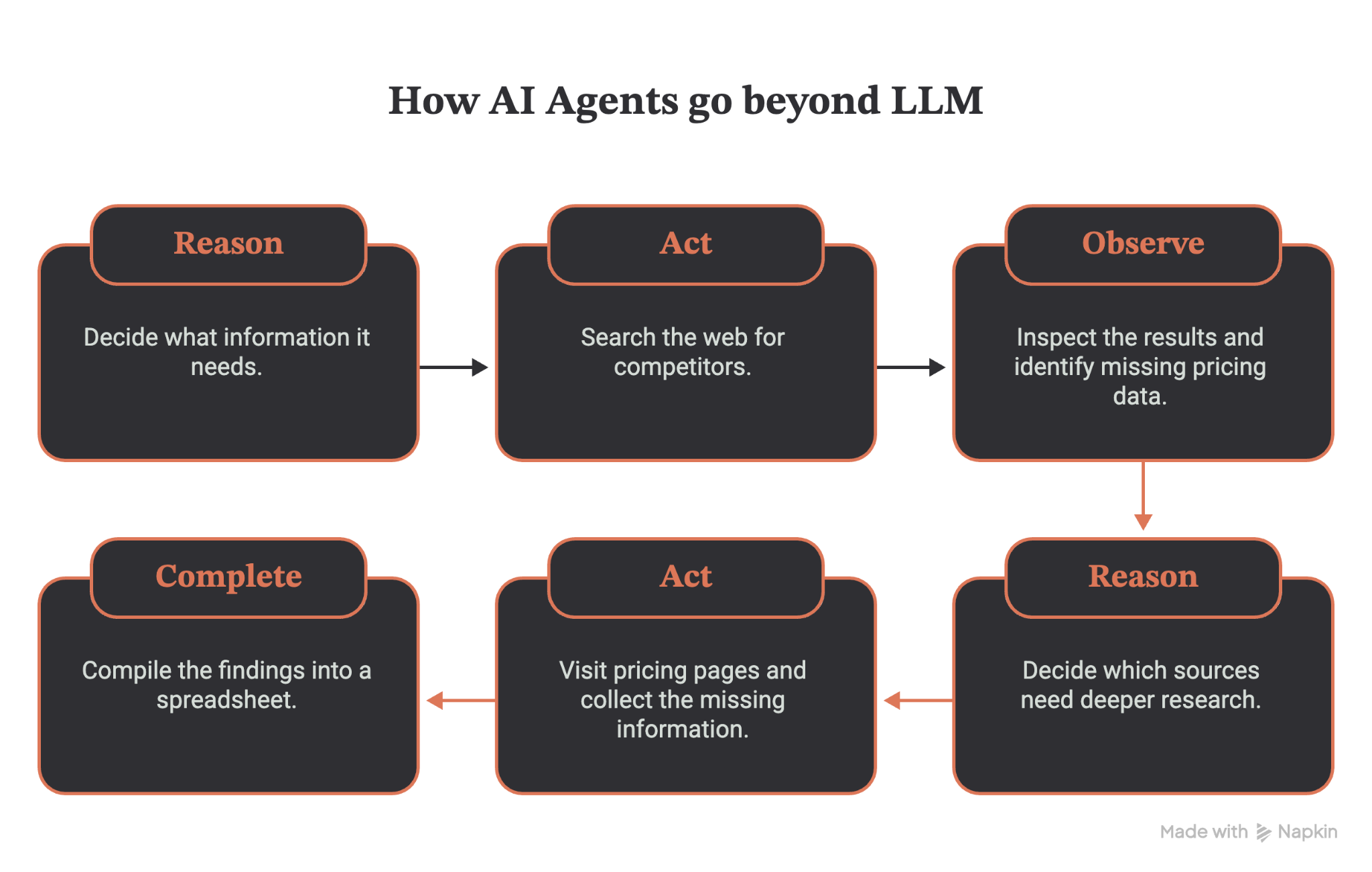
Consider a task: Research the top 10 competitors in a market and compare their pricing.
An LLM can suggest how to approach the task. An agent can actually carry it out:
The cycle can repeat dozens of times. And this is exactly where AI agents go beyond just an LLM model.
The model supplies reasoning.
Tools provide capabilities.
Infrastructure determines where those actions can happen.
Access decides how autonomous (human-free) actions can be.
Put another way, an LLM can tell an agent what it should do. The rest of the stack determines whether the agent can actually do it.
And this is where today's agents begin to hit a boundary.
AI Agents Hit the Autonomy Wall
Most AI agents interact with the world through infrastructure built for humans. They use API keys created by developers, accounts registered by people, cloud services billed to companies, payment methods attached to those accounts, and permissions granted by administrators.
The agent may decide to take an action, but the underlying ability to take that action often still belongs to someone else.
This is the gap between an agent that can call tools and an agent that can operate independently.
Greater autonomy requires more than better LLMs. Agents need ways to establish identity, control assets, exchange value, and execute actions without humans.
That's where blockchain becomes interesting.
Why Put AI Agents Onchain?
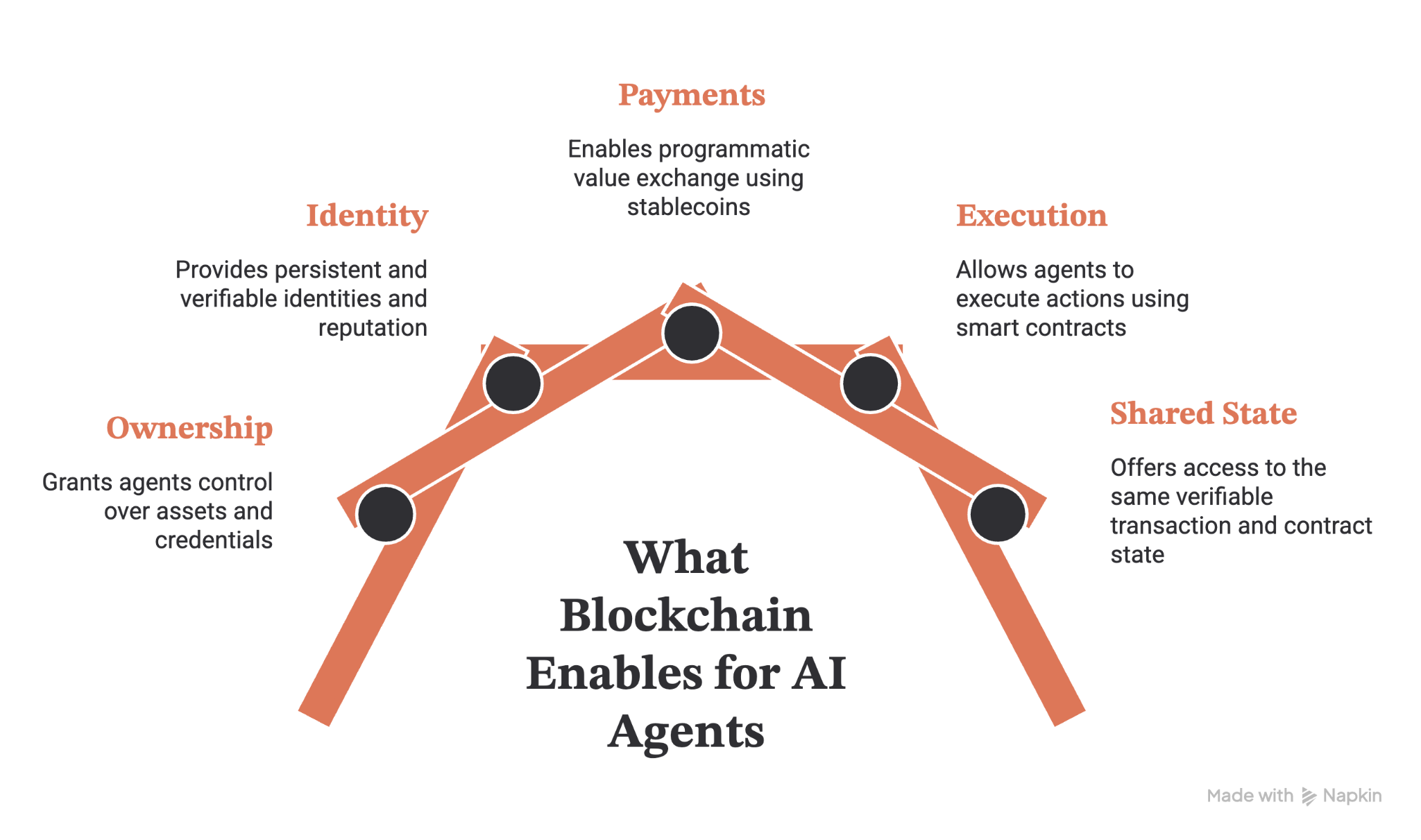
Blockchain gives AI agents access to programmable primitives for ownership, identity, payments, execution, and shared state.
It doesn't make an LLM autonomous by itself. Instead, it gives an agent new ways to interact with the world.
Five primitives are particularly relevant:
Together, these primitives change what an agent can do.
An agent could hold funds, pay for a service, prove which identity it is acting through, interact with a smart contract, and leave a verifiable record of what happened.
But none of this happens simply because an agent has a wallet.
There is a stack of infrastructure sitting between the reasoning loop and the blockchain for those capabilities to work in practice. Let's take a look.
What is the Onchain AI Agent Stack?
The onchain AI agent stack is a set of infrastructure layers, spanning payment, identity, access, and coordination, that let AI agents act autonomously on blockchain.
These layers come together to let an agent hold a wallet, prove identity, pay for resources, and execute transactions with limited to no human involvement.
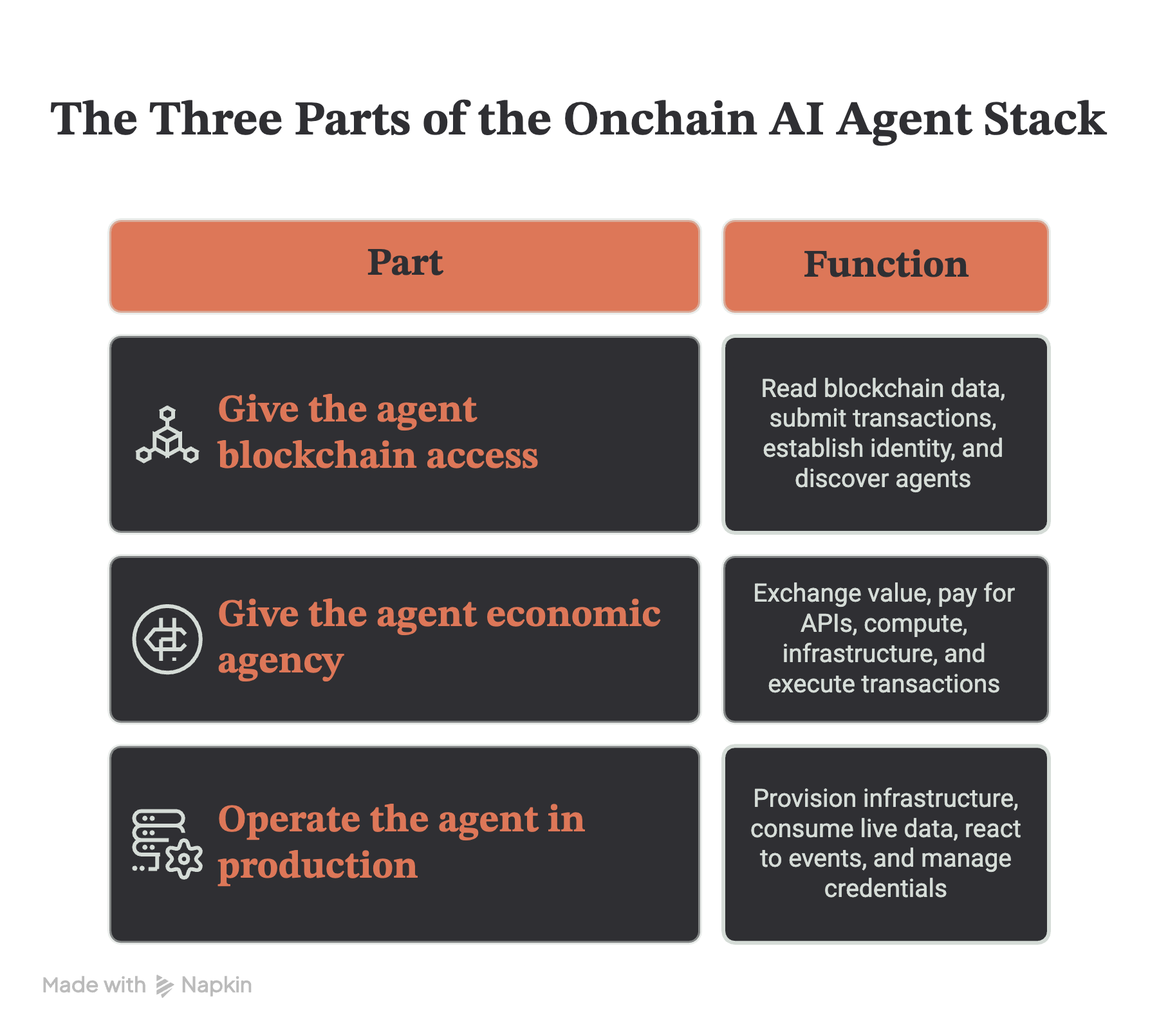
For this guide, the stack can be understood through three parts.
These three parts form the architecture for the rest of this guide:
Each part depends on the one before it. Economic agency without access is a concept, not a capability. Operations without economic agency have nothing to operate.
So, let's begin where the stack actually starts: getting the agent onto the chain in the first place.
Giving AI Agents Blockchain Access
Blockchain access gives an AI agent the ability to read onchain state and submit transactions. In practice, this usually starts with an RPC endpoint that connects the agent to a blockchain node.
RPC works much like an API. The agent sends a request to a node and receives blockchain data in return. The same interface can broadcast signed transactions when the agent needs to act.
That covers the two basic directions an agent needs:
Read: Check balances, query smart contracts, inspect transactions, estimate gas, or retrieve the latest block.
Write: Broadcast transfers, swaps, contract calls, or other signed transactions.
Choosing the Right Blockchain Interface
The interface depends on what the agent needs to observe.
JSON-RPC over HTTP works for basic request-response tasks such as checking a balance or broadcasting a transaction.
WebSockets maintain a persistent connection. They suit agents that need to watch new blocks, logs, or other state changes and react as they happen.
gRPC is built for specialized workloads like high-throughput streaming of accounts, transactions, slots, and other real-time data.
Quicknode provides these interfaces across 80+ chains and 130+ networks through a common API point.
For latency-sensitive or high-volume workloads, Dedicated Clusters provide isolated infrastructure.
Reacting to Onchain Events
Reading the state and reacting to it are different problems. Polling works but wastes calls and misses anything between checks.
This is why AI agents need a way to detect onchain events and respond to them. A trading agent, for example, cannot wait for a prompt before noticing a price change, transaction, or contract event.
Quicknode provides two main ways to build these workflows:
Streams delivers real-time and historical blockchain data to destinations such as webhooks and databases. It supports filtering, reorg handling, and reliable delivery for workflows where missing an event can affect execution.
Webhooks sends event notifications through HTTP callbacks. It offers a simpler setup for workflows where best-effort delivery is sufficient.
With access and event delivery sorted, let's tackle agentic identity, i.e., establishing which agent is doing the observing and acting.
How AI Agents Get an Onchain Identity
Onchain identity allows AI agents to be recognized and identified verifiably before any interaction or transaction happens.
ERC-8004 provides this through onchain registries for identity, reputation, and validation. Registering costs one transaction. After that, any agent or service can look up the registration and decide whether to interact.
Every agent gets:
A reputation score that takes into account feedback volume, how many distinct counterparties left that feedback, and how often the agent's work got flagged or reversed.
Validation attestation, i.e., an independent check on whether an agent actually did what it claimed*.
Bonus: Read how ERC-8004 works, how it fares against OAuth, DIDs, and ENS, and more importantly, how to register and interact with other AI agents.
*Not live on mainnet as of mid-August 2026.
An agent can query these registries two ways using Quicknode:
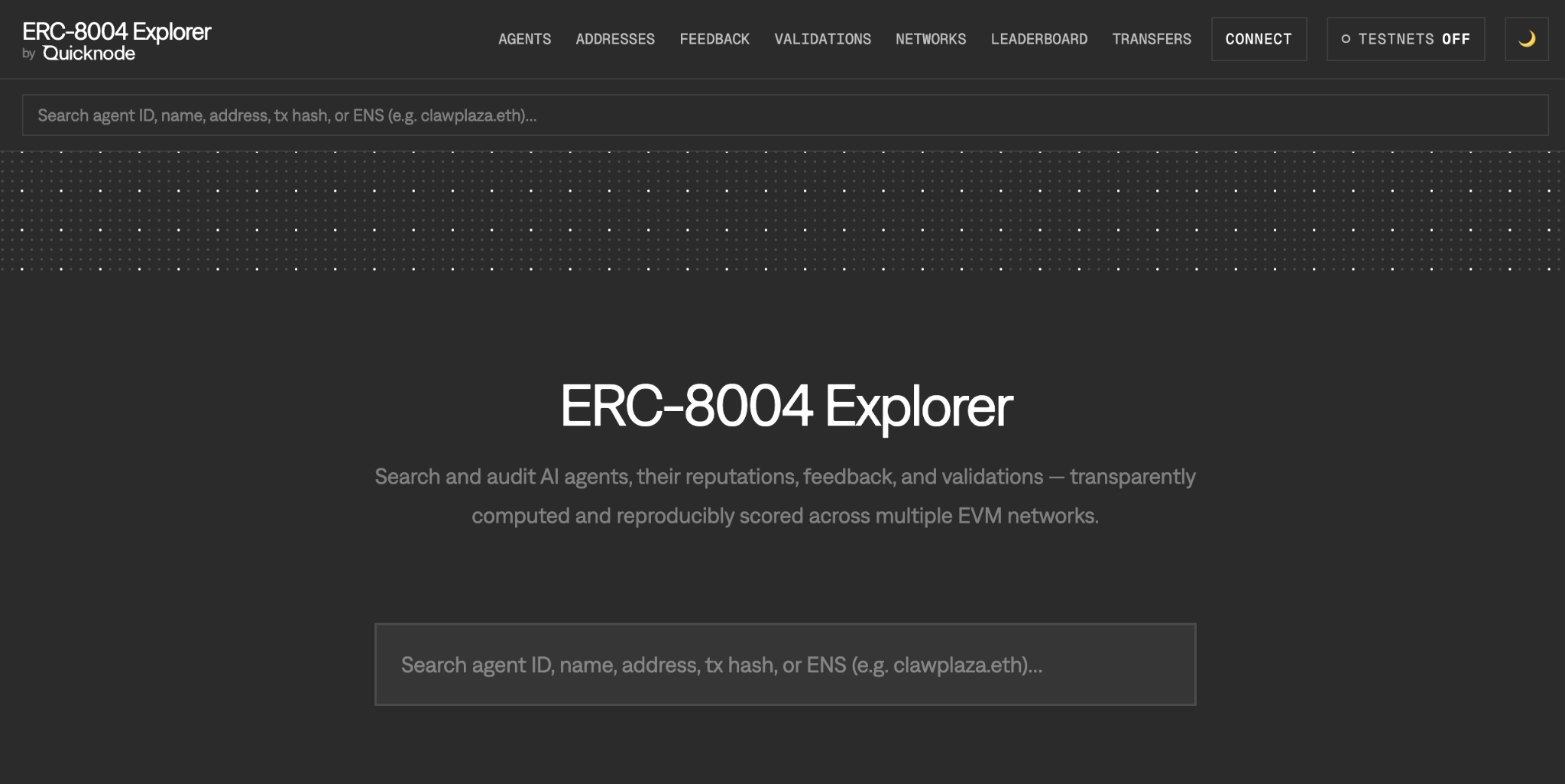
The ERC-8004 Explorer provides a human-readable interface for searching registered agents and inspecting their profiles, reputation, and activity.
Applications can retrieve the same indexed data through the ERC-8004 REST API or JSON-RPC add-on. Developers that need direct access can query the underlying ERC-8004 registry contracts through Core RPC instead.
Identity establishes who an agent is and how to discover other AI agents. The next question becomes economic: how can AI agents transact with each other?
How AI Agents Pay Autonomously
Autonomous payments let AI agents purchase APIs, data, compute, and other services without relying on a human.
Two protocols do this today: x402 and MPP.
x402: Pay Per Request
x402 lets an agent pay for an HTTP resource as part of the request itself.
When the agent requests a paid resource, the server returns 402 Payment Required with the price, network, token, and payment instructions.
The agent signs the payment, retries the request with the authorization attached, and receives the resource once payment is verified. A facilitator can handle verification and onchain settlement for the server.
This works well for discrete purchases such as API calls, data queries, or compute jobs.
MPP: Pay for Ongoing Access
Machine Payments Protocol (MPP) lets agents establish paid sessions for services that involve repeated or ongoing interactions.
Instead of treating every request as a separate purchase, payment and access can persist across a longer session.
This fits services such as persistent infrastructure or long-running workloads, where repeatedly negotiating a new payment for every request is unnecessary.
The distinction is practical: x402 prices the request; MPP can price the relationship that continues across requests.
Quicknode Enables Both x402 and MPP
Quicknode makes both payment models usable against its own infrastructure.
x402 access lets a wallet consume Quicknode endpoints without creating an account or API key, with pay-per-request, nanopayment, and prepaid credit-drawdown models across JSON-RPC, REST, gRPC-Web, and WebSocket.
MPP access supports both one-off charges and reusable payment sessions; sessions open a payment channel once, then use signed vouchers for subsequent requests before final onchain settlement.
Both protocols share one free-tier bucket, i.e., 1 million API credits a month per wallet, and both can query any of Quicknode's supported chains regardless of which network the payment settles on.
Now, an AI agent has decided what to do and has the economic ability to do it. How does that decision become an onchain transaction?
How AI Agents Execute Onchain Actions
Onchain execution turns an agent's decision into a blockchain transaction.
An agent might decide to transfer USDC, execute a swap, claim a position, or call a smart contract.
This decision is taken at the reasoning layer. But transaction execution infrastructure handles how that action reaches the blockchain.
From Decision to Transaction
Execution starts by translating an agent's intent into a valid transaction. That means identifying the contract and method, preparing parameters, estimating fees, and constructing the transaction in the format expected by the target chain.
Signing is the critical boundary. Once signed, the transaction can be broadcast through Quicknode Core RPC.
Preparing Assets Before Execution
Agents will not always hold the asset required for the next action.
A payment may require USDC while the wallet holds ETH. A protocol interaction may require another token entirely. Quicknode's Swap API provides a programmatic way to fetch routes and prepare swaps without requiring the agent to integrate with individual DEXs.
That makes asset routing another callable capability inside the workflow:
At this point, the agent can access the blockchain state, establish an identity, pay for resources, and execute transactions.
The remaining challenge is operational: keeping those capabilities available, reliable, and constrained while the agent runs without constant human supervision.
Managing AI Agent Infrastructure in Production
Production AI agents need infrastructure that stays available, reacts to changing workloads, discovers and interacts with the right tools, and monitors and limits access.
Earlier layers give an agent capabilities.
The production layer determines whether those capabilities can run continuously without turning every infrastructure change into a human task.
Letting Agents Manage Their Own Infrastructure
Quicknode's Admin API exposes infrastructure management programmatically. This creates a path for approved agent workflows to provision and manage resources through APIs.
Managing Infrastructure in Natural Language
Quicknode also enables access to the same infrastructure through an MCP server so that an agent, or the developer working alongside one, can create an endpoint, check usage, or update a rate limit by asking for it in plain language instead of writing API calls by hand.
Agent-facing resources such as Blockchain Skills and llms.txt complement this layer by making documentation and blockchain knowledge easier for agents to consume.
Constraining What an Agent Can Do
Production autonomy should have explicit boundaries. An agent only needs access to the networks, methods, resources, and credentials required for its task.
This creates bounded autonomy: enough authority for an agent to operate independently, without turning a compromised prompt or incorrect decision into unrestricted infrastructure or asset access.
With that, the stack closes its loop. Intelligence determines what should happen; the surrounding infrastructure determines what an agent can observe, pay for, execute, and operate safely over time.
AI Agents May Be Blockchain's Most Natural Users
For more than a decade, blockchain applications have largely been designed around humans. Today, when we zoom out and look at portable identity, programmable money, and execution without intermediaries, we realize agents are the first class of economic actors blockchain's original design assumptions were built for.
Trustless, because there's no legal recourse between two pieces of software.
Programmable, because a human isn't reading the terms.
Permissionless, because nobody's there to approve the application.
Knowing this, we look optimistically toward a future where the primary user of blockchain is AI agents.
FAQs: Frequently Asked Questions
1. Does every AI agent need blockchain infrastructure?
No. Blockchain becomes useful when agents need onchain state, programmable assets, payments, portable identity, or execution across independent systems.
2. What can AI agents actually do onchain?
Agents can monitor blockchain activity, query contracts, manage assets, make payments, execute transactions, and trigger workflows based on onchain events.
3. Can an AI agent lose money it controls?
Yes. A wallet an agent controls has no fraud protection, no chargebacks, and no bank to call if something goes wrong.
4. What is the difference between an onchain AI agent and a trading bot?
Trading bots automate predefined market strategies. AI agents can reason, select tools, adapt workflows, and perform broader onchain tasks.
5. Can existing AI agents be made onchain?
Yes. Existing agents can add blockchain capabilities through RPC APIs, wallets, payment protocols, identity standards, and transaction tools.
6. Can two AI agents transact without any humans involved?
Yes. End-to-end discovery, payment, and execution can all happen without a person approving each step.
7. How is an onchain identity different from an OAuth token?
An OAuth token is issued and revoked by one platform. Onchain identity is self-owned and portable across any of them.
Fondée en 2017, Quicknode met à disposition des développeurs et des entreprises une infrastructure blockchain de niveau institutionnel. Grâce à une disponibilité de 99,99 % et à la prise en charge de plus de 75 chaînes, les équipes peuvent développer et faire évoluer des applications sur la chaîne sans faire de compromis.