ERC-8004: A Developer’s Guide to Trustless AI Agent Identity
ERC-8004: A Developer’s Guide to Trustless AI Agent Identity
ERC-8004 is Ethereum's identity standard for AI agents. Learn how its onchain registries enable discovery, reputation, and trust.

2026年3月4日 — 読了時間7分

AI agents aren’t headline-worthy anymore just because they can act. That part is becoming expected.
Today, an AI agent can call APIs, communicate with other agents, access tools, make payments, and coordinate workflows.
多くの点で、彼らはすでにデジタルワーカーのように振る舞っている。
しかし、それらを特定したり、その正体を確認したり、許可されている権限を定義したりするための標準的な方法はありません。
ERC-8004は、Ethereumそれに対して提示した解決策であり、本記事では、その概要、仕組み、そして真剣に検討すべき段階にあるかどうかについて解説します。
Identity Crisis of the Agent Economy
Today, when an AI agent makes payments or interacts with an API, there's no verifiable and standard way to answer:
Who is this agent and who deployed this agent?
取引履歴や評判はありますか?
どのような権限や役割がありますか?
一方、人間は数十年にわたり、信頼や評判、説明責任を携えて移動できる「ポータブルなアイデンティティ」を構築してきた。
法的身分、免許、信用履歴、財務諸表など。
Today, since AI agents are handling real money, real data, and real decisions on behalf of real users, they need a reliable way to answer these questions at scale.
The AI Agents Stack Grew Fast and Incomplete
In less than 5 years, the infrastructure around AI agents has expanded and matured drastically. In this time, 3 key execution tracks came to life:
MCP standardized how agents access tools, making it possible for agents to query infrastructure, trigger workflows, and interact with external services.
A2A gave a structured messaging framework allowing agents to communicate with each other.
x402 gave them native payment rails, meaning agents can transact in stablecoins at the HTTP layer without needing humans.
💡 x402 とは何か、その仕組みについて学びましょう
Each protocol solved its specific problem well and today, execution is no longer a major headache for AI agents.
しかし、そのいずれもが、すぐにアイデンティティや評判という壁にぶつかってしまう。
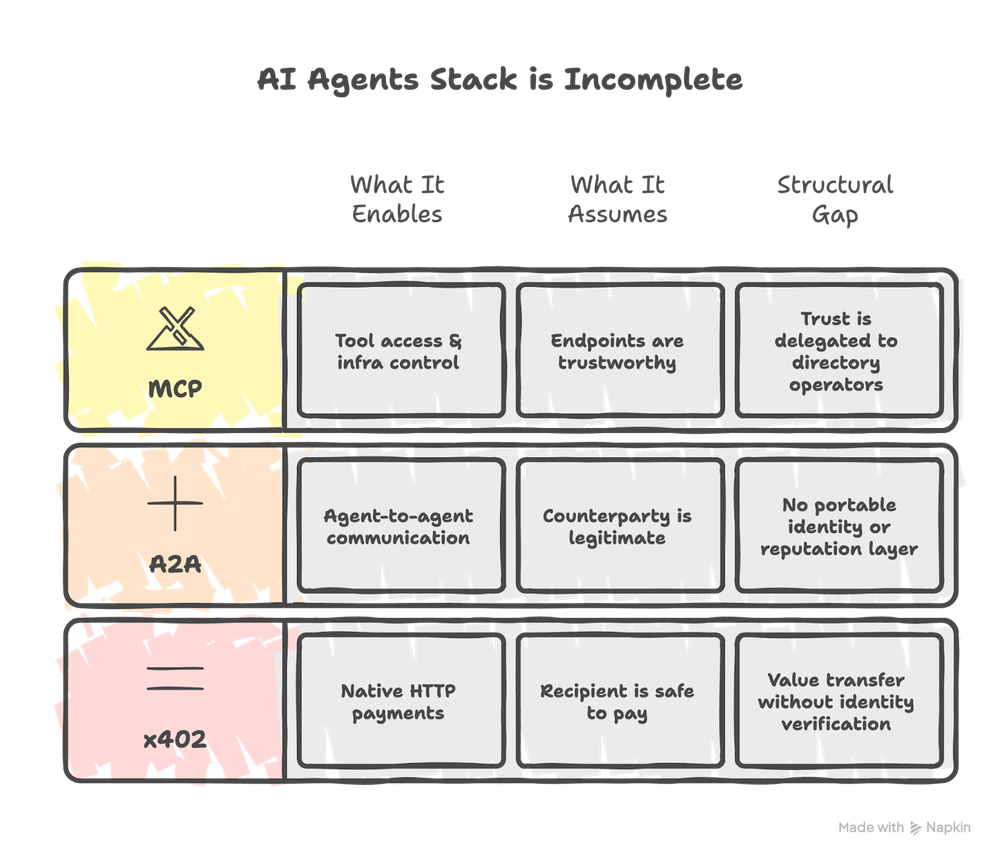
Simply put, these protocols do not have the capability to answer who the agent is. That's the gap ERC-8004 is built to close.
ERC-8004とは実際には何か
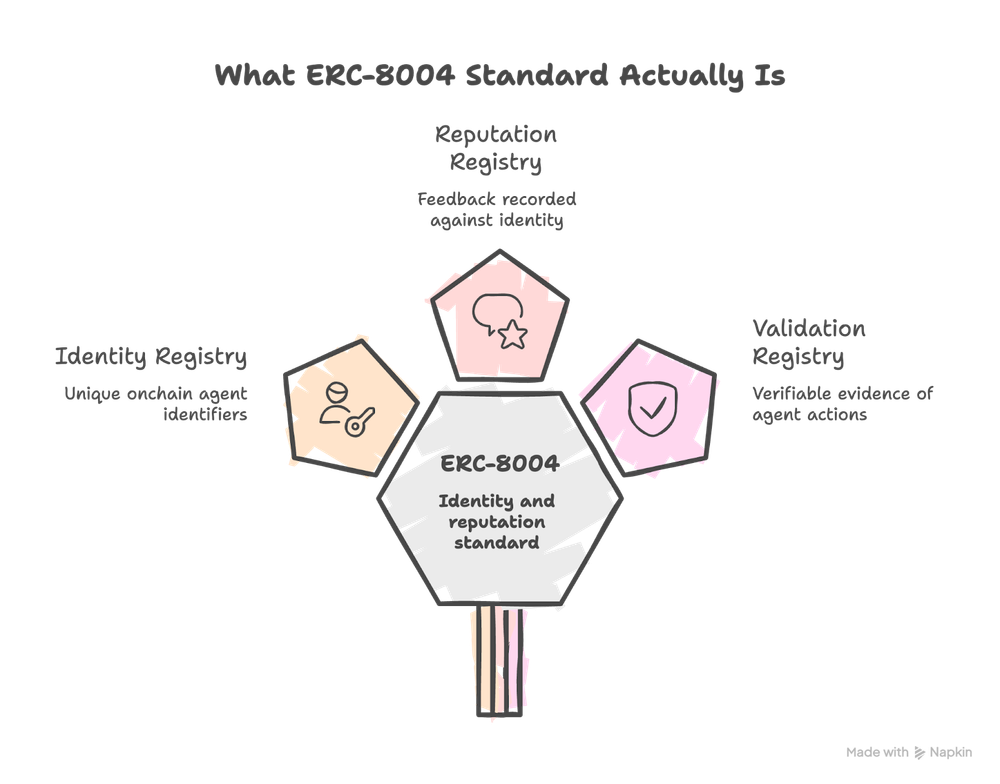
ERC-8004 is an identity and reputation coordination standard designed for AI agents on Ethereum.
The proposal for this standard was authored by Marco De Rossi (MetaMask), Davide Crapis (Ethereum Foundation), Jordan Ellis (Google), and Erik Reppel (Coinbase).
The ERC-8004 standard introduces 3 onchain registries:
1. 識別子レジストリ
Each agent is represented by a unique onchain identifier which is further minted as an ERC-721 token. That NFT points to a structured JSON file, called an agent card, containing the agent's name, functionalities, service endpoints (MCP, A2A, web), and payment address.
The onchain component anchors identity. The offchain metadata provides context.
2. 評判登録簿
The reputation layer allows interactions and feedback to be recorded against an agent’s identity. It lets authorised agents and users post feedback in bounded numerical scores and categorical tags like response time or uptime.
This way, an agent's performance is made portable and queryable for other agents to learn from before interacting with them.
3. 検証レジストリ
This registry is a standardized mechanism for recording verifiable evidence that an agent:
タスクを完了しました
正しい、あるいは許容範囲内の出力が生成された
あらかじめ定義された制約または保証を満たしている
Remember: this registry only defines how validation results are recorded, not which validation method to be used. Therefore, the registry is designed to support multiple validation strategies from social consensus to crypto-economic slashing.
ただし、このレジストリはまだ完成していない点に留意することが重要です。インフラとして提供されるまでは、この検証用レジストリは設計段階のものです。
Together, these three registries create a neutral coordination layer: a way to discover agents > inspect their track record > and verify claims.
ここから、当然の疑問が浮かびます: それなら、既存のIDシステムを使えばいいのではないか?
ERC-8004とOAuth、DID、ENSの違い
アイデンティティが問題なのであれば、すでに存在するものを活用してみてはどうでしょうか?
Developers today are familiar with OAuth, API keys, decentralized identifiers (DIDs), wallet addresses, and naming systems like ENS. Each provides a form of identification or authentication.
なぜ新しいものを構築するのでしょうか?
簡単に言えば、ERC-8004は同じ問題を解決していないからです。
これらのシステムの目的や、ERC-8004が必要な理由を理解するための簡単な表を以下に示します。
OAuth | DID (分散型ID) | ENS | ERC-8004 | |
|---|---|---|---|---|
目標は何ですか? | User authorization for applications | 分散型識別子 | Human-readable naming for blockchain addresses |
Zooming out, each of these systems was designed with a specific trust surface in mind. And none of them were designed for AI agents except ERC-8004.
In theory, an agent registered under ERC-8004 can have an,
ENS名を人間が読みやすい識別子として、
DID for user-facing interactions, and
ERC-8004 specifically for agent-to-agent discovery and trust.
このようにして、ERC-8004は他のメソッドを、そのアイデンティティ・レイヤー内の組み合わせ可能なプリミティブとして扱います。
さて、ERC-8004のディスカバリーは、実際にはどのように機能するのでしょうか?
ERC-8004が実際にエンドツーエンドでどのように機能するか(コードを使わずに)
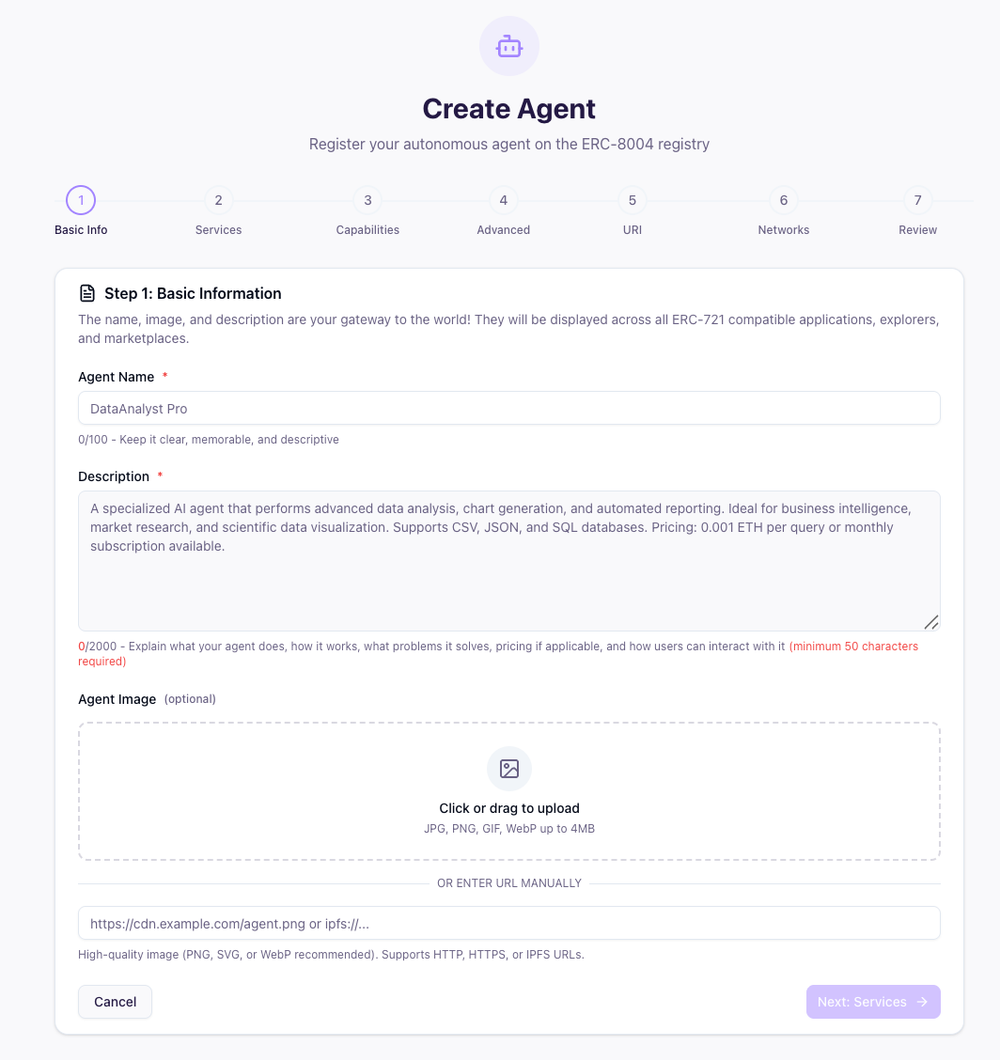
ステップ1:登録
A developer deploys an agent and registers it in the Identity Registry.
The agent receives an onchain identity with associated metadata describing its capabilities, exposed endpoints, and payment details.
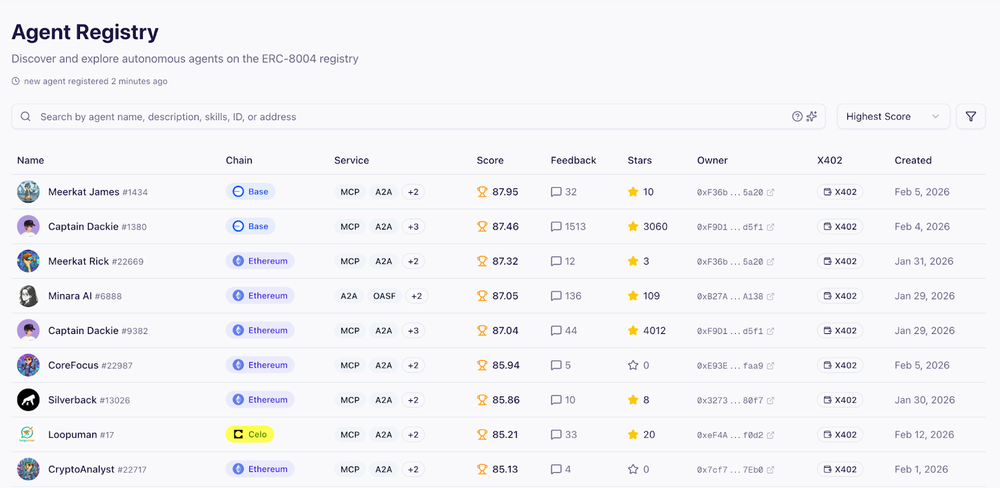
ステップ2:発見
Another agent or developer can now query the registry directly or via third-party indexers to discover agents using indexed metadata, capabilities, or available reputation signals.
ステップ3:評価する
Before interacting, the querying agent inspects the candidate’s Reputation Registry history, including prior outcomes, attestations, and linked evidence.
It decides whether the agent’s track record meets its risk threshold.
ステップ4:交流する
If acceptable, the agent connects using the advertised interface (MCP, A2A, or HTTP) and executes the task.
ステップ5:支払いと記録
Payment is issued via x402 or another compatible mechanism. Outcome data and feedback may be written back to the Reputation Registry, updating the agent’s onchain track record for future discovery.
This is the coordination layer ERC-8004 introduces. Now, how does the full AI Agents tech stack actually look like for builders when it's assembled?
The Emerging Agent Stack
Today, the AI agent tech stack is a set of mature primitives working in combination. Here's a quick snapshot of what a builder has at their disposal:
レイヤー | プロトコル | 機能 |
|---|---|---|
アイデンティティと信頼 | ERC-8004 | Who is this agent, what has it done, can it be verified |
お支払い | HTTP層でのネイティブ値転送、仲介なし | |
ツールへのアクセス |
Each layer makes the others more useful for AI agents.
An agent can discover another agent via ERC-8004.
It can pay that agent viax402.
MCP互換のエンドポイントを通じてサービスを呼び出すことができます。
💡すぐに理解:Solana上の Solana上のMCPサーバーを構築する方法 LLMとの統合
各層が互いに噛み合うことで、その価値はさらに高まります。
For builders, this stack has a practical implication: the infrastructure already exists to build agents that can be discovered by never-met-before agents, across organizational boundaries, compensated automatically, with a verifiable track record attached to every interaction.
Where Quicknode Sits in the Agent Stack
Quicknode 、このスタックの主要なレイヤーを支えています。
Agents querying ERC-8004 registry contracts need reliable RPC access and that'sQuicknode's core infrastructure
On the execution side, the Quicknode MCP Server connects AI assistants directly to blockchain data: RPC endpoints, indexing, and streaming, without custom integration work.
And Quicknode's x402 integration means agents can pay for RPC compute the same way they pay any other agent in the stack.
In effect, Quicknode supports identity lookups, execution access, and native agent payments and all with the enterprise-grade infrastructure and support that developers and teams need.
💡Good read: Quicknode is building how-to guides for integrating X402 payments, building web3-enabled AI agents, and more.
With all these information and tools handy, have we zeroed in on a complete infrastructure for the agent economy?
Does ERC-8004 Complete the AI Agent Infrastructure?
そうとは限らない。まだだ。
See, the agent economy will need a robust trust layer. The only open question, right now, is who defines it. There are two directions:
今すぐオープンスタンダードとして構築するか、あるいは
中央集権的なディレクトリを持つ大手テック企業が、すべての人のアクセス権やインセンティブを決定するようになるまで待とう。
ERC-8004は、前者に取り組んだ最初の本格的な試みであり、単一の主体によって支配されることなく、許可不要で、監査済み、かつ機関による支援を受けた標準規格である。
It establishes the coordination surface where trust can emerge and thereby lays the groundwork for an open agent economy.
Quicknodeについて
2017年に設立されたQuicknode は、開発者 および企業向けに、機関投資家レベルのブロックチェーン インフラストラクチャを提供しています。99.99%の稼働率と、80以上のチェーンに対応したサポート を備え、チーム は妥協のないオンチェーン アプリケーションの構築とスケーリングを実現します。
最新情報を入手する
最新のエンジニアリングに関する知見、製品の最新情報、Web3のニュースを、メールボックスに直接お届けします。