A Developer's Guide to Building on the Onchain AI Agent Stack
A Developer's Guide to Building on the Onchain AI Agent Stack
Explore the onchain AI agent stack, from blockchain access and ERC-8004 identity to x402 payments, execution, and production infrastructure.

2026年8月18日 — 読了時間13分
AI agents are everywhere today. McDonald's support bot, coding assistants, and seemingly every startup pitch in the last two years.
Yet ask ten builders, or read ten articles ranking on page one of Google, and there will be ten different answers to "what is an AI agent?" and "how do AI agents actually work?".
Why so? Universally, there's no exact definition. Yet everyone is convinced that everyone needs AI agents and that building one is easy.
This piece breaks AI agents down to their atoms: what they actually are, how autonomy works, where blockchain fits, and how each piece of the stack works together.
What are AI Agents, Actually?
AI agents are software that observes its environment, uses reasoning and memory to decide what to do, and takes actions autonomously to achieve a goal.
Every AI agent is built around four fundamental components:
Goal: Defines the objective the agent is trying to accomplish.
Observe: Gathers information from its environment through user input, APIs, databases, browsers, or other data sources.
理由:モデル、メモリ、および利用可能なコンテキストを用いて、次に何が起こるべきかを決定する。
Act:ツールを使用して、リクエストの送信、ファイルへの書き込み、コードの実行、トランザクションの実行、あるいは別のシステムの起動といったアクションを開始します。
The goal sets the direction. Observe > Reason > Act forms the loop that continues until the goal is achieved or the agent reaches a stopping condition.
The ability to act is what matters here. Without it, reasoning stays inside the model, which brings us to a huge confusion present online: agents vs models.
AI Agents vs LLM Models
An LLM provides the reasoning engine inside many AI agents. The "agent" emerges when reasoning is connected to memory, tools, workflows, and execution.
次のようなタスクを考えてみましょう。ある市場における上位10社の競合他社を調査し、それぞれの価格を比較することです。
An LLM can suggest how to approach the task. An agent can actually carry it out:
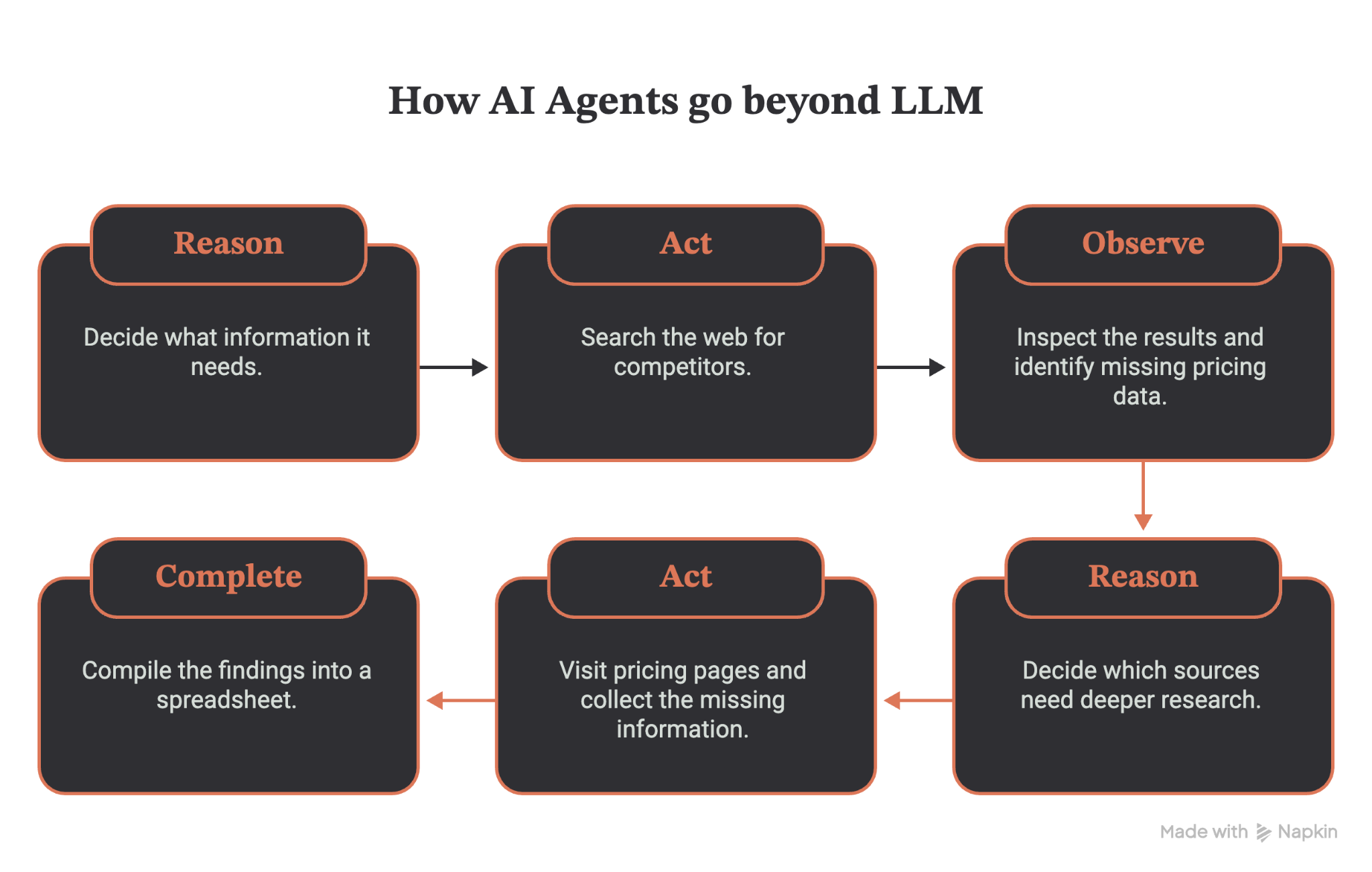
The cycle can repeat dozens of times. And this is exactly where AI agents go beyond just an LLM model.
このモデルは推論を行う。
ツールは機能を提供します。
インフラによって、そうした行動がどこで行えるかが決まります。
Accessは、どの程度自律的(人間の手を借りない)な動作が可能かを決定します。
Put another way, an LLM can tell an agent what it should do. The rest of the stack determines whether the agent can actually do it.
And this is where today's agents begin to hit a boundary.
AI Agents Hit the Autonomy Wall
Most AI agents interact with the world through infrastructure built for humans. They use API keys created by developers, accounts registered by people, cloud services billed to companies, payment methods attached to those accounts, and permissions granted by administrators.
The agent may decide to take an action, but the underlying ability to take that action often still belongs to someone else.
This is the gap between an agent that can call tools and an agent that can operate independently.
Greater autonomy requires more than better LLMs. Agents need ways to establish identity, control assets, exchange value, and execute actions without humans.
That's where blockchain becomes interesting.
Why Put AI Agents Onchain?
Blockchain gives AI agents access to programmable primitives for ownership, identity, payments, execution, and shared state.
It doesn't make an LLM autonomous by itself. Instead, it gives an agent new ways to interact with the world.
特に重要なプリミティブは5つあります:
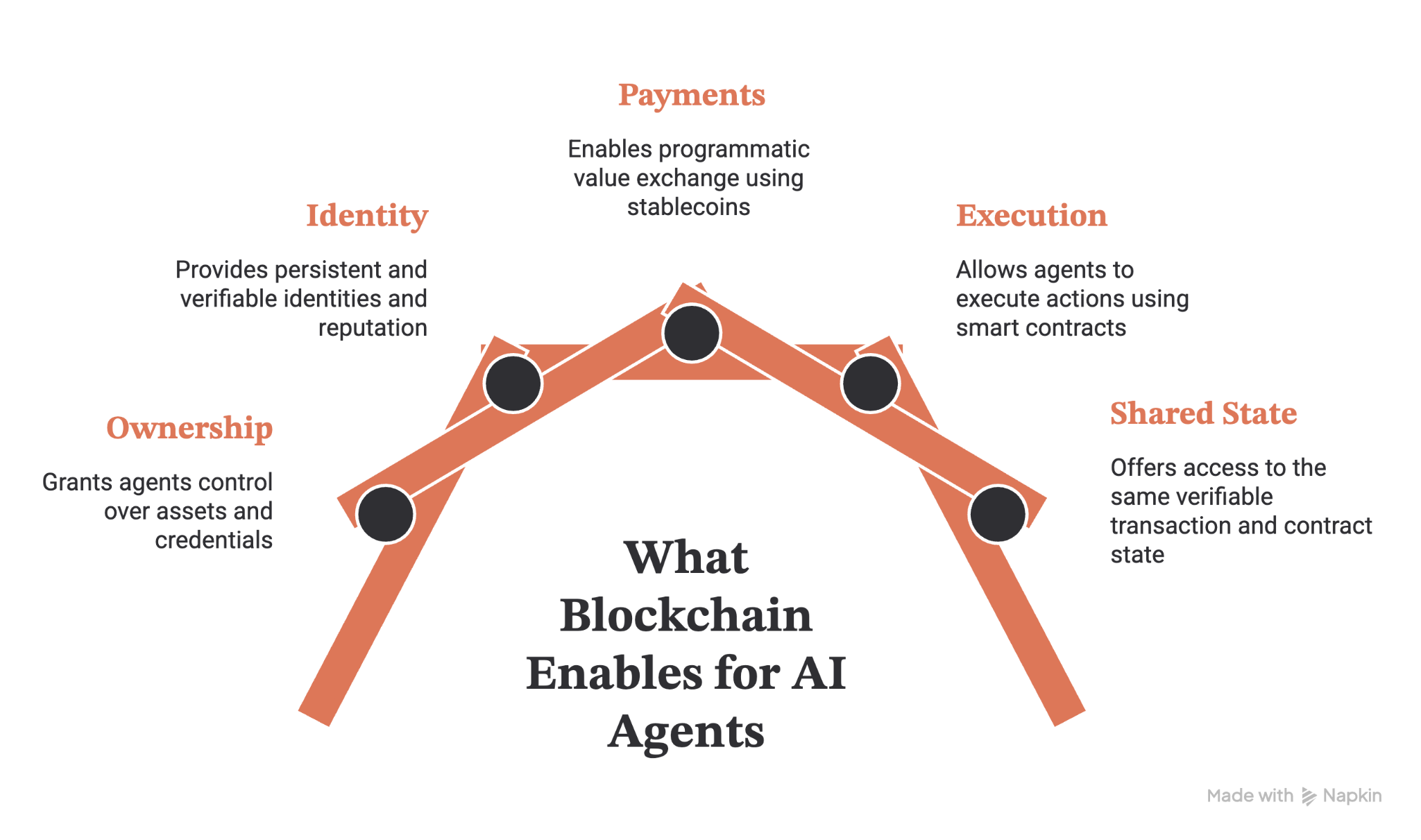
Together, these primitives change what an agent can do.
An agent could hold funds, pay for a service, prove which identity it is acting through, interact with a smart contract, and leave a verifiable record of what happened.
But none of this happens simply because an agent has a wallet.
There is a stack of infrastructure sitting between the reasoning loop and the blockchain for those capabilities to work in practice. Let's take a look.
What is the Onchain AI Agent Stack?
The onchain AI agent stack is a set of infrastructure layers, spanning payment, identity, access, and coordination, that let AI agents act autonomously on blockchain.
These layers come together to let an agent hold a wallet, prove identity, pay for resources, and execute transactions with limited to no human involvement.
このガイドでは、スタックは3つの部分から構成されていると理解できます。
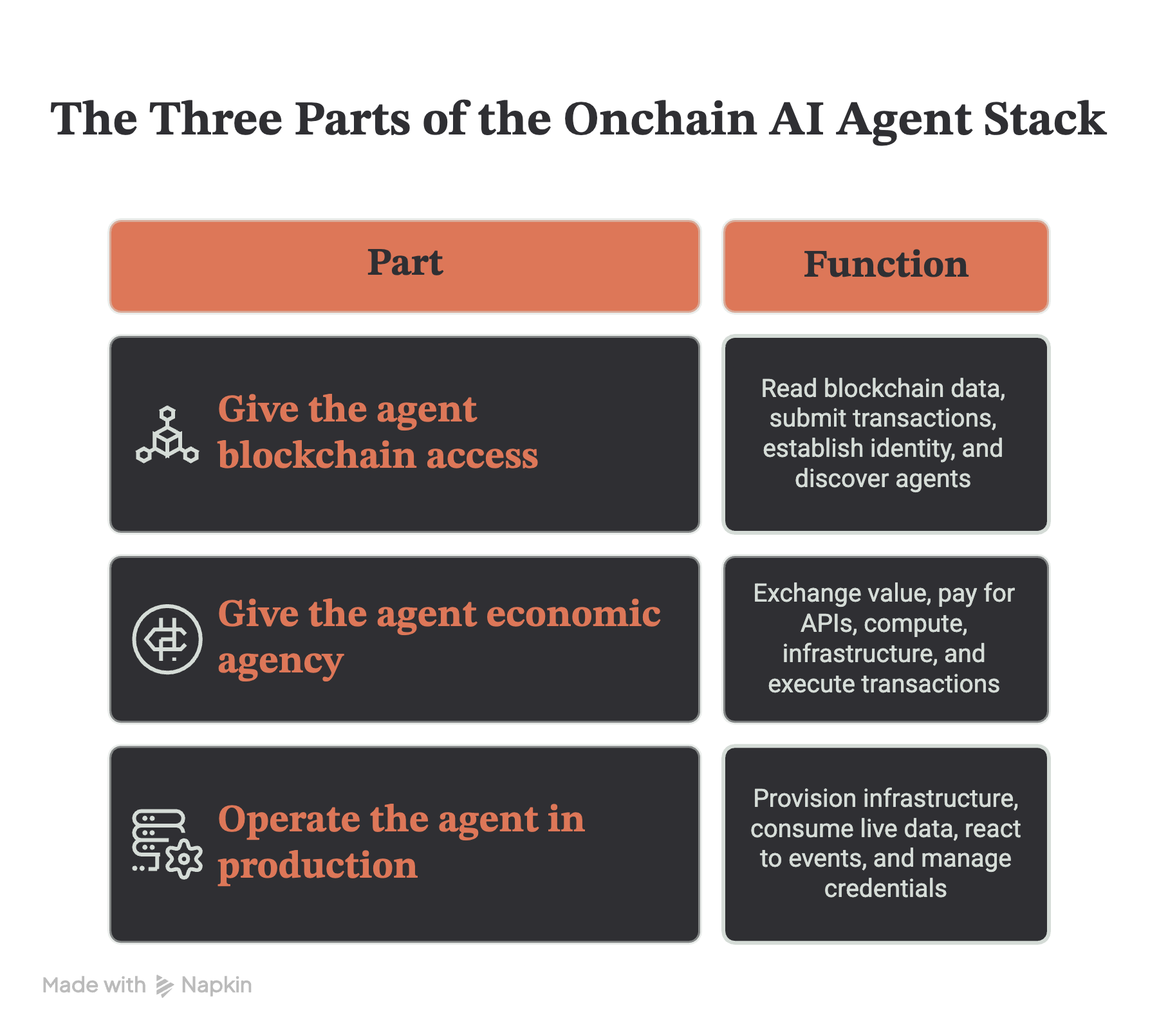
これら3つのパートが、このガイドの残りの部分の構成となっています:
アクセス > アイデンティティ > ディスカバリー > 決済 > 実行 > 運用
各部分は、その前の部分に依存している。アクセス権のない経済的主体性は、単なる概念に過ぎず、実効性のある能力ではない。経済的主体性のない事業活動には、運営すべき対象が存在しない。
So, let's begin where the stack actually starts: getting the agent onto the chain in the first place.
Giving AI Agents Blockchain Access
Blockchain access gives an AI agent the ability to read onchain state and submit transactions. In practice, this usually starts with an RPC endpoint that connects the agent to a blockchain node.
RPC works much like an API. The agent sends a request to a node and receives blockchain data in return. The same interface can broadcast signed transactions when the agent needs to act.
That covers the two basic directions an agent needs:
参照:残高の確認、スマートコントラクトへのクエリ、トランザクションの確認、ガス料金の推定、または最新のブロックの取得。
記述:ブロードキャスト転送、スワップ、契約コール、またはその他の署名付きトランザクション。
Choosing the Right Blockchain Interface
The interface depends on what the agent needs to observe.
HTTP 経由のJSON-RPC は、残高の確認や取引の送信といった基本的なリクエスト・レスポンス処理に有効です。
WebSockets maintain a persistent connection. They suit agents that need to watch new blocks, logs, or other state changes and react as they happen.
gRPC アカウント、取引、スロット、その他のリアルタイムデータのハイスループットなストリーミングなど、特定のワークロード向けに設計されています。
Quicknode 共通のAPIポイントを通じて、80以上のチェーンと130以上のネットワークにわたり、これらのインターフェースを提供しています。
レイテンシに敏感なワークロードや処理量の多いワークロードの場合、専用Clusters が分離されたインフラストラクチャを提供します。
Reacting to Onchain Events
状態を読み取るのと、それに応じて処理を行うのは別の問題です。ポーリングは機能しますが、不要な呼び出しが発生し、チェックの合間に何かを見逃してしまう可能性があります。
This is why AI agents need a way to detect onchain events and respond to them. A trading agent, for example, cannot wait for a prompt before noticing a price change, transaction, or contract event.
Quicknode これらのワークフローを構築するには、主に2つの方法があります:
Streams delivers real-time and historical blockchain data to destinations such as webhooks and databases. It supports filtering, reorg handling, and reliable delivery for workflows where missing an event can affect execution.
Webhooks HTTPコールバックを通じてイベント通知を送信します。ベストエフォート型の配信で十分なワークフローにおいて、より簡単な設定が可能です。
With access and event delivery sorted, let's tackle agentic identity, i.e., establishing which agent is doing the observing and acting.
How AI Agents Get an Onchain Identity
Onchain identity allows AI agents to be recognized and identified verifiably before any interaction or transaction happens.
ERC-8004 provides this through onchain registries for identity, reputation, and validation. Registering costs one transaction. After that, any agent or service can look up the registration and decide whether to interact.
Every agent gets:
A reputation score that takes into account feedback volume, how many distinct counterparties left that feedback, and how often the agent's work got flagged or reversed.
Validation attestation, i.e., an independent check on whether an agent actually did what it claimed*.
Bonus: Read how ERC-8004 works, how it fares against OAuth, DIDs, and ENS, and more importantly, how to register and interact with other AI agents.
*Not live on mainnet as of mid-August 2026.
An agent can query these registries two ways using Quicknode:
The ERC-8004 Explorer provides a human-readable interface for searching registered agents and inspecting their profiles, reputation, and activity.
Applications can retrieve the same indexed data through the ERC-8004 REST API or JSON-RPC add-on. Developers that need direct access can query the underlying ERC-8004 registry contracts through Core RPC instead.
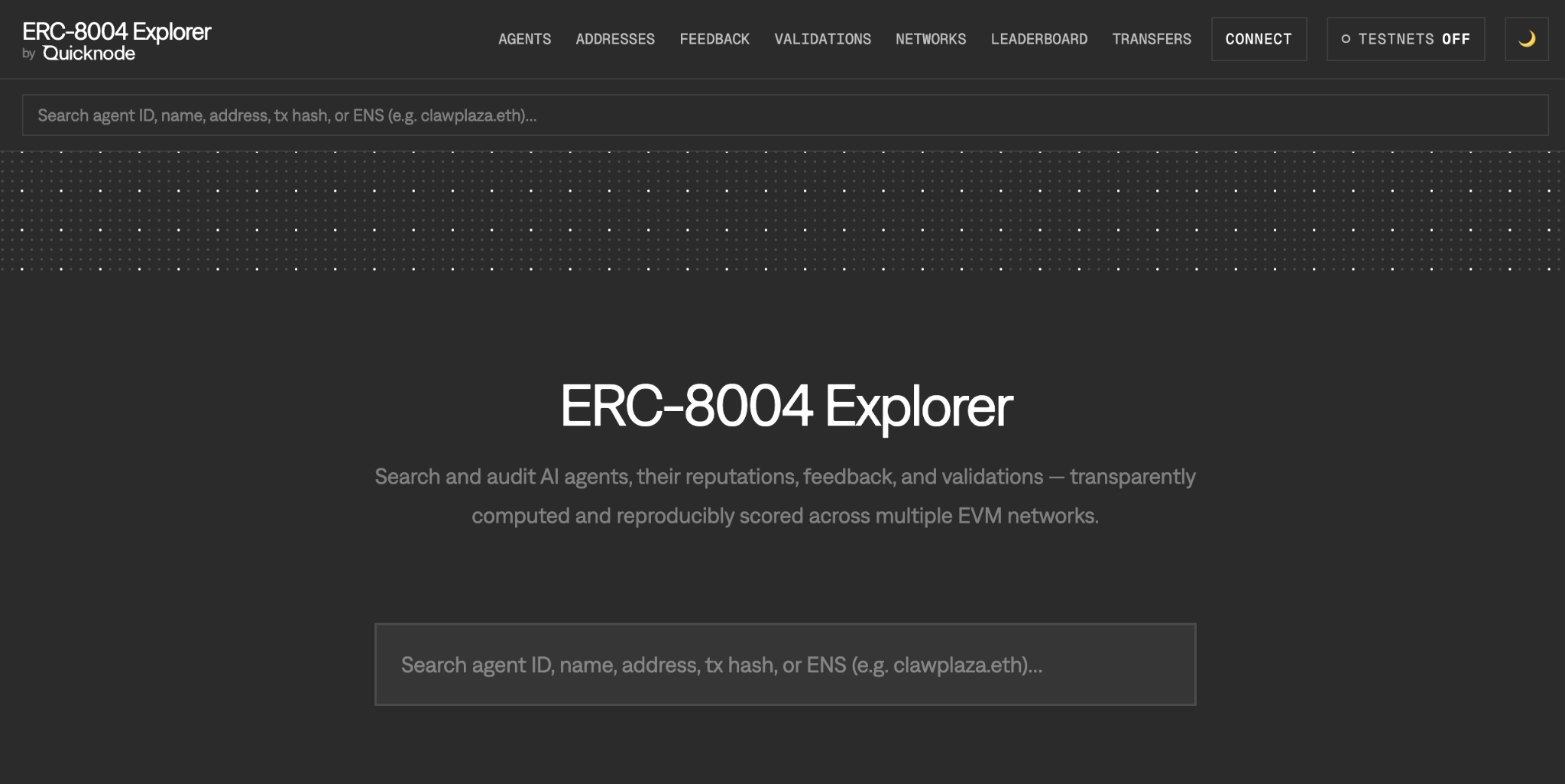
Identity establishes who an agent is and how to discover other AI agents. The next question becomes economic: how can AI agents transact with each other?
How AI Agents Pay Autonomously
Autonomous payments let AI agents purchase APIs, data, compute, and other services without relying on a human.
現在、この機能を実現しているプロトコルは2つあります。x402 とMPPです。
x402: リクエストごとの課金
x402 lets an agent pay for an HTTP resource as part of the request itself.
When the agent requests a paid resource, the server returns 402 Payment Required with the price, network, token, and payment instructions.
The agent signs the payment, retries the request with the authorization attached, and receives the resource once payment is verified. A facilitator can handle verification and onchain settlement for the server.
おまけ: x402 を使ってコンテンツのペイウォールを構築する方法に関する YouTube チュートリアル。
これは、API呼び出し、データクエリ、またはコンピュートジョブといった個別の購入に適しています。
MPP:継続的な利用料
Machine Payments Protocol (MPP) lets agents establish paid sessions for services that involve repeated or ongoing interactions.
すべてのリクエストを個別の購入として扱うのではなく、支払いとアクセス権限をより長いセッションにわたって維持することができます。
これは、リクエストごとに新たな支払いの交渉を繰り返す必要がない、永続的なインフラや長時間実行されるワークロードなどのサービスに適しています。
Bonus: Learn how to use MPP to access blockchain data via Quicknode.
この区別は実用的なものです。x402 はリクエストごとに価格を設定するのに対し、MPPはリクエストをまたいで継続する関係性に対して価格を設定することができます。
Quicknode x402 とMPPの両方を有効にします
Quicknode これにより、両方の課金モデルを自社のインフラ上で利用可能にする。
x402 accessを利用すると、ウォレットはアカウントや API キーを作成することなく、Quicknode のエンドポイントを利用できます。JSON-RPC、REST、gRPC-Web、WebSocket に対応しており、リクエストごとの課金、ナノペイメント、およびプリペイドクレジットの引き出しといったモデルが利用可能です。
MPP access supports both one-off charges and reusable payment sessions; sessions open a payment channel once, then use signed vouchers for subsequent requests before final onchain settlement.
両プロトコルは、1つの無料枠(ウォレットあたり月間100万APIクレジット)を共有しており、支払いがどのネットワークで決済されるかに関係なく、Quicknode がサポートするどのチェーンに対してもクエリを実行できます。
Now, an AI agent has decided what to do and has the economic ability to do it. How does that decision become an onchain transaction?
How AI Agents Execute Onchain Actions
Onchain execution turns an agent's decision into a blockchain transaction.
An agent might decide to transfer USDC, execute a swap, claim a position, or call a smart contract.
This decision is taken at the reasoning layer. But transaction execution infrastructure handles how that action reaches the blockchain.
意思決定から取引まで
Execution starts by translating an agent's intent into a valid transaction. That means identifying the contract and method, preparing parameters, estimating fees, and constructing the transaction in the format expected by the target chain.
署名こそが重要な境界です。署名されると、そのトランザクションは Quicknode Core RPCを通じてブロードキャストされるようになります。
実行前のアセットの準備
Agents will not always hold the asset required for the next action.
A payment may require USDC while the wallet holds ETH. A protocol interaction may require another token entirely. Quicknode's Swap API provides a programmatic way to fetch routes and prepare swaps without requiring the agent to integrate with individual DEXs.
これにより、アセットルーティングはワークフロー内のもう1つの呼び出し可能な機能となります:
残高を確認 > スワップルートを取得 > スワップを実行 > 残高を確認 > タスクを続行
At this point, the agent can access the blockchain state, establish an identity, pay for resources, and execute transactions.
The remaining challenge is operational: keeping those capabilities available, reliable, and constrained while the agent runs without constant human supervision.
Managing AI Agent Infrastructure in Production
Production AI agents need infrastructure that stays available, reacts to changing workloads, discovers and interacts with the right tools, and monitors and limits access.
Earlier layers give an agent capabilities.
本番環境レイヤーは、インフラストラクチャの変更のたびに手作業を必要とすることなく、これらの機能が継続的に実行できるかどうかを決定します。
Letting Agents Manage Their Own Infrastructure
Quicknode's Admin API exposes infrastructure management programmatically. This creates a path for approved agent workflows to provision and manage resources through APIs.
自然言語によるインフラ管理
Quicknode also enables access to the same infrastructure through an MCP server so that an agent, or the developer working alongside one, can create an endpoint, check usage, or update a rate limit by asking for it in plain language instead of writing API calls by hand.
Agent-facing resources such as Blockchain Skills and llms.txt complement this layer by making documentation and blockchain knowledge easier for agents to consume.
Constraining What an Agent Can Do
Production autonomy should have explicit boundaries. An agent only needs access to the networks, methods, resources, and credentials required for its task.
Quicknode JWT認証、IP許可リスト、メソッドごとのレート制限、ロールベースのアクセス制御(RBAC)などの制御機能を提供します。
This creates bounded autonomy: enough authority for an agent to operate independently, without turning a compromised prompt or incorrect decision into unrestricted infrastructure or asset access.
With that, the stack closes its loop. Intelligence determines what should happen; the surrounding infrastructure determines what an agent can observe, pay for, execute, and operate safely over time.
AI Agents May Be Blockchain's Most Natural Users
For more than a decade, blockchain applications have largely been designed around humans. Today, when we zoom out and look at portable identity, programmable money, and execution without intermediaries, we realize agents are the first class of economic actors blockchain's original design assumptions were built for.
「トラストレス」というのは、2つのソフトウェアの間には法的救済手段が存在しないためである。
プログラム可能である。なぜなら、利用規約を読んでいるのは人間ではないからだ。
許可不要。というのも、申請を承認する担当者がいないからだ。
Knowing this, we look optimistically toward a future where the primary user of blockchain is AI agents.
FAQ:よくある質問
1. Does every AI agent need blockchain infrastructure?
No. Blockchain becomes useful when agents need onchain state, programmable assets, payments, portable identity, or execution across independent systems.
2. What can AI agents actually do onchain?
Agents can monitor blockchain activity, query contracts, manage assets, make payments, execute transactions, and trigger workflows based on onchain events.
3. Can an AI agent lose money it controls?
Yes. A wallet an agent controls has no fraud protection, no chargebacks, and no bank to call if something goes wrong.
4. What is the difference between an onchain AI agent and a trading bot?
Trading bots automate predefined market strategies. AI agents can reason, select tools, adapt workflows, and perform broader onchain tasks.
5. Can existing AI agents be made onchain?
Yes. Existing agents can add blockchain capabilities through RPC APIs, wallets, payment protocols, identity standards, and transaction tools.
6. Can two AI agents transact without any humans involved?
はい。発見、支払い、実行の全プロセスを、各ステップごとに人が承認することなく行うことができます。
7. How is an onchain identity different from an OAuth token?
An OAuth token is issued and revoked by one platform. Onchain identity is self-owned and portable across any of them.
Quicknodeについて
2017年に設立されたQuicknode は、開発者 および企業向けに、機関投資家レベルのブロックチェーン インフラストラクチャを提供しています。99.99%の稼働率と75以上のチェーンに対応したサポート を備え、チーム は妥協のないオンチェーン アプリケーションの構築とスケーリングを実現します。
最新情報を入手する
最新のエンジニアリングに関する知見、製品の最新情報、Web3のニュースを、メールボックスに直接お届けします。