The Simplified Web3 Tech Stack
The Simplified Web3 Tech Stack
We break down the web3 tech stack, including the protocol layer, infrastructure layer, development layer, and application layer for building trustless and permissionless decentralized applications on blockchain architectures

March 2, 2023 — 6 min read
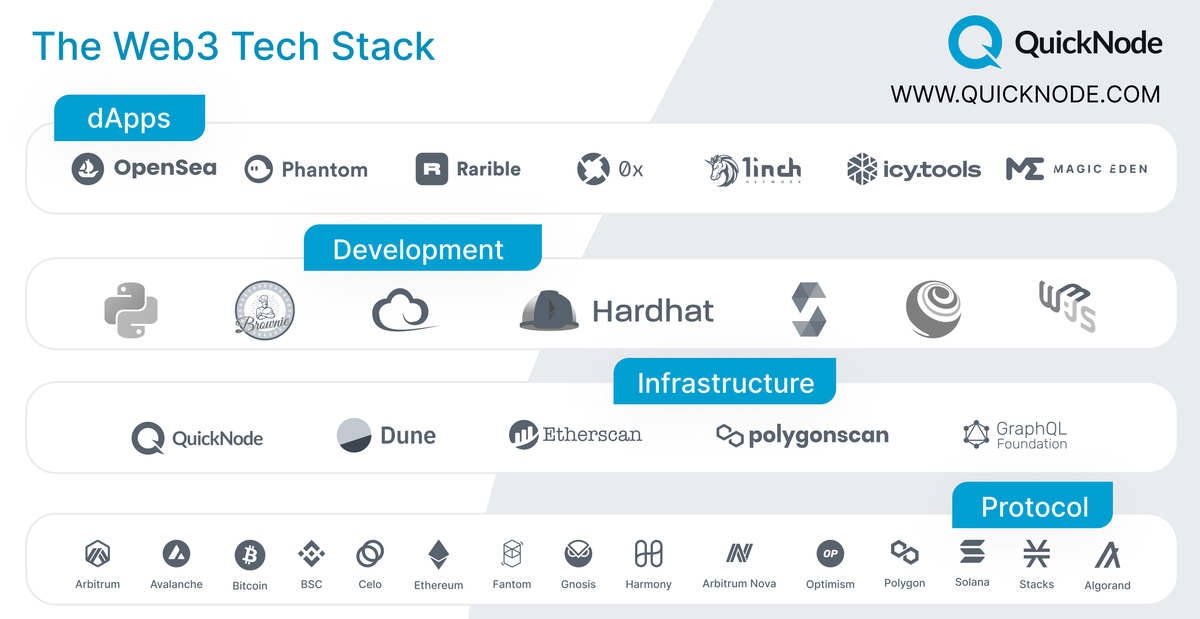
A "tech stack" can mean many things, especially in the web3 space.
In this article, we'll break down the web3 tech stack as simply as possible. We'll be focusing on the protocol, infrastructure, development, and application layers that make web3 possible. Blockchain technology plays a crucial role in the web3 ecosystem, providing a decentralized and immutable ledger for secure data storage and transactional capabilities. Web3 development typically involves the use of smart contracts, decentralized applications (dApps), and tokenization to facilitate trustless interactions and create new business models.
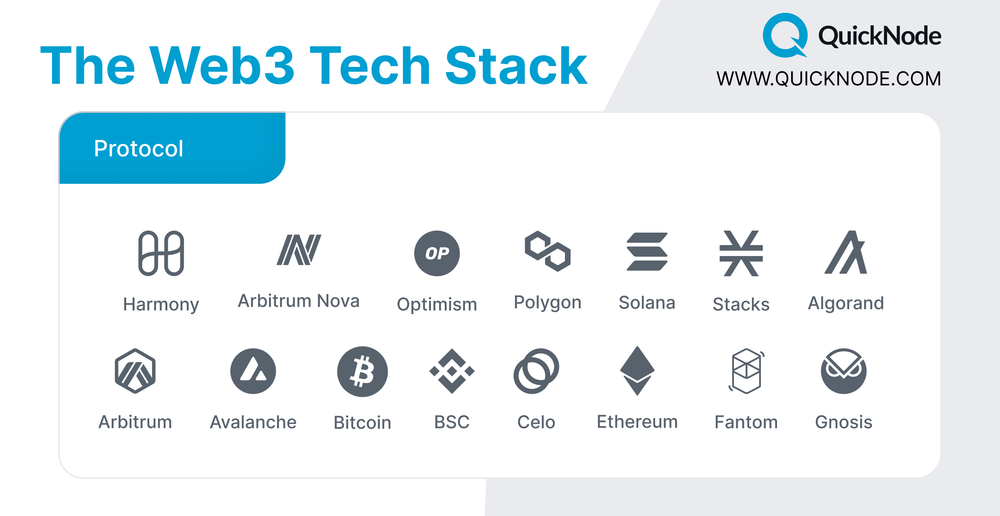
The Protocol Layer
The protocol layer is precisely what you'd expect: everything relating to blockchain protocols.
The most important of these protocols are layer-1 (L1) blockchains. When you think of crypto, odds are you think of an L1 blockchain. Household names like Bitcoin, Ethereum, Solana, Avalanche, and Cosmos are all examples of L1 blockchains.
In addition to the L1 blockchains, the protocol layer also consists of the various scaling solutions that exist to help alleviate the congestion on L1s during busy periods. These scaling solutions come in many forms:
As a layer-2 rollup such as Arbitrum, Optimism, zkSync, or Loopring.
As a sidechain such as Polygon.
Or as an AppChain, as seen in Cosmos, Avalanche, and Polkadot.
The protocol layer also consists of the technology that enables blockchain protocols to function. Thus, the consensus algorithms, such as proof-of-work and proof-of-stake, that ensure the blockchain's safety and the virtual machines, such as the EVM, that run the actual code are both parts of the protocol layer.
Finally, in the multi-chain world we live in, the tools that connect blockchains are both pieces of critical infrastructure and part of the protocol layer. This means that bridges such as Synapse and Hop and cross-chain communication tools like the IBC, LayerZero, and the CCIP call the protocol layer home.
Quicknode currently supports over 17 chains, making it the preferred blockchain development platform for multi-chain scaling solutions.
The Infrastructure Layer
The Infrastructure layer is how users and dApps interact with the blockchain. It's also where Quicknode shines as the leading blockchain infrastructure provider!
Just like how the bottom floor of a building serves as its foundation, the infrastructure layer serves as the foundation on which all of web3 is built.
For the infrastructure layer, think of obvious but crucial and overlooked tools: the internet, computer hardware, web hosting, domain names, storage, etc.
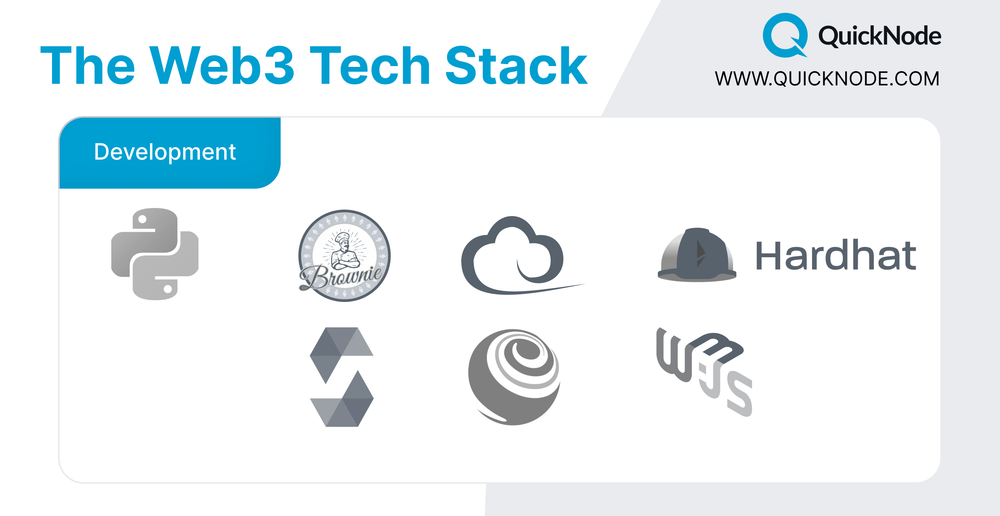
The Development Layer
In the development layer, web3 libraries and developer environments leverage blockchain technology to build and deploy decentralized applications. Web3 developers use a variety of tools and frameworks, including Web3.js, JavaScript, Ethers.js, Hardhat, Truffle, and Brownie — to name a few.
Web3.js is a JavaScript library that provides a set of APIs for interacting with the Ethereum blockchain. It allows developers to write code that can be executed on the blockchain, including smart contracts, decentralized applications, and other web3-related tools.
Ethers.js is another JavaScript library that provides a more advanced set of APIs for interacting with Ethereum and other web3-compatible blockchains. It offers a more comprehensive set of tools for developers, including support for transaction signing, contract deployment, and event handling.
Hardhat is a JavaScript-based development environment that allows developers to compile, test, deploy, and debug Ethereum software. It comes with a flexible plugin system that allows developers to customize their local blockchain development environments and includes a robust documentation set for troubleshooting and debugging.
Truffle is another suite of JavaScript-based developer tools that includes Truffle, Ganache, and Drizzle. Truffle provides a development environment, testing framework, and deployment pipeline for EVM-compatible blockchains. Ganache allows developers to quickly create a local blockchain, while Drizzle provides a set of frontend libraries to connect frontend components with smart contracts.
Brownie is an alternative to Hardhat and Truffle that is based on the Python programming language. It offers a full suite of web3 developer tools built off of the web3.py package for compiling, testing, and deploying dApps.
The development layer of the web3 technology stack is essential for building trustless and permissionless web3 applications on top of blockchain architectures. With tools like Web3.js, Ethers.js, Hardhat, Truffle, and Brownie, developers can easily write and deploy code that can interact with the blockchain and other web3-compatible networks.
📢 Check out our thorough guide if you want to take a deeper dive into the web3 developer tech stack.
We also have a great Youtube video guide from the Quicknode team:
The Application Layer (dApps)
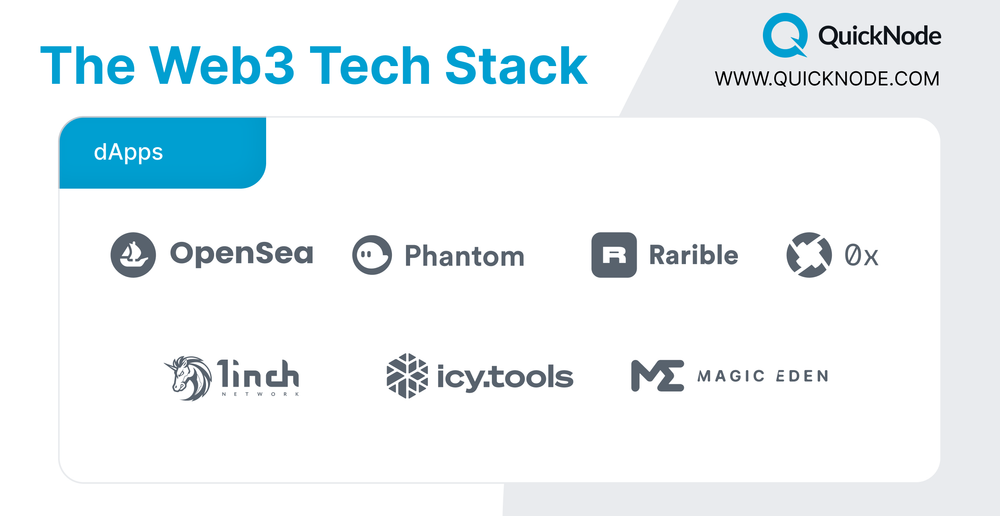
The dApp layer provides the crucial web3 component of decentralized applications (dApps) in the form of Web3 applications. By leveraging blockchain technology, dApps provide users with enhanced security, ownership of digital assets, and new economic models.
The top L1s like Ethereum and Solana are more well-known, but dApps are where users spend most of their time.
At this point, there are dApps built for anything you can think of:
dApps for swapping tokens like Uniswap, Curve, and Pancakeswap.
dApps for borrowing and lending, such as Compound and Aave.
dApps for liquid staking, such as Lido and Rocket Pool.
dApps for NFTs, such as OpenSea, Sudoswap, and JPEG'd.
dApps for leverage trading, such as dYdX and GMX.
dApps for stablecoins, such as MakerDAO and Liquity.
dApps for options, such as Dopex and Ribbon.
dApps for building DAOs, such as Syndicate and Clarity.
dApps for gaming, such as Decentraland and Axie Infinity…
And on and on it goes. If you don't believe me, just take a scroll through DeFi Llama. The amount of innovation in the space is astounding, and the best part is that it's constantly increasing. The potential for Web3 applications to revolutionize various industries is immense, and we can expect more groundbreaking innovations in the future.
The Stack (For Now)
Web3 is constantly changing.
Just because the web3 tech stack currently consists of protocol, infrastructure, development, and application layers doesn't mean it will always be so.
Web3 is evolving so rapidly that it is likely that the stack will change considerably over the coming years. For example, a dozen years ago, web3 was still solely known as crypto and had little to offer besides Bitcoin. Today, Bitcoin is the last thing on the mind of many web3 participants.
Nobody knows where we will be a week, a month, a year, or a decade from now. The only thing for sure is that we will be here building, and we can't wait to see where it goes!
지금 바로 시작하세요
Quicknode로 개발을 시작해 보세요Quicknode 소개
2017년에 설립된 Quicknode 개발자와 기업을 위해 기관급 블록체인 인프라를 Quicknode . 99.99%의 가동률과 80개 이상의 체인을 지원함으로써, 팀들은 타협 없이 온체인 애플리케이션을 구축하고 확장할 수 있습니다.
최신 소식을 받아보세요
최신 엔지니어링 인사이트, 제품 업데이트, 웹3 뉴스를 여러분의 이메일로 바로 받아보세요.