How to Use Quicknode Yellowstone and Carbon to Decode and Process Solana Updates
How to Use Quicknode Yellowstone and Carbon to Decode and Process Solana Updates
Learn how to integrate Quicknode’s Yellowstone gRPC Geyser Add-on with Carbon to enhance Solana blockchain data indexing.

April 15, 2025 — 3 min read
Developers working with blockchain data understand the importance of timely and reliable access to on-chain updates. Carbon is a lightweight indexing framework for Solana, offering a modular pipeline to source data, decode program-specific account updates using instruction decoders, and process them into complete indexing solutions. A practical example provided by Carbon is its Raydium example, which facilitates tracking key transactions on Raydium, a leading decentralized exchange (DEX) on Solana.
This post explains how to integrate Quicknode’s Yellowstone gRPC Geyser Add-on with Carbon to decode and handle Solana blockchain updates, delivering enhanced performance, lower latency, and increased reliability.
Understanding Carbon’s Raydium Framework
Carbon’s Raydium example enables developers to rapidly establish notification frameworks based on transaction events—such as large token swaps or liquidity pool changes occurring on Raydium. This capability is crucial for traders, analytics platforms, and developers building decentralized finance (DeFi) applications on Solana, as it ensures immediate visibility into critical blockchain events.
Quicknode Yellowstone gRPC Geyser Add-on
Quicknode’s Yellowstone gRPC Geyser Add-on provides developers with a high-performance method for receiving real-time Solana blockchain updates. A dedicated node is not required; the add-on can easily be included in a pay-as-you-go plan. For applications demanding even higher performance, developers can opt for a dedicated node. Using gRPC technology guarantees low latency and scalability, making it an ideal backend solution for real-time blockchain applications such as Carbon.
Boosting Carbon’s Performance with Yellowstone gRPC
Carbon’s ability to decode and process blockchain updates relies heavily on the speed and reliability of data ingestion. Integrating Yellowstone gRPC with Carbon delivers immediate benefits:
Faster Updates: Efficient data streaming via Yellowstone gRPC significantly reduces latency between blockchain events and their decoding.
Enhanced Reliability: Quicknode’s managed infrastructure ensures high availability and consistent delivery of updates.
Reduced Operational Complexity: Utilizing Quicknode’s managed solutions removes the complexity associated with maintaining infrastructure, allowing developers to focus solely on development.
Step-by-Step Integration Guide
Integrating Quicknode Yellowstone gRPC into Carbon’s Raydium framework involves these straightforward steps:
Step 1: Provision Yellowstone gRPC
Navigate to Quicknode Marketplace and provision your Yellowstone gRPC endpoint.
Step 2: Clone the Repository
Clone the Carbon repository and navigate to the Raydium example:
git clone git@github.com:sevenlabs-hq/carbon.git
cd examples/raydium-alerts
Step 3: Set Environment Variables
Create a .env file in your project root and set the following environment variables:
GEYSER_URL=...
X_TOKEN=...
GEYSER_URL should point to your Quicknode Yellowstone Geyser RPC URL.
X_TOKEN is your Geyser authentication token provided in the quicknode console.
Step 4: Build the Project
Compile the project using:
cargo build --release
Step 5: Run the Pipeline
Execute the pipeline with:
cargo run --release
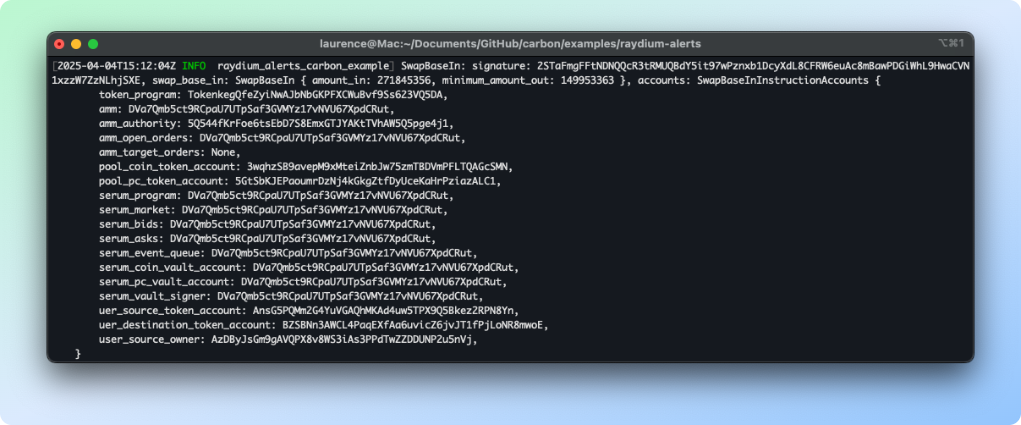
This command starts the Geyser client, and the pipeline will begin processing transactions for the specified program ID (RAYDIUM_AMM_V4_PROGRAM_ID).
Fazit
Integrating Quicknode Yellowstone gRPC with Carbon provides significant performance enhancements for developers working with Solana blockchain updates. This combination delivers speed, reliability, and simplicity, allowing you to efficiently build and scale your blockchain applications.
Ready to enhance your Solana applications? Visit Quicknode’s Yellowstone gRPC on the Marketplace and elevate your Carbon-powered frameworks today.
Jetzt mit dem Bauen beginnen
Beginnen Sie mit Quicknode zu entwickelnÜber Quicknode
Quicknode wurde 2017 gegründet und Quicknode Entwicklern und Unternehmen eine Blockchain-Infrastruktur auf institutionellem Niveau Quicknode . Dank einer Verfügbarkeit von 99,99 % und der Unterstützung von mehr als 80 Blockchains können Teams On-Chain-Anwendungen ohne Kompromisse entwickeln und skalieren.
Bleiben Sie auf dem Laufenden
Die neuesten Erkenntnisse aus der Technik, Produkt-Updates und Neuigkeiten aus der Web3-Welt – direkt in Ihren Posteingang.