Fuel: the modular execution layer for the Ethereum Ecosystem
Fuel: the modular execution layer for the Ethereum Ecosystem
Build game-changing apps on Fuel with Quicknode. Harness Fuel's lightning-fast, secure, and scalable technology to turn your ideas into reality.

October 16, 2024 — 6 min read
The demand for faster, more efficient blockchain solutions is growing as dApps become increasingly mainstream. Existing platforms often need help with high transaction fees and slow processing times, hindering user experience and widespread adoption. There's a clear need for innovative technologies that can overcome these limitations and pave the way for scalable, user-friendly blockchain applications.
Fuel emerges as a robust modular execution layer designed to enhance the Ethereum ecosystem. By leveraging advanced technologies like optimistic rollups and a unique transaction model, Fuel dramatically boosts transaction throughput while reducing gas costs. This makes blockchain interactions more accessible and efficient for users and developers alike.
Now, let's dive deeper into what Fuel brings to the table.
What is Fuel?
Fuel is a next-generation blockchain platform designed from scratch to enhance the scalability and performance of dApps within the Ethereum ecosystem. By introducing a modular execution layer and leveraging advanced technologies like optimistic rollups, Fuel aims to significantly increase transaction throughput and reduce gas fees without compromising security or decentralization. Its innovative approach addresses the limitations of current blockchain architectures, making it a pivotal development for the future of scalable blockchain solutions.
Some features of Fuel:
Modular Execution Layer Architecture
Fuel introduces a modular execution layer that separates the execution of transactions from data availability and consensus. This architectural innovation allows each blockchain component to be optimized independently, significantly improving overall system performance. By decoupling these layers, Fuel enables scalability, flexibility, and interoperability. Scalability is achieved through specialized optimization of the execution layer, allowing Fuel to handle more transactions than monolithic blockchains. Flexibility is afforded to developers who can customize and upgrade individual modules without affecting the entire system, fostering innovation and adaptability. Interoperability is enhanced by the modular design, which facilitates more straightforward integration with other blockchains and layer-2 solutions, thus improving the interconnectedness of the blockchain ecosystem.
Tecnología «Optimistic Rollup»
Fuel leverages optimistic rollups to increase transaction throughput and reduce gas costs. Optimistic rollups work by processing transactions off-chain and submitting them to the main Ethereum chain in batches. This approach offers several benefits, including efficiency, cost-effectiveness, and security. Efficiency is gained as off-chain transaction processing reduces the computational load on the main chain, leading to faster confirmation times. Cost-effectiveness comes from batching transactions, which minimizes gas fees and makes micro-transactions and complex smart contract interactions more economically viable. Security is maintained because, while transactions are processed off-chain, the optimistic rollup mechanism ensures that fraudulent transactions can be identified and challenged, maintaining the integrity of the blockchain.
GraphQL-Based Interaction Model
Fuel uses GraphQL as its primary interface for blockchain interactions, moving away from the traditional JSON-RPC or REST APIs commonly used by other platforms like Ethereum. This modern approach offers significant benefits in terms of developer experience and network efficiency. GraphQL allows developers to make precise and efficient queries, fetching exactly the data they need in a single request. This reduces unnecessary data transfer and optimizes network performance, aligning with Fuel's commitment to enhancing scalability and speed.
UTXO-Based Transaction Model
Unlike Ethereum's account-based model, Fuel employs a UTXO (Unspent Transaction Output) model, similar to that of Bitcoin. This model offers distinct advantages like parallel processing, enhanced security, and simplified state management. Parallel processing is possible because the UTXO model allows transactions to be processed simultaneously, significantly increasing throughput and performance. Enhanced security is achieved through the deterministic nature of UTXO transactions, which reduces the risk of certain types of attacks and errors in smart contract execution. Simplified state management is realized by managing unspent outputs, simplifying the tracking of funds, and reducing the complexity associated with account balances.
Innovative Development Tools: Sway Language and FuelVM
Fuel introduces its own virtual machine, FuelVM, and a domain-specific language called Sway for smart contract development. FuelVM is designed for high performance, executing transactions more efficiently than the traditional Ethereum Virtual Machine (EVM), thus optimizing resource usage and execution speed. Sway is a Rust-based programming language offering modern features, strong typing, and improved safety guarantees. It simplifies the development process and reduces the likelihood of vulnerabilities in smart contracts. With comprehensive tooling and documentation, Fuel provides a developer-friendly environment for building, testing, and deploying scalable decentralized applications with ease.
Why Quicknode for Fuel Development?
Anyone can build on Fuel by signing up for a Quicknode account and creating a Fuel GraphQL endpoint. The following are the benefits of using Quicknode for Fuel development:
Dedicated Endpoints: Public endpoints are great for getting started, but since they are free and available to everyone, they are rate-limited to avoid abuse from a single user. With Quicknode, you can create a dedicated endpoint to interact with Fuel nodes. So, you don't hit those rate limits on the public endpoints.
Nivel gratuito: Cualquiera puede empezar con un plan gratuito para siempre.
Velocidad y estabilidad: gracias a la sólida infraestructura Quicknode, no tendrás que preocuparte por las latencias elevadas ni por la estabilidad de los nodos. Comprueba por ti mismo cómo stacks el rendimiento Quicknode con el
Scalability & Reliability: With nodes in 14+ regions and load-balancing solutions under the hood, Quicknode scales with your dApp traffic.
Wide suite of Web3 tools: Along with blockchain read and write via GraphQL, users can also use Streams to set up robust blockchain data delivery systems without having to set up their own ETL pipelines. With Clusters, go beyond normal endpoints and get an entire dedicated cluster of Fuel nodes, which is truly unmetered, isolated for your use, and scalable. With Functions, create your blockchain serverless functions in the cloud without hosting it on your infrastructure.
Recursos para desarrolladores: Easing the development process with products and education. With robust products, Quicknode offers high-quality developer resources in
Create A Fuel Endpoint on Quicknode
Paso 1: Regístrate para crear una Quicknode (si aún no tienes una)
Paso 2: Una vez verificado el correo electrónico, haz clic en «Crear endpoint»

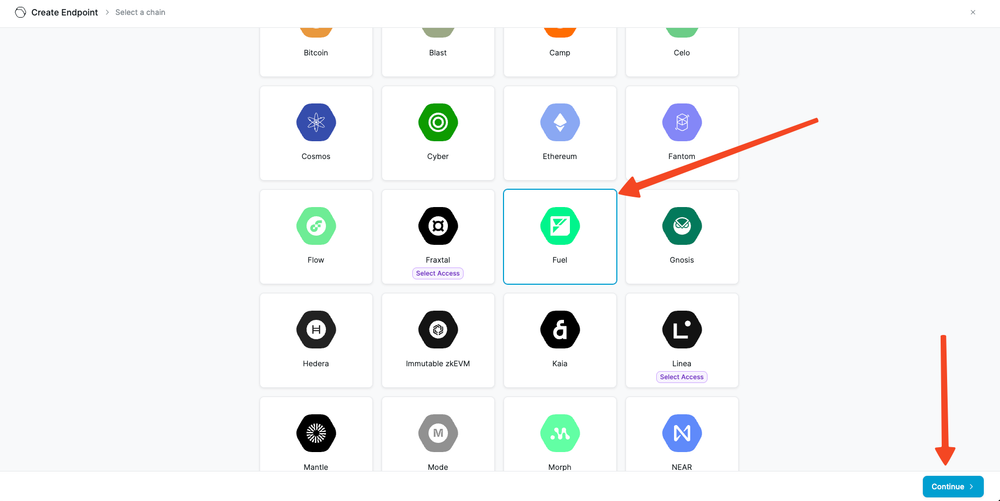
Step 3: Select the Fuel chain and click `Continue`
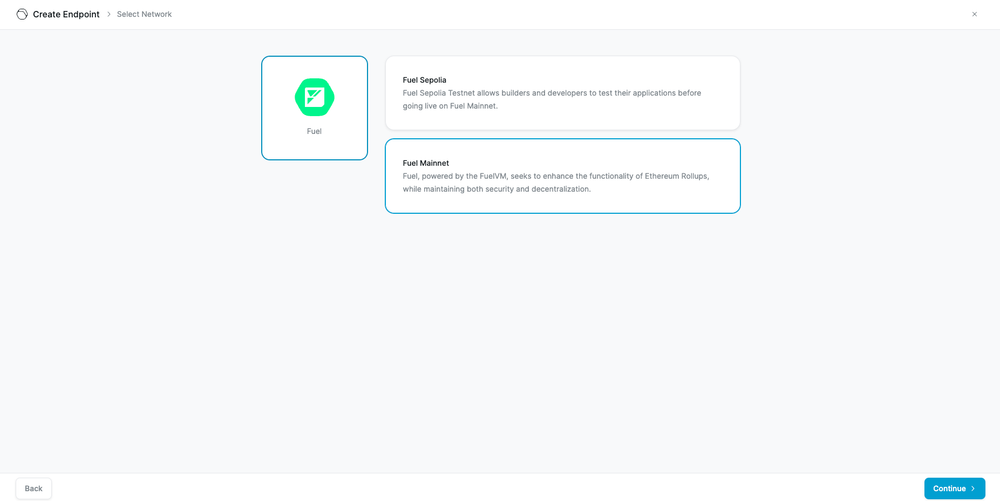
Step 4: Select the network and click `Continue`
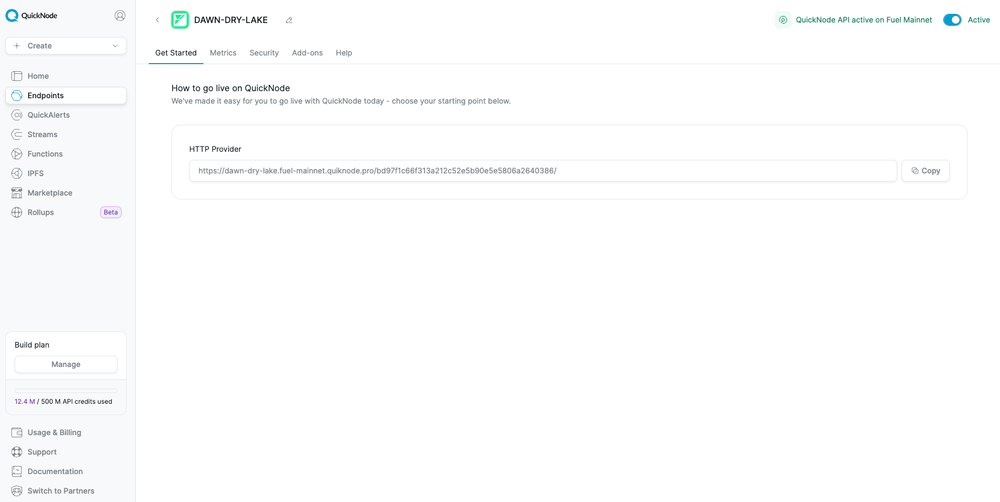
Once your Fuel endpoint is ready, it will look like this. You can interact with the Fuel chain using an HTTPS endpoint.
Recursos
¿Por qué Quicknode?
Quicknode la infraestructura de blockchain, lo que permite a los desarrolladores centrarse en las dApps (aplicaciones descentralizadas) que están creando, en lugar de en todo lo que conlleva el funcionamiento de dicha infraestructura, como DevOps/NodeOps, el tiempo de actividad, el escalado, la seguridad y las herramientas.
Al eliminar las complicaciones que supone el mantenimiento y la sincronización de los nodos y ofrecer una plataforma integral de extremo a extremo, ahorramos a los desarrolladores un tiempo muy valioso, agilizamos la comercialización de dApps de alta calidad y ayudamos a las empresas a escalar y poner en práctica sus estrategias de Web3.
Quicknode una herramienta indispensable en el arsenal de cualquier desarrollador de Web3, creada por desarrolladores para desarrolladores y probada en la práctica por proyectos líderes del sector.
En la actualidad, la Quicknode procesa más de 200 000 millones de solicitudes al mes en más de 40 redes repartidas por más de 14 regiones de todo el mundo.
Visit Quicknode.com for more information.
Empieza a crear ahora mismo
Empieza a desarrollar con QuicknodeAcerca de Quicknode
Fundada en 2017, Quicknode una infraestructura de blockchain de nivel institucional para desarrolladores y empresas. Con un tiempo de actividad del 99,99 % y compatibilidad con más de 80 cadenas, los equipos pueden crear y ampliar aplicaciones en cadena sin renunciar a nada.
Mantente al día
Las últimas novedades sobre ingeniería, actualizaciones de productos y noticias sobre la Web3, directamente en tu bandeja de entrada.