Explorateur Ethereum
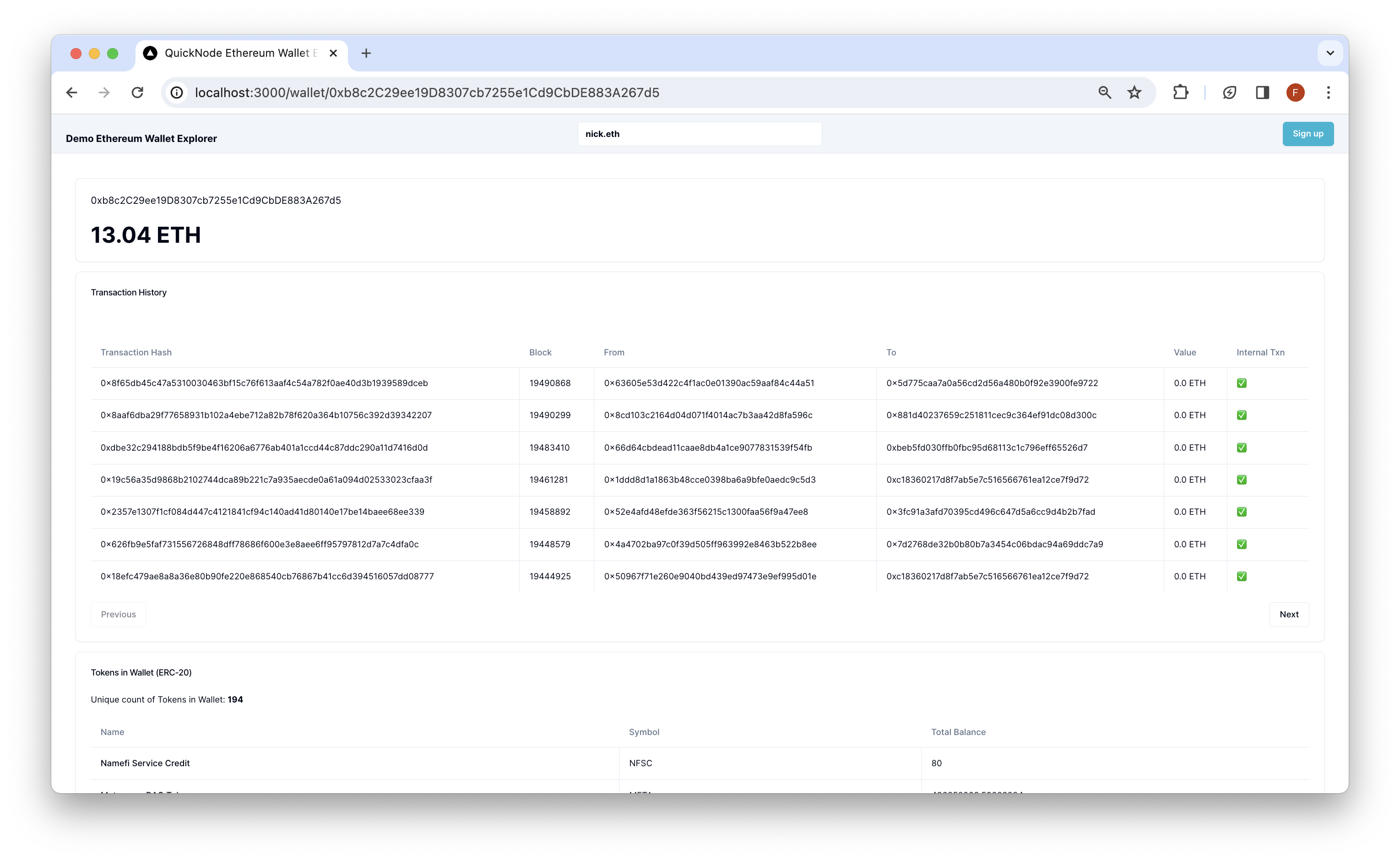
The Ethereum Wallet Explorer uses Quicknode's Ethereum endpoint and APIs to query the blockchain for tokens, transactions, and NFTs associated with a given wallet.



Présentation générale
The Ethereum Wallet Explorer demonstrates how to use your Quicknode Ethereum endpoint, the Blockbook product, and an endpoint add-on to query tokens, transactions, and NFTs associated with a given wallet.
To run this demo with full functionality, you need the free Token and NFT API v2 bundle endpoint add-on and access to the API Blockbook.
The demo uses Next.js 14 projet lancé grâce à create-next-app.
Pour commencer
Installer les dépendances
Commencez par installer les dépendances :
npm installer
# ou
yarn
# ou
pnpm installer
# ou
bun install
Définir les variables d'environnement
Renommer .env.example à .env.local and update with your Quicknode Ethereum Node Endpoint.
ETHEREUM_RPC_URL=https://example.ethereum-mainnet.quiknode.pro/123456/
Commencez par lancer le serveur de développement :
npm exécuter dev
# ou
yarn dev
# ou
pnpm dev
# ou
bun dev
Ouvrez http://localhost:3000 dans votre navigateur pour voir le résultat.
Utilisation de la Dapp
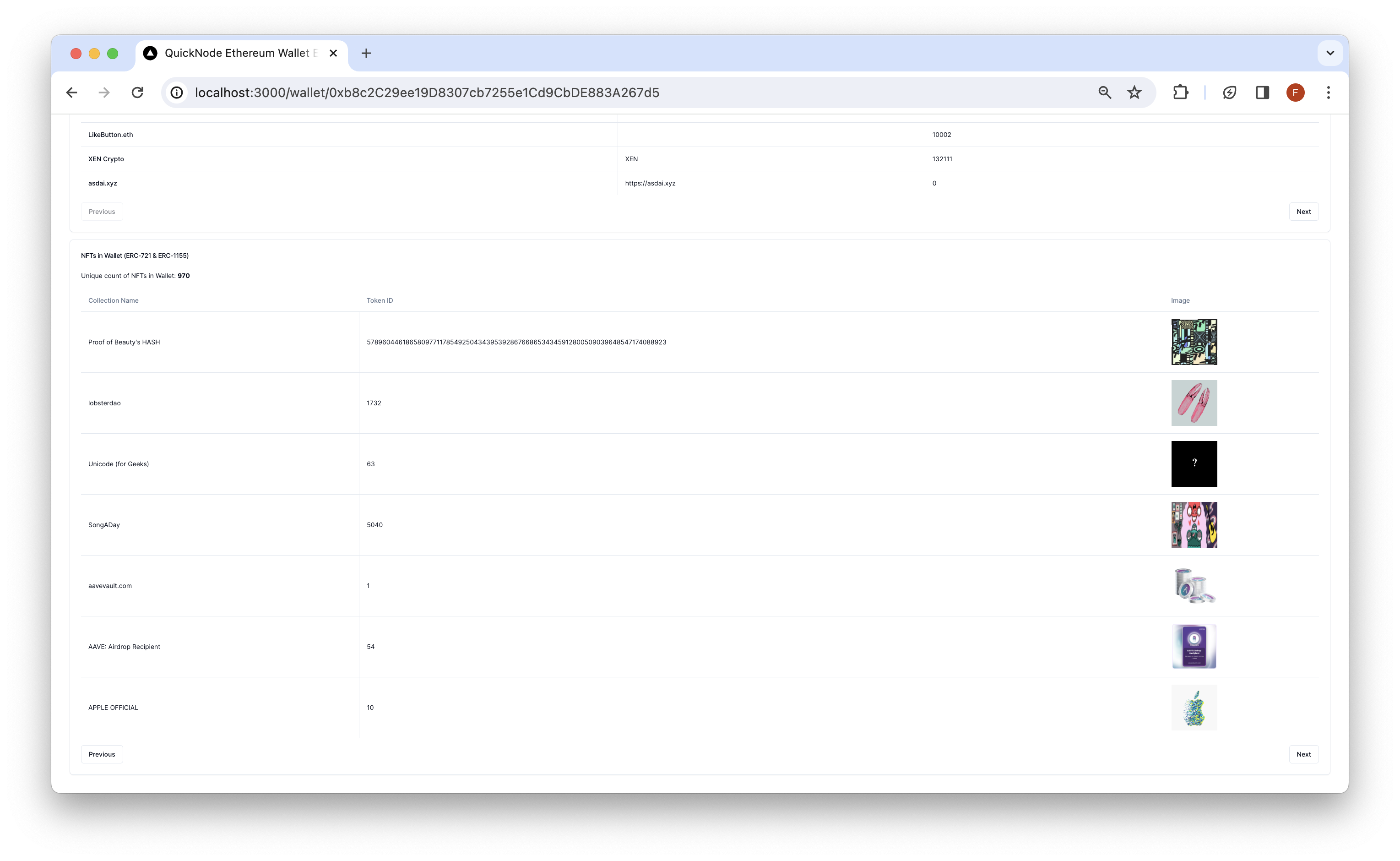
Search for an Ethereum wallet address and press enter. The Dapp will redirect to /wallet/[adresse] and query the Ethereum blockchain for the wallet's token balances, transactions, and NFTs. Results are rendered in respective cards.
Architecture
src/
├── app/
│   └── api/
│       └── wallet/
├── components/
    ├── explorer/
    └── header/
-
API- Contains the API routes for the Ethereum RPC calls. These can be accessed from the client via/api/wallet/[méthode]?walletAddress=[adresse]. These GET requests use theEtherslibrary to interact with Ethereum and parse data, theToken and NFT API v2 bundleendpoint add-on to retrieve NFT and ERC-20 token information, and theAPI Blockbookto retrieve transaction history for any Ethereum address. -
composants- Contient les composants React destinés à la dapp.- Le
explorateurLe composant contient des éléments côté client qui appellent les routes de l'API et affichent les résultats. - Le
en-têteCe composant contient la barre de recherche de la dapp.
- Le
Déployer sur Vercel

Aperçu
Documentation Next.js
Pour en savoir plus sur Next.js, consultez les ressources suivantes :
- Documentation Next.js: découvrez les fonctionnalités et l'API de Next.js.
- Apprenez Next.js – un tutoriel interactif sur Next.js.
Vous pouvez consulter le dépôt GitHub de Next.js: vos commentaires et vos contributions sont les bienvenus !
- Créer une branche du dépôt
- Créer une branche de fonctionnalité :git checkout -b feature/amazing-feature
- Validez vos modifications :git commit -m "Ajout d'une fonctionnalité géniale"
- Publiez votre branche :git push origin feature/amazing-feature
- Créez une demande de fusion.