Portemonnee volgen
Monitor a list of wallet addresses on Solana and Ethereum easily with Quicknode Streams. Update the wallet list through a simple UI.



Overzicht
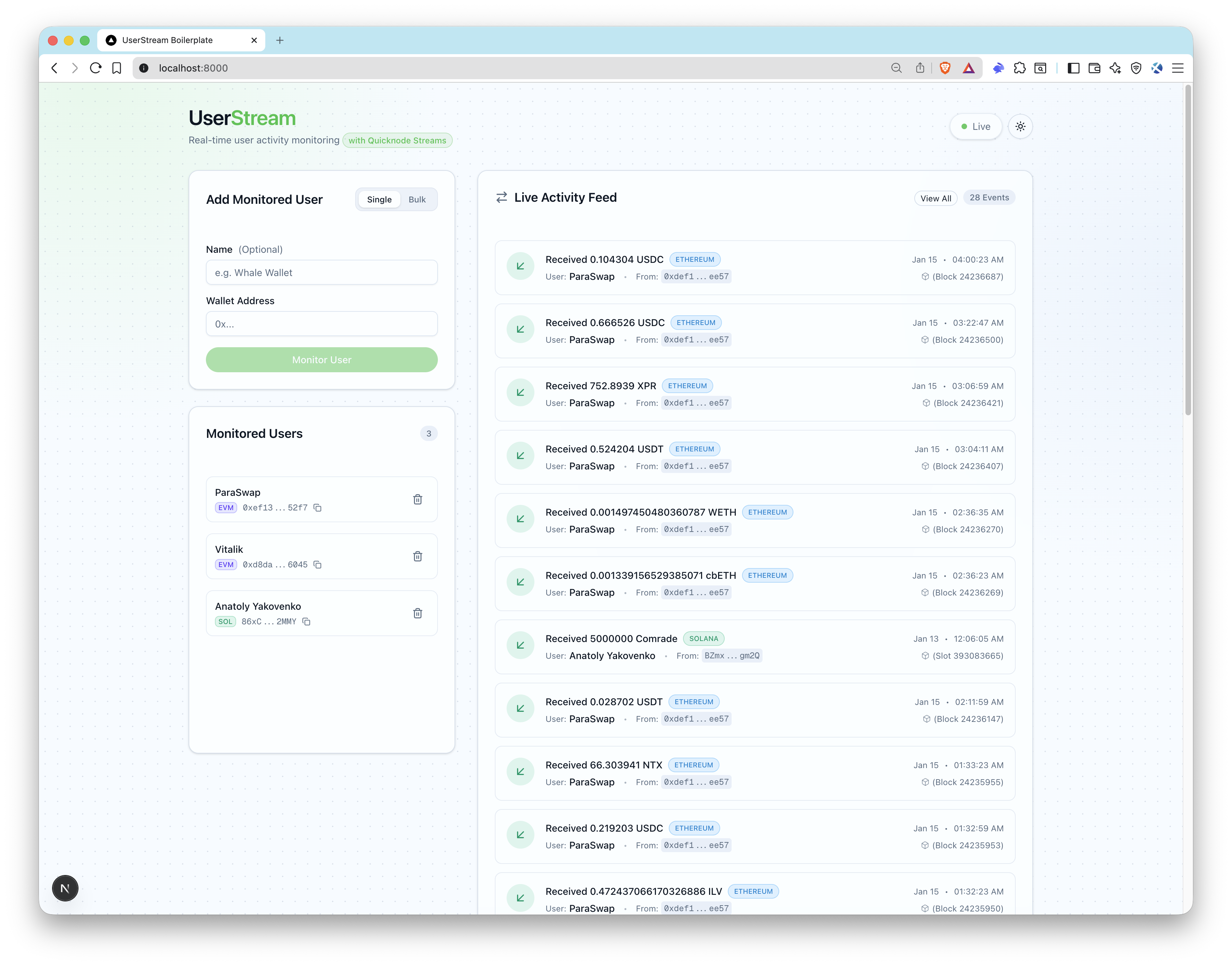
This sample app ships a live user activity feed that wires Quicknode Streams + Key-Value Store (KV Store) to monitor addresses, verify webhooks, store events in SQLite via Prisma, and push updates over SSE in real time (EVM + Solana).
Architectuur
Blockchain (EVM + Solana)
  -> Quicknode Streams + KV
    -> POST /api/webhook/streams (signature verified)
      -> DB insert + SSE emit
        -> UI live feed
Kenmerken
- Quicknode Streams (aanmaken + activeren)
- EVM filter for native transfers and ERC-20 Transfer logs
- Solana filter for native transfers and SPL token transfers
- Quicknode KV list backed user monitoring, enabling dynamic user monitoring without redeploying the stream
- Labeling monitored addresses
- Bulk add monitored addresses
- Verificatie van webhook-handtekeningen en controle van tijdstempels
- SSE live updates
- ENS resolution for EVM addresses
- Prisma + lokale opslag via SQLite
Vereisten
- Node.js 20+ en een pakketbeheerder (pnpm, yarn, npm).
- Quicknode and API key: Create an account, and get your Admin API voor
QN_API_KEY. - EVM endpoint for ENS/ERC-20 metadata: Create an Ethereum endpoint and copy the HTTPS URL for
QN_EVM_ENDPOINT. - Solana RPC endpoint for SPL token metadata: Create a Solana endpoint and copy the HTTPS URL for
QN_SOLANA_ENDPOINT. - Openbare webhook-URL: Gebruik een tunnel zoals
ngrokof de app zo implementeren datAPP_URLis bereikbaar via Quicknode.
Projectopbouw
filters/
  evm-filter.js           # Quicknode Streams filter (EVM)
  solana-filter.js        # Quicknode Streams filter (Solana)
scripts/
  setup-streams.ts        # Creates KV lists + stream (paused)
  activate-streams.ts     # Activates stream by id
src/
  app/api/                # API routes (webhooks, users, SSE)
  lib/                    # Quicknode, webhook, SSE helpers
  types/                  # Stream payload types
prisma/
  schema.prisma           # SQLite schema
Omgevingsvariabelen
Kopiëren .env.voorbeeld naar .env en vul het volgende in:
QN_API_KEY=""                  # Quicknode API key
QN_STREAM_SECURITY_TOKEN_EVM="" # EVM stream security token (from setup)
QN_STREAM_SECURITY_TOKEN_SOL="" # Solana stream security token (from setup)
QN_EVM_ENDPOINT=""             # Quicknode EVM endpoint URL
QN_SOLANA_ENDPOINT=""          # Solana RPC endpoint URL
DATABASE_URL="file:./dev.db"   # SQLite DB
APP_URL="http://localhost:3000" # Public app URL (ngrok for local webhooks)
Opmerkingen:
QN_STREAM_SECURITY_TOKEN_EVMenQN_STREAM_SECURITY_TOKEN_SOLare returned byconfiguratie:streamsper chain.APP_URLmoet bereikbaar zijn via Quicknode gebruik ngrok of een geïmplementeerde URL).
Aan de slag
1. Install dependencies
npm install
# pnpm install
# yarn install
2. Create your env file
cp .env.voorbeeld .env
3. Add required variables
Vul in .env (zie Vereisten).
Voor lokale webhooks maak je je app toegankelijk via ngrok en kopieer je de HTTPS-URL naar APP_URL:
ngrok http 3000
4. Create Quicknode Streams + KV lists
npm run setup:streams
# pnpm run setup:streams
# yarn setup:streams
Kopieer het afgedrukte beveiligingstoken naar .env (QN_STREAM_SECURITY_TOKEN_EVM of QN_STREAM_SECURITY_TOKEN_SOL).
If you want Solana, run the command again with chain=solana-mainnet (zie Quicknode Streams Setup for options).
5. Set up the database and start the app
npx prisma migrate dev --name init
# pnpm prisma migrate dev --name init
# yarn prisma migrate dev --name init
npm run dev
# pnpm dev
# yarn dev
6. Activate the stream
npm run activate:streams
# pnpm run activate:streams
# yarn activate:streams
Openen http://localhost:3000, add wallet addresses, and you should see live events as streams deliver webhooks.
Database
SQLite wordt standaard gebruikt. Het Prisma-schema bevindt zich in prisma/schema.prisma.
Veelgebruikte opdrachten:
pnpm prisma migrate dev --name init
pnpm prisma studio
Quicknode Streams Setup
Following the Getting Started section is enough. However, if you want to manage Streams settings or KV lists manually, follow these steps.
1. Check the filter
The EVM filter lives in filters/evm-filter.js. It emits:
nativeTransferevents (ETH transfers with non-zero value)erc20Transferevents (ERC-20 Transfer logs)
The filter checks addresses against the userstream_monitored_users_evm KV list.
The Solana filter lives in filters/solana-filter.js. It emits:
solTransferevents (native SOL transfers)splTransferevents (SPL token transfers)
The filter checks addresses against the userstream_monitored_users_sol KV list.
Adding addresses through UI will update the KV list automatically. However, if you need to manage KV lists manually, you can do so through the Quicknode REST API. Check the Key-Value Store documentation page to learn more.
2. Create stream + KV lists
pnpm run setup:streams
This will:
- Create the KV list for the selected chain (
userstream_monitored_users_evmofuserstream_monitored_users_sol) - Base64 encode the filter for the chosen chain
- Test the filter with a test block number (as KV list will be empty at first, no events will be emitted.)
- Create a stream with:
status=pauseddataset=block_with_receipts(EVM) ordataset=block(Solana)- required webhook attributes (compression, retries, timeouts)
- Save the stream id to
.quicknode/streams.json - Print the
security_tokenvoor.env(QN_STREAM_SECURITY_TOKEN_EVMofQN_STREAM_SECURITY_TOKEN_SOL) - Creates a single stream per run (run again with
chain=solana-mainnetofchain=ethereum-mainnetto create both).
You can override options using key=value args, for example:
pnpm run setup:streams chain=ethereum-mainnet name="UserStream EVM Monitor" test_block_number=24223192
pnpm run setup:streams chain=solana-mainnet name="UserStream Solana Monitor" test_block_number=393612994
Common options:
chain=ethereum-mainnet(alias:network=ethereum-mainnet)dataset=block_with_receiptsdataset_batch_size=1status=pausedelastic_batch_enabled=truefilter_path=filters/evm-filter.jstest_block_number=24223192destination_compression=nonedestination_headers='{"Content-Type":"application/json"}'destination_max_retry=3destination_retry_interval_sec=1destination_post_timeout_sec=10
Webhook Security and Payload
- Endpoint:
POSTstreams - Vereiste kopteksten:
x-qn-nonce,x-qn-tijdstempel,x-qn-handtekening - De payload kan met gzip worden gecomprimeerd; de handler detecteert dit automatisch
content-encoding: gzip - Toepassingen van handtekeningverificatie
QN_STREAM_SECURITY_TOKEN_EVMofQN_STREAM_SECURITY_TOKEN_SOL
API-eindpunten
GET /api/health- gezondheidscontroleGET /api/users- list monitored usersPOST /api/users- add a single user (walletAddress, optionalnaam)PATCH /api/users?id=...- update user name/displayNameDELETE /api/users?id=...- delete a userPOST /api/users/bulk- bulk add users (newline separated)POSTstreams- Quicknode StreamsPOST /api/webhook/test- local-only webhook testGET /api/sse- SSE stream of activity events
Voorbeeld
- Maak een fork van de repository
- Maak een feature-branch aan:git checkout -b feature/amazing-feature
- Sla je wijzigingen op:git commit -m "Geweldige functie toevoegen"
- Pusht je branch:git push origin feature/amazing-feature
- Dien een pull-verzoek in.