
Arc mainnet is now liveGet started with RPC, Streams, and Webhooks.
建立一個endpointHIP-1 scaleWei: How Hyperliquid Handles Corporate Actions for Tokenized Equities
Hyperliquid's scaleWei function powers tokenized stocks to handle stock splits, dividend distribution, and other corporate actions onchain.
已通過 SOC 2 Type II 認證 · ISO 27001
September 16, 2026 — 7 min read
Tokenized stocks are easy to understand when nothing changes: issue a token, back it with a stock, and let it trade onchain.
Real stocks don't stay that simple. Companies split shares, combine them through reverse splits, and distribute dividends.
Any tokenized stock or equity needs to be capable of mirroring all these actions.
Hyperliquid's answer is scaleWei, an addition to HIP-1 built to bring some of these corporate actions directly into its native token infrastructure.
We break down exactly how scaleWei works on Hyperliquid, walk through splits, reverse splits, and dividends with real numbers, and cover what it can't do.
scaleWei is Hyperliquid's addition to proportionally adjust token balances across all HIP-1 tokens. This is an upgrade to Hyperliquid's existing native tokens, allowing them to handle events such as stock splits, reverse splits, or dividend distributions at the protocol level.
This upgrade emerges from a practical problem. Hyperliquid is increasingly attracting traditional equities and assets to come onchain and be traded.
HIP-1 can create and trade native spot assets, but real-world assets do not always remain structurally static after issuance.
If a stock completes a 10-for-1 split, a token representing one share cannot simply continue representing the old unit.
Holder balances need to change.
Prices need to adjust.
Existing orders may need to change with them.
Traditionally, brokers, exchanges, and custodians coordinate these changes.
The role of scaleWei is to make this coordination possible on Hyperliquid.
scaleWei works by taking an amount of a HIP-1 token and distributing it across a set of holders in proportion to what they already own.
The proposed function uses four inputs:
token: the asset being added or removed.
totalWei: how much of that asset should be distributed or removed.
referenceToken: the asset whose balances determine each holder's share.
systemAddress: the address supplying or receiving the tokens.
The relationship between token and referenceToken determines what scaleWei actually does.
Configuration | 結果 |
|---|---|
token = referenceToken | Existing balances scale up or down proportionally |
token ≠ referenceToken | Holders receive or lose another asset proportionally |
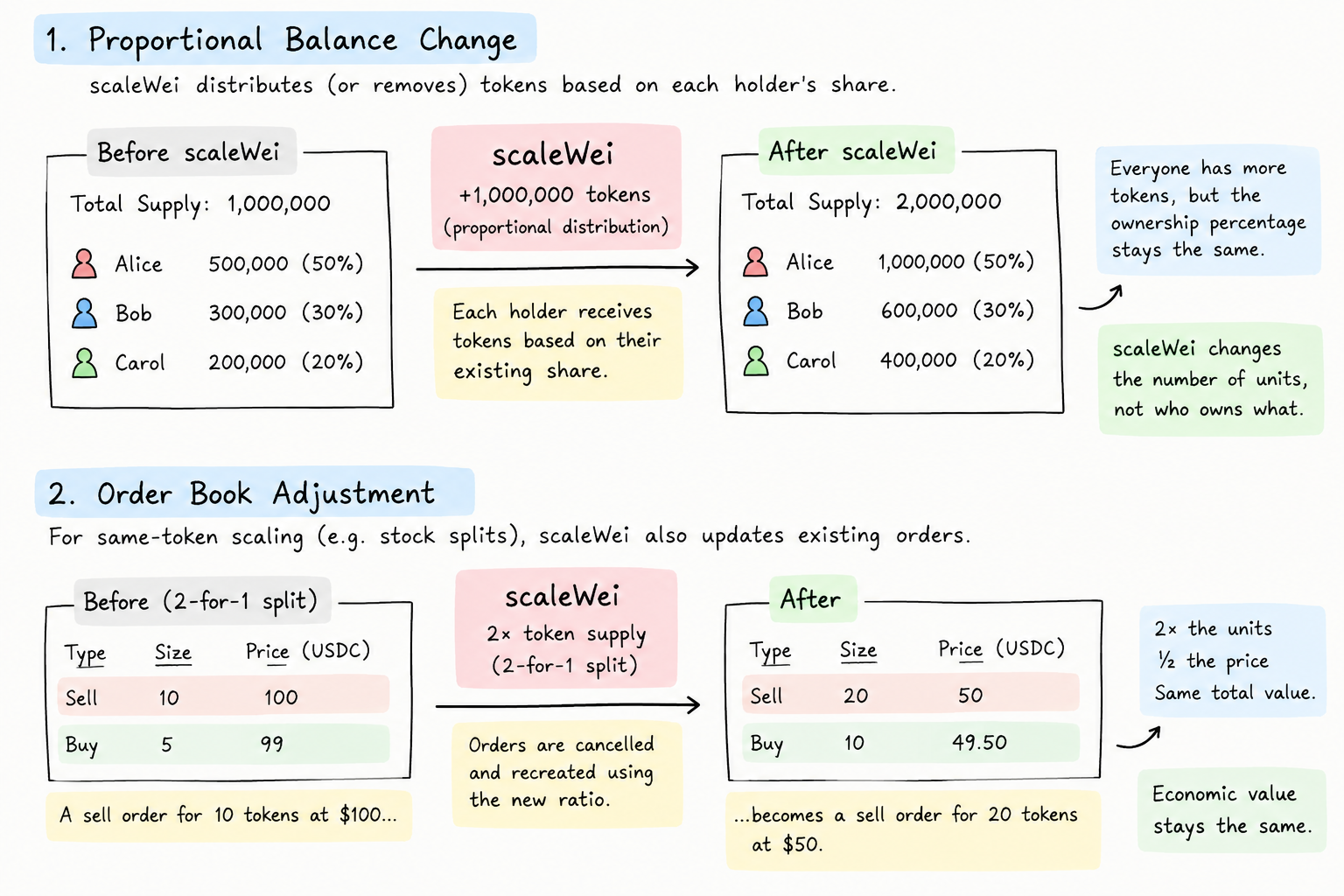
All the math and logic work together to ensure one key thing: Immediate economic exposure of the owner remains the same.
Altering token quantity and adjusting unit price are the tools to make this possible.
Let's understand further with the first real application of scaleWei: stock splits.
A stock split changes the number of shares representing the same ownership.
Consider a 10-for-1 split. Two things happen:
A holder with 10 shares becomes a holder of 100 shares.
A $1,000 share price becomes roughly $100.
scaleWei handles this with token and referenceToken set to the same asset.
The function reads each holder's current balance, multiplies it by the split ratio, and writes the new balance back for every holder, in one transaction.
Before split | After 10-for-1 split | |
|---|---|---|
Holder balance | 10 | 100 |
Price per token | $1,000 | ~$100 |
Position value | $10,000 | ~$10,000 |
Ownership share | 0.01% | 0.01% |
No holder needs to swap the old token for a new one or submit a claim transaction. The asset continues trading under its new denomination once the change is applied.
Important: Open orders get rewritten too in the same transaction. A sell order for 5 tokens at $1,000 becomes 50 tokens at $100.
This is the magic of scaleWei for tokenized stocks on Hyperliquid. Now, let's see how reverse split works.
A reverse stock split runs the same process in the opposite direction on Hyperliquid.
Consider a 1-for-10 reverse split. Again, two things happen:
A holder with 100 shares becomes a holder of 10 shares.
A $100 share price becomes roughly $1,000.
totalWei goes negative instead of positive, but the mechanism is the same: every balance and every order rescales in one transaction.
Before split | After 1-for-10 reverse split | |
|---|---|---|
Holder balance | 100 | 10 |
Price per token | $100 | ~$1,000 |
Position value | $10,000 | ~$10,000 |
Ownership share | 0.01% | 0.01% |
The mechanics are identical to a stock split. However, there's a nuance here.
A reverse split compresses balances. Small holdings can produce fractions that fall below the token's supported precision.
Open orders also run into the same problem when their sizes are scaled down.
Those amounts cannot always be represented cleanly. scaleWei therefore has to account for rounding and orders that no longer fit the permitted size precision.
Now, split and reverse split both work on resizing the same asset. Dividends can't work that way. So, how?
Dividends use scaleWei differently. Instead of changing the balance of the same asset, scaleWei distributes another asset based on how much of the stock each holder owns.
For a cash-like dividend:
referenceToken = the tokenized stock.
token = the asset being distributed, such as USDC.
totalWei = the total amount being distributed.
Suppose 10,000 USDC is distributed to holders of a tokenized stock. An address holding 2% of the eligible stock balance receives 2% of the distribution or 200 USDC.
scaleWei calculates these allocations and credits holders directly. There's no "claim" page required here.
Also, there's a caveat that we have observed with scaleWei and dividend execution.
scaleWei appears to use the reference token balances that exist when the operation executes. It does not natively encode a historical record-date snapshot.
So, if the eligibility for dividend is ownership of stock before so and so date (as is the norm), then that would need another, maybe external, input to truly execute dividends on Hyperliquid.
And this is where scaleWei's limitations start showing up.
scaleWei solves the onchain execution of a few corporate actions. Much of the decision-making that comes before and coordination that follows still sits elsewhere.
Stock splits, reverse splits, and proportional distributions fit scaleWei because the same arithmetic can apply across holders.
Many corporate actions cannot.
Mergers, tender offers, rights issues, spin-offs, or shareholder elections can depend on eligibility, choice, deadlines, or exchanging one security for another.
Those need infrastructure beyond proportional balance changes.
scaleWei acts on the balances available when the function executes.
Dividends don't work that way. They use a record date. Own the stock by that date, get paid, no matter what happens after.
However, scaleWei executes dividend payout to whoever holds the balance the instant the function runs.
An issuer or another system must preserve that information and translate it into the eventual onchain action. This again means another logistical and operational step with risks and costs attached.
scaleWei runs after humans decide.
So, the control surface is external: who can trigger scaleWei, how that authority is secured, and what happens when the instruction is wrong.
This means all human-first errors and unlawful actions are still possible onchain.
Also, the immutable nature of onchain actions furthers the impact of bad actors if the control surface is corrupted.
scaleWei does one job: removing manual work from the settlement transaction onchain. This is an important upgrade to the tokenized stocks and equities market.
But, it doesn't complete tokenized stocks. What's next?
Tokenized equities have spent much of their development solving issuance: how to represent a stock onchain, back it with underlying assets, and transact them 24/7.
scaleWei starts addressing what happens after issuance and while the asset is trading.
The significance of scaleWei is therefore broader: enabling corporate actions inside Hyperliquid's native infrastructure.
Of course there are incomplete pieces, but today, scaleWei moves Hyperliquid closer to being a comprehensive house for tokenized stocks and equities.
Quicknode 成立於 2017 年,為開發者與企業Quicknode 機構級的區塊鏈基礎設施。憑藉 99.99% 的正常運行時間以及對 80 多條區塊鏈的支持,各團隊得以在無需妥協的情況下,開發並擴展鏈上應用程式。
將最新的工程見解、產品更新及 Web3 新聞直接送至您的收件匣。