
75 min read
概覽
If you are interested in creating an NFT contract that can mint multiple tokens at a time, you may want to consider the ERC721A implementation. This guide will teach you about the ERC721A implementation and how to deploy and mint NFTs from an ERC721A contract using Hardhat.
您將負責的工作內容
- Learn about the ERC721A implementation
- Deploy and test an ERC721A contract using Hardhat
- Mint multiple NFTs in one transaction using the ERC721A contract
您需要準備的物品
- Intermediate knowledge of Solidity and EVM-blockchains.
- Node.js and npm installed.
- Experience with Hardhat.
- A Polygon Mumbai node (you can get free access to a Quicknode one here).
- Access to your private key and MATIC testnet tokens (you can get some at Quicknode's faucet).
What is ERC721A?
To better understand the ERC721A implementation, we must first do a quick recap of the ERC-721 standard.
The ERC-721 standard outlines how to create Non-Fungible Tokens (NFTs) on EVM-compatible blockchains. The ERC-721 standard provides an interface for NFTs and contains a set of rules that make working with NFTs simple. To learn more about ERC-721, read this Quicknode guide.
One key aspect of the ERC-721 standard is that it does not natively support the minting of multiple NFTs in one transaction. This is where the ERC721A implementation comes in. The ERC721A implementation was created by Azuki, and its main purpose is to allow for gas-efficient minting of multiple NFTs in one transaction. With this implementation, users will save on gas fees over the long run if they are minting more than one token at a time. You can see the estimated gas savings by looking at the Measurements section on the ERC721A implementation page.
Establish a Connection to Your Quicknode RPC
To create and deploy an ERC721A smart contract, we will first need an RPC connection to the Polygon Mumbai test network. You're free to run your own Polygon node by looking at the "Run a full node" page on Polygon's documentation. However, this can be hard to manage at times and may not be optimized as well as we'd like. Instead, you can easily set up a free Quicknode account here and have access to 20+ blockchains. Quicknode's infrastructure is optimized for latency and redundancy, making it up to 8x faster than competitors.
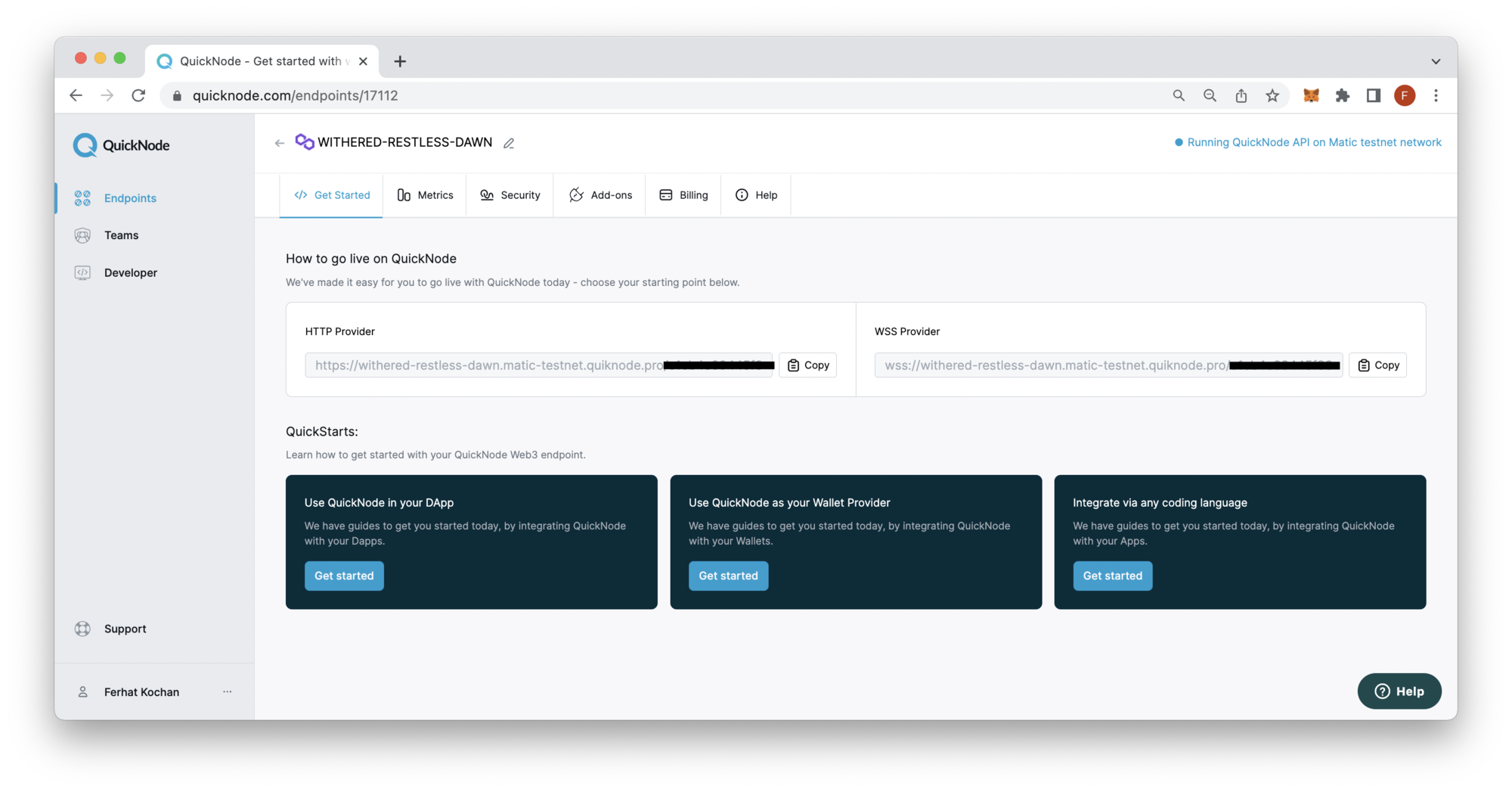
Click the Create an Endpoint button and select the Polygon chain, then select Mumbai testnet. Then once your endpoint is ready, keep the HTTP Provider URL handy, as you'll need it in the following section.
Next, head to the Quicknode Faucet to retrieve some testnet MATIC tokens.
Creating and Deploying the ERC721A Contract
Now that we have our Quicknode RPC, Testnet MATIC tokens, and a better understanding of what the ERC721A implementation is, let us move onto creating and deploying the ERC721A contract.
In your terminal, run the following commands to create the project directory and install the required dependencies:
mkdir erc721a-implementation
cd erc721a-implementation
npx hardhat && npm i dotenv
When prompted about the Hardhat setup, press enter (yes) for each prompt.
Once Hardhat is installed, run the following command within your contracts directory:
echo > BatchNFTs.sol
echo > ERC721A.sol
echo > Ownable.sol
mkdir interfaces && cd interfaces
echo > IERC721A.sol
cd ..
mkdir utils && cd utils
echo > Context.sol
cd ../../
echo > .env
This will create the folders and files we'll need for creating our ERC721A contract (i.e. BatchNFTs.sol)
Next, open up the project directory in a code editor (we're using VSCode) and add the following code to BatchNFTs.sol:
// SPDX-License-Identifier: MIT
pragma solidity ^0.8.13;

import "./ERC721A.sol";
import "./Ownable.sol";

contract BatchNFTs is Ownable, ERC721A {

    uint256 public constant MAX_SUPPLY = 100;
    uint256 public constant PRICE_PER_TOKEN = 0.01 ether;
    uint256 public immutable START_TIME;
    bool public mintPaused;
    string private _baseTokenURI;

    constructor(uint256 _startTime, bool _paused) ERC721A("ERC721A Token", "721AT") {
        START_TIME = _startTime;
        mintPaused = _paused;
    }

    function mint(address to, uint256 quantity) external payable {
        require(!mintPaused, "Mint is paused");
        require(block.timestamp >= START_TIME, "Sale not started");
        require(_totalMinted() + quantity <= MAX_SUPPLY, "Max Supply Hit");
        require(msg.value >= quantity * PRICE_PER_TOKEN, "Insufficient Funds");
        _mint(to, quantity);
    }

    function withdraw() external onlyOwner {
        (bool success, ) = msg.sender.call{value: address(this).balance}("");
        require(success, "Transfer Failed");
    }

    function setBaseURI(string calldata baseURI) external onlyOwner {
        _baseTokenURI = baseURI;
    }

    function _baseURI() internal view override returns (string memory) {
        return _baseTokenURI;
    }

    function pauseMint(bool _paused) external onlyOwner {
        require(!mintPaused, "Contract paused.");
        mintPaused = _paused;
    }
}
Let's recap the code.
- Line 1-2: Define the license and version pragma.
- Lines 4-5: Import contracts that our NFT contract will inherit from. In this case we are importing ERC721A.sol from Chiru Labs and Ownable.sol from OpenZeppelin.
- Line 7: Declare the contract name (e.g., BatchNFTs) and the contracts you inherit from (e.g., 721A & Ownable).
- Lines 9-13: Declare the NFT contract's state variables. In this case, we declare the token supply, token price, start time for minting, a boolean variable representing the minting status (e.g., live, paused), and metadata URI.
- Lines 15-18: Declare a constructor where we define the name and symbol of the ERC721A token (e.g., ERC721A Token, ERC72AT). Additionally, define inputs for the START_TIME and mintPaused variables as its needed for deployment.
- Lines 20-26: Declare a public mint function. There are four require checks before the internal _mint function is executed. Take a look at each require statement's error message for more information. The last line of code is the _mint function, which takes an address for the first argument and quantity for the second argument.
- Lines 28-31: Declare a withdraw function. This is only available for the contract owner by using the onlyOwner modifier. The function allows the contract owner to withdraw funds. Note that you can alternatively add logic to the mint function to send the funds instead of having to call the withdraw function and pay gas.
- Lines 33-35: Define the setBaseURI function which acts as the base URL for our NFTs metadata. Check out this ERC721 Token guide to learn about setting NFT metadata. This is only available for the contract owner by inheriting the onlyOwner modifier.
- Lines 37-39: Return the baseURI currently set in the contract.
- Lines 41-44: Define a pauseMint function which acts as an emergency stop. This is only available for the contract owner by inheriting the onlyOwner modifier.
- Line 45: Set the ending (i.e. } ) of the NFT contract.
Now, add code logic to each Solidity file.
In ERC721A.sol add the code:
// SPDX-License-Identifier: MIT
// ERC721A Contracts v4.2.3
// Creator: Chiru Labs
pragma solidity ^0.8.4;
import './interfaces/IERC721A.sol';
/**
* @dev Interface of ERC721 token receiver.
*/
interface ERC721A__IERC721Receiver {
function onERC721Received(
address operator,
address from,
uint256 tokenId,
bytes calldata data
) external returns (bytes4);
}
/**
* @title ERC721A
*
* @dev Implementation of the [ERC721](https://eips.ethereum.org/EIPS/eip-721)
* Non-Fungible Token Standard, including the Metadata extension.
* Optimized for lower gas during batch mints.
*
* Token IDs are minted in sequential order (e.g. 0, 1, 2, 3, ...)
* starting from `_startTokenId()`.
*
* Assumptions:
*
* - An owner cannot have more than 2**64 - 1 (max value of uint64) of supply.
* - The maximum token ID cannot exceed 2**256 - 1 (max value of uint256).
*/
contract ERC721A is IERC721A {
// Bypass for a `--via-ir` bug (https://github.com/chiru-labs/ERC721A/pull/364).
struct TokenApprovalRef {
address value;
}
// =============================================================
// CONSTANTS
// =============================================================
// Mask of an entry in packed address data.
uint256 private constant _BITMASK_ADDRESS_DATA_ENTRY = (1 << 64) - 1;
// The bit position of `numberMinted` in packed address data.
uint256 private constant _BITPOS_NUMBER_MINTED = 64;
// The bit position of `numberBurned` in packed address data.
uint256 private constant _BITPOS_NUMBER_BURNED = 128;
// The bit position of `aux` in packed address data.
uint256 private constant _BITPOS_AUX = 192;
// Mask of all 256 bits in packed address data except the 64 bits for `aux`.
uint256 private constant _BITMASK_AUX_COMPLEMENT = (1 << 192) - 1;
// The bit position of `startTimestamp` in packed ownership.
uint256 private constant _BITPOS_START_TIMESTAMP = 160;
// The bit mask of the `burned` bit in packed ownership.
uint256 private constant _BITMASK_BURNED = 1 << 224;
// The bit position of the `nextInitialized` bit in packed ownership.
uint256 private constant _BITPOS_NEXT_INITIALIZED = 225;
// The bit mask of the `nextInitialized` bit in packed ownership.
uint256 private constant _BITMASK_NEXT_INITIALIZED = 1 << 225;
// The bit position of `extraData` in packed ownership.
uint256 private constant _BITPOS_EXTRA_DATA = 232;
// Mask of all 256 bits in a packed ownership except the 24 bits for `extraData`.
uint256 private constant _BITMASK_EXTRA_DATA_COMPLEMENT = (1 << 232) - 1;
// The mask of the lower 160 bits for addresses.
uint256 private constant _BITMASK_ADDRESS = (1 << 160) - 1;
// The maximum `quantity` that can be minted with {_mintERC2309}.
// This limit is to prevent overflows on the address data entries.
// For a limit of 5000, a total of 3.689e15 calls to {_mintERC2309}
// is required to cause an overflow, which is unrealistic.
uint256 private constant _MAX_MINT_ERC2309_QUANTITY_LIMIT = 5000;
// The `Transfer` event signature is given by:
// `keccak256(bytes("Transfer(address,address,uint256)"))`.
bytes32 private constant _TRANSFER_EVENT_SIGNATURE =
0xddf252ad1be2c89b69c2b068fc378daa952ba7f163c4a11628f55a4df523b3ef;
// =============================================================
// STORAGE
// =============================================================
// The next token ID to be minted.
uint256 private _currentIndex;
// The number of tokens burned.
uint256 private _burnCounter;
// Token name
string private _name;
// Token symbol
string private _symbol;
// Mapping from token ID to ownership details
// An empty struct value does not necessarily mean the token is unowned.
// See {_packedOwnershipOf} implementation for details.
//
// Bits Layout:
// - [0..159] `addr`
// - [160..223] `startTimestamp`
// - [224] `burned`
// - [225] `nextInitialized`
// - [232..255] `extraData`
mapping(uint256 => uint256) private _packedOwnerships;
// Mapping owner address to address data.
//
// Bits Layout:
// - [0..63] `balance`
// - [64..127] `numberMinted`
// - [128..191] `numberBurned`
// - [192..255] `aux`
mapping(address => uint256) private _packedAddressData;
// Mapping from token ID to approved address.
mapping(uint256 => TokenApprovalRef) private _tokenApprovals;
// Mapping from owner to operator approvals
mapping(address => mapping(address => bool)) private _operatorApprovals;
// =============================================================
// CONSTRUCTOR
// =============================================================
constructor(string memory name_, string memory symbol_) {
_name = name_;
_symbol = symbol_;
_currentIndex = _startTokenId();
}
// =============================================================
// TOKEN COUNTING OPERATIONS
// =============================================================
/**
* @dev Returns the starting token ID.
* To change the starting token ID, please override this function.
*/
function _startTokenId() internal view virtual returns (uint256) {
return 0;
}
/**
* @dev Returns the next token ID to be minted.
*/
function _nextTokenId() internal view virtual returns (uint256) {
return _currentIndex;
}
/**
* @dev Returns the total number of tokens in existence.
* Burned tokens will reduce the count.
* To get the total number of tokens minted, please see {_totalMinted}.
*/
function totalSupply() public view virtual override returns (uint256) {
// Counter underflow is impossible as _burnCounter cannot be incremented
// more than `_currentIndex - _startTokenId()` times.
unchecked {
return _currentIndex - _burnCounter - _startTokenId();
}
}
/**
* @dev Returns the total amount of tokens minted in the contract.
*/
function _totalMinted() internal view virtual returns (uint256) {
// Counter underflow is impossible as `_currentIndex` does not decrement,
// and it is initialized to `_startTokenId()`.
unchecked {
return _currentIndex - _startTokenId();
}
}
/**
* @dev Returns the total number of tokens burned.
*/
function _totalBurned() internal view virtual returns (uint256) {
return _burnCounter;
}
// =============================================================
// ADDRESS DATA OPERATIONS
// =============================================================
/**
* @dev Returns the number of tokens in `owner`'s account.
*/
function balanceOf(address owner) public view virtual override returns (uint256) {
if (owner == address(0)) revert BalanceQueryForZeroAddress();
return _packedAddressData[owner] & _BITMASK_ADDRESS_DATA_ENTRY;
}
/**
* Returns the number of tokens minted by `owner`.
*/
function _numberMinted(address owner) internal view returns (uint256) {
return (_packedAddressData[owner] >> _BITPOS_NUMBER_MINTED) & _BITMASK_ADDRESS_DATA_ENTRY;
}
/**
* Returns the number of tokens burned by or on behalf of `owner`.
*/
function _numberBurned(address owner) internal view returns (uint256) {
return (_packedAddressData[owner] >> _BITPOS_NUMBER_BURNED) & _BITMASK_ADDRESS_DATA_ENTRY;
}
/**
* Returns the auxiliary data for `owner`. (e.g. number of whitelist mint slots used).
*/
function _getAux(address owner) internal view returns (uint64) {
return uint64(_packedAddressData[owner] >> _BITPOS_AUX);
}
/**
* Sets the auxiliary data for `owner`. (e.g. number of whitelist mint slots used).
* If there are multiple variables, please pack them into a uint64.
*/
function _setAux(address owner, uint64 aux) internal virtual {
uint256 packed = _packedAddressData[owner];
uint256 auxCasted;
// Cast `aux` with assembly to avoid redundant masking.
assembly {
auxCasted := aux
}
packed = (packed & _BITMASK_AUX_COMPLEMENT) | (auxCasted << _BITPOS_AUX);
_packedAddressData[owner] = packed;
}
// =============================================================
// IERC165
// =============================================================
/**
* @dev Returns true if this contract implements the interface defined by
* `interfaceId`。請參閱對應的
* [EIP section](https://eips.ethereum.org/EIPS/eip-165#how-interfaces-are-identified)
* 欲進一步了解這些 ID 是如何產生的。
*
* This function call must use less than 30000 gas.
*/
function supportsInterface(bytes4 interfaceId) public view virtual override returns (bool) {
// The interface IDs are constants representing the first 4 bytes
// of the XOR of all function selectors in the interface.
// See: [ERC165](https://eips.ethereum.org/EIPS/eip-165)
// (e.g. `bytes4(i.functionA.selector ^ i.functionB.selector ^ ...)`)
return
interfaceId == 0x01ffc9a7 || // ERC165 interface ID for ERC165.
interfaceId == 0x80ac58cd || // ERC165 interface ID for ERC721.
interfaceId == 0x5b5e139f; // ERC165 interface ID for ERC721Metadata.
}
// =============================================================
// IERC721Metadata
// =============================================================
/**
* @dev Returns the token collection name.
*/
function name() public view virtual override returns (string memory) {
return _name;
}
/**
* @dev Returns the token collection symbol.
*/
function symbol() public view virtual override returns (string memory) {
return _symbol;
}
/**
* @dev Returns the Uniform Resource Identifier (URI) for `tokenId` token.
*/
function tokenURI(uint256 tokenId) public view virtual override returns (string memory) {
if (!_exists(tokenId)) revert URIQueryForNonexistentToken();
string memory baseURI = _baseURI();
return bytes(baseURI).length != 0 ? string(abi.encodePacked(baseURI, _toString(tokenId))) : '';
}
/**
* @dev Base URI for computing {tokenURI}. If set, the resulting URI for each
* token will be the concatenation of the `baseURI` and the `tokenId`. Empty
* by default, it can be overridden in child contracts.
*/
function _baseURI() internal view virtual returns (string memory) {
return '';
}
// =============================================================
// OWNERSHIPS OPERATIONS
// =============================================================
/**
* @dev Returns the owner of the `tokenId` token.
*
* 要求:
*
* - `tokenId` 必須存在。
*/
function ownerOf(uint256 tokenId) public view virtual override returns (address) {
return address(uint160(_packedOwnershipOf(tokenId)));
}
/**
* @dev Gas spent here starts off proportional to the maximum mint batch size.
* It gradually moves to O(1) as tokens get transferred around over time.
*/
function _ownershipOf(uint256 tokenId) internal view virtual returns (TokenOwnership memory) {
return _unpackedOwnership(_packedOwnershipOf(tokenId));
}
/**
* @dev Returns the unpacked `TokenOwnership` struct at `index`.
*/
function _ownershipAt(uint256 index) internal view virtual returns (TokenOwnership memory) {
return _unpackedOwnership(_packedOwnerships[index]);
}
/**
* @dev Initializes the ownership slot minted at `index` for efficiency purposes.
*/
function _initializeOwnershipAt(uint256 index) internal virtual {
if (_packedOwnerships[index] == 0) {
_packedOwnerships[index] = _packedOwnershipOf(index);
}
}
/**
* Returns the packed ownership data of `tokenId`.
*/
function _packedOwnershipOf(uint256 tokenId) private view returns (uint256) {
uint256 curr = tokenId;
unchecked {
if (_startTokenId() <= curr)
if (curr < _currentIndex) {
uint256 packed = _packedOwnerships[curr];
// If not burned.
if (packed & _BITMASK_BURNED == 0) {
// Invariant:
// There will always be an initialized ownership slot
// (i.e. `ownership.addr != address(0) && ownership.burned == false`)
// before an unintialized ownership slot
// (i.e. `ownership.addr == address(0) && ownership.burned == false`)
// Hence, `curr` will not underflow.
//
// We can directly compare the packed value.
// If the address is zero, packed will be zero.
while (packed == 0) {
packed = _packedOwnerships[--curr];
}
return packed;
}
}
}
revert OwnerQueryForNonexistentToken();
}
/**
* @dev Returns the unpacked `TokenOwnership` struct from `packed`.
*/
function _unpackedOwnership(uint256 packed) private pure returns (TokenOwnership memory ownership) {
ownership.addr = address(uint160(packed));
ownership.startTimestamp = uint64(packed >> _BITPOS_START_TIMESTAMP);
ownership.burned = packed & _BITMASK_BURNED != 0;
ownership.extraData = uint24(packed >> _BITPOS_EXTRA_DATA);
}
/**
* @dev Packs ownership data into a single uint256.
*/
function _packOwnershipData(address owner, uint256 flags) private view returns (uint256 result) {
assembly {
// Mask `owner` to the lower 160 bits, in case the upper bits somehow aren't clean.
owner := and(owner, _BITMASK_ADDRESS)
// `owner | (block.timestamp << _BITPOS_START_TIMESTAMP) | flags`.
result := or(owner, or(shl(_BITPOS_START_TIMESTAMP, timestamp()), flags))
}
}
/**
* @dev Returns the `nextInitialized` flag set if `quantity` equals 1.
*/
function _nextInitializedFlag(uint256 quantity) private pure returns (uint256 result) {
// For branchless setting of the `nextInitialized` flag.
assembly {
// `(quantity == 1) << _BITPOS_NEXT_INITIALIZED`.
result := shl(_BITPOS_NEXT_INITIALIZED, eq(quantity, 1))
}
}
// =============================================================
// APPROVAL OPERATIONS
// =============================================================
/**
* @dev Gives permission to `to` to transfer `tokenId` token to another account.
* 當代幣轉移時,該批准即告完成。
*
* Only a single account can be approved at a time, so approving the
* zero address clears previous approvals.
*
* 要求:
*
* - 呼叫者必須擁有該代幣,或為經核准的操作員。
* - `tokenId` 必須存在。
*
* Emits an {Approval} event.
*/
function approve(address to, uint256 tokenId) public payable virtual override {
address owner = ownerOf(tokenId);
if (_msgSenderERC721A() != owner)
if (!isApprovedForAll(owner, _msgSenderERC721A())) {
revert ApprovalCallerNotOwnerNorApproved();
}
_tokenApprovals[tokenId].value = to;
emit Approval(owner, to, tokenId);
}
/**
* @dev Returns the account approved for `tokenId` token.
*
* 要求:
*
* - `tokenId` 必須存在。
*/
function getApproved(uint256 tokenId) public view virtual override returns (address) {
if (!_exists(tokenId)) revert ApprovalQueryForNonexistentToken();
return _tokenApprovals[tokenId].value;
}
/**
* @dev Approve or remove `operator` as an operator for the caller.
* Operators can call {transferFrom} or {safeTransferFrom}
* for any token owned by the caller.
*
* 要求:
*
* - `運算子` 不能是呼叫者。
*
* Emits an {ApprovalForAll} event.
*/
function setApprovalForAll(address operator, bool approved) public virtual override {
_operatorApprovals[_msgSenderERC721A()][operator] = approved;
emit ApprovalForAll(_msgSenderERC721A(), operator, approved);
}
/**
* @dev Returns if the `operator` is allowed to manage all of the assets of `owner`.
*
* See {setApprovalForAll}.
*/
function isApprovedForAll(address owner, address operator) public view virtual override returns (bool) {
return _operatorApprovals[owner][operator];
}
/**
* @dev Returns whether `tokenId` exists.
*
* Tokens can be managed by their owner or approved accounts via {approve} or {setApprovalForAll}.
*
* Tokens start existing when they are minted. See {_mint}.
*/
function _exists(uint256 tokenId) internal view virtual returns (bool) {
return
_startTokenId() <= tokenId &&
tokenId < _currentIndex && // If within bounds,
_packedOwnerships[tokenId] & _BITMASK_BURNED == 0; // and not burned.
}
/**
* @dev Returns whether `msgSender` is equal to `approvedAddress` or `owner`.
*/
function _isSenderApprovedOrOwner(
address approvedAddress,
address owner,
address msgSender
) private pure returns (bool result) {
assembly {
// Mask `owner` to the lower 160 bits, in case the upper bits somehow aren't clean.
owner := and(owner, _BITMASK_ADDRESS)
// Mask `msgSender` to the lower 160 bits, in case the upper bits somehow aren't clean.
msgSender := and(msgSender, _BITMASK_ADDRESS)
// `msgSender == owner || msgSender == approvedAddress`.
result := or(eq(msgSender, owner), eq(msgSender, approvedAddress))
}
}
/**
* @dev Returns the storage slot and value for the approved address of `tokenId`.
*/
function _getApprovedSlotAndAddress(uint256 tokenId)
私人
檢視
returns (uint256 approvedAddressSlot, address approvedAddress)
{
TokenApprovalRef storage tokenApproval = _tokenApprovals[tokenId];
// The following is equivalent to `approvedAddress = _tokenApprovals[tokenId].value`.
assembly {
approvedAddressSlot := tokenApproval.slot
approvedAddress := sload(approvedAddressSlot)
}
}
// =============================================================
// TRANSFER OPERATIONS
// =============================================================
/**
* @dev Transfers `tokenId` from `from` to `to`.
*
* 要求:
*
* - `from` 不能是零位址。
* - `to` 不能是零位址。
* - `tokenId` 代幣必須由 `from` 持有。
* - If the caller is not `from`, it must be approved to move this token
* by either {approve} or {setApprovalForAll}.
*
* Emits a {Transfer} event.
*/
function transferFrom(
address from,
address to,
uint256 tokenId
) public payable virtual override {
uint256 prevOwnershipPacked = _packedOwnershipOf(tokenId);
if (address(uint160(prevOwnershipPacked)) != from) revert TransferFromIncorrectOwner();
(uint256 approvedAddressSlot, address approvedAddress) = _getApprovedSlotAndAddress(tokenId);
// The nested ifs save around 20+ gas over a compound boolean condition.
if (!_isSenderApprovedOrOwner(approvedAddress, from, _msgSenderERC721A()))
if (!isApprovedForAll(from, _msgSenderERC721A())) revert TransferCallerNotOwnerNorApproved();
if (to == address(0)) revert TransferToZeroAddress();
_beforeTokenTransfers(from, to, tokenId, 1);
// Clear approvals from the previous owner.
assembly {
if approvedAddress {
// This is equivalent to `delete _tokenApprovals[tokenId]`.
sstore(approvedAddressSlot, 0)
}
}
// Underflow of the sender's balance is impossible because we check for
// ownership above and the recipient's balance can't realistically overflow.
// Counter overflow is incredibly unrealistic as `tokenId` would have to be 2**256.
unchecked {
// We can directly increment and decrement the balances.
--_packedAddressData[from]; // Updates: `balance -= 1`.
++_packedAddressData[to]; // Updates: `balance += 1`.
// Updates:
// - `address` to the next owner.
// - `startTimestamp` to the timestamp of transfering.
// - `burned` to `false`.
// - `nextInitialized` to `true`.
_packedOwnerships[tokenId] = _packOwnershipData(
to,
_BITMASK_NEXT_INITIALIZED | _nextExtraData(from, to, prevOwnershipPacked)
);
// If the next slot may not have been initialized (i.e. `nextInitialized == false`) .
if (prevOwnershipPacked & _BITMASK_NEXT_INITIALIZED == 0) {
uint256 nextTokenId = tokenId + 1;
// If the next slot's address is zero and not burned (i.e. packed value is zero).
if (_packedOwnerships[nextTokenId] == 0) {
// If the next slot is within bounds.
if (nextTokenId != _currentIndex) {
// Initialize the next slot to maintain correctness for `ownerOf(tokenId + 1)`.
_packedOwnerships[nextTokenId] = prevOwnershipPacked;
}
}
}
}
emit Transfer(from, to, tokenId);
_afterTokenTransfers(from, to, tokenId, 1);
}
/**
* @dev Equivalent to `safeTransferFrom(from, to, tokenId, '')`.
*/
function safeTransferFrom(
address from,
address to,
uint256 tokenId
) public payable virtual override {
safeTransferFrom(from, to, tokenId, '');
}
/**
* @dev Safely transfers `tokenId` token from `from` to `to`.
*
* 要求:
*
* - `from` 不能是零位址。
* - `to` 不能是零位址。
* - `tokenId` 代幣必須存在,且須由 `from` 持有。
* - If the caller is not `from`, it must be approved to move this token
* by either {approve} or {setApprovalForAll}.
* - If `to` refers to a smart contract, it must implement
* {IERC721Receiver-onERC721Received}, which is called upon a safe transfer.
*
* Emits a {Transfer} event.
*/
function safeTransferFrom(
address from,
address to,
uint256 tokenId,
bytes memory _data
) public payable virtual override {
transferFrom(from, to, tokenId);
if (to.code.length != 0)
if (!_checkContractOnERC721Received(from, to, tokenId, _data)) {
revert TransferToNonERC721ReceiverImplementer();
}
}
/**
* @dev Hook that is called before a set of serially-ordered token IDs
* are about to be transferred. This includes minting.
* And also called before burning one token.
*
* `startTokenId` - the first token ID to be transferred.
* `quantity` - the amount to be transferred.
*
* 呼叫條件:
*
* - When `from` and `to` are both non-zero, `from`'s `tokenId` will be
* 已轉移至 `to`。
* - 當 `from` 為零時,系統將為 `to` 鑄造 `tokenId`。
* - When `to` is zero, `tokenId` will be burned by `from`.
* - `from` and `to` are never both zero.
*/
function _beforeTokenTransfers(
address from,
address to,
uint256 startTokenId,
uint256 quantity
) internal virtual {}
/**
* @dev Hook that is called after a set of serially-ordered token IDs
* have been transferred. This includes minting.
* And also called after one token has been burned.
*
* `startTokenId` - the first token ID to be transferred.
* `quantity` - the amount to be transferred.
*
* 呼叫條件:
*
* - When `from` and `to` are both non-zero, `from`'s `tokenId` has been
* 已轉移至 `to`。
* - When `from` is zero, `tokenId` has been minted for `to`.
* - When `to` is zero, `tokenId` has been burned by `from`.
* - `from` and `to` are never both zero.
*/
function _afterTokenTransfers(
address from,
address to,
uint256 startTokenId,
uint256 quantity
) internal virtual {}
/**
* @dev Private function to invoke {IERC721Receiver-onERC721Received} on a target contract.
*
* `from` - Previous owner of the given token ID.
* `to` - Target address that will receive the token.
* `tokenId` - Token ID to be transferred.
* `_data` - Optional data to send along with the call.
*
* Returns whether the call correctly returned the expected magic value.
*/
function _checkContractOnERC721Received(
address from,
address to,
uint256 tokenId,
bytes memory _data
) private returns (bool) {
try ERC721A__IERC721Receiver(to).onERC721Received(_msgSenderERC721A(), from, tokenId, _data) returns (
bytes4 retval
) {
return retval == ERC721A__IERC721Receiver(to).onERC721Received.selector;
} catch (bytes memory reason) {
if (reason.length == 0) {
revert TransferToNonERC721ReceiverImplementer();
} else {
assembly {
revert(add(32, reason), mload(reason))
}
}
}
}
// =============================================================
// MINT OPERATIONS
// =============================================================
/**
* @dev Mints `quantity` tokens and transfers them to `to`.
*
* 要求:
*
* - `to` 不能是零位址。
* - `quantity` must be greater than 0.
*
* Emits a {Transfer} event for each mint.
*/
function _mint(address to, uint256 quantity) internal virtual {
uint256 startTokenId = _currentIndex;
if (quantity == 0) revert MintZeroQuantity();
_beforeTokenTransfers(address(0), to, startTokenId, quantity);
// Overflows are incredibly unrealistic.
// `balance` and `numberMinted` have a maximum limit of 2**64.
// `tokenId` has a maximum limit of 2**256.
unchecked {
// Updates:
// - `balance += quantity`.
// - `numberMinted += quantity`.
//
// We can directly add to the `balance` and `numberMinted`.
_packedAddressData[to] += quantity * ((1 << _BITPOS_NUMBER_MINTED) | 1);
// Updates:
// - `address` to the owner.
// - `startTimestamp` to the timestamp of minting.
// - `burned` to `false`.
// - `nextInitialized` to `quantity == 1`.
_packedOwnerships[startTokenId] = _packOwnershipData(
to,
_nextInitializedFlag(quantity) | _nextExtraData(address(0), to, 0)
);
uint256 toMasked;
uint256 end = startTokenId + quantity;
// Use assembly to loop and emit the `Transfer` event for gas savings.
// The duplicated `log4` removes an extra check and reduces stack juggling.
// The assembly, together with the surrounding Solidity code, have been
// delicately arranged to nudge the compiler into producing optimized opcodes.
assembly {
// Mask `to` to the lower 160 bits, in case the upper bits somehow aren't clean.
toMasked := and(to, _BITMASK_ADDRESS)
// Emit the `Transfer` event.
log4(
0, // Start of data (0, since no data).
0, // End of data (0, since no data).
_TRANSFER_EVENT_SIGNATURE, // Signature.
0, // `address(0)`.
toMasked, // `to`.
startTokenId // `tokenId`.
)
// The `iszero(eq(,))` check ensures that large values of `quantity`
// that overflows uint256 will make the loop run out of gas.
// The compiler will optimize the `iszero` away for performance.
for {
let tokenId := add(startTokenId, 1)
} iszero(eq(tokenId, end)) {
tokenId := add(tokenId, 1)
} {
// Emit the `Transfer` event. Similar to above.
log4(0, 0, _TRANSFER_EVENT_SIGNATURE, 0, toMasked, tokenId)
}
}
if (toMasked == 0) revert MintToZeroAddress();
_currentIndex = end;
}
_afterTokenTransfers(address(0), to, startTokenId, quantity);
}
/**
* @dev Mints `quantity` tokens and transfers them to `to`.
*
* This function is intended for efficient minting only during contract creation.
*
* It emits only one {ConsecutiveTransfer} as defined in
* [ERC2309](https://eips.ethereum.org/EIPS/eip-2309),
* instead of a sequence of {Transfer} event(s).
*
* Calling this function outside of contract creation WILL make your contract
* non-compliant with the ERC721 standard.
* For full ERC721 compliance, substituting ERC721 {Transfer} event(s) with the ERC2309
* {ConsecutiveTransfer} event is only permissible during contract creation.
*
* 要求:
*
* - `to` 不能是零位址。
* - `quantity` must be greater than 0.
*
* Emits a {ConsecutiveTransfer} event.
*/
function _mintERC2309(address to, uint256 quantity) internal virtual {
uint256 startTokenId = _currentIndex;
if (to == address(0)) revert MintToZeroAddress();
if (quantity == 0) revert MintZeroQuantity();
if (quantity > _MAX_MINT_ERC2309_QUANTITY_LIMIT) revert MintERC2309QuantityExceedsLimit();
_beforeTokenTransfers(address(0), to, startTokenId, quantity);
// Overflows are unrealistic due to the above check for `quantity` to be below the limit.
unchecked {
// Updates:
// - `balance += quantity`.
// - `numberMinted += quantity`.
//
// We can directly add to the `balance` and `numberMinted`.
_packedAddressData[to] += quantity * ((1 << _BITPOS_NUMBER_MINTED) | 1);
// Updates:
// - `address` to the owner.
// - `startTimestamp` to the timestamp of minting.
// - `burned` to `false`.
// - `nextInitialized` to `quantity == 1`.
_packedOwnerships[startTokenId] = _packOwnershipData(
to,
_nextInitializedFlag(quantity) | _nextExtraData(address(0), to, 0)
);
emit ConsecutiveTransfer(startTokenId, startTokenId + quantity - 1, address(0), to);
_currentIndex = startTokenId + quantity;
}
_afterTokenTransfers(address(0), to, startTokenId, quantity);
}
/**
* @dev Safely mints `quantity` tokens and transfers them to `to`.
*
* 要求:
*
* - If `to` refers to a smart contract, it must implement
* {IERC721Receiver-onERC721Received}, which is called for each safe transfer.
* - `quantity` must be greater than 0.
*
* See {_mint}.
*
* Emits a {Transfer} event for each mint.
*/
function _safeMint(
address to,
uint256 quantity,
bytes memory _data
) internal virtual {
_mint(to, quantity);
unchecked {
if (to.code.length != 0) {
uint256 end = _currentIndex;
uint256 index = end - quantity;
do {
if (!_checkContractOnERC721Received(address(0), to, index++, _data)) {
revert TransferToNonERC721ReceiverImplementer();
}
} while (index < end);
// Reentrancy protection.
if (_currentIndex != end) revert();
}
}
}
/**
* @dev Equivalent to `_safeMint(to, quantity, '')`.
*/
function _safeMint(address to, uint256 quantity) internal virtual {
_safeMint(to, quantity, '');
}
// =============================================================
// BURN OPERATIONS
// =============================================================
/**
* @dev Equivalent to `_burn(tokenId, false)`.
*/
function _burn(uint256 tokenId) internal virtual {
_burn(tokenId, false);
}
/**
* @dev Destroys `tokenId`.
* 當代幣被銷毀時,該批准即告解除。
*
* 要求:
*
* - `tokenId` 必須存在。
*
* Emits a {Transfer} event.
*/
function _burn(uint256 tokenId, bool approvalCheck) internal virtual {
uint256 prevOwnershipPacked = _packedOwnershipOf(tokenId);
address from = address(uint160(prevOwnershipPacked));
(uint256 approvedAddressSlot, address approvedAddress) = _getApprovedSlotAndAddress(tokenId);
if (approvalCheck) {
// The nested ifs save around 20+ gas over a compound boolean condition.
if (!_isSenderApprovedOrOwner(approvedAddress, from, _msgSenderERC721A()))
if (!isApprovedForAll(from, _msgSenderERC721A())) revert TransferCallerNotOwnerNorApproved();
}
_beforeTokenTransfers(from, address(0), tokenId, 1);
// Clear approvals from the previous owner.
assembly {
if approvedAddress {
// This is equivalent to `delete _tokenApprovals[tokenId]`.
sstore(approvedAddressSlot, 0)
}
}
// Underflow of the sender's balance is impossible because we check for
// ownership above and the recipient's balance can't realistically overflow.
// Counter overflow is incredibly unrealistic as `tokenId` would have to be 2**256.
unchecked {
// Updates:
// - `balance -= 1`.
// - `numberBurned += 1`.
//
// We can directly decrement the balance, and increment the number burned.
// This is equivalent to `packed -= 1; packed += 1 << _BITPOS_NUMBER_BURNED;`.
_packedAddressData[from] += (1 << _BITPOS_NUMBER_BURNED) - 1;
// Updates:
// - `address` to the last owner.
// - `startTimestamp` to the timestamp of burning.
// - `burned` to `true`.
// - `nextInitialized` to `true`.
_packedOwnerships[tokenId] = _packOwnershipData(
from,
(_BITMASK_BURNED | _BITMASK_NEXT_INITIALIZED) | _nextExtraData(from, address(0), prevOwnershipPacked)
);
// If the next slot may not have been initialized (i.e. `nextInitialized == false`) .
if (prevOwnershipPacked & _BITMASK_NEXT_INITIALIZED == 0) {
uint256 nextTokenId = tokenId + 1;
// If the next slot's address is zero and not burned (i.e. packed value is zero).
if (_packedOwnerships[nextTokenId] == 0) {
// If the next slot is within bounds.
if (nextTokenId != _currentIndex) {
// Initialize the next slot to maintain correctness for `ownerOf(tokenId + 1)`.
_packedOwnerships[nextTokenId] = prevOwnershipPacked;
}
}
}
}
emit Transfer(from, address(0), tokenId);
_afterTokenTransfers(from, address(0), tokenId, 1);
// Overflow not possible, as _burnCounter cannot be exceed _currentIndex times.
unchecked {
_burnCounter++;
}
}
// =============================================================
// EXTRA DATA OPERATIONS
// =============================================================
/**
* @dev Directly sets the extra data for the ownership data `index`.
*/
function _setExtraDataAt(uint256 index, uint24 extraData) internal virtual {
uint256 packed = _packedOwnerships[index];
if (packed == 0) revert OwnershipNotInitializedForExtraData();
uint256 extraDataCasted;
// Cast `extraData` with assembly to avoid redundant masking.
assembly {
extraDataCasted := extraData
}
packed = (packed & _BITMASK_EXTRA_DATA_COMPLEMENT) | (extraDataCasted << _BITPOS_EXTRA_DATA);
_packedOwnerships[index] = packed;
}
/**
* @dev Called during each token transfer to set the 24bit `extraData` field.
* Intended to be overridden by the cosumer contract.
*
* `previousExtraData` - the value of `extraData` before transfer.
*
* 呼叫條件:
*
* - When `from` and `to` are both non-zero, `from`'s `tokenId` will be
* 已轉移至 `to`。
* - 當 `from` 為零時,系統將為 `to` 鑄造 `tokenId`。
* - When `to` is zero, `tokenId` will be burned by `from`.
* - `from` and `to` are never both zero.
*/
function _extraData(
address from,
address to,
uint24 previousExtraData
) internal view virtual returns (uint24) {}
/**
* @dev Returns the next extra data for the packed ownership data.
* The returned result is shifted into position.
*/
function _nextExtraData(
address from,
address to,
uint256 prevOwnershipPacked
) private view returns (uint256) {
uint24 extraData = uint24(prevOwnershipPacked >> _BITPOS_EXTRA_DATA);
return uint256(_extraData(from, to, extraData)) << _BITPOS_EXTRA_DATA;
}
// =============================================================
// OTHER OPERATIONS
// =============================================================
/**
* @dev Returns the message sender (defaults to `msg.sender`).
*
* If you are writing GSN compatible contracts, you need to override this function.
*/
function _msgSenderERC721A() internal view virtual returns (address) {
return msg.sender;
}
/**
* @dev Converts a uint256 to its ASCII string decimal representation.
*/
function _toString(uint256 value) internal pure virtual returns (string memory str) {
assembly {
// The maximum value of a uint256 contains 78 digits (1 byte per digit), but
// we allocate 0xa0 bytes to keep the free memory pointer 32-byte word aligned.
// We will need 1 word for the trailing zeros padding, 1 word for the length,
// and 3 words for a maximum of 78 digits. Total: 5 * 0x20 = 0xa0.
let m := add(mload(0x40), 0xa0)
// Update the free memory pointer to allocate.
mstore(0x40, m)
// Assign the `str` to the end.
str := sub(m, 0x20)
// Zeroize the slot after the string.
mstore(str, 0)
// Cache the end of the memory to calculate the length later.
let end := str
// We write the string from rightmost digit to leftmost digit.
// The following is essentially a do-while loop that also handles the zero case.
// prettier-ignore
for { let temp := value } 1 {} {
str := sub(str, 1)
// Write the character to the pointer.
// The ASCII index of the '0' character is 48.
mstore8(str, add(48, mod(temp, 10)))
// Keep dividing `temp` until zero.
temp := div(temp, 10)
// prettier-ignore
if iszero(temp) { break }
}
let length := sub(end, str)
// Move the pointer 32 bytes leftwards to make room for the length.
str := sub(str, 0x20)
// Store the length.
mstore(str, length)
}
}
}
In Ownable.sol, add the following code:
// SPDX-License-Identifier: MIT
// OpenZeppelin Contracts (last updated v4.7.0) (access/Ownable.sol)

pragma solidity ^0.8.0;

import "./utils/Context.sol";

/**
 * @dev Contract module which provides a basic access control mechanism, where
 * 存在一個帳戶(所有者),可被授予對該項目的專屬存取權限
 * 特定功能。
 *
 * 預設情況下,擁有者帳戶將是部署合約的帳戶。這
 * can later be changed with {transferOwnership}.
 *
 * 此模組是透過繼承來使用的。它將提供該修飾子
 * `onlyOwner`,可套用至您的函式,以將其使用範圍限制於
 * 業主。
 */
abstract contract Ownable is Context {
    address private _owner;

    event OwnershipTransferred(address indexed previousOwner, address indexed newOwner);

    /**
     * @dev Initializes the contract setting the deployer as the initial owner.
     */
    constructor() {
        _transferOwnership(_msgSender());
    }

    /**
     * @dev Throws if called by any account other than the owner.
     */
    modifier onlyOwner() {
        _checkOwner();
        _;
    }

    /**
     * @dev Returns the address of the current owner.
     */
    function owner() public view virtual returns (address) {
        return _owner;
    }

    /**
     * @dev Throws if the sender is not the owner.
     */
    function _checkOwner() internal view virtual {
        require(owner() == _msgSender(), "Ownable: caller is not the owner");
    }

    /**
     * @dev Leaves the contract without owner. It will not be possible to call
     * `onlyOwner` 函式。現在只能由當前擁有者呼叫。
     *
     * 注意:放棄所有權將導致合約沒有所有者,
     * 藉此移除所有僅限擁有者使用的功能。
     */
    function renounceOwnership() public virtual onlyOwner {
        _transferOwnership(address(0));
    }

    /**
     * @dev Transfers ownership of the contract to a new account (`newOwner`).
     * 僅能由當前擁有者呼叫。
     */
    function transferOwnership(address newOwner) public virtual onlyOwner {
        require(newOwner != address(0), "Ownable: new owner is the zero address");
        _transferOwnership(newOwner);
    }

    /**
     * @dev Transfers ownership of the contract to a new account (`newOwner`).
     * Internal function without access restriction.
     */
    function _transferOwnership(address newOwner) internal virtual {
        address oldOwner = _owner;
        _owner = newOwner;
        emit OwnershipTransferred(oldOwner, newOwner);
    }
}
In the interfaces/IERC721A.sol, add the following code:
// SPDX-License-Identifier: MIT
// ERC721A Contracts v4.2.3
// Creator: Chiru Labs

pragma solidity ^0.8.4;

/**
 * @dev Interface of ERC721A.
 */
interface IERC721A {
    /**
     * The caller must own the token or be an approved operator.
     */
    error ApprovalCallerNotOwnerNorApproved();

    /**
     * The token does not exist.
     */
    error ApprovalQueryForNonexistentToken();

    /**
     * Cannot query the balance for the zero address.
     */
    error BalanceQueryForZeroAddress();

    /**
     * Cannot mint to the zero address.
     */
    error MintToZeroAddress();

    /**
     * The quantity of tokens minted must be more than zero.
     */
    error MintZeroQuantity();

    /**
     * The token does not exist.
     */
    error OwnerQueryForNonexistentToken();

    /**
     * The caller must own the token or be an approved operator.
     */
    error TransferCallerNotOwnerNorApproved();

    /**
     * The token must be owned by `from`.
     */
    error TransferFromIncorrectOwner();

    /**
     * Cannot safely transfer to a contract that does not implement the
     * ERC721Receiver interface.
     */
    error TransferToNonERC721ReceiverImplementer();

    /**
     * Cannot transfer to the zero address.
     */
    error TransferToZeroAddress();

    /**
     * The token does not exist.
     */
    error URIQueryForNonexistentToken();

    /**
     * The `quantity` minted with ERC2309 exceeds the safety limit.
     */
    error MintERC2309QuantityExceedsLimit();

    /**
     * The `extraData` cannot be set on an unintialized ownership slot.
     */
    error OwnershipNotInitializedForExtraData();

    // =============================================================
    //                            STRUCTS
    // =============================================================

    struct TokenOwnership {
        // The address of the owner.
        address addr;
        // Stores the start time of ownership with minimal overhead for tokenomics.
        uint64 startTimestamp;
        // Whether the token has been burned.
        bool burned;
        // Arbitrary data similar to `startTimestamp` that can be set via {_extraData}.
        uint24 extraData;
    }

    // =============================================================
    //                         TOKEN COUNTERS
    // =============================================================

    /**
     * @dev Returns the total number of tokens in existence.
     * Burned tokens will reduce the count.
     * To get the total number of tokens minted, please see {_totalMinted}.
     */
    function totalSupply() external view returns (uint256);

    // =============================================================
    //                            IERC165
    // =============================================================

    /**
     * @dev Returns true if this contract implements the interface defined by
     * `interfaceId`。請參閱對應的
     * [EIP section](https://eips.ethereum.org/EIPS/eip-165#how-interfaces-are-identified)
     * 欲進一步了解這些 ID 是如何產生的。
     *
     * This function call must use less than 30000 gas.
     */
    function supportsInterface(bytes4 interfaceId) external view returns (bool);

    // =============================================================
    //                            IERC721
    // =============================================================

    /**
     * @dev Emitted when `tokenId` token is transferred from `from` to `to`.
     */
    event Transfer(address indexed from, address indexed to, uint256 indexed tokenId);

    /**
     * @dev Emitted when `owner` enables `approved` to manage the `tokenId` token.
     */
    event Approval(address indexed owner, address indexed approved, uint256 indexed tokenId);

    /**
     * @dev Emitted when `owner` enables or disables
     * (`approved`) `operator` to manage all of its assets.
     */
    event ApprovalForAll(address indexed owner, address indexed operator, bool approved);

    /**
     * @dev Returns the number of tokens in `owner`'s account.
     */
    function balanceOf(address owner) external view returns (uint256 balance);

    /**
     * @dev Returns the owner of the `tokenId` token.
     *
     * 要求:
     *
     * - `tokenId` 必須存在。
     */
    function ownerOf(uint256 tokenId) external view returns (address owner);

    /**
     * @dev Safely transfers `tokenId` token from `from` to `to`,
     * checking first that contract recipients are aware of the ERC721 protocol
     * to prevent tokens from being forever locked.
     *
     * 要求:
     *
     * - `from` 不能是零位址。
     * - `to` 不能是零位址。
     * - `tokenId` 代幣必須存在,且須由 `from` 持有。
     * - If the caller is not `from`, it must be have been allowed to move
     * this token by either {approve} or {setApprovalForAll}.
     * - If `to` refers to a smart contract, it must implement
     * {IERC721Receiver-onERC721Received}, which is called upon a safe transfer.
     *
     * Emits a {Transfer} event.
     */
    function safeTransferFrom(
        address from,
        address to,
        uint256 tokenId,
        bytes calldata data
    ) external payable;

    /**
     * @dev Equivalent to `safeTransferFrom(from, to, tokenId, '')`.
     */
    function safeTransferFrom(
        address from,
        address to,
        uint256 tokenId
    ) external payable;

    /**
     * @dev Transfers `tokenId` from `from` to `to`.
     *
     * WARNING: Usage of this method is discouraged, use {safeTransferFrom}
     * whenever possible.
     *
     * 要求:
     *
     * - `from` 不能是零位址。
     * - `to` 不能是零位址。
     * - `tokenId` 代幣必須由 `from` 持有。
     * - If the caller is not `from`, it must be approved to move this token
     * by either {approve} or {setApprovalForAll}.
     *
     * Emits a {Transfer} event.
     */
    function transferFrom(
        address from,
        address to,
        uint256 tokenId
    ) external payable;

    /**
     * @dev Gives permission to `to` to transfer `tokenId` token to another account.
     * 當代幣轉移時,該批准即告完成。
     *
     * Only a single account can be approved at a time, so approving the
     * zero address clears previous approvals.
     *
     * 要求:
     *
     * - 呼叫者必須擁有該代幣,或為經核准的操作員。
     * - `tokenId` 必須存在。
     *
     * Emits an {Approval} event.
     */
    function approve(address to, uint256 tokenId) external payable;

    /**
     * @dev Approve or remove `operator` as an operator for the caller.
     * Operators can call {transferFrom} or {safeTransferFrom}
     * for any token owned by the caller.
     *
     * 要求:
     *
     * - `運算子` 不能是呼叫者。
     *
     * Emits an {ApprovalForAll} event.
     */
    function setApprovalForAll(address operator, bool _approved) external;

    /**
     * @dev Returns the account approved for `tokenId` token.
     *
     * 要求:
     *
     * - `tokenId` 必須存在。
     */
    function getApproved(uint256 tokenId) external view returns (address operator);

    /**
     * @dev Returns if the `operator` is allowed to manage all of the assets of `owner`.
     *
     * See {setApprovalForAll}.
     */
    function isApprovedForAll(address owner, address operator) external view returns (bool);

    // =============================================================
    //                        IERC721Metadata
    // =============================================================

    /**
     * @dev Returns the token collection name.
     */
    function name() external view returns (string memory);

    /**
     * @dev Returns the token collection symbol.
     */
    function symbol() external view returns (string memory);

    /**
     * @dev Returns the Uniform Resource Identifier (URI) for `tokenId` token.
     */
    function tokenURI(uint256 tokenId) external view returns (string memory);

    // =============================================================
    //                           IERC2309
    // =============================================================

    /**
     * @dev Emitted when tokens in `fromTokenId` to `toTokenId`
     * (inclusive) is transferred from `from` to `to`, as defined in the
     * [ERC2309](https://eips.ethereum.org/EIPS/eip-2309) standard.
     *
     * See {_mintERC2309} for more details.
     */
    event ConsecutiveTransfer(uint256 indexed fromTokenId, uint256 toTokenId, address indexed from, address indexed to);
}
Lastly, add the following code to utils/Context.sol:
// SPDX-License-Identifier: MIT
// OpenZeppelin Contracts v4.4.1 (utils/Context.sol)

pragma solidity ^0.8.0;

/**
 * @dev Provides information about the current execution context, including the
 * 交易的發送者及其相關資料。雖然這些資訊通常皆可取得
 * 透過 msg.sender 和 msg.data,不應以如此直接的方式存取它們
 * manner, since when dealing with meta-transactions the account sending and
 * 支付執行費用的可能並非實際發送者(就應用程式而言)
 *(涉及此部分)。
 *
 * 此合約僅適用於中階、類似函式庫的合約。
 */
abstract contract Context {
    function _msgSender() internal view virtual returns (address) {
        return msg.sender;
    }

    function _msgData() internal view virtual returns (bytes calldata) {
        return msg.data;
    }
}
Now that the solidity files are set up, let's compile the contracts (e.g., convert Solidity into machine code; take a look at this What is EVM? guide to learn more).
While navigated inside your projects root directory, run the following terminal command:
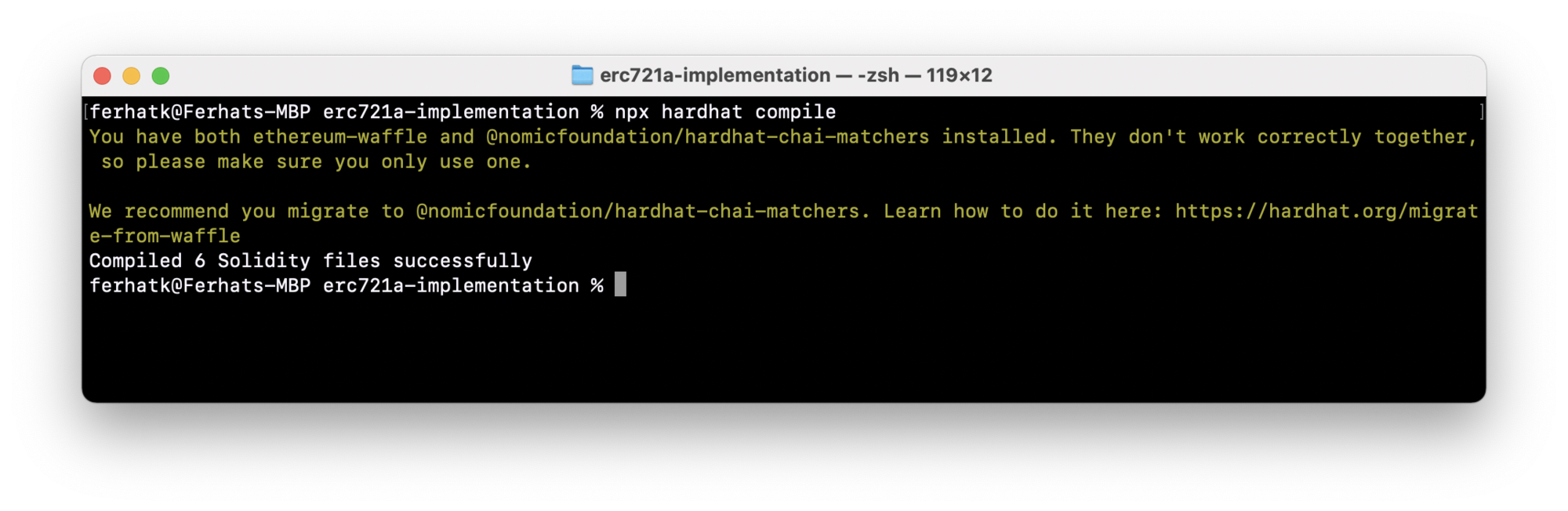
npx hardhat compile
You should see an output similar to this:
Now we will need to configure the Hardhat deployment script (scripts/deploy.js) and our Hardhat settings (hardhat.config.js).
First, we will create a script to deploy the contract. In the scripts directory, edit the contents of the deploy.js file to include the following code logic:
const hre = require("hardhat");

async function main() {

  const latestBlock = await hre.ethers.provider.getBlock("latest")
  //const add100BlocksToCurrent = latestBlock.timestamp + 1000;

  const BatchNFTs = await hre.ethers.getContractFactory("BatchNFTs");
  const batchNFTs = await BatchNFTs.deploy(latestBlock.timestamp, false);

  await batchNFTs.deployed(latestBlock.timestamp);

  console.log(
    `Deploy ERC721A contract and schedule mint to open on block ${latestBlock.timestamp}`,
    `Deployed to https://mumbai.polygonscan.com/address/${batchNFTs.address}`
  );
}

main().catch((error) => {
  console.error(error);
  process.exitCode = 1;
});
Let's recap the code.
- Line 1: Import the hardhat dependency.
- Line 3: Declare an async function called main.
- Line 5: Retrieve the latest block using Ethers.js and the PRIVATE_KEY we will define later in .env.
- Line 6: You can uncomment this line to use a start time in the future.
- Line 8: Create an instance of the BatchNFTs contract as described by the interface and bytecode initcode.
- Line 9: Deploy the BatchNFTs contract.
- Line 11: Define the callback once the contract is deployed.
- Lines 13-17: Define print statements that output the contract address and start time for minting NFTs.
- Lines 19-22: Declare the main function and attach a callback for catching errors.
Next, open up the hardhat.config.js file and update the contents to include the following code:
require("@nomicfoundation/hardhat-toolbox");
require("dotenv").config();

/** @type import('hardhat/config').HardhatUserConfig */
module.exports = {
  solidity: {
    version: "0.8.17",
    settings: {
      optimizer: {
        enabled: true,
        runs: 200
      }
    }
  },
  networks: {
    hardhat: {
    },
    mumbai: {
      url: process.env.RPC_URL,
      accounts: [process.env.PRIVATE_KEY]
    }
  },
};
Then, in your .env file, add your HTTP Provider URL and private key in the following format:
RPC_URL=YOUR_QUICKNODE_HTTP_URL
PRIVATE_KEY=YOUR_PRIVATE_KEY
Remember to save the file.
Now that all the contract code, scripts, and environment files are configured, we can move on to deploying the ERC721A contract. At this point, the account you are using to deploy the contract should be funded with some testnet MATIC tokens.
Upon successfully completing all the sections above, run the following command to deploy the contract to Mumbai testnet.
npx hardhat run --network mumbai scripts/deploy.js
Note you can also replace mumbai in the command above with localhost to test in a local environment. It would be best if you also ran "npx hardhat node" in your terminal to start a JSON-RPC server on top of Hardhat Network.
You should see the following output in your terminal:
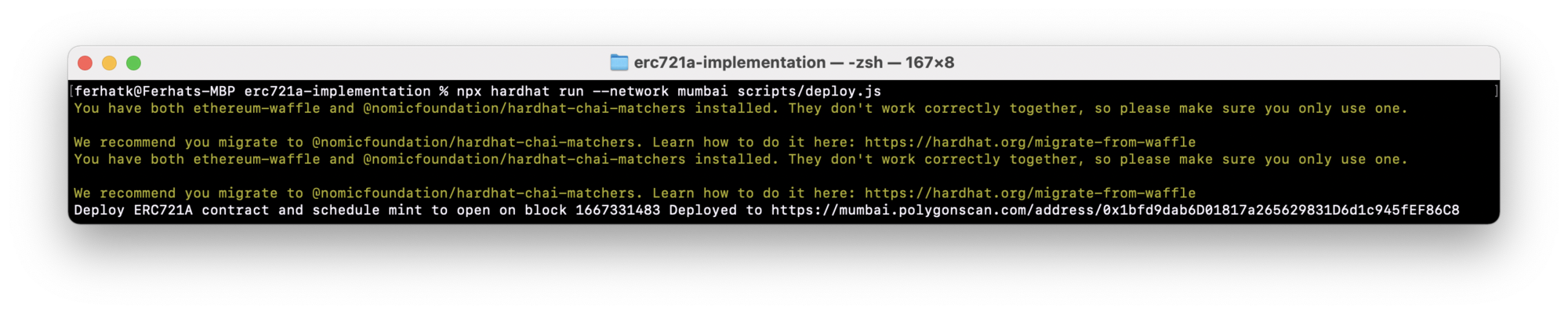
You can copy and paste the URL to see the transaction on Polygonscan
If you want to verify your contract source code on a block explorer, check out the PolygonScan API and this Hardhat reference.
Batch Minting NFTs Using the ERC721A Contract
With our ERC721A contract deployed, we can now test the batch minting function of the contract.
In your project's scripts directory, create a file called mint.js and add the following code:
const hre = require("hardhat");

async function main() {

    const contractAddress = "BATCHNFTS_CONTRACT_ADDRESS";
    const recieverAddress = "RECEIVER_ADDRESS"
    const batchNFTs = await hre.ethers.getContractAt("BatchNFTs", contractAddress);

    const mintTokens = await batchNFTs.mint(recieverAddress, 3, { value: ethers.utils.parseEther("0.03") });
    console.log(`Transaction Hash: https://mumbai.polygonscan.com/tx/${mintTokens.hash}`);
}

main().catch((error) => {
  console.error(error);
  process.exitCode = 1;
});
Make sure to replace the YOUR_CONTRACT_ADDRESS & RECEIVER_ADDRESS placeholder with the address of your smart contract and the receiver address.
Let's recap the code.
- Line 1: Import the Hardhat dependency
- Line 3: Declare the async main function
- Lines 5-6: Declare our contracts address and receiver address
- Line 7: Declare an instance of our contract with Ethers.js by inputting the contract representation and public address
- Line 9: Call the mint function which we request 3 NFTs to the receiver address and pass along 0.03 MATIC (i.e., 0.01 MATIC for each NFT)
- Line 10: Output the transaction hash
- Lines 13-16: Declare the main function and add an additional callback to catch errors
The moment you have been waiting for. To mint NFTs from the contract you deployed, run the following command:
npx hardhat run --network mumbai scripts/mint.js
Note you must have at least .03 MATIC as each mint costs .01 MATIC. You can get additional testnet MATIC from the Quicknode Faucet or Polygon Faucet.
It could take a few minutes for the transaction to be processed. However, when it is completed, the output should look like this:
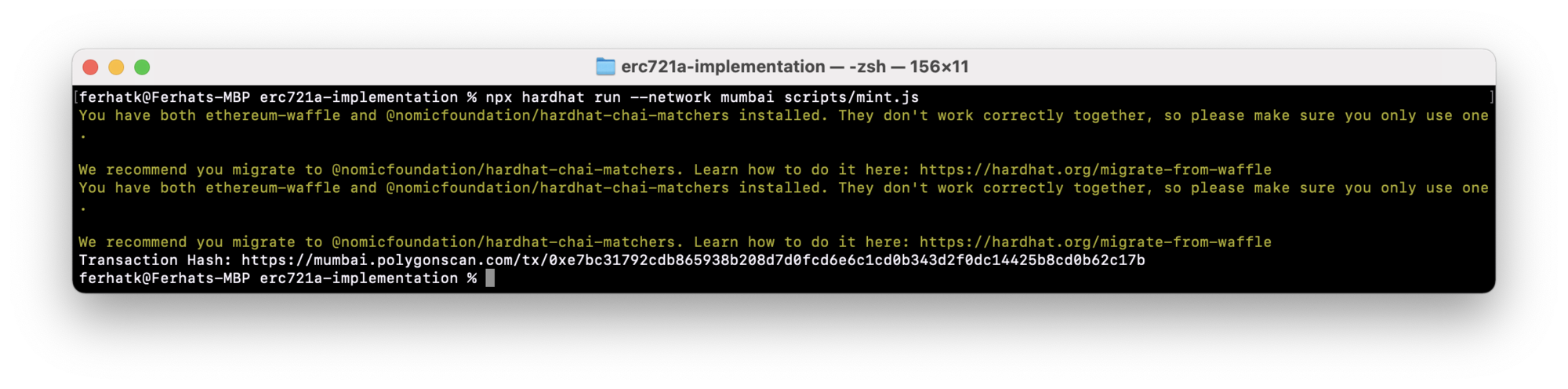
You can navigate to Polygonscan to view the transaction your NFTs were minted from.
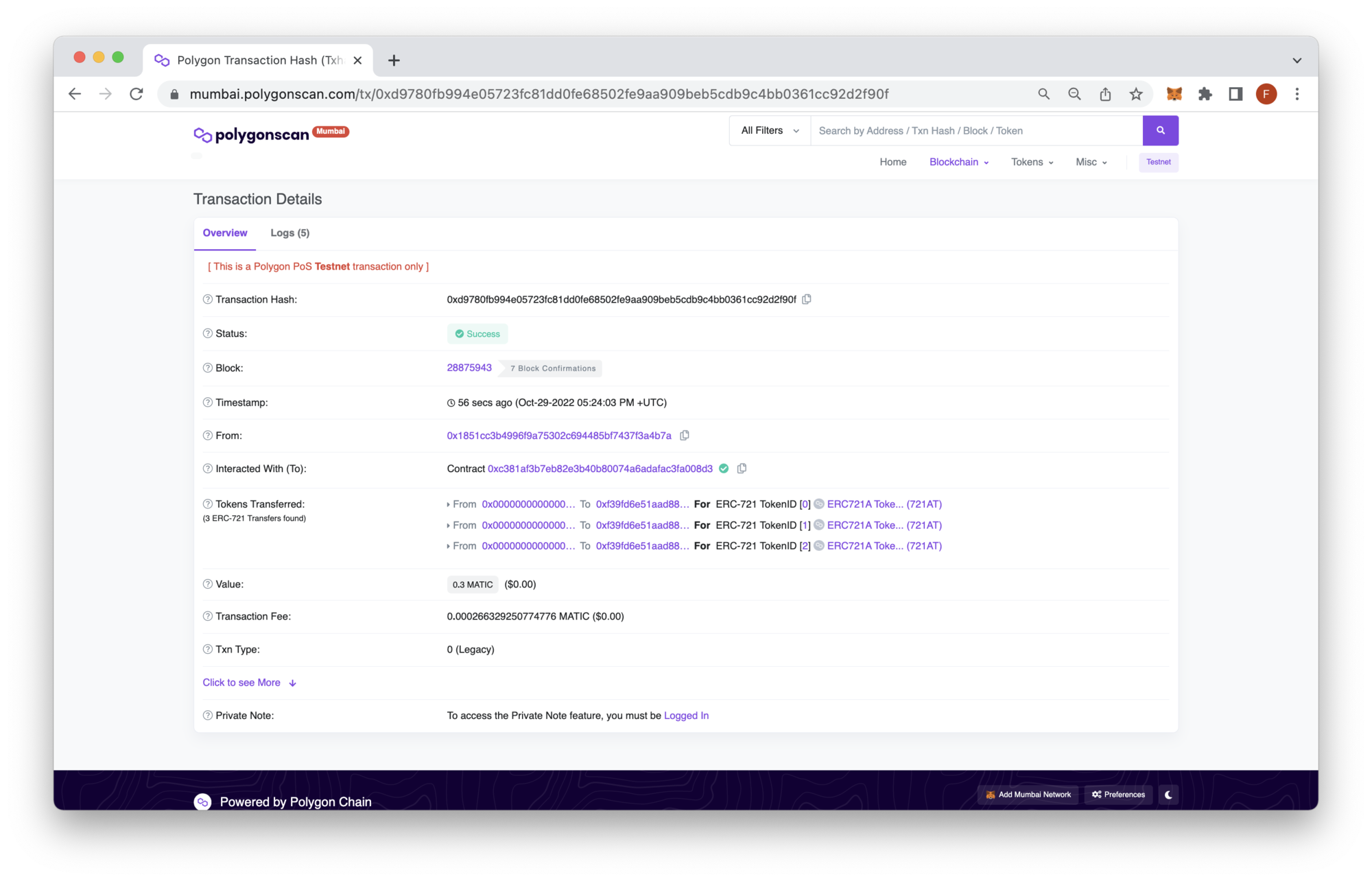
If your curious about setting Metadata in your NFTs, check out some of our other guides such as "How to Create and Deploy a ERC721 NFT" and "How to Create and Deploy a ERC1155 NFT".
Get the entire code from this GitHub repo.
References
結語
Kudos! You now know how to create, deploy and mint multiple NFTs in one transaction using the ERC721A implementation.
Join our Discord if you have any questions, or reach out to us via Twitter.