Denim activated on Base Mainnet on November 5, 2026 at 18:00 UTC and on Base Sepolia on October 21, 2026. Both networks now produce canonical 200ms blocks. Flashblocks streams no longer return data, and pending resolves to the latest canonical block.
This app documents the former Flashblocks demo. Its screenshots and comparison results describe behavior before Denim; you can no longer reproduce the Flashblocks speed comparison on either network.
For a current integration, use the standard Viem base or baseSepolia chain, remove preconfirmation overrides, and read canonical state with latest. Replace newFlashblocks with newHeads, pendingLogs with logs, and newFlashblockTransactions with newHeads followed by fetching each block's transactions. See the Denim migration guide.
Flashblocks Base App (Historical)
Historical Base Flashblocks demo. Denim retired Flashblocks on Mainnet and Sepolia; migrate to canonical 200ms blocks.


Overview
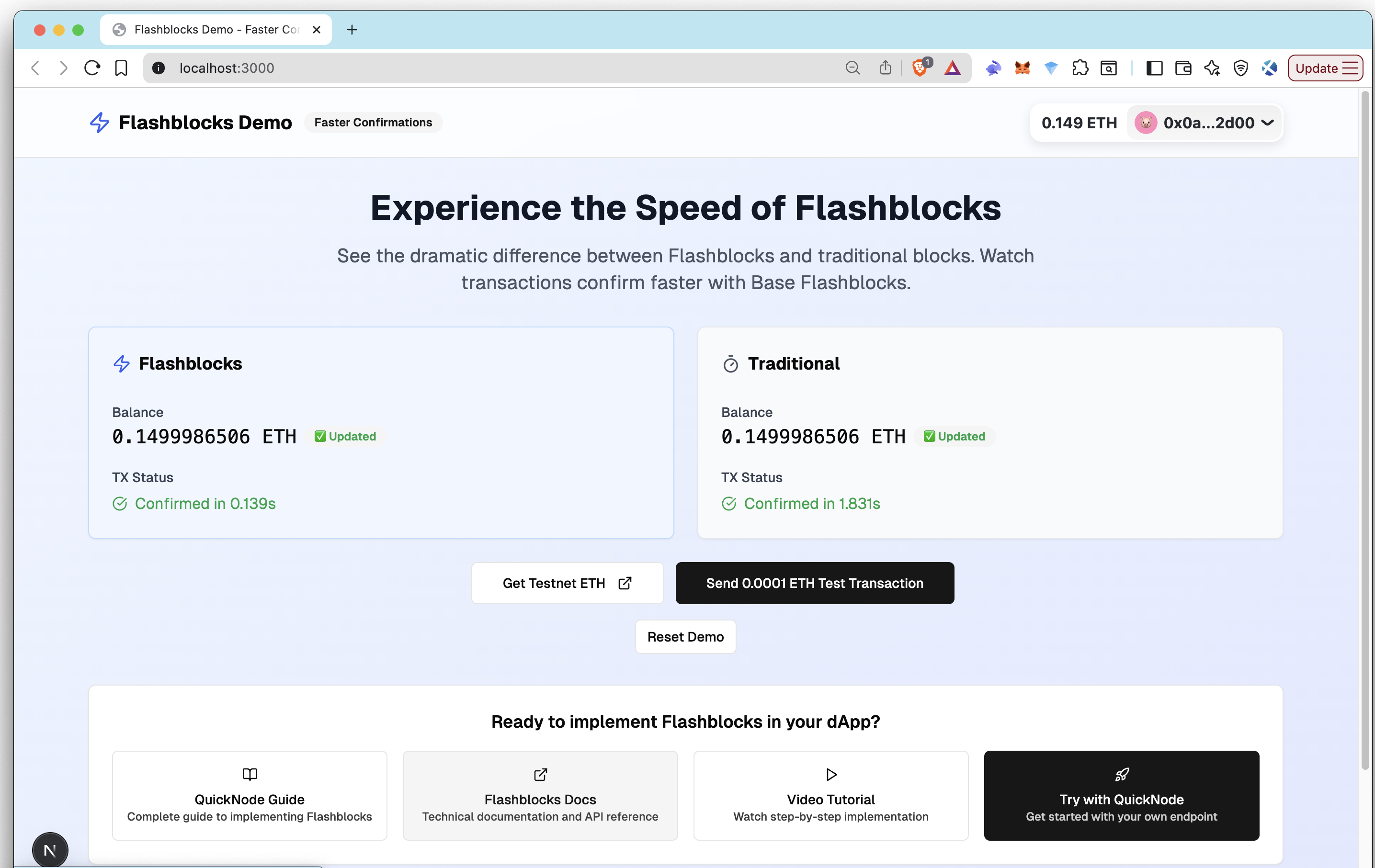
The original demo compared preconfirmed and canonical transaction inclusion on Base Sepolia in a side-by-side dashboard.
This example app is provided for educational and demonstration purposes only.
For an in-depth guide on implementing Flashblocks in your own applications, check out our comprehensive guide on Quicknode
To learn more about Flashblocks, check out our What are Flashblocks on Base video.
Features
- ⚡ Side-by-Side Comparison: Live visual comparison of Flashblocks vs Traditional transaction confirmations
- 🔄 Transaction Tracking: Send test transactions and monitor confirmation speeds using
getBlockpolling - 🎯 Dual Client Architecture: Simultaneous monitoring with both
baseSepoliaPreconfandbaseSepoliachains
Technology Stack
Frontend Framework
- Next.js: React framework with App Router for optimal performance
- TypeScript: Type-safe development experience
- Tailwind CSS: Utility-first CSS framework for rapid UI development
- shadcn/ui: Modern, accessible React component library
Web3 Integration
- Viem: TypeScript-first Ethereum interface with Flashblocks support
- Wagmi: React hooks for Ethereum interactions
- RainbowKit: Beautiful wallet connection experience
- Base Sepolia: Testnet for Flashblocks demonstration
Original Demo Requirements
- Node.js 18+ and pnpm (or npm/yarn)
- A pre-Denim Base Sepolia RPC that served Flashblocks preconfirmations
- Project ID from Reown (formerly WalletConnect)
- Browser wallet with Base Sepolia support (MetaMask, Rabby, etc.)
- Small amount of Base Sepolia ETH for testing (available from Quicknode's faucet)
Base Sepolia RPC Configuration
The original comparison used a public preconfirmation RPC for pending and a second RPC for latest. Base Sepolia now returns canonical state for both.
Setting Up Reown (formerly WalletConnect)
-
Create Project: Head to Reown Cloud and create a new project for wallet connectivity.
-
Get Project ID: Copy your Project ID from the project dashboard for use in the application configuration.
Archived Setup
1. Clone the Repository
git clone https://github.com/quiknode-labs/qn-guide-examples.git
cd qn-guide-examples/sample-dapps/flashblocks-base
2. Install Dependencies
pnpm install
# or using npm
npm install
# or using yarn
yarn install
3. Environment Configuration
cp .env.example .env.local
Edit .env.local:
NEXT_PUBLIC_FLASHBLOCKS_RPC_URL=
NEXT_PUBLIC_BASE_SEPOLIA_RPC_URL=

# WalletConnect Project ID (Required)
NEXT_PUBLIC_WALLETCONNECT_PROJECT_ID=your_walletconnect_project_id_here
These archived settings represent browser-facing URLs configured by the app operator. Base Sepolia no longer serves Flashblocks preconfirmations.
4. Run Development Server
pnpm dev
# or using npm
npm run dev
# or using yarn
yarn dev
The original app ran at http://localhost:3000. Its Flashblocks speed comparison is no longer reproducible after Denim.
How It Works
Transaction Confirmation Strategy
The app uses Viem's getBlock method with different client configurations to demonstrate the speed difference:
- Flashblocks Client: Uses
baseSepoliaPreconfchain which automatically applies thependingtag - Traditional Client: Uses standard
baseSepoliachain withlatesttag
// Flashblocks client
export const flashblocksClient = createPublicClient({
  chain: baseSepoliaPreconf, // Auto-uses "pending" for Flashblocks
  transport: http(flashblocksRpc),
})

// Traditional client
export const traditionalClient = createPublicClient({
  chain: baseSepolia, // Standard blocks with "latest"
  transport: http(canonicalRpc),
})
Note: This polling implementation is optimized for demonstration purposes. Production applications should use
waitForTransactionReceiptfor better performance.
The Flashblocks Advantage
- 10x Faster Confirmations: See transactions confirm in 200-600ms vs 2-4 seconds
- Progressive Updates: Watch as 10 flashblocks build into 1 complete block
- Same Security: Cryptographic guarantees maintained with faster feedback
- Better UX: Near-instant feedback matches Web2 user expectations
Preview
Learn More
- Quicknode Flashblocks Documentation
- Video: Flashblocks Technical Deep Dive
- Base Flashblocks Official Docs
- Viem Documentation
- Fork the repository
- Create a feature branch:git checkout -b feature/amazing-feature
- Commit your changes:git commit -m "Add amazing feature"
- Push your branch:git push origin feature/amazing-feature
- Open a Pull Request.