Hypercore for Hyperliquid Enters Public Beta
Hypercore for Hyperliquid Enters Public Beta
Quicknode has released Hypercore for Hyperliquid in public beta, giving builders filtered access to Hyperliquid data via Streams, gRPC, and JSON-RPC.

January 20, 2026 — 3 min read
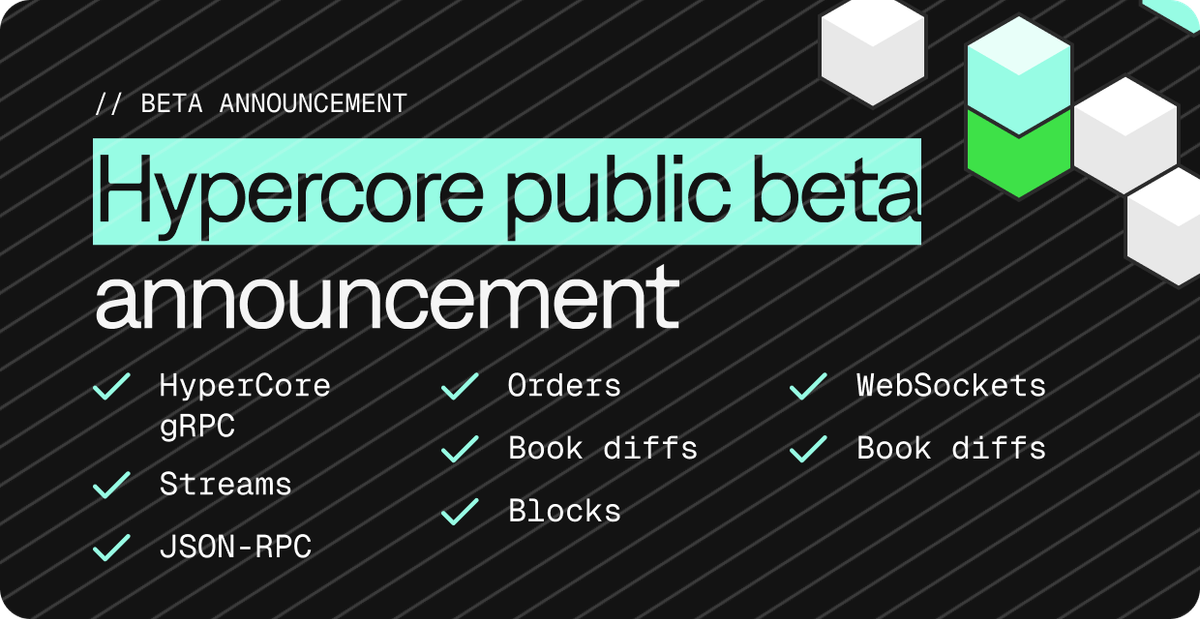
Quicknode is making Hypercore powered access to Hyperliquid data available in public beta.
This release gives builders production-ready access to Hyperliquid data through Streams, gRPC, and JSON-RPC, without the operational burden of running and maintaining custom infrastructure.
This is a public beta, and we expect to make updates as we learn from real usage as teams run Hypercore at scale.
Why this matters for Hyperliquid builders
Hyperliquid’s architecture enables high-performance trading systems, real-time order books, and rich onchain trading semantics. As teams move from experimentation into production, the way data is delivered becomes as important as the data itself.
Hyperliquid operates at very high throughput, producing blocks at ~12 blocks per second under normal conditions, which quickly turns raw data access into an operational challenge as systems scale.
Many teams begin with familiar patterns:
Polling JSON-RPC endpoints
Using WebSockets broadly for real-time updates
Running nodes or building custom indexers to fill gaps
This approach can work early on. Over time, it becomes harder to operate reliably as volume increases, systems grow more complex, and latency requirements tighten.
The Hypercore public beta introduces a more durable data delivery model for these conditions.
What’s included in the public beta
This public beta makes the following Hypercore-powered capabilities available for Hyperliquid:
Streams support for Hypercore datasets, enabling filtered, push-based delivery of Hyperliquid data
gRPC APIs designed for high-volume, low-latency data pipelines
JSON-RPC and WebSocket-related methods for compatibility with existing workflows
Access is provided via endpoint creation, reflecting a production-focused beta.
No add-on is required. Hypercore capabilities for Hyperliquid are available on all paid Quicknode plans.
How Hypercore changes the data model
Hypercore indexes and structures Hyperliquid data centrally, shifting teams away from collect-everything pipelines toward filtered, upstream data delivery based on what their systems actually need.
Instead of collecting everything and filtering downstream, teams can:
Subscribe to specific datasets such as trades, orders, book updates, or blocks. For example, trading teams can subscribe only to specific markets or event types instead of ingesting the full Hyperliquid data stream
Apply filtering upstream before data reaches their systems
Choose delivery mechanisms that better suit sustained, real-time workloads
Streams and gRPC are well suited for continuous, high-throughput pipelines, while JSON-RPC and WebSockets remain available where request-response or event-based access makes sense.
The goal is not to replace familiar access patterns, but to give teams more control over how data is delivered as their systems grow.
定价
Hypercore usage is metered in API credits based on data volume across Streams, gRPC, and WebSocket-related methods.
View current pricing: https://www.quicknode.com/api-credits/hyperliquid
Beta posture and next steps
The focus is on real usage under production conditions, understanding behaviour at scale, and incorporating feedback from teams building serious systems on Hyperliquid. We expect to iterate based on what we learn as usage grows.
Broader amplification, case studies, and live formats can follow once early usage and proof points emerge.
If you’re building on Hyperliquid and want to explore a more scalable data delivery model, you can get started today.
Create an endpoint | Read the documentation
关于Quicknode
Quicknode 成立于 2017 年,Quicknode 为开发者和企业Quicknode 机构级区块链基础设施。凭借 99.99% 的运行时间以及对 80 多条区块链的支持,各团队能够毫无妥协地构建和扩展链上应用。
随时掌握最新动态
将最新的工程见解、产品更新和 Web3 资讯直接发送至您的收件箱。