Blog>Quicknode vs Alchemy: 82 Days of Solana RPC Latency Data
Blog>Quicknode vs Alchemy: 82 Days of Solana RPC Latency Data
Quicknode vs Alchemy: 82 Days of Solana RPC Latency Data
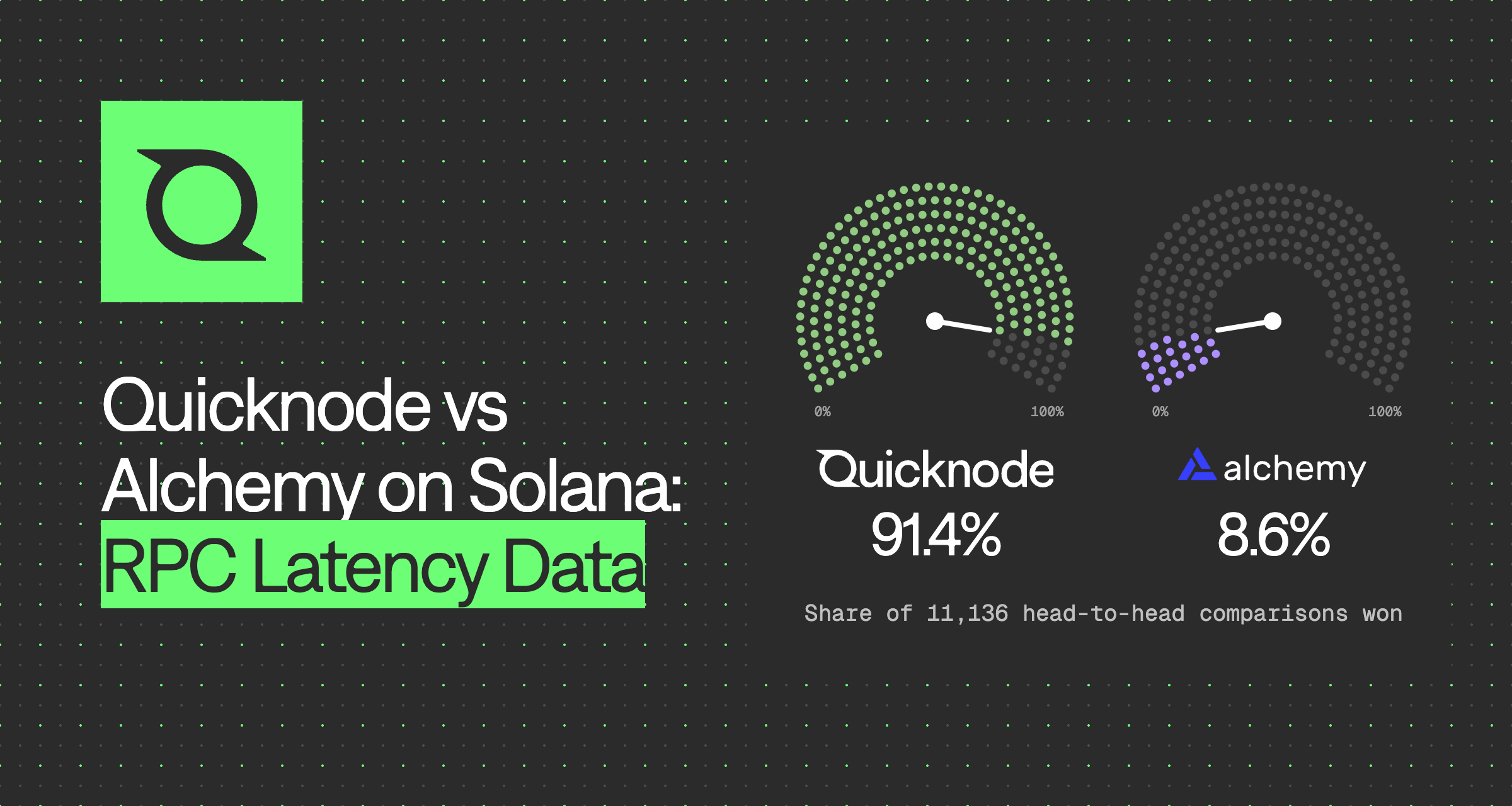
Quicknode led the daily Solana RPC latency comparison vs Alchemy on all 82 scored days, with lower latency in 91.4% of 11,136 head-to-head measurements.
Alchemy and Quicknode both run Solana RPC at scale. To compare them on neutral ground, we used the Solana Foundation's public RPC latency monitor: an open-source runner that probes six providers the same way from 29 locations.
On that monitor, Quicknode led the daily latency comparison on all 82 scored days, from July 16 through October 5, 2026. Across 11,136 head-to-head measurements, Quicknode recorded lower latency in 91.4%.
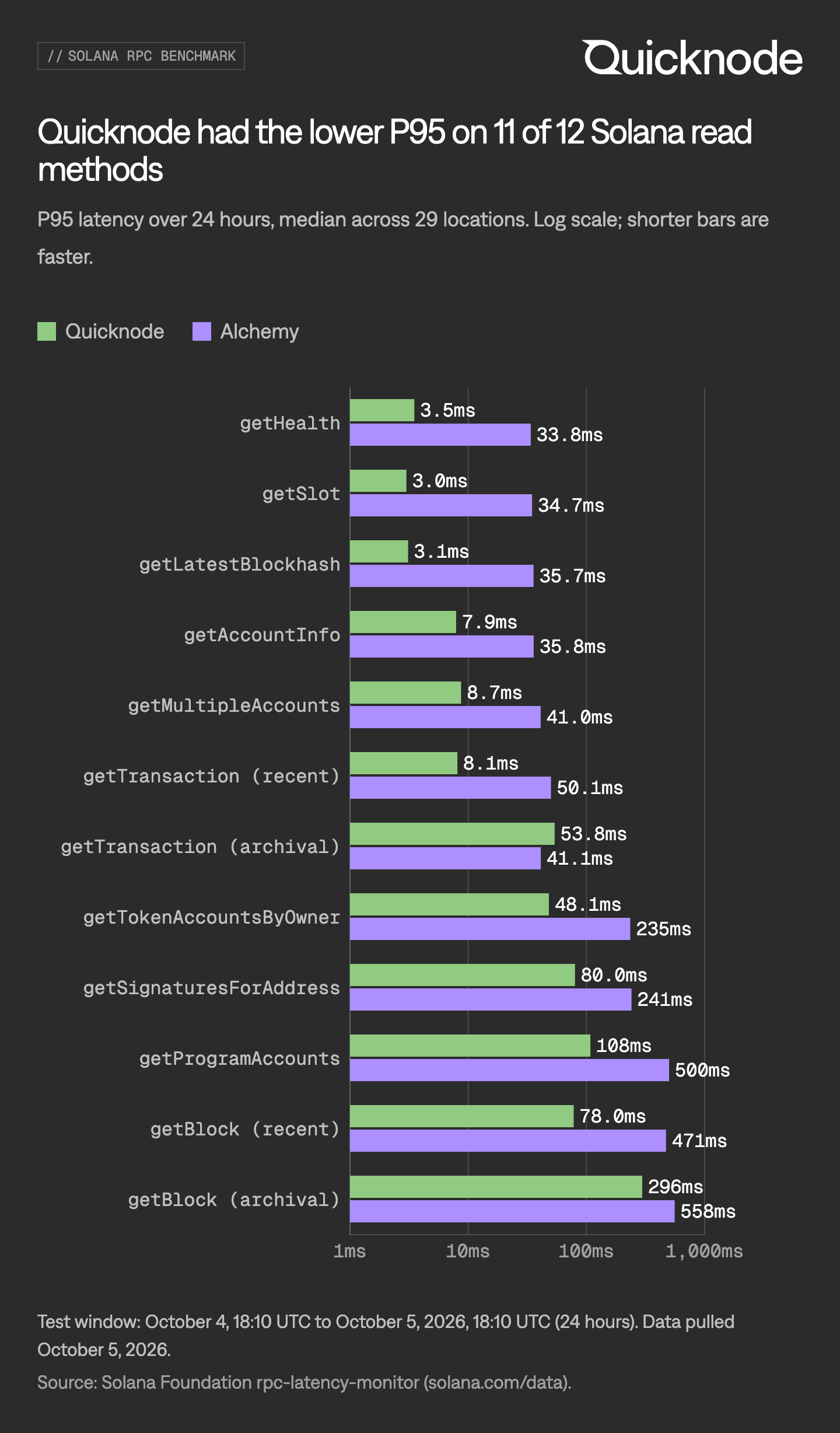
Quicknode, on 11 of the 12 Solana read methods the Solana Foundation measures. Here is the result in numbers:
Quicknode recorded lower latency in 10,182 of 11,136 head-to-head measurements (91.4%) across 12 read methods, 29 locations, four latency measures, and eight time windows.
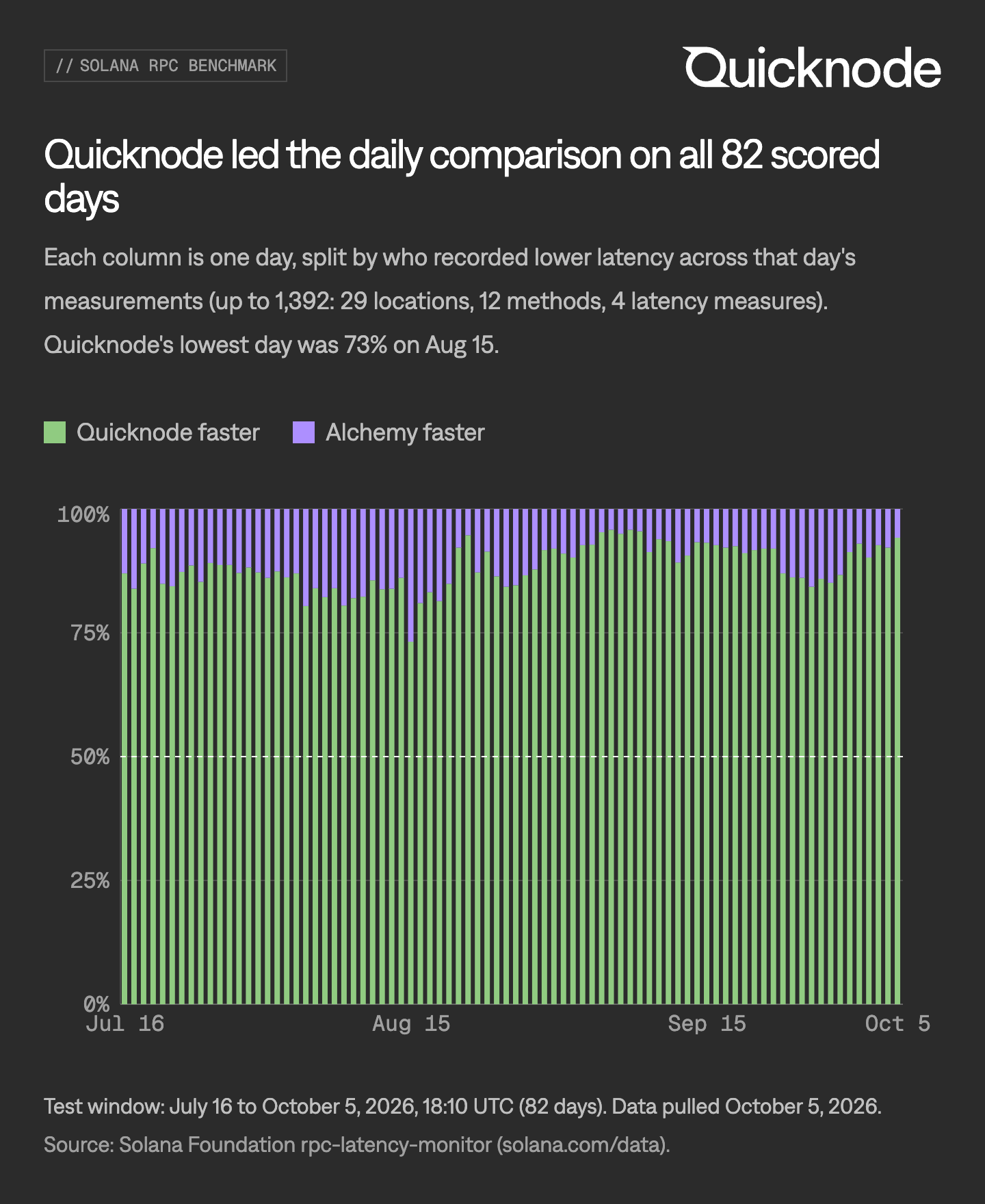
Quicknode led the daily comparison on all 82 scored days, July 16 through October 5, 2026.
Light calls ran about 11x faster in the 24 hours to October 5, 2026: getSlot P50 was 1.9ms for Quicknode and 20.5ms for Alchemy.
Heavy reads showed the largest absolute gaps: recent getBlock P95 was 78.0ms vs 471ms, and getProgramAccounts P95 was 108ms vs 500ms.
The one close call is archival getTransaction, where Alchemy posted the lower 24-hour medians.
How the Solana Foundation measures RPC latency
The Solana Foundation runs rpc-latency-monitor as a neutral measurement party for its VIP Trading Program. The Foundation doesn't run RPC infrastructure. It probes every provider the same way from the same vantage points, and the code is open source under Apache 2.0. Results are public on the Solana Foundation RPC dashboard.
The dashboard covers 29 locations on four infrastructure types: Teraswitch, Latitude, AWS, and Google Cloud. Each location probes 12 read methods and reports average, P50, P95, and P99 latency, plus error rate, for each provider.
The probes are built so a provider can't win on cached or empty answers:
No-cache requests. Every request sets no-cache headers, and targets move each cycle. Account reads rotate over real accounts seen in recent blocks rather than one fixed address.
Real work. Recent getBlock fetches full transaction details, and getProgramAccounts returns real account data across a rotating set of query shapes.
Empty answers fail. A 200 response with an empty, null, or truncated payload counts as a failure, not a fast success.
Archival reads are randomized. Every provider gets the same random, never-repeated block from roughly 40 million slots back, so nothing can be pre-cached.
How we scored Quicknode vs Alchemy
We pulled every location, method, and time window the dashboard publishes on October 5, 2026, between 18:10 and 18:19 UTC. The data runs through October 5, 2026 at 18:10 UTC, and the monitor's history starts on July 16, 2026.
For each combination, we compared Quicknode's and Alchemy's reported values for average latency, P50, P95, and P99. Each value is the mean of the dashboard's data points for that series across the time window. That gives 11,136 head-to-head measurements: 29 locations, 12 methods, 4 latency measures, and 8 time windows.
For the daily view, we scored each day on its own. A day goes to whichever provider recorded lower latency in more of that day's measurements, up to 1,392 per day (29 locations, 12 methods, and 4 latency measures). Days where fewer than 80% of series reported are left out.
Quicknode vs Alchemy latency by Solana RPC method
In the 24 hours to October 5, 2026, Quicknode had the lower P95 on 11 of 12 methods. The gap ranges from about 2x on archival getBlock to more than 10x on light calls.
Tested October 4 to 5, 2026 (24 hours), data pulled October 5, 2026. Quicknode had the lower P95 on 11 of 12 Solana read methods; Alchemy led on archival getTransaction. Source: Solana Foundation rpc-latency-monitor.
Each figure is the median across 29 locations of that provider's reported value for the 24-hour window ending October 5, 2026 at 18:10 UTC. Lower is faster. The last column counts the days, out of 82, on which Quicknode led on that method.
方法
Quicknode P50
Alchemy P50
Quicknode P95
Alchemy P95
Days Quicknode faster (of 82)
getHealth
1.9ms
20.4ms
3.5ms
33.8ms
82
getSlot
1.9ms
20.5ms
3.0ms
34.7ms
82
getLatestBlockhash
1.9ms
20.4ms
3.1ms
35.7ms
82
getAccountInfo
3.3ms
20.5ms
7.9ms
35.8ms
81
getMultipleAccounts
4.0ms
20.6ms
8.7ms
41.0ms
81
getTransaction (recent)
3.3ms
29.8ms
8.1ms
50.1ms
81
getTransaction (archival)
21.5ms
20.8ms
53.8ms
41.1ms
75
getTokenAccountsByOwner
16.7ms
76.0ms
48.1ms
235ms
82
getSignaturesForAddress
24.0ms
156ms
80.0ms
241ms
82
getProgramAccounts
27.0ms
102ms
108ms
500ms
82
getBlock (recent)
28.6ms
271ms
78.0ms
471ms
82
getBlock (archival)
167ms
357ms
296ms
558ms
82
Light calls: about 11x faster
getHealth, getSlot,以及 getLatestBlockhash returned in 1.9ms at the median location for Quicknode and about 20ms for Alchemy. Account reads follow the same pattern: getAccountInfo at 3.3ms vs 20.5ms and getMultipleAccounts at 4.0ms vs 20.6ms. These are the calls a trading bot or wallet makes most often, so small per-call differences add up across a session.
Heavy reads: the largest absolute gaps
Recent getBlock came back in 28.6ms vs 271ms at P50. getSignaturesForAddress ran 24.0ms vs 156ms, getTokenAccountsByOwner 16.7ms vs 76.0ms, and getProgramAccounts 27.0ms vs 102ms. The tails spread further: getProgramAccounts P95 was 108ms for Quicknode and 500ms for Alchemy.
Archival getTransaction: close, with Alchemy ahead on 24-hour medians
This is the one method where the two providers are near even. In the 24 hours to October 5, 2026, Alchemy's median P50 was 20.8ms against Quicknode's 21.5ms, and its P95 was 41.1ms against 53.8ms. Across all time windows, Quicknode was faster in 68.5% of comparisons on this method and on 75 of 82 days, so the lead holds over time but it is narrow. Teams with archival-heavy workloads should test this call on their own traffic.
Does Quicknode stay faster than Alchemy over time?
A single snapshot can reflect one good hour. The more useful question is whether the result repeats. It does: Quicknode led the daily comparison on all 82 scored days, and its daily share never fell below 73%.
Tested July 16 to October 5, 2026, data pulled October 5, 2026. Quicknode was faster in most of each day's 348 comparisons on all 82 days, and never below 73%. Source: Solana Foundation rpc-latency-monitor.
On 11 of the 12 methods, Quicknode was faster on at least 81 of the 82 days.
Across the eight time windows, from 30 minutes to one year, Quicknode's share ranged from 88.6% to 94.3%.
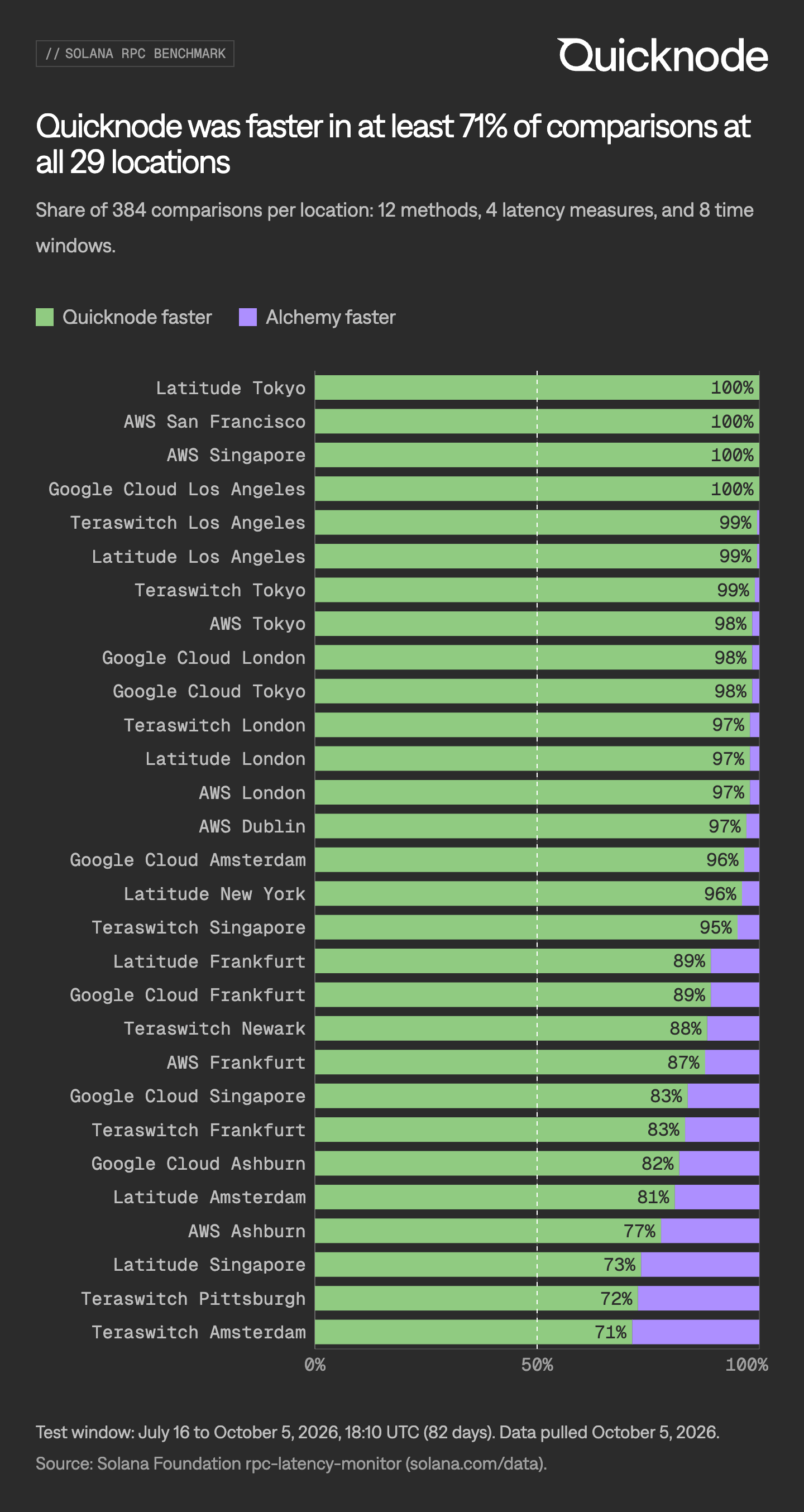
Quicknode was faster in at least 71% of comparisons at every one of the 29 locations. The closest were Teraswitch Amsterdam (71.4%), Teraswitch Pittsburgh (72.7%), and Latitude Singapore (73.4%).
Broken down by method and location, Quicknode won every one of the 32 comparisons in 208 of 348 pairs. Alchemy led in 11, and 9 of those were archival getTransaction. Here is every location:
Tested July 16 to October 5, 2026, data pulled October 5, 2026. Quicknode was faster in at least 71% of comparisons at every location, and in every comparison at four of them. Source: Solana Foundation rpc-latency-monitor.
The result also holds on every infrastructure type the monitor uses:
基础设施
Comparisons
Quicknode faster
AWS
2,688
94.2%
Google Cloud
2,688
92.6%
Latitude
2,688
91.0%
Teraswitch
3,072
88.4%
Error rates
Latency only matters if the request succeeds. In the 24 hours to October 5, 2026, the median error rate was 0% for both providers on 10 of the 12 methods. Alchemy's median was 0.34% on getProgramAccounts, and Quicknode's was 0.52% on getSignaturesForAddress.
What this comparison doesn't cover
Writes. The Foundation monitor measures reads only, so sendTransaction and transaction landing are out of scope.
Other providers. The Foundation monitor tracks six Solana providers and this post compares two. The full field is on the Solana Foundation RPC dashboard.
Test it on your own workload
Public data narrows the shortlist. Your own traffic makes the decision. Point the methods your app calls most at both providers, from the region closest to your users, and compare P95 rather than averages. See Solana RPC on Quicknode for endpoints, supported methods, and archive access.
常见问题
Is Quicknode faster than Alchemy on Solana?
On the Solana Foundation's public RPC monitor, Quicknode led the daily latency comparison on all 82 scored days from July 16 through October 5, 2026. Across 11,136 head-to-head measurements covering 12 read methods and 29 locations, Quicknode recorded lower latency in 91.4%.
Which Solana RPC methods show the biggest difference?
Heavy reads. In the 24 hours to October 5, 2026, recent getBlock P95 was 78.0ms on Quicknode vs 471ms on Alchemy, and getProgramAccounts P95 was 108ms vs 500ms. Light calls such as getSlot ran about 11x faster on Quicknode.
Where is Alchemy competitive with Quicknode on Solana?
Archival getTransaction. Alchemy posted lower 24-hour medians on that method (20.8ms vs 21.5ms at P50), though Quicknode was faster on 75 of 82 days.
How was this Quicknode vs Alchemy comparison measured?
We pulled every location, method, and time window from the Solana Foundation's public RPC monitor on October 5, 2026 and compared the two providers' reported average, P50, P95, and P99 latency for each combination, 11,136 measurements in all. Each day was also scored on its own across up to 1,392 measurements.
What is P95 latency and why does it matter for Solana RPC?
P95 is the response time that 95% of requests come in under. It captures the slow tail that an average hides, which is what a trading bot or wallet feels during busy periods. A provider with a low average but a high P95 still causes timeouts.
Who runs the Solana Foundation RPC monitor?
The Solana Foundation runs it as an independent measurement party for its VIP Trading Program. The Foundation does not operate RPC infrastructure, the runner is open source under Apache 2.0, and results are published at solana.com/data.