Blog>Hyperliquid Le peering Sentry expliqué : comment les pairs dédiés modifient le fonctionnement des nœuds
Blog>Hyperliquid Le peering Sentry expliqué : comment les pairs dédiés modifient le fonctionnement des nœuds
Hyperliquid Le « Sentry Peering » expliqué : comment les pairs dédiés modifient le fonctionnement des nœuds
Qu'est-ce que le peering « sentry » d'Hyperliquid ? Pourquoi les opérateurs de nœuds ont-ils besoin de pairs dédiés ? Comment configurer votre nœud ? Et comment fonctionne le service de peering à 500 $ par mois proposé par Quicknode?
Hyperliquid Le « sentry peering » est une connexion directe entre un nœud non validateur Hyperliquid géré en propre et des nœuds « sentry » dédiés. Ainsi, le nœud reçoit les blocs et l'intégralité du mempool via des pairs stables figurant sur une liste blanche, plutôt que via des pairs racine publics dont la disponibilité est variable. C'est l'aspect de l'exploitation d'un nœud Hyperliquid qui pose le plus de difficultés à la plupart des équipes, et c'est cet aspect qui détermine si les données de votre nœud sont suffisamment cohérentes pour permettre des transactions.
Ce guide explique ce que sont les nœuds de surveillance, pourquoi le peering est important pour les teneurs de marché et les opérateurs de nœuds, toutes les options disponibles pour mettre un nœud en peering en 2026, et comment fonctionne le service de peering proposé parQuicknode Hyperliquid au tarif de 500 $ par mois.
Qu'est-ce qu'un nœud de sentinelle sur Hyperliquid?
HyperliquidLe réseau compte trois niveaux de participants :
Les validateurs gèrent le consensus HyperBFT. Ils proposent des blocs et votent pour ceux-ci. L'ensemble actif est constitué des validateurs les mieux classés en fonction de leur mise, et les adresses IP des validateurs ne sont pas divulguées à des nœuds arbitraires.
Nœuds sentinelles sont des nœuds non validateurs fonctionnant parallèlement aux validateurs. Dans le logiciel officiel du nœud, chaque validateur peut enregistrer jusqu'à deux pairs non validateurs en tant que sentry_ips. Les « Sentries » se situent à un pas du consensus, absorbent le trafic public et protègent le validateur. Elles peuvent servir de nœuds racine, de serveurs API et d’interfaces RPC EVM.
Les nœuds non validateurs ne nécessitent aucune autorisation. Tout le monde peut en exploiter un en suivant les instructions du dépôt de code «Hyperliquid ». Un nœud non validateur rejoue chaque bloc, expose les données locales streams et peut alimenter un serveur API local pour les exécutions en temps réel, les ordres et l'état du carnet d'ordres.
Le hic : un nœud non validateur ne vaut que ce que valent ses pairs. Votre nœud prend connaissance des nouveaux blocs et des transactions en attente par le biais du « gossip », et la qualité de ce « gossip » dépend entièrement des nœuds auxquels vous êtes connecté.
Pourquoi le peering est la partie la plus difficile de la gestion d'un nœud Hyperliquid
La mise en place du nœud en lui-même est bien documentée. Conformément aux exigences officielles, un nœud non validateur nécessite 16 cœurs de processeur, 128 Go de RAM, un SSD de 500 Go, Ubuntu 24.04, les ports 4001 et 4002 ouverts au public, et, dans l'idéal, un emplacement à Tokyo, puisque c'est là que se concentre l'ensemble des validateurs. Le travail quotidien commence après bloc appliqué apparaît dans vos journaux.
Par défaut, votre nœud se connecte aux pairs racines publics. Vous pouvez consulter la liste actuelle à tout moment :
Les pairs racine publics sont gratuits, mais ils posent trois problèmes :
Ils sont partagés et variables. Les nœuds racine alternent, atteignent leur capacité maximale et se déconnectent. La transmission de vos blocs dépend de la charge à laquelle ils sont soumis à un moment donné. Il en résulte une latence irrégulière, et en particulier une latence à « queue épaisse » : ce bloc occasionnel qui arrive avec quelques secondes de retard, et qui est précisément celui qu’un système de négociation ne peut se permettre de manquer.
La plupart ne passent pas par le mempool. Pour recevoir des transactions en attente d'un pair, il faut que ce dernier soit configuré pour les transférer. Or, ce n'est généralement pas le cas des pairs publics aléatoires. Si votre stratégie nécessite une visibilité avant confirmation, le « gossip » public à lui seul ne suffira pas à vous l'assurer.
La reprise après une déconnexion est lente. Lorsqu’un pair public vous déconnecte, votre nœud doit redécouvrir un pair opérationnel via le protocole « gossip » avant que l’ flow de blocs ne reprenne.
L’alternative mentionnée dans la documentation est le nœud « non validateur » de la Fondation, qui offre un pair fiable avec moins de sauts vers les validateurs. L’accès direct à ce nœud nécessite toutefois de staker 10 000 HYPE et de détenir le statut de « maker » de niveau 1, défini comme représentant plus de 0,5 % du volume pondéré des transactions sur 14 jours, et il est proposé « au mieux » sans garantie de disponibilité. Pour la plupart des équipes, cela n’est pas envisageable.
Il reste donc le « sentry peering » dédié : une connexion payante, soumise à une liste blanche, vers des nœuds Sentry gérés par des professionnels.
Ce que change réellement le peering « sentry » dédié
Le peering Sentry ne rend pas votre nœud plus rapide que le reste du réseau, et tout fournisseur prétendant que cela vous donne un avantage sur les autres participants fait de la publicité mensongère. Ce que cela change, c'est la stabilité de votre connexion :
Transmission des blocs optimisée. Un nœud dédié, situé à un saut d’un validateur, transmet les blocs selon un chemin prévisible. Cette amélioration est particulièrement visible au niveau de la latence de queue : les délais les plus longs générés par le « gossip » public disparaissent en grande partie lorsque vos nœuds sont stables et non saturés.
Transmission intégrale du mempool. Des sentinelles dédiées peuvent être configurées pour transférer les transactions en attente, ce qui permet à votre nœud d'accéder au mempool brut que les pairs publics retiennent généralement.
Récupération rapide. Grâce à la présence de plusieurs pairs autorisés répartis dans différents centres de données, une seule déconnexion n'interrompt pas l'flow des blocs, et la reconnexion ne dépend pas de la découverte par « gossip ».
Un interlocuteur à contacter. Le « peering » vers une infrastructure gérée signifie qu’un « equipe » surveille le côté « sentry » de votre connexion.
Pour les teneurs de marché, les systèmes de trading haute fréquence (HFT) et toute stratégie reposant sur le mempool sur Hyperliquid, c'est ce qui distingue un nœud sur lequel on peut effectuer des transactions d'un nœud qu'il faut surveiller de près.
Quicknode Hyperliquid Peering : 3 adresses IP de pairs « sentry », mempool complet, 500 $/mois
Quicknode Hyperliquid Peering est un service de peering Sentry à tarif forfaitaire destiné aux équipes qui exploitent leur propre nœud sans validation.
Caractéristiques techniques
Détails
Adresses IP des nœuds Sentry
3, dédié
Régions
Plusieurs centres de données, à Tokyo
Mempool
Complet, pas de compteur d'utilisation séparé
Volume observé du mempool
Environ 1,1 To/jour, en fonction de l'activité
Type de nœud pris en charge
Sans validation
SLA de disponibilité
99,99 %, avec surveillance et alertes
Assistance
Adresse e-mail directe de l'ingénieur, zone de couverture APAC
Prix
500 $ par mois ; souscription à un forfait « Quicknode » en cours de validité requise
Activation
Manuel, configuré par un ingénieur
Évaluation
7 jours à compter de l'activation, remboursement au prorata
Quelques détails qui méritent d'être soulignés :
Les pairs sont des nœuds de surveillance, et non des validateurs. Vous vous connectez à des nœuds de surveillance non validateurs qui sont eux-mêmes connectés à un validateur. Vos pairs ne participent pas au consensus, et la mise en relation entre pairs n’implique ni staking ni délégation. Les nœuds non validateurs de Quicknode, ceux qui se trouvent derrière ses points de terminaison gérés Hyperliquid , s’interconnectent via cette même couche de surveillance.
Le mempool est illimité. Avec un volume brut observé d'environ 1,1 To par jour, le coût au Go grimpe très vite. Quicknode inclut l'accès complet au mempool dans son forfait forfaitaire de 500 $, sans facturation à l'utilisation.
La mise en service est, par nature, manuelle. L'ajout à la liste blanche s'effectue par adresse IP. Un ingénieur d'Quicknode examine chaque demande, ajoute le nœud à la liste blanche et renvoie les trois adresses IP des pairs accompagnées de consignes de configuration. Il n'y a aucune exigence en matière de staking, aucun seuil de volume et aucun examen de votre candidature visant à déterminer si votre entreprise est suffisamment importante.
Comparaison de toutes les méthodes permettant de se connecter à un nœud Hyperliquid
Pairs racine publics
Nœud de base non validant
Quicknode Hyperliquid Peering
Coût
Gratuit
Gratuit, sous certaines conditions
500 $ par mois, plus un forfait actif
Conditions requises
Aucun
10 000 HYPE mis en jeu, remises pour les makers de niveau 1
Plan d'Quicknode s actives
Stabilité entre pairs
Variable, partagée
« Au mieux », sans garantie
SLA de 99,99 %, surveillé
Mempool plein
N'est généralement pas transféré
Cela dépend de la configuration
Inclus, sans limite de consommation
Redondance
Découverte d'une rumeur
Cible unique de pair
3 adresses IP réparties entre différents centres de données
Assistance
Aucun
Aucun
Ingénieur direct, horaires APAC
Comment configurer le peering Sentry d'Hyperliquid , en 4 étapes
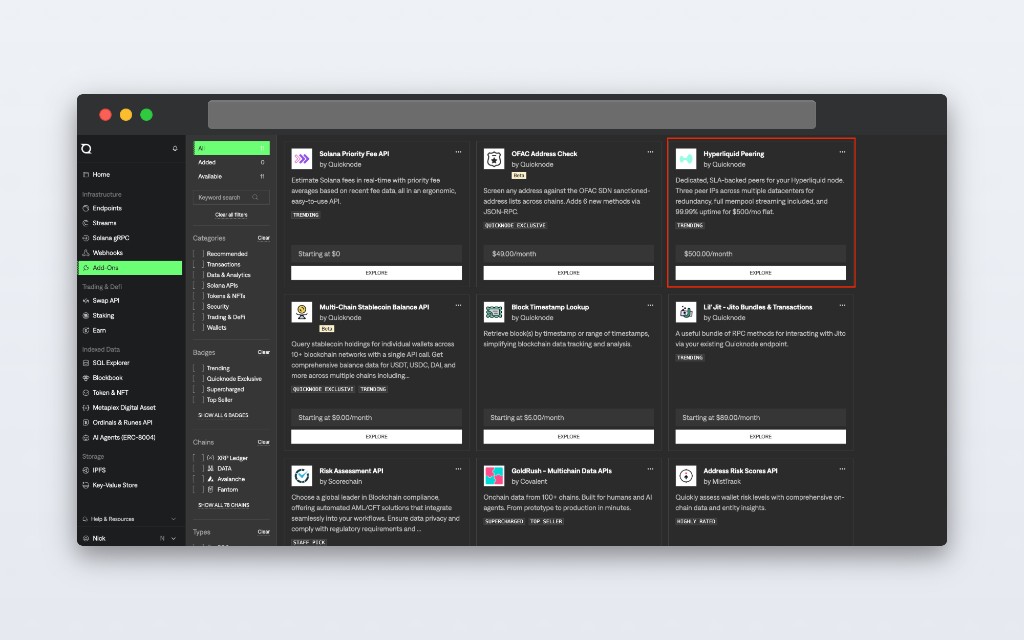
Abonnez-vous.Créez un compte Quicknode , puis accédez à la section « Modules complémentaires » dans votre tableau de bord Quicknode et sélectionnez le module complémentaire « Hyperliquid Peering » pour vous abonner au tarif de 500 $ par mois. L'abonnement est facturé lors du paiement, avec une période d'essai de 7 jours à compter de l'activation.
Envoyez-nous les informations relatives à votre nœud. Envoyez un e-mail à support@quicknode.com en indiquant l'adresse e-mail associée à votre compte et l'adresse IP publique de votre nœud.
Accueillez vos pairs. Un ingénieur ajoute votre nœud à la liste blanche et vous communique les trois adresses IP des pairs Sentry, accompagnées de conseils de configuration.
Configurer et vérifier. Ajoutez les adresses IP des pairs à ~/override_gossip_config.json et définir split_client_blocks : true. Les transactions en attente sont ensuite transmises vers ~/hl/data/mempool_txs/ sur votre serveur. Il s'agit du mécanisme standard des nœuds « Hyperliquid », et non d'une interface personnalisée ; vos outils ne subissent donc aucun changement.
Où trouver l'extension « Peering » d'Hyperliquid : ouvrez la section « Extensions » dans le tableau de bord d'Quicknode , puis sélectionnez-la (mise en surbrillance).
Au cours de cette période de 7 jours, évaluez les paramètres clés : la répartition de la latence des blocs (notamment les percentiles p95 et p99), le temps de rétablissement après des déconnexions forcées, ainsi que la capacité à fournir un flux constant de mempool pendant les périodes de forte volatilité. Si la stabilité ne répond pas à vos exigences, contactez le service d'assistance pendant cette période pour obtenir un remboursement au prorata.
Dimensionnement de votre serveur pour prendre en charge l'intégralité du mempool
Avant d'activer la livraison depuis le mempool, vérifiez trois éléments sur l'hôte du nœud : la marge de bande passante entrante pour 1,1+ To/jour, la capacité de stockage sur disque et une politique de conservation pour ~/hl/data/mempool_txs/, ainsi que la rotation des fichiers journaux, car un nœud « Hyperliquid » génère déjà à lui seul un volume important de fichiers journaux quotidiens.
Peering ou « endpoint » gérée : quelle solution vous convient le mieux ?
La question qui se pose réellement est de savoir si vous voulez un nœud ou les données d'un nœud.
Exploiter votre propre nœud non validateur implique un serveur performant, une implantation à Tokyo, une gestion quotidienne intensive des journaux et un engagement opérationnel 24 h/24, 7 j/7. Si votre equipe a déjà pris cet engagement, le peering résout le dernier problème majeur qui subsiste. Si ce n’est pas le cas, un service géré Quicknode Hyperliquid endpoint fournit des blocs, des échanges et des transactions via JSON-RPC, WebSocket, gRPC et Streams , avec une configuration instantanée en libre-service et sans nœud à gérer.
Hyperliquid Peering
Géré Hyperliquid endpoint
C'est vous qui gérez le nœud
Oui
Non
Vous vous connectez à
3 adresses IP dédiées pour les nœuds de surveillance
API gérée endpoint
Mempool
Illimité, sans forfait
Via gRPC
Configuration
Manuel, configuré par un ingénieur
En libre-service, instantané
Idéal pour
Teneurs de marché, HFT, opérateurs de nœuds propres
dApps, bots, outils d'analyse, indexeurs
Foire aux questions
Qu'est-ce que le « sentry peering » d'Hyperliquid ?
Hyperliquid Le « sentry peering » est une connexion directe, fonctionnant selon une liste blanche, entre un nœud non validateur de la Hyperliquid que vous exploitez et des nœuds Sentry dédiés. Il permet de transmettre les blocs et l'intégralité du mempool via des pairs stables, plutôt que par l'intermédiaire de pairs publics variables. Quicknode propose ce service à 500 $ par mois pour 3 adresses IP de pairs dédiées réparties dans plusieurs centres de données à Tokyo.
Dois-je faire tourner mon propre nœud Hyperliquid pour utiliser le peering ?
Oui. Le peering n’est utile que si vous exploitez déjà un nœud non validant de type « Hyperliquid ». Si vous souhaitez obtenir des données « Hyperliquid » sans gérer d’infrastructure, utilisez plutôt un service géré Hyperliquid endpoint à la place.
Quelle est la configuration matérielle requise pour un nœud non validateur de la chaîne de blocs « Hyperliquid » ?
Selon le référentiel officiel : 16 cœurs de processeur, 128 Go de RAM, un SSD de 500 Go et Ubuntu 24.04, avec les ports 4001 et 4002 ouverts au public. L'implantation à Tokyo est recommandée pour bénéficier de la latence la plus faible possible par rapport à l'ensemble des validateurs.
Comment puis-je récupérer l'intégralité du mempool d'Hyperliquid ?
Votre nœud doit établir une connexion entre pairs avec un sentinelle configuré pour transférer les transactions en attente, avec split_client_blocks : true se déroule à ~/override_gossip_config.json. Les transactions sont ensuite transmises vers ~/hl/data/mempool_txs/. Les pairs racine publics ne transmettent généralement pas les données du mempool ; les pairs « sentry » d’ Quicknode sont configurés à cet effet, sans compteur d’utilisation distinct.
Combien coûte le peering « Hyperliquid » ?
Quicknode Hyperliquid Le peering est proposé à un tarif forfaitaire de 500 $ par mois, comprenant 3 adresses IP dédiées pour les nœuds Sentry, une transmission illimitée vers le mempool et un SLA garantissant une disponibilité de 99,99 %. Un abonnement actif à « Quicknode » est requis. Le peering avec le nœud non validateur de la Fondation est gratuit, mais nécessite un staking de 10 000 HYPE et le statut de remise « Tier 1 » pour les makers.
Le « sentry peering » rendra-t-il mon nœud plus rapide que ceux des autres traders ?
Non. Le peering vous offre un chemin fiable et redondant vers les blocs et l'intégralité du mempool. Il ne vous donne pas d'avantage par rapport aux autres participants du réseau, et la latence réelle dépend de l'emplacement de votre nœud et de votre chemin réseau vers les pairs.
QuicknodeOù se trouvent les nœuds de surveillance « Hyperliquid » de ?
Dans plusieurs centres de données de la région de Tokyo, où se concentre l'ensemble des validateurs d'Hyperliquid. Les trois adresses IP de pair sont partagées après l'activation.
Que se passe-t-il si l'adresse IP de mon serveur change ?
La mise sur liste blanche s'effectue par adresse IP ; veuillez donc envoyer un e-mail avec la nouvelle adresse, de préférence avant la migration prévue, afin que la liste blanche soit mise à jour.
Comparer votre nœud
Si vous exploitez un nœud non validant de type « Hyperliquid » et que vous avez besoin de pairs dédiés, d’un mempool complet et d’un SLA réellement surveillé, le service de peering «Hyperliquid » est désormais disponible. Créez un compte, ajoutez l’extension « Hyperliquid Peering », envoyez l’adresse IP publique de votre nœud, et un ingénieur se chargera de vous mettre en relation avec les trois sentinelles. Vous n’exploitez pas de nœud ? Commencez plutôt par un service géré « Hyperliquid »: endpoint.
Fondée en 2017, Quicknode met à disposition une infrastructure blockchain de niveau institutionnel destinée aux développeurs et aux entreprises. Grâce à une disponibilité de 99,99 % et à la prise en charge de plus de 75 chaînes, les équipes peuvent développer et faire évoluer des applications sur la chaîne sans aucun compromis.