Respuestas>Más información sobre la Capa 2 y los rollups>Rollups optimistas frente a rollups ZK
Rollups optimistas frente a rollups ZK
// Tags
rollup optimistaRollup ZK
TL;DR: Optimistic and ZK rollups scale Layer 2 in very different ways. Optimistic rollups post state updates to Layer 1 and assume they're valid unless someone challenges them during a seven-day fraud proof window. ZK rollups attach a cryptographic validity proof to each update, which Layer 1 checks right away, so there's no challenge period. Optimistic rollups are simpler, more EVM compatible, and more mature today. ZK rollups offer faster finality, near-instant withdrawals, and better long-term efficiency. The cost is harder proof generation and, historically, weaker EVM compatibility, though that gap is closing fast. Pick based on what matters more to you: compatibility and maturity today, or faster finality and a future-proof design.
La explicación sencilla
Imagine two airport security systems.
The optimistic approach is like TSA PreCheck. Passengers are assumed trustworthy and pass through quickly, but random audits catch problems after the fact. If someone is caught with something prohibited, the process is reversed.
The ZK approach is like a full body scanner. Every passenger is checked before they pass, so you know right away, with mathematical certainty, that nothing is wrong.
Both reach the same goal (security) in different ways. PreCheck (optimistic) is faster and simpler but has a delay before full clearance. The scanner (ZK) verifies instantly but needs more advanced technology.
Cómo funcionan los «rollups» optimistas
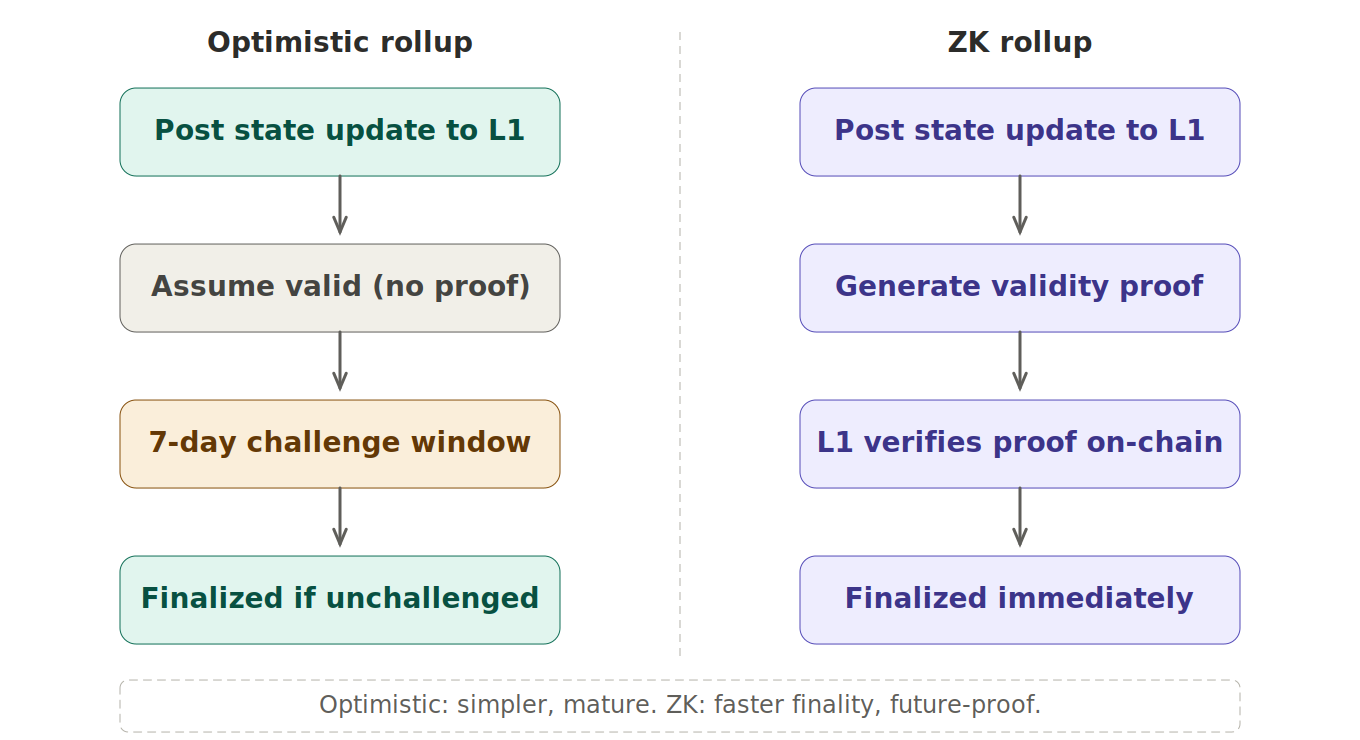
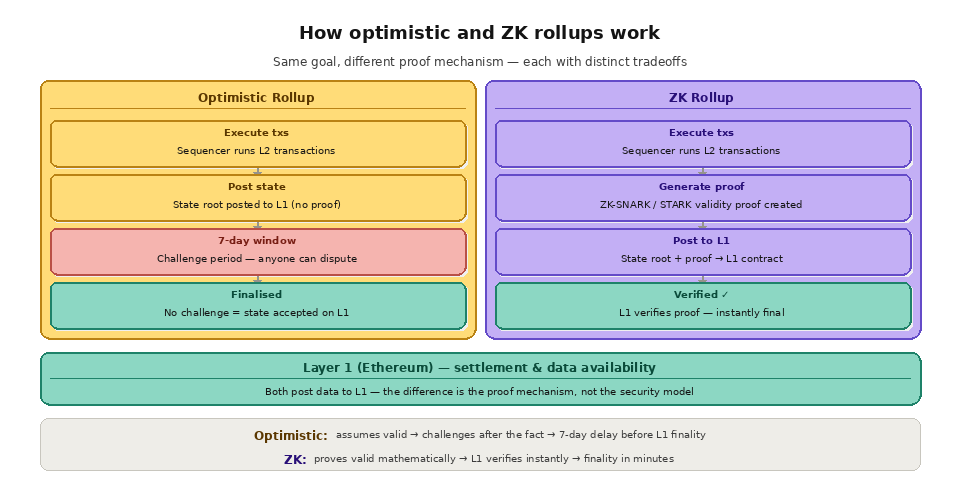
In an optimistic rollup, the sequencer runs transactions on L2 and posts the resulting state update to L1. The key word is "optimistic": the system assumes the update is correct and moves on without checking it right away. That assumption is what makes it fast and cheap, because L1 doesn't have to re-run or verify every transaction.
Security comes from the dispute process. After an update is posted, there's a challenge window, typically 7 days on Arbitrum and Optimism. During that window, anyone who thinks the update is wrong can submit a fraud proof. A fraud proof shows that running the transactions gives a different result than the sequencer claimed. If the proof is valid, the bad update is reverted and the dishonest sequencer is penalized.
In practice, this means a 7-day withdrawal delay. To move assets from an optimistic rollup back to L1, you wait for the challenge window to close before the withdrawal finalizes. Third-party bridges offer faster withdrawals by fronting the liquidity, but protocol settlement still takes 7 days.
Major optimistic rollups include:
Arbitrum, the largest L2 by TVL
Optimism, which powers the OP Stack used by Base, Mode, Zora, and other chains
Base, operated by Coinbase
Cómo funcionan los rollups ZK
In a ZK rollup, the sequencer runs transactions on L2 and generates a cryptographic validity proof (a zero-knowledge proof, such as a ZK-SNARK or ZK-STARK). The proof shows mathematically that the state change was computed correctly. It's posted to L1 along with the state update. An L1 smart contract then verifies the proof onchain, which is fast and cheap (a few hundred thousand gas).
Because the proof guarantees the update is correct, there's no need for a challenge window. The state is final as soon as L1 verifies the proof. Withdrawals from ZK rollups to L1 can finish in minutes to hours, the time it takes to generate and post the proof, instead of 7 days.
The tradeoff is complexity:
Generating ZK proofs takes heavy compute and specialized hardware.
Proving adds latency before a batch is final.
Full EVM compatibility is hard, because the EVM wasn't designed with zero-knowledge proofs in mind.
Early ZK rollups made developers rewrite contracts in custom languages. Modern zkEVMs (zkSync Era, Polygon zkEVM, Scroll) now support Solidity, with varying levels of compatibility.
Entre los principales rollups ZK se encuentran zkSync , StarkNet que utiliza Cairo en lugar de Solidity), Scroll y Polygon .
Elegir entre ellos
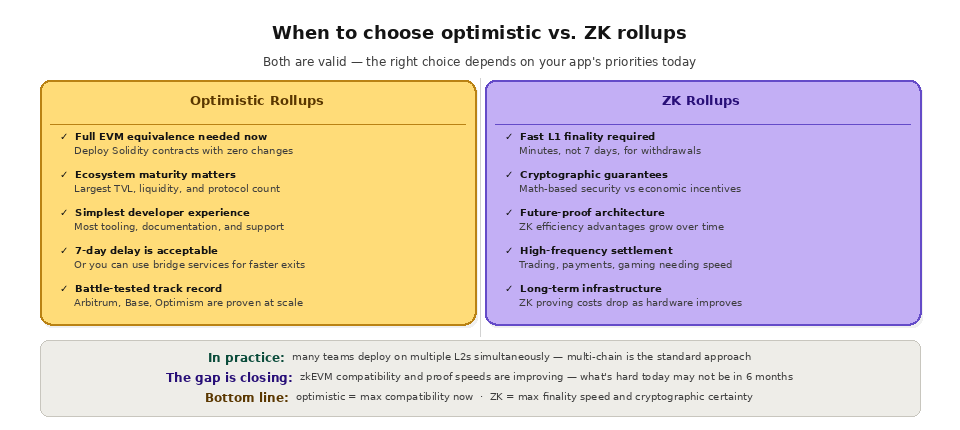
Choose optimistic rollups when you need:
Maximum EVM compatibility today
Access to the largest L2 ecosystem and liquidity
The simplest developer experience, deploying existing Solidity contracts with few changes
And you can live with 7-day withdrawals, or use bridges for faster exits
Choose ZK rollups when you need:
Fast L1 finality and near-instant withdrawals
Stronger security guarantees based on math rather than economic incentives
Better long-term efficiency as ZK proving improves
And your team can work with today's zkEVM compatibility
In practice, the choice matters less and less for many apps. Both types keep improving, and L2s are converging on shared standards and interoperability. Many teams deploy on several L2s at once.
¿Cuál es la principal diferencia entre los rollups optimistas y los rollups ZK?
Both rollup types run transactions offchain and post data back to Ethereum, but they prove correctness in opposite ways. Optimistic rollups assume transactions are valid and rely on a fraud proof window to catch cheating. ZK rollups prove validity up front with a cryptographic proof, so Layer 1 can trust each batch right away. That one design choice affects finality, withdrawal speed, cost, and compatibility, as the table shows.
Dimensión
Rollups optimistas
Rollups ZK
Método de verificación
Pruebas de fraude (se dan por válidas)
Pruebas de validez (demostrar que es válido)
Retirada a L1
Unos 7 días
De minutos a horas
Modelo de seguridad
Económico, basado en retos
Criptográfico, basado en las matemáticas
Compatibilidad con EVM
Hoy hace mucho calor
Está mejorando, varía según el zkEVM
Coste de la prueba
Bajo, no hay pruebas que generar
A mayor nivel, la generación de pruebas es muy laboriosa
Ejemplos
Arbitrum, Optimism, Base
zkSync , StarkNet, Scroll
Si eres nuevo en este ámbito, empieza por entender qué es un «rollup» y cómo encaja en una cadena de bloques de Capa 2 más amplia antes de comparar ambos diseños en detalle.
¿Qué tiene una finalización más rápida, los rollups optimistas o los rollups ZK?
ZK rollups reach Layer 1 finality faster. A validity proof guarantees the batch is correct, so the state settles as soon as Ethereum verifies the proof, often within minutes to hours. Optimistic rollups have to wait out the roughly 7-day challenge window before a withdrawal fully settles on L1, even though the transaction feels instant on L2. This follows directly from how each system handles blockchain finality.
¿Son los rollups ZK más seguros que los rollups optimistas?
They offer different kinds of security, not strictly more or less. ZK rollups get their security from cryptography: a valid proof means the state change is correct. Optimistic rollups get theirs from economic incentives and the assumption that at least one honest party will submit a fraud proof during the challenge window. Both are considered secure when built correctly. Both also still depend on a sequencer, which teams are working to decentralize.
¿Mejoran los rollups el rendimiento de la cadena de bloques?
Yes. Rollups are the main way Ethereum scales today. They batch many L2 transactions into one L1 submission, which raises throughput and lowers the cost per transaction. Both optimistic and ZK rollups handle far more transactions per second than Layer 1 alone. So the choice between them is rarely about raw capacity. It's about finality, cost, and compatibility. See throughput vs latency for how those two measures differ.
Cómo Quicknode ambos tipos
Quicknode provides full RPC support for both optimistic and ZK rollups. Arbitrum, Optimism, Base, zkSync, StarkNet, Scroll, and Polygon zkEVM all run on the same Quicknode platform, with the same developer experience, SLAs, and tooling. Quicknode Streams supports data streaming from both rollup types, and enhanced API methods work on both.
Preguntas frecuentes
¿Son los rollups optimistas más baratos que los rollups ZK?
Los rollups optimistas evitan el coste de generar pruebas criptográficas, por lo que su sobrecarga de verificación es menor. Los rollups ZK dedican más recursos computacionales a generar pruebas de validez, pero pueden enviar datos a la Capa 1 de forma más compacta. Las comisiones reales dependen de la red concreta y de los costes de los datos, y ambos tipos se han abaratado drásticamente a medida que ha mejorado la disponibilidad Ethereum .
¿Por qué los rollups optimistas tienen un plazo de retirada de 7 días?
El plazo de 7 días es el periodo de impugnación durante el cual cualquier persona puede presentar una prueba de fraude contra una actualización incorrecta del estado. Las retiradas a la Capa 1 solo se hacen definitivas una vez que finaliza este plazo, lo que garantiza que haya tiempo suficiente para detectar y revertir el fraude. Los puentes de terceros pueden aportar liquidez para agilizar las salidas, pero la liquidación del protocolo subyacente sigue esperando a que finalice el plazo.
¿Qué es un zkEVM?
Una zkEVM es una máquina virtual de rollup ZK compatible con la máquina Ethereum , lo que permite a los desarrolladores implementar contratos Solidity estándar sin dejar de beneficiarse de las pruebas de validez. Implementaciones como zkSync , Polygon y Scroll distintos grados de equivalencia con la EVM, y la brecha de compatibilidad con los rollups optimistas sigue reduciéndose.
¿Se puede utilizar el mismo código de la dApp en ambos tipos de rollup?
A menudo, sí. Los rollups optimistas son altamente compatibles con EVM, por lo que los contratos Solidity existentes suelen implementarse con cambios mínimos. Los zkEVM modernos también son compatibles con Solidity, aunque algunos rollups ZK, como StarkNet un lenguaje propio como Cairo. Muchos equipos implementan la misma aplicación en varias L2 de ambos tipos.
¿Qué tipo de rollup debería utilizar?
Elige los rollups optimistas si buscas la máxima compatibilidad con EVM, el ecosistema más amplio en la actualidad y la forma más sencilla de implementar contratos existentes. Opta por los rollups ZK cuando lo más importante sea una finalización rápida, retiradas near y seguridad criptográfica. Muchas aplicaciones se implementan en ambos, ya que los ecosistemas están convergiendo hacia estándares comunes.