Elysium vs HyperEVM vs HyperCore: Where Should You Build on Hyperliquid?
Elysium vs HyperEVM vs HyperCore: Where Should You Build on Hyperliquid?
Compare Elysium, HyperEVM, and HyperCore on speed, gas, finality, and HyperCore access, and learn which Hyperliquid layer fits your app.

November 25, 2026 — 9 min read
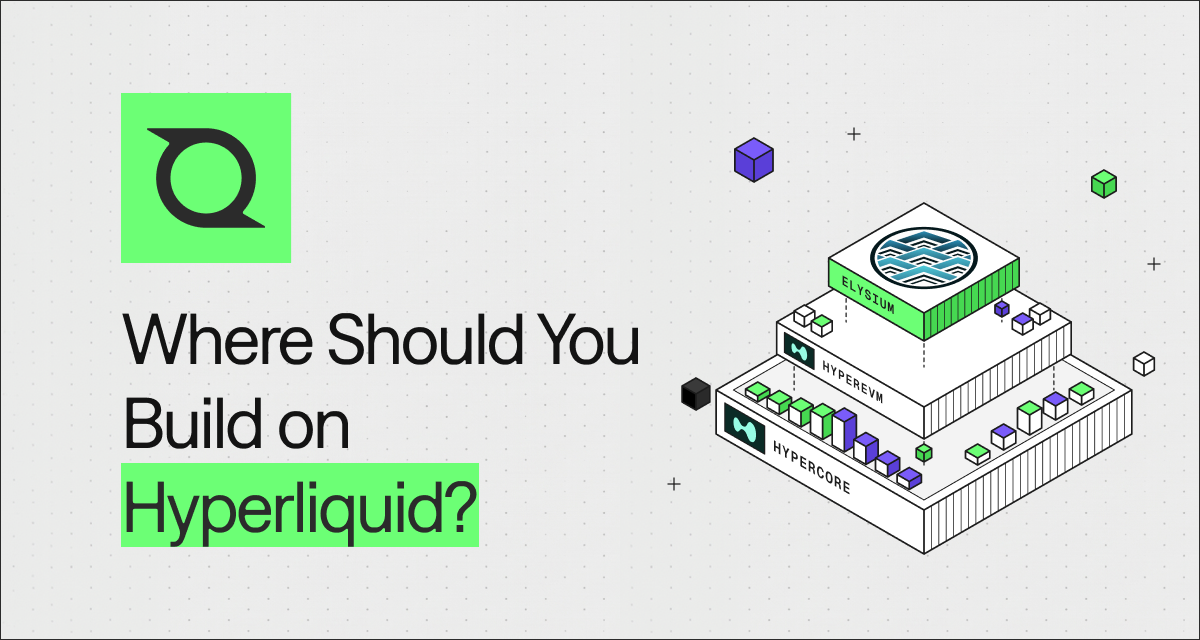
Hyperliquid now has three places to run your app's logic. HyperCore runs the native order books. HyperEVM runs Solidity contracts next to those order books. Elysium, the L2 built by Kinetiq that launched on mainnet on November 9, 2026, runs Solidity contracts that need more speed and gas than HyperEVM allows. Quicknode supports Elysium mainnet.
All three use HYPE, and two of them run the EVM. But they make very different trade-offs. This post compares them side by side and helps you choose.
The short answer
Deploy on HyperEVM if your contract needs direct access to HyperCore today, or if it fits comfortably within one-second blocks.
Deploy on Elysium if your contract needs fast blocks, frequent updates, or gas-heavy logic.
Use HyperCore directly if you are trading on the native order books rather than building contracts.
Use more than one if your app has both slow and fast parts. Many apps will.
The three layers at a glance
Feature | HyperCore | HyperEVM | Elysium |
|---|---|---|---|
What it is | Hyperliquid's native trading engine | EVM on the Hyperliquid L1 | Arbitrum Orbit L2 that settles to HyperEVM |
Runs Solidity | No | Yes | Yes |
Block time | About 70 ms | About 1 second (small blocks) | About 100 ms |
Gas capacity | No EVM gas | 3M per small block; 30M per big block (every 60 seconds) | 300M gas per second target |
Gas token | Not applicable | HYPE | HYPE, bridged 1:1 from HyperEVM |
Transaction receipt | With the L1 block | With the L1 block | About 300 ms |
Finality | Hyperliquid L1 finality | Hyperliquid L1 finality | When its batch posts to HyperEVM |
Settles to | Hyperliquid L1 (HyperBFT) | Hyperliquid L1 (HyperBFT) | HyperEVM (chain ID 999) |
Ordering | L1 consensus | L1 consensus | Single sequencer operated with Conduit, priority-fee ordering |
HyperCore access | Native | Best bid and ask reads, one-way writes | Planned ArbOS upgrade, around early December 2026 |
Built by | Hyperliquid | Hyperliquid | Kinetiq |
Elysium values come from Kinetiq's official Elysium documentation.
Comparison 1: Speed and gas
This is the reason Elysium exists. HyperEVM is limited on purpose. Its small blocks arrive about once per second and hold 3 million gas. Big blocks hold 30 million gas but arrive only every 60 seconds and are meant for heavy deployments. These limits keep EVM activity from slowing down HyperCore. Read more in Hyperliquid fees explained.
For most DeFi apps, this is enough. For apps that depend on speed, it is a hard ceiling:
A market maker can only change a quote once per block, so one-second blocks mean one quote per second.
When gas is scarce and fees rise with activity, frequent price updates become too expensive to run profitably.
Gas-heavy logic, such as matching engines and batch auctions, does not fit well in a 3-million-gas block.
Elysium produces a block every 100 ms. It targets 300 million gas per second, roughly two orders of magnitude more than HyperEVM. Kinetiq has tuned fees so a market maker can refresh quotes 5 to 10 times per second cheaply. See Kinetiq's blocks, fees, and ordering docs.
HyperCore is the fastest of the three, at about 70 ms per block. But it is not an EVM, so you cannot deploy your own contracts there.
Winner for speed and gas: Elysium, among the layers that run your own code.
Comparison 2: Access to HyperCore
This is where HyperEVM still leads, for now. HyperEVM shares consensus with HyperCore, so its contracts can interact with the order books today. That access has two limits:
Reads are shallow. Contracts can read only the best bid and best ask, and the data updates about once per second.
Writes are one-way. Contracts can send orders through CoreWriter, but it runs at HyperEVM's one-second cadence, gives no execution guarantee, and reports no failures.
Elysium launched on mainnet on November 9, 2026 without direct HyperCore access. Kinetiq plans an ArbOS upgrade about four weeks later, around early December 2026, that adds:
A market data precompile. Contracts can read order books up to full depth, plus prices, balances, and positions, for ordinary call gas. Data comes at HyperCore block granularity (about 70 ms), with about 150 to 350 ms freshness inside the EVM. The sequencer attests to this data. Kinetiq docs: HyperCore market data
A fast trading lane. Contracts can drive orders on HyperCore in about 100 ms, through a trade-only agent on the user's own HyperCore account, so custody stays with the user. Apps can opt in to receive each order's result back onchain. Kinetiq docs: Trading on HyperCore from Elysium
Until this ships, apps that need HyperCore data or order placement inside a contract should stay on HyperEVM. For an example of what HyperEVM can do today, see our guide on how to read HyperCore oracle prices in HyperEVM. For HyperCore data outside contracts, see Hypercore for Hyperliquid on Quicknode.
Winner for HyperCore access: HyperEVM today. Elysium may take the lead after the upgrade.
Comparison 3: Finality
This is the trade-off you accept for Elysium's speed. On HyperEVM and HyperCore, a transaction is final when its Hyperliquid L1 block is final. On Elysium, there are two stages:
Receipt (about 300 ms). The sequencer puts your transaction in a block. HyperEVM has not seen it yet.
Finality (when the batch posts). The sequencer groups many blocks into one batch and posts it to HyperEVM. On mainnet, Elysium posts a batch about every 15 minutes, so finality takes from under a minute up to about 15 minutes.
Withdrawals from Elysium back to HyperEVM take longer. They finalize only after the rollup's challenge period, about 5.5 days on mainnet, as on other optimistic rollups.
In practice, show users the receipt right away to keep your interface fast. Then wait for the finalized block tag before any action you cannot undo, such as crediting a deposit or releasing funds. To track batches, use arb_findBatchContainingBlock and arb_getL1Confirmations. For a hands-on walkthrough, follow an Elysium transaction to finality in our guide.
Winner for finality: HyperEVM and HyperCore.
Comparison 4: Trust model
HyperCore and HyperEVM share Hyperliquid's L1 consensus. Elysium is an optimistic rollup that launches with the standard posture for Arbitrum Nitro chains:
Single sequencer. It is operated with Conduit and orders transactions by priority fee, with no privileged lanes. If it censors a transaction, users can force inclusion through the delayed inbox on HyperEVM.
AnyTrust data availability. At launch, a single data availability server operated by Conduit stores the full data and posts a compact certificate to HyperEVM. Kinetiq plans a multi-member committee. If the server is unavailable, the chain posts full data to HyperEVM instead.
Permissioned validation at launch. Kinetiq plans to move to permissionless fraud proofs (Arbitrum BoLD), along with audits, as the chain matures.
This is a common starting point for new L2s. If your app holds large amounts of user funds, include the current trust model in your risk review. See Kinetiq's security and data availability docs.
Winner for trust model: HyperEVM and HyperCore, which use L1 consensus.
Comparison 5: Developer experience
HyperEVM and Elysium both run the EVM, so the developer experience is very similar.
Same tools. Solidity, Foundry, Hardhat, viem, and ethers.js work on both.
Same RPC. Both use standard Ethereum JSON-RPC. Elysium also supports Arbitrum methods for tracking batches. See the Elysium docs.
No public mempool on Elysium. Subscribe to new blocks and logs with
eth_subscribeinstead of watching pending transactions.Chain setup. Some libraries do not include Elysium as a built-in chain yet, so you may need to define it with its chain ID (99901 on mainnet).
Winner for developer experience: a tie.
Which layer fits your app?
Your app | Best fit | Why |
|---|---|---|
Vault or yield strategy | HyperEVM | Fits in small blocks and can use HyperCore data today |
Lending market | HyperEVM | Low update frequency; benefits from L1 finality |
Onchain order book or perp DEX | Elysium | Needs many updates per second |
Market maker or keeper bot | Elysium | Competes on reaction time |
Proprietary AMM (prop AMM) | Elysium | Updates prices on every move and needs cheap gas |
Liquidation engine | Elysium | Must act inside a single price move |
Matching engine or batch auction | Elysium | Gas-heavy logic |
Contract that places HyperCore orders | HyperEVM today | Consider Elysium after the planned upgrade |
Manual or API-based trading | HyperCore | Trade the native order books directly |
Using more than one layer
You do not have to choose only one. Because Elysium settles to HyperEVM and HYPE bridges between them, many apps can split their logic:
Vault on HyperEVM, strategy on Elysium. Keep user deposits on HyperEVM with L1 finality, and run fast rebalancing or quoting logic on Elysium.
A token path across all three. Kinetiq describes a path where a token launches on an Elysium AMM, deepens on Elysium prop AMM markets, graduates to a HyperCore spot order book, and reaches a perpetual listing through HIP-3. Learn how HyperCore spot tokens work in our HIP-1 explainer.
To read from Elysium and HyperEVM in one app, use a Quicknode multichain endpoint, which reaches both networks with the same endpoint name and token. For background on the full Hyperliquid stack, see the Hyperliquid developer stack guide.
Moving a contract from HyperEVM to Elysium
Set the correct chain ID. Elysium mainnet is 99901. Elysium testnet is 99801. An unrelated chain also called Elysium uses chain IDs 1338 and 1339, so check carefully.
Use the finalized tag. On Elysium, block count tells you nothing about finality. Check the
finalizedtag instead.Review priority fees, and expect ordering to change. Elysium orders transactions by priority fee today. Kinetiq's roadmap adds a keeper lane in the ArbOS upgrade planned for around early December 2026, and Timeboost later, so do not hard-code assumptions about ordering.
Subscribe to blocks and logs. There is no public mempool, so pending-transaction monitoring will not work.
Plan for withdrawal delays. Bridging back to HyperEVM waits for the challenge period, about 5.5 days on mainnet.
Check token compatibility. Fee-on-transfer and rebasing tokens are not currently supported on Elysium's EVM bridges. See Kinetiq's token bridging docs.
Keep HyperCore-dependent logic on HyperEVM until the ArbOS upgrade is live.
Frequently asked questions
Is Elysium part of Hyperliquid?
Elysium is built by Kinetiq, not by Hyperliquid. It is part of the Hyperliquid ecosystem: it uses HYPE for gas and settles to HyperEVM.
Is Elysium faster than HyperEVM?
Yes. Elysium produces a block every 100 ms, compared with about one second for HyperEVM small blocks. It also targets far more gas per second.
Can Elysium contracts access HyperCore?
Not yet. Kinetiq plans to add HyperCore market data and a fast trading lane in an ArbOS upgrade about four weeks after the November 9, 2026 mainnet launch, around early December.
How long does Elysium finality take?
A receipt arrives in about 300 ms. Finality comes when the transaction's batch posts to HyperEVM. Batches post about every 15 minutes on mainnet, so finality takes up to about 15 minutes.
Do I need a new token to use Elysium?
No. Elysium uses HYPE for gas, bridged 1:1 from HyperEVM.
Start building
Quicknode supports Elysium, HyperEVM, and HyperCore. Create an endpoint for the layer that fits your app, or use a multichain endpoint to reach several at once. Get started on the Elysium chain page, explore the Hyperliquid docs, or read our full guide: What is Elysium? A Developer's Guide to Hyperliquid's L2.
About Quicknode
Founded in 2017, Quicknode deploys institutional-grade blockchain infrastructure for developers and enterprises. With 99.99% uptime and support for 75+ chains, teams build and scale onchain applications without compromise.
Stay updated
The latest engineering insights, product updates, and web3 news delivered straight to your inbox.