Is Privacy by Default Necessary for Ethereum to Exist?
Is Privacy by Default Necessary for Ethereum to Exist?
Why does Ethereum need privacy? Explore real-world risks, economic trade-offs, live tools, and the roadmap to privacy by default.

November 23, 2026 — 15 min read
On Ethereum, transparency requires no effort. Privacy does.
An Ethereum address is a pseudonym until one link ties it to a person. An ENS name or a CEX withdrawal is enough to expose the full history behind that address.
Today, Ethereum has privacy tools, from shielded transfers to applications built with zero-knowledge proofs.
But the burden falls on users to know which tools to choose, what they hide, and where privacy can still fail.
That is the line between privacy being available and privacy being the default.
Let’s explore Ethereum privacy, default versus opt-in, and everything in between.
How Transparency Hurts: Why Ethereum Needs Privacy
Once financial activity becomes observable, users are at the mercy of bad actors and exploiters.
1. Individuals carry the physical risk
Public holdings can help criminals identify targets for extortion, kidnapping, or wrench attacks.
One incident database counts 165 physical attacks on crypto holders in 2025, up from 37 in 2020, with 134 more through mid-October 2026.
Visible transfers can also expose donations, salaries, and personal relationships.
2. Businesses expose commercial intelligence
Treasury movements, supplier payments, and collateral positions can reveal counterparties, financial stress, or trading strategies to competitors.
3. Markets pay through worse execution
Searchers can monitor pending transactions and place trades around them, including sandwich attacks. The transaction remains valid, but the user usually receives a worse execution price.
Each of these harms traces to the same cause: information leaking at specific points of an Ethereum transaction.
What Ethereum Actually Leaks
Onchain data can leak at every stage of an Ethereum transaction: while a wallet reads blockchain data, submits a transaction, or interacts with an application.
Surface | What becomes visible and to whom |
|---|---|
Reads | RPC providers can observe which addresses and contracts a wallet queries, often alongside its IP address. |
Network metadata | Nodes and submission services may correlate a transaction’s network origin with its sender address. |
Contents | Public transactions expose senders, recipients, values, calldata, and emitted events. Contract execution can reveal additional details. |
Application logic | Contract calls and public state can expose positions, strategies, and user behavior, even when selected amounts are hidden. |
Identity linkage | ENS records, disclosed addresses, and other offchain information can connect onchain activity to real people or businesses. |
Privacy is only as strong as the weakest exposed surface.
Hiding transfer amounts does little if a wallet query, funding transaction, or contract interaction can be strung together.
Ethereum and Privacy: Promise, Economics, and Need
Ethereum makes financial activity transparent, and as we’ve seen, that openness has a cost. But does Ethereum owe its users privacy?
Privacy Is Part of Ethereum’s Promise
Ownership means control over assets, including how much others can learn about their use.
Public balances and transaction histories give outside observers information that would normally require access to a bank’s records.
That information creates unequal power.
Ethereum’s ledger is open to everyone, but not everyone benefits from it equally. Those with more capital and resources gain an unfair advantage.
Searchers scan pending swaps in the mempool and sandwich them.
Analytics firms cluster addresses and sell the map to exchanges and compliance teams.
Governments and institutions can use the ledger for surveillance.
That brings us to censorship.
Even when a transaction’s contents are hidden, builders or intermediaries may recognize and exclude transactions associated with privacy protocols.
This is why every user has a right to demand freely available, unconditional privacy from Ethereum.
Economics and Business Case for Ethereum Privacy
Privacy widens what can happen onchain. Some activity only becomes viable once counterparties and amounts stop being public.
Is there proof? Not directly, because the cost of transparency does not show up in onchain data: activity that needs confidentiality never arrives.
Several use cases become possible on a private Ethereum:
Shared financial infrastructure: Competing banks could settle on common Ethereum rails without exposing proprietary client relationships, transaction flows, or commercial activity to rivals.
Confidential credit markets: Lenders could assess verified borrower information without publishing customer liabilities, credit terms, and financing relationships to competitors.
Private business negotiations: Suppliers could submit competing bids and settle contracts onchain without revealing prices.
Global corporate payroll: Companies with thousands of employees around the world could pay salaries in stablecoins within minutes, without relying on banks, while keeping those payments private.
These use cases become more compelling as more participants share the same infrastructure. But privacy itself also depends on how many participants use it.
Network Effects of Ethereum Privacy
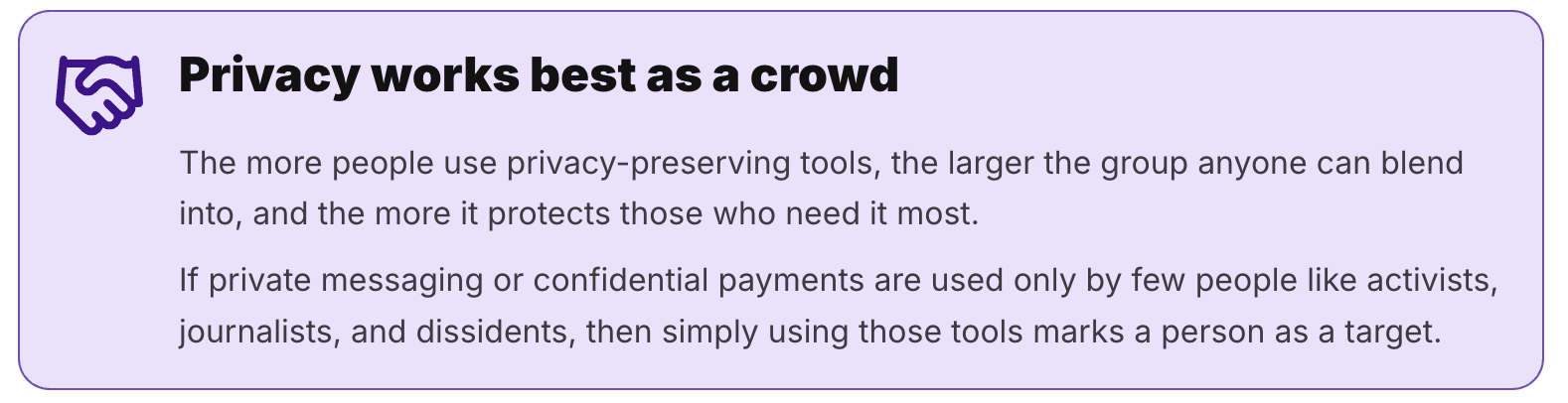
Source: Ethereum.org
Privacy works best with a network effect: more private activity can improve privacy for everyone in the same anonymity set.
Optional privacy works against that effect.
Users pay extra fees, learn separate workflows, and enter pools that may attract attention precisely because most activity remains public. If mainly users with exceptional confidentiality needs participate, the act of entering a pool can itself become informative.
So privacy matters for Ethereum and its users. Why, then, after more than a decade, does Ethereum still lack a full-fledged privacy system?
Why Native, Default Privacy Is Difficult on Ethereum
Ethereum’s public state works against privacy here, bringing technical, economic, and institutional trade-offs.
Technical Constraints
1. Privacy complicates smart contract composability.
Ethereum contracts work together because they share access to public state. A lending protocol can check collateral, while an exchange can read available liquidity.
Encrypting that information raises a difficult question: how can one contract use another contract’s data without revealing it?
Private execution needs new ways to share and verify state across applications.
2. Private execution changes who does the computing.
Ethereum nodes execute public transactions using information available to every validator.
With zero-knowledge privacy, users or specialized provers must perform additional computation to generate proofs. That takes time and hardware resources. Outsourcing proof generation can also expose sensitive inputs unless the system protects them.
Fully encrypted general-purpose execution remains a longer-term technical challenge.
3. Privacy can fail when activity crosses systems.
Shielded transfers can hide amounts and counterparties while revealing when a transaction occurred or which public contract received it. RPC queries and network activity can create further links. Moving funds between private and public applications may expose relationships that the original proof concealed.
Each interaction creates another opportunity for information to escape.
Beyond the technical trade-offs, making Ethereum private has other dimensions too.
Economic and Institutional Trade-Offs
Each privacy fix, especially at the Ethereum-native level, comes with its own costs, financial and otherwise, that need to be accounted for.
1. Proving costs, latency, and infrastructure
Generating a proof adds delay, and verifying it onchain adds gas. Private reads cost server computation and bandwidth. Heavy workloads pull toward specialized provers, relayers, and sequencers, but each brings its own reliability, resource, and censorship risks.
2. Separate privacy systems can fragment liquidity.
Funds held in a shielded pool may not be directly usable across public lending markets and exchanges.
Moving between those environments introduces fees, delays, and observable entry or exit points. Privacy becomes less useful when maintaining it means giving up access to Ethereum’s existing liquidity.
3. Compliance and selective disclosure
Compliance creates another constraint. Financial institutions must meet reporting, sanctions-screening, and recordkeeping obligations. Privacy systems may need selective disclosure or verifiable compliance checks without publishing complete transaction histories.
This is why a technically sound privacy measure can still struggle to become an everyday primitive.
Despite these costs, privacy on Ethereum has moved beyond research. Several working protocols are already available to learn from and use.
What Privacy Tools Exist on Ethereum Today?
Ethereum already offers ways to conceal payments, reduce address linkage, and keep transactions out of the public mempool.
But these tools protect different parts of an interaction.
The relevant question is not simply whether a transaction is private. It is: private from whom, and until what point?
Privacy need | Existing tool | What it protects | What remains exposed |
|---|---|---|---|
Receiving payments privately | ERC-5564 stealth addresses, Fluidkey | Gives each payment a distinct receiving address, reducing address linkability. | Transfers and balances remain public. Funding patterns can reveal links. Fluidkey has viewing access. |
Shielded transfers and balances | RAILGUN | Uses zero-knowledge proofs to hide selected transaction details. | Deposits and withdrawals remain visible. Public interactions can expose links. |
Private transfers with association checks | Privacy Pools | Allows withdrawals while proving compliance with an approved association set. | Entry and exit remain visible. Association Set Providers determine eligibility. |
Private transaction submission | Flashbots Protect | Hides transactions from public-mempool searchers before inclusion. | Included transactions remain publicly observable. |
Private application execution | Aztec Alpha | Experiments with private state and ZK execution. | Early-stage limitations include observable public effects and restricted private third-party queries. |
Private RPC queries | Self-hosted Ethereum node | Keeps wallet queries away from third-party RPC providers. | Onchain activity remains public. Network metadata can still leak. |
Why Existing Tools Aren’t Enough
The tools above demonstrate that Ethereum privacy is technically possible. They also show that no single tool makes an entire user journey private.
Why not?
1. Privacy breaks in transit
Users rarely make just one transaction. They receive funds, swap tokens, borrow, repay, and move assets between wallets and protocols.
Privacy can weaken at every transition:
Entering a shielded pool: The public deposit may reveal the funding address, asset, amount, and timing.
Leaving the pool: A withdrawal into a public wallet creates another observable point that analysts may try to correlate with earlier activity.
Using public DeFi: A private balance does not automatically hide a subsequent swap, collateral position, or contract interaction.
These clues do not always establish a link. But the more information an observer can combine, the less protection any single private transaction provides.
2. Privacy often shifts trust elsewhere
Keeping information off the public ledger does not guarantee that nobody else sees it.
Infrastructure | Remaining dependency |
|---|---|
RPC providers | May observe wallet queries, IP addresses, and the addresses users are interested in. |
Private transaction relays | Can receive transaction details before inclusion, even when public-mempool observers cannot. |
Broadcasters and proving services | May introduce availability or censorship dependencies. Some proving arrangements can expose private inputs. |
These are different risks that a user needs to be aware of, and today the responsibility for navigating them falls entirely on users.
3. Users must navigate the privacy landmines on Ethereum
Even sound cryptography cannot protect a transaction if the wallet workflow reveals the connection it was designed to hide.
Did you know? Vitalik Buterin has described accidentally broadcasting a Tornado Cash withdrawal through the same address used for the deposit.
The privacy mechanism was not broken, yet the surrounding workflow exposed the link.
Today’s users must understand which wallet to use, how to fund it, which interactions remain public, and what happens when funds leave a private system.
That is why privacy being available is not the same as privacy being the default.
The next challenge for Ethereum is to make confidentiality work on an everyday basis.
Ethereum’s Privacy Roadmap: Private Reads, Writes, and Proving

Ethereum’s privacy roadmap describes privacy moving from an optional add-on to a network-level default. It tackles three different problems:
What wallets reveal when accessing blockchain data
What transactions expose when changing state
How to make cryptographic privacy practical at scale
Private Reads: Stop Revealing What Wallets Look At
Every time a wallet opens, it needs information from the blockchain: balances, transaction history, contract state, and more.
Most wallets obtain that information from an RPC provider. The provider may see the addresses being queried, the requests being made, and their IP addresses.
Private reads require three distinct protections:
Protection | What it prevents | Possible approach |
|---|---|---|
Origin privacy | Linking a query to the user’s network identity | Tor or other anonymity networks |
Query privacy | Learning which account or contract the wallet is inspecting | |
Response correctness | A provider returning false or manipulated information | Light clients and cryptographically verifiable responses |
These solve different problems. Alongside them, Ethereum’s Kohaku wallet initiative aims to bring privacy into wallet infrastructure, including private data access.
The objective is straightforward: opening a wallet should not require disclosing which accounts you care about to a third party.
Private Writes: Transaction Validity Without Sacrificing Privacy
Ethereum transactions currently disclose extensive information, including addresses, values, and contract interactions. Before inclusion, transactions submitted through the public mempool can also expose users’ intentions.
Private writes therefore involve two different problems:
Transaction confidentiality: Hiding information that does not need to be public, like selected amounts, counterparties, or private application state.
Pre-inclusion privacy: Preventing observers from exploiting a transaction before it reaches a block.
These should not be confused. A private relay may protect a pending transaction from public-mempool searchers while leaving its contents public after inclusion.
Several individual efforts are underway in this space.
Proposal or approach | Contribution | Limitation |
|---|---|---|
EIP-8182: Shared shielded pool | Proposes shared infrastructure for confidential ETH and ERC-20 transfers | Doesn’t privatize Ethereum applications |
EIP-8141: Frame transactions | Enables flexible authorization and execution workflows | Doesn’t encrypt transactions |
EIP-8250: Keyed nonces | Supports separate nonce sequences for different transaction workflows | Doesn’t provide confidentiality or remove public-mempool restrictions |
EIP-8272: Recent block roots | Gives contracts access to recent block roots for proof-based applications | Doesn’t hide activity |
EIP-7805: FOCIL | Limits builders’ ability to exclude eligible transactions | Doesn’t conceal transactions or eliminate censorship |
Encrypted mempools and commit-reveal | Limit pre-execution information available to observers | Add timing, coordination, and disclosure trade-offs |
Zooming out, most of these EIPs make privacy systems easier to build or harder to censor. They do not themselves make transfers confidential.
Private Proving: Make Privacy Affordable
Zero-knowledge proofs allow a user to demonstrate that a private transaction follows the rules without revealing the underlying private information.
But someone must generate that proof.
Consider a wallet proving that it owns sufficient funds to make a confidential payment. The proof may reveal nothing about the balance. Yet if the wallet sends its private inputs to an external proving service, that service could learn exactly what the proof was intended to conceal.
Private verification is not enough if proof generation exposes the secret.
This creates a practical trade-off:
Local proving keeps sensitive inputs on the user’s device but requires efficient software and sufficient computing power.
Outsourced proving can improve performance and accessibility, but must be designed so the service cannot inspect private inputs or become an unavoidable point of control.
Faster proving systems, more efficient circuits, and better wallet integration matter because they make local generation more realistic for everyday users.
The goal isn’t simply cheaper zero-knowledge proofs. It’s making confidentiality possible without handing private financial information to another operator.
The Roadmap Is Ahead of the User Experience
Ethereum is making progress on the components, but private reads, writes, and proving are not yet a smooth default experience on mainnet.
These three layers have to work together, and today there are many gaps in how they interact.
That gap matters more than the number of privacy proposals in development. The real test is whether an ordinary user can receive, hold, and use funds without assembling a fragile privacy workflow or trusting a handful of intermediaries to keep their information confidential.
Default, Optional, or Minimum Viable Privacy: What Does Ethereum Actually Need?
Ethereum does not need privacy by default to keep producing blocks, settling transactions, or supporting applications. Its existence is not at stake.
Its ambitions, however, are a different matter.
Freely available, unconditional privacy on Ethereum is a tough ask. Is there a workable middle ground?
Exploring Minimum Viable Privacy on Ethereum
Ethereum doesn’t need to make every transaction or contract private. It needs a baseline ordinary users can rely on:
Private reads: Checking a balance or interacting with a wallet should not disclose a user’s intent and network identity to an RPC provider.
Private transactions: Users should have a practical way to transfer and hold assets without exposing unnecessary financial information to the public.
Private proving: Generating a proof should not require handing sensitive inputs to a trusted third party.
Usable defaults: Privacy should survive ordinary wallet workflows without users having to juggle multiple protocols, relays, and privacy-only practices.
Even all of this won’t fully eliminate surveillance. Entry and exit points, timing patterns, and app behavior can still reveal connections.
Nor does it remove the need for accountability. Contracts can preserve verifiable rules, while regulated participants may need mechanisms for appropriate disclosure.
Ethereum can exist without privacy by default.
But if it wants to serve as neutral financial infrastructure for ordinary people and institutions, privacy cannot remain a specialist feature.
It has to become part of ordinary use.
FAQs on Ethereum and Privacy
Can someone track my Ethereum wallet?
Yes. Blockchain explorers and analytics tools can trace transactions between addresses. On- and off-ramps, ENS names, and social media activity can help connect a wallet to its owner.
Can Ethereum support private smart contracts?
Yes, through privacy-focused execution environments such as Aztec. However, private execution introduces challenges involving composability, proving costs, and interactions with public contracts.
General-purpose private execution is not Ethereum mainnet’s default.
What is Ethereum doing to improve privacy?
Ethereum’s privacy roadmap focuses on private reads, writes, and proving. Initiatives such as Kohaku and proposals for shared shielded infrastructure aim to reduce information leakage and dependence on trusted intermediaries.
What’s the difference between opt-in and default privacy?
Opt-in privacy requires users to select tools, maintain privacy, and guard against data leaks themselves. Default privacy makes confidentiality part of ordinary wallet activity.
Can institutions use Ethereum without revealing sensitive financial data?
Partially. Privacy systems can conceal selected payments and positions, but confidentiality across applications remains difficult. Institutions also need reliable settlement, appropriate disclosure controls, and ways to satisfy obligations without publishing entire financial histories.
About Quicknode
Founded in 2017, Quicknode deploys institutional-grade blockchain infrastructure for developers and enterprises. With 99.99% uptime and support for 75+ chains, teams build and scale onchain applications without compromise.
Stay updated
The latest engineering insights, product updates, and web3 news delivered straight to your inbox.