What’s new in Quicknode Earn
What’s new in Quicknode Earn
Add or remove USDC on a live strategy, cap what a rebalance can cost, and ask your agent how your strategy is doing.

November 16, 2026 — 6 min read
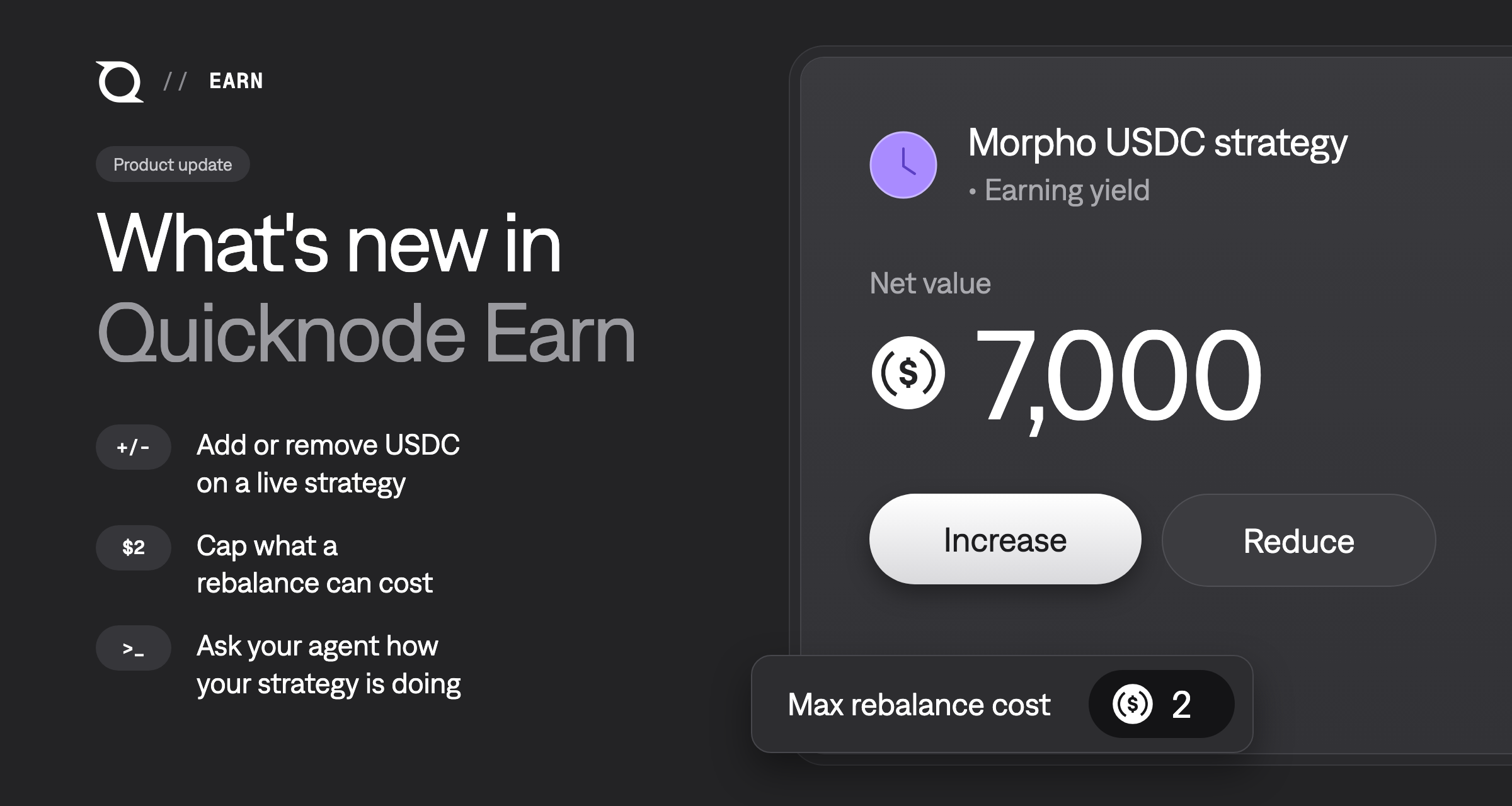
Quicknode Earn moves your USDC between the Morpho vaults you approve, on seven networks, and looks for a better rate every five minutes. This release gives you more say over three things: how much USDC is in a strategy, when Earn is allowed to move it, and how you keep track of it.
Add or remove USDC without closing your strategy
Every active standard strategy now has Increase and Reduce on its strategy page. Before, changing the amount meant closing the strategy and starting a new one.
Increase adds USDC from your wallet to the vaults the strategy already holds.
Reduce takes the same share from every position and sends the USDC back to your wallet. The rest keeps earning.
Say you start a strategy on Base with 500 USDC, the Base minimum. A month later you Increase it by 2,000. When you need 1,000 back, you Reduce, and the other 1,500 stays in the vaults. (Example amounts.)
Your Realized APY stays honest. USDC you add counts only from the moment it lands, so a top-up never shows up as yield.
Each action is at least 10 USDC, or more when part of it has to bridge. One Reduce can take up to 90% of the strategy and has to leave the network minimum behind; to take out more, close the strategy. You pay network gas, plus a relay fee when a Reduce bridges USDC back from another network. Covered strategies don't have Increase or Reduce yet.
Cap what a rebalance can cost
Gas on Ethereum is usually cheap. Earn prices one Ethereum rebalance at every five-minute check, and over the last 30 days the median estimate was 16 cents.
Then came October 29, the day of the Binance hack. At 3:40 pm Central the estimate passed $2. Ten minutes later it was near $300, and it peaked above $500 at 4:10 pm. It stayed above $2 for about seven hours. On-chain, the Ethereum base fee went from 0.04 gwei that morning to 183 gwei at the peak.
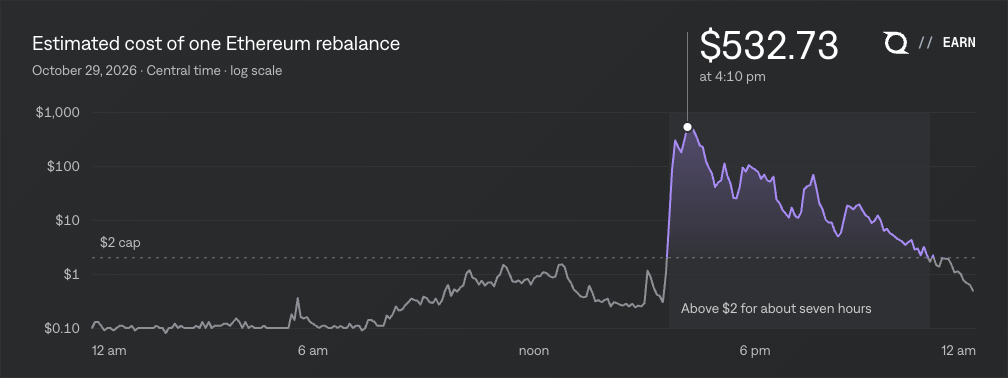
A spike like that can't eat into your deposit through a normal rebalance. Earn already skips any move whose fee would push your net value below the capital you put in.
Now you can set a Max rebalance cost on any strategy that includes Ethereum. It starts at $2, and 0 turns it off. When a move to or from Ethereum would cost more than your cap, Earn holds it, keeps its place in the confirmation window, and prices it again on the next check. Moves that don't touch Ethereum carry on.
With the default cap, Earn would have held every Ethereum move priced above $2 that evening and made it once fees came back down.
The Rebalancing step of the strategy wizard graphs the last 30 days of Ethereum move costs next to the setting, so you can pick a number from real data. You can change it later on the strategy's Manage tab. One exception: forced exits ignore both the cap and the deposit guard. If a vault you hold breaks one of your floors, Earn moves you out whatever the fee.
You control the automation
Earn's Auto-Pilot moves your USDC only when your settings say it can. You set these when you create a strategy and can change them on its Manage tab:
Rebalance gap and Cross-network gap. How much more a vault on the same network has to pay before Earn moves, and a separate, bigger edge before it bridges to another network.
Confirmation window. A move has to keep qualifying at every five-minute check for the whole window, which you can set anywhere from 5 minutes to 6 hours (1 hour by default). A rate spike that fades resets the count.
Floors. A Minimum withdrawable liquidity and an Auto-exit vault size. If a vault you hold drops below either one, Earn moves you to your best approved vault on its very next check.
Max rebalance cost. The cap above, for strategies that include Ethereum.
Clone a strategy
Clone one of your own strategies to reuse settings you've already tuned, or clone one from the leaderboard. A clone copies the settings (networks, gaps, confirmation window, floors and cost cap), and you choose the amount. The leaderboard ranks Earn strategies by Realized APY after fees. Past results do not predict future returns.
Know what Earn is doing
Alerts. Turn on Telegram or browser alerts from the Notifications menu on any strategy page. Earn tells you when it rebalances (with the APY change and the fee), bridges, deposits, or closes, and when a better vault is waiting on your approval.
Ask your agent. Earn is now a remote MCP server. Connect it once and your agent can answer questions about your strategy, the vaults and your fees. Setup is one line, with no account and no API key. In Claude Code:
claude mcp add --transport http earn https://earn.quicknode.com/mcp
Any MCP client that supports Streamable HTTP works too. Then ask:
“What did my Earn strategy make this week, after fees?”
“Which USDC vaults on Base pay the most right now?”
“How do I add Earn to my yield product?”
Because the server is remote, your agent gets every update we ship without reinstalling anything.
Also shipped
Buy USDC in the wizard. Pay with a debit card or Apple Pay through Coinbase while you set up a strategy, and the USDC lands in your wallet on Base. It doesn't work from a Safe.
A redesigned homepage. A new rates chart up top, a section that shows the settings you control on live vault data, the API and agent setup in one place, and a shortcut back to your strategies when you return.
Run Earn from a Safe. Load Earn as a custom app in your Safe. Transactions wait in the Safe queue for co-signers, and Earn gives a Safe 24 hours to sign its messages instead of 5 minutes. Wallets that support batching, a Safe included, approve up to 10 vaults in one transaction.
Optional cover from OpenCover. Add third-party cover on a set of Base vaults, funded from any network. The premium comes out inside the vault, so the APY you see is already net of it. Cover starts 24 hours after your first deposit and does not remove risk.
The Earn API. Apps and agents can run the full strategy lifecycle over HTTP. The user's own wallet signs every write.
Network minimums, shown in the wizard. It opens with the lowest minimum and lists the networks your amount can use: 250 USDC on Optimism, Unichain and Monad, 500 on Base, Polygon and Arbitrum, and 5,000 on Ethereum.
Your vault shares stay in your wallet the whole time.
Want a walkthrough first? Book 20 minutes with Rory, who leads Earn →
Yield rates are variable and not guaranteed. Past performance does not predict future results. Cover does not remove risk. DeFi involves smart-contract risk. Earn is non-custodial and does not provide investment advice.
About Quicknode
Founded in 2017, Quicknode deploys institutional-grade blockchain infrastructure for developers and enterprises. With 99.99% uptime and support for 75+ chains, teams build and scale onchain applications without compromise.
Stay updated
The latest engineering insights, product updates, and web3 news delivered straight to your inbox.