USDC Yield With Cover Built InQuicknode Earn now runs USDC yield with cover for protocol risk built in, underwritten by OpenCover. Six covered vaults on Base.
Why should you consider deploying and running your own Layer 2 rollup? Learn how rollups are powering the future of decentralized applications and some compelling advantages of running your own rollup.
In the quest to scale Ethereum, Layer 2 solutions—especially rollups—have emerged as leading contenders.
By compressing data and bundling transactions, rollups significantly reduce the load on the Ethereum mainnet, all while preserving robust security through a blend of off-chain computation and on-chain validation. This means faster transaction speeds and lower costs without sacrificing the underlying blockchain's security.
However, for many, deploying a Layer 2 rollup can seem daunting without the right guidance and infrastructure.
That's where this blog comes in.
Let's break down the Rollup process into manageable steps, from understanding the basics of Layer 2 rollups to configuring rollup parameters and setting up the necessary infrastructure to get you rollin' in no time!
The Rise of L2 Rollups
At the heart of Ethereum's scalability challenges lies the need to process more transactions without compromising security. Rollups are Layer 2 scaling solutions that process transactions off-chain while maintaining the security guarantees of Layer 1.
How Do Rollups Achieve This?
Data Compression and Transaction Bundling: By aggregating multiple transactions into a single batch and compressing the data, rollups significantly reduce the load on the Ethereum mainnet. This leads to faster transactions and lower fees.
Off-Chain Computation with On-Chain Security: Rollups execute transactions off-chain but submit proofs of these executions back to the mainnet for validation. This ensures that the security of Layer 1 is upheld.
Types of Rollups
Optimistic Rollups: Assume transactions are valid by default and use fraud proofs to challenge any discrepancies.
Zero-Knowledge (ZK) Rollups: Generate cryptographic proofs (validity proofs) that transactions are valid, ensuring correctness without needing to trust the operator.
By utilizing fraud proofs or validity proofs, L2 rollups ensure that off-chain activities remain honest and verifiable, even in the event of disputes.
Benefits of Deploying Your Own Rollup
Why should you consider deploying your own Layer 2 rollup?
Here are some compelling advantages:
Cost Efficiency: Off-chain computation means significantly lower transaction fees—ideal for applications requiring microtransactions or handling high volumes of transactions.
Scalability: Rollups dramatically increase transaction throughput, enabling your decentralized application (dApp) to scale without being hampered by Layer 1 network congestion.
Customization: Tailor network parameters, such as proof submission frequency and smart contract rules, to suit your specific requirements. This allows you to enhance performance and security according to your needs.
Popular Rollup Frameworks
Several prominent frameworks are available to help developers deploy their own Layer 2 rollups, each offering unique features tailored to different needs.
Optimism
The OP Stack is a modular, standardized, and open-source software stack developed by the Optimism Collective. It simplifies the deployment of Optimistic Rollups, making it easier to launch new Layer 2 blockchains that are compatible with the upcoming Superchain ecosystem.
ZKsync
The ZK Stack enables the launch of zero-knowledge rollups designed to scale Ethereum. Known as Elastic Chains, these rollups leverage the zkEVM at their core—a zero-knowledge Ethereum Virtual Machine designed to execute transactions while maintaining full compatibility with Ethereum.
Arbitrum
Arbitrum Nitro is the tech stack underlying Arbitrum's Optimistic Rollups, providing high throughput and low transaction costs. New Layer 2 rollups built using Nitro are called Orbit Chains, offering customizations in areas such as throughput, privacy, gas tokens, precompiles, data availability layers, and more.
Comparing the Frameworks
Each framework has its architectural nuances:
ZK Stack: Zero-Knowledge Rollups using validity proofs; utilizes zkEVM for Ethereum compatibility; ideal for applications needing high security and privacy.
Arbitrum Nitro: Optimistic Rollups with improved throughput and lower costs; offers extensive customization; supports Orbit Chains for specialized needs.
OP Stack: Optimistic Rollups using fraud proofs; modular design; compatibility with Optimism's Superchain ecosystem.
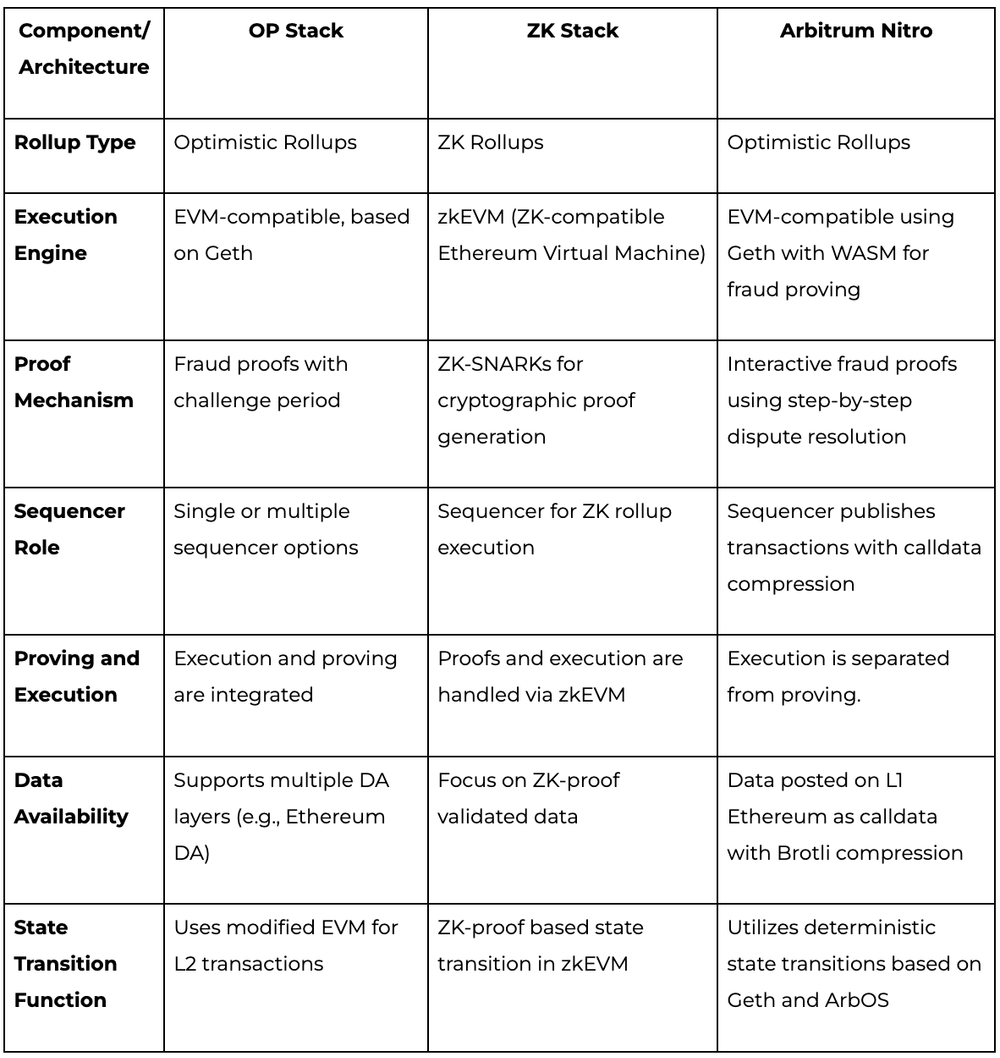
Here are some key architectural differences between these three frameworks:
OP Stack vs ZK Stack vs Arbitrum Nitro
Now that we've explored different rollup frameworks and the benefits of deploying your own rollup, let's dive into how you can set up, deploy, and manage your rollup.
Step 1: Setting Up the Rollup
Setting up your rollup properly is crucial to ensure it operates efficiently and securely. Here's how to get started:
Understand Your Project's Requirements
Begin by clearly defining the purpose of your rollup:
DeFi Application: Handling complex transactions with high security.
NFT Marketplace: Prioritizing low fees and quick finality.
Your project's specific needs will influence the rollup's architecture and configuration, so it's essential to have a clear understanding from the outset.
Install Node.js and npm/yarn: Essential for running development tools and managing dependencies.
Set Up a Development Framework: Tools like Hardhat or Truffle help you write, compile, and deploy smart contracts.
Install the Rollup SDK: Use npm to install the SDK specific to your chosen rollup framework (e.g., Optimism, zkSync, or Arbitrum). This provides utilities to streamline interactions with the rollup.
Configure Network Settings: Update your Hardhat or Truffle configuration to include both Layer 1 and Layer 2 network settings, ensuring your dApp connects to the correct RPC URLs.
Install Required Libraries:
For Optimistic Rollups: Libraries for fraud-proof mechanisms.
For ZK Rollups: Cryptographic libraries for generating zero-knowledge proofs.
Configure Network Parameters
Adjust key parameters to tailor performance and security:
Block Size: Determines how many transactions can be included in a block.
Gas Limits: Sets the maximum amount of gas per block or transaction.
Sequencers: Control the order of transaction processing.
Validators: Verify the correctness of transactions and proofs.
Proofs: Configure submission frequency and type (fraud or validity proofs).
Set Up Smart Contracts
Deploying smart contracts in a rollup environment involves:
Writing Smart Contracts in Solidity: Handle transactions, interact with Layer 1, and manage logic for fraud or zero-knowledge proofs.
Optimizing Gas Usage: Minimize gas consumption by reducing on-chain operations, avoiding expensive storage, and using calldata efficiently.
Deploy on a Testnet
Before going live, test your rollup in a safe environment:
Select an Appropriate Testnet: Use Goerli for Optimism/zkSync or Rinkeby for Arbitrum.
Deploy and Test: Deploy your rollup and smart contracts to the testnet.
Troubleshoot and Optimize: Use tools like Ganache or Hardhat's debugger to identify and fix issues.
Step 2: Embedding Infrastructure
With your rollup set up, the next crucial step is embedding the right infrastructure to ensure smooth and reliable operations. Here's how you can leverage Quicknode's comprehensive suite of tools to manage and scale your rollup.
1. Utilize RPC for Seamless Transactions
An RPC (Remote Procedure Call) node is essential for your dApp to communicate with both Layer 1 and Layer 2 networks, send transactions, and query data.
No Maintenance Overhead: Quicknode handles updates, scaling, and monitoring.
Auto-Scaling: Nodes dynamically scale to handle increased traffic.
Global Network: Distributed nodes provide low-latency access worldwide.
High Uptime: 99.99% uptime ensures consistent access with minimal downtime.
2. Test Deployment with the Testnet Faucet
Quicknode offers testnet faucets providing free test ETH (or other tokens), allowing you to simulate transactions and smart contract interactions risk-free.
Benefits:
Simple Token Access: Obtain test tokens by connecting your wallet and claiming them in a few clicks.
Regular Claims: Tokens can be claimed every 12 hours.
Multi-Network Support: Supports various testnets for easy testing between Layer 1 and Layer 2 chains.
3. Monitor with Block Explorer
Monitoring your rollup's activity is essential for maintaining integrity and security.
Complete Control: Customize how blockchain data is presented and monitored.
Focus on Key Activities: Monitor specific contract interactions, batch submissions, or Layer 1-to-Layer 2 transactions.
Real-Time Insights: Get a focused view of your rollup's health and performance.
4. Install Technical Add-Ons from Quicknode's Marketplace
Enhance your rollup's functionality with a variety of technical add-ons available in Quicknode's Marketplace:
Decentralized Storage
Enhanced Security Features
Cross-Chain Bridges
Additional Tools: Simplify development and scaling with tools tailored to your needs.
Step 3: Post-Deployment Management
Ongoing management is crucial to ensure your rollup operates efficiently and scales as needed. Quicknode simplifies this process by providing reliable solutions for maintaining your rollup post-deployment.
Proactive Management
Automatic Updates and Optimizations: We handle updates, load balancing, and optimizations without manual intervention.
Ensured Responsiveness: Keeps your rollup online and responsive.
Automated Monitoring
24/7 Health Monitoring: Our systems monitor your rollup's health continuously.
Prompt Issue Identification: Quickly address performance issues before they impact users.
Real-Time Alerts
Streams or QuickAlerts: Receive instant notifications for anomalies like multiple failed transactions.
Swift Action: Prevent performance degradation with timely interventions.
Prevent Bottlenecks: Ensure consistent transaction throughput, even during peak times.
Scalability
Automatic Scaling: Infrastructure scales with your rollup's growth.
High Performance: Maintains optimal performance regardless of demand.
Rollups Are Really Easy with Quicknode
Quicknode simplifies the complexities of deploying and managing Layer 2 rollups, allowing both businesses and developers to innovate and scale with confidence. With our robust infrastructure and comprehensive tools, you're equipped to build the future of decentralized applications.
At Quicknode, we're committed to simplifying the process of building and managing rollups, providing you with a seamless experience backed by robust infrastructure.
Building your rollup with Quicknode offers you:
Streamlined Deployment: Our Rollup-as-a-Service (RaaS) handles technical complexities, allowing you to focus on innovation.
Comprehensive Tooling: From custom block explorers to validator management and an API indexer, we equip you with the tools needed for easy monitoring and management.
Reliable Infrastructure: With 99.99% uptime and SOC2 Type 2 certification, we ensure a secure and stable foundation for your rollup.
Whether you're building on Optimism, zkSync, or Arbitrum, Quicknode provides the infrastructure needed for global scaling and reliability.
Ready to Get Started?
See how easy it is to deploy and manage your rollup with Quicknode:
Get Started Today – Visit the Quicknode Dashboard to deploy your rollup and experience the future of blockchain scalability. Contact Us, and let’s build the future of your chain together.
To learn more and dive deeper into rollups, explore more content from Quicknode like this blog:
Unlock superior performance, reliability, and cost-efficiency by integrating your existing rollup with Quicknode's industry-leading RPC infrastructure. Discover how Quicknode can transform your rollup experience, providing unparalleled support and scalability.
Simply click the button and fill out the form below to discuss how we can enhance your existing Rollup together:
Founded in 2017, Quicknode deploys institutional-grade blockchain infrastructure for developers and enterprises. With 99.99% uptime and support for 80+ chains, teams build and scale onchain applications without compromise.