Answers>Learn about decentralization tradeoffs>What does decentralization mean?
What does decentralization mean?
// Tags
decentralization blockchain
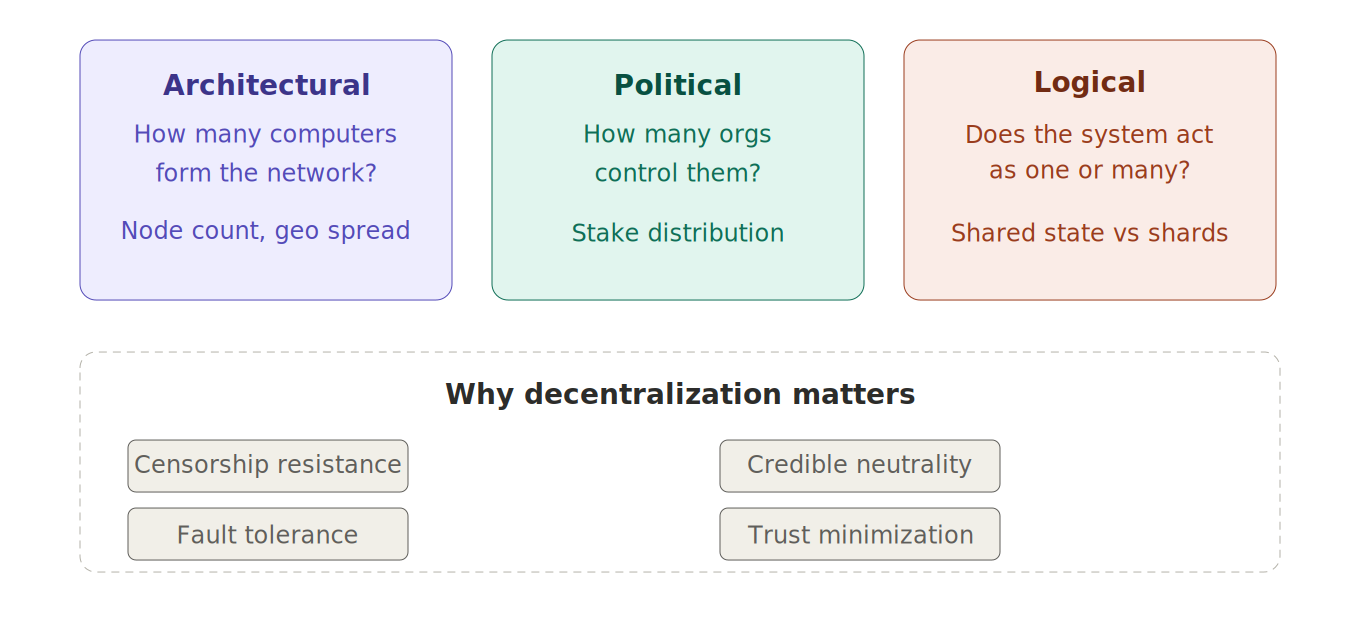
TL;DR: Decentralization in blockchain means distributing control, data, and decision-making across many independent participants rather than concentrating power in a single entity. It operates on three levels: architectural (how many computers form the network), political (how many organizations control those computers), and logical (whether the system behaves as one unified entity or many independent ones). Decentralization is not binary. It is a spectrum, and different blockchains make different tradeoffs along it. What matters is that decentralization enables the properties that make blockchain valuable: censorship resistance, fault tolerance, credible neutrality, and trust minimization.
The Simple Explanation
When people describe blockchain as "decentralized," they usually mean that no single company, government, or individual controls the network. But decentralization is more nuanced than that. A network can have thousands of nodes (architecturally decentralized) but be controlled by three mining pools (politically centralized). Or it can have many independent operators (politically decentralized) but rely entirely on a single cloud provider (infrastructurally concentrated).
Think of it like a voting system. A truly decentralized vote means many independent people casting ballots, many independent organizations counting them, and no single authority that can override the result. If 10,000 people vote but one company counts all the ballots, the process is architecturally distributed but politically centralized. If 100 independent counters verify the results but they all use the same counting software from one vendor, there is a logical single point of failure despite the political distribution.
Blockchain decentralization works the same way. The value comes not from the number of nodes alone but from the independence and diversity of the participants at every layer.
Three Levels of Decentralization
Architectural decentralization measures how many physical computers make up the network. A blockchain with 10,000 nodes spread across 50 countries is more architecturally decentralized than one with 100 nodes in 3 data centers. More nodes means more redundancy: the network can tolerate individual machines going offline, entire regions losing connectivity, or specific hardware configurations failing. Ethereum runs approximately 7,000-10,000 nodes globally. Bitcoin runs approximately 15,000-20,000 reachable nodes. Solana runs approximately 1,500-2,000 validators.
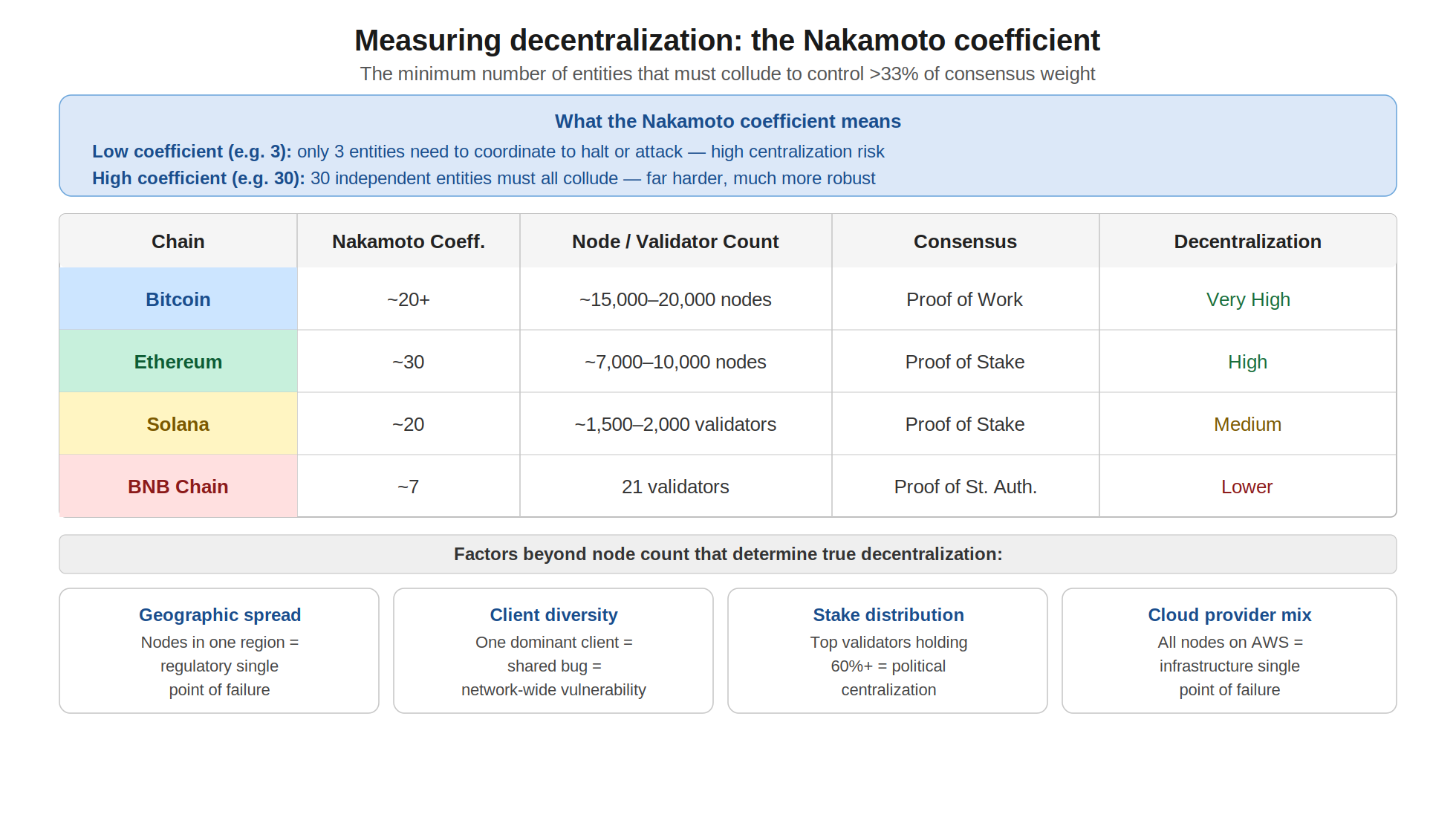
Political decentralization measures how many independent organizations or individuals control the network's nodes and decision-making. This is often more important than raw node count. If 10,000 nodes are all operated by the same company, the network is architecturally distributed but politically centralized. The Nakamoto coefficient quantifies this: it is the minimum number of entities that would need to collude to control more than 33% of the network (the threshold needed to disrupt consensus on most PoS chains). A higher Nakamoto coefficient means more political decentralization. Ethereum's Nakamoto coefficient is approximately 30. Solana's is approximately 20. BNB Chain's is approximately 7.
Logical decentralization measures whether the system's interface and state behave as one unified whole or as many independent parts. Most blockchains are logically centralized in the sense that there is one canonical chain state that all nodes agree on. This is by design: consensus on a single state is what makes the system useful. But the logical centralization of state does not negate the political and architectural decentralization of who maintains and validates that state.
Why Decentralization Matters
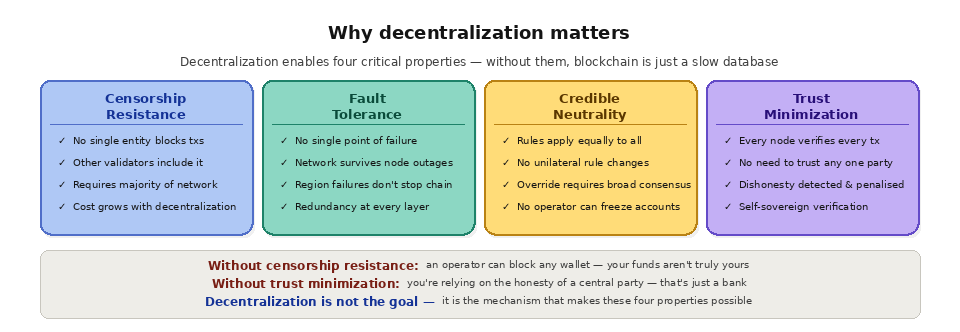
Decentralization is not an end in itself. It is the mechanism that enables four critical properties.
Censorship resistance means no single entity can prevent a valid transaction from being included in the chain. If one validator refuses to include your transaction, other validators will include it. As long as the validator set is sufficiently distributed, censorship requires controlling a majority of the network, which becomes prohibitively expensive as decentralization increases.
Fault tolerance means the network continues operating even when individual components fail. A centralized server is a single point of failure: if it goes down, everything goes down. A decentralized network can absorb the failure of many individual nodes without interruption because the remaining nodes continue processing and validating.
Credible neutrality means the network's rules apply equally to all participants, and no party can change the rules to favor themselves. In a centralized system, the operator can change the terms of service, freeze accounts, or prioritize certain users. In a sufficiently decentralized system, changing the rules requires broad consensus among many independent participants, making unilateral manipulation practically impossible.
Trust minimization means users do not need to trust any single entity for the system to function correctly. Every node independently verifies every transaction. You do not need to trust that the validator processing your transaction is honest because the network's consensus mechanism ensures that dishonest behavior is detected and penalized.
How Decentralization Is Measured
Measuring decentralization requires looking beyond headline numbers. Node count alone is insufficient because it does not capture who controls those nodes. Geographic distribution matters because nodes concentrated in one jurisdiction are vulnerable to coordinated regulatory action. Client diversity matters because networks dominated by a single software implementation are vulnerable to client-specific bugs. Stake distribution on PoS chains determines how much influence each validator has over block production. The Nakamoto coefficient synthesizes these factors into a single metric: the minimum number of entities needed to collude and control over 33% of the network's consensus weight.
How Quicknode Fits In
Quicknode operates infrastructure across 14+ regions and 5+ cloud and bare-metal providers, contributing to the geographic and provider diversity of blockchain node infrastructure. By giving developers easy access to 80+ chains without requiring them to run their own nodes, Quicknode lowers the barrier to building on decentralized networks while maintaining the reliability needed for production applications. Quicknode's Dedicated Clusters provide isolated infrastructure that avoids the concentration risk of shared endpoints.
How decentralized are the major blockchains?
Headline node counts only tell part of the story, but combined with the Nakamoto coefficient they give a useful snapshot of how decentralized a network actually is. The table below summarizes approximate figures for several major chains.
Network
Approx. nodes or validators
Approx. Nakamoto coefficient
Bitcoin
15,000 to 20,000 reachable nodes
Varies by mining pool concentration
Ethereum
7,000 to 10,000 nodes
About 30
Solana
1,500 to 2,000 validators
About 20
BNB Chain
Smaller validator set
About 7
Why is there a tradeoff between decentralization and performance?
Adding more independent, geographically spread validators improves censorship resistance and fault tolerance, but it also means consensus messages travel farther and agreement takes longer. This is the heart of the decentralization vs performance tradeoff, and it shows up directly in a chain's throughput and latency. Faster chains often accept a smaller, more concentrated validator set to keep block times low.
What is the Nakamoto coefficient?
The Nakamoto coefficient is the minimum number of independent entities that would need to collude to control more than 33% of a network's consensus weight, the threshold needed to disrupt consensus on most proof-of-stake chains. A higher number means more political decentralization. It is closely tied to validator concentration, because a few large operators can quietly lower the coefficient even when the raw node count looks healthy.
Does using an RPC provider reduce decentralization?
Using a provider does not change the underlying network's consensus or validator set, so the chain stays exactly as decentralized as before. What changes is your access path: instead of running a node yourself, you read and write through provider infrastructure that sits in the Web3 infrastructure stack. To understand where that access layer fits, see how Web3 infrastructure works.
Frequently Asked Questions
What are the three levels of decentralization?
Architectural (how many physical machines run the network), political (how many independent organizations control them), and logical (whether the system behaves as one unified state or many independent parts). A network can be strong on one level and weak on another.
Is more nodes always more decentralized?
No. Node count measures architectural decentralization, but if a few organizations control most of those nodes the network is still politically centralized. Independence and diversity of operators matter more than the raw count.
What does the Nakamoto coefficient measure?
It measures the minimum number of entities that would need to collude to control over 33% of consensus weight. A higher coefficient indicates greater political decentralization and a higher cost to attack or censor the network.
Why does decentralization matter for developers?
It is what delivers censorship resistance, fault tolerance, credible neutrality, and trust minimization. Those properties are why a decentralized network can be relied on without trusting any single operator to behave honestly.
Can a blockchain be too decentralized?
There are tradeoffs. Maximizing decentralization tends to reduce throughput and increase latency, so chains balance the validator set against the performance their applications require.