Answers>Learn about decentralization tradeoffs>Decentralization vs performance
Decentralization vs performance
// Tags
decentralization tradeoffsblockchain trilemma
TL;DR: The tension between decentralization and performance is one of blockchain's defining challenges, often described as the "blockchain trilemma." Greater decentralization requires more nodes reaching consensus, which increases communication overhead, raises latency, and lowers throughput. Higher performance requires fewer validators, faster consensus rounds, or steeper hardware requirements, all of which drive centralization. The trilemma holds that blockchains can fully optimize at most two of three properties: decentralization, security, and scalability. Different chains make different tradeoffs along this spectrum, and strategies like Layer 2 rollups, sharding, and parallel execution are pushing the boundaries of what is possible.
The Simple Explanation
Imagine trying to make a decision in a group. If three people need to agree, the conversation is fast. If 10,000 people need to agree, the conversation takes much longer, even if everyone is acting in good faith. Blockchain consensus works the same way. Every validator needs to receive, verify, and attest to each new block. The more validators participate, the more messages need to be exchanged, and the longer consensus takes.
This creates a fundamental tradeoff. You can have a fast network with few validators (high performance, low decentralization), or a slow network with many validators (low performance, high decentralization), or something in between. You cannot have maximum performance and maximum decentralization simultaneously with current technology.
The Blockchain Trilemma
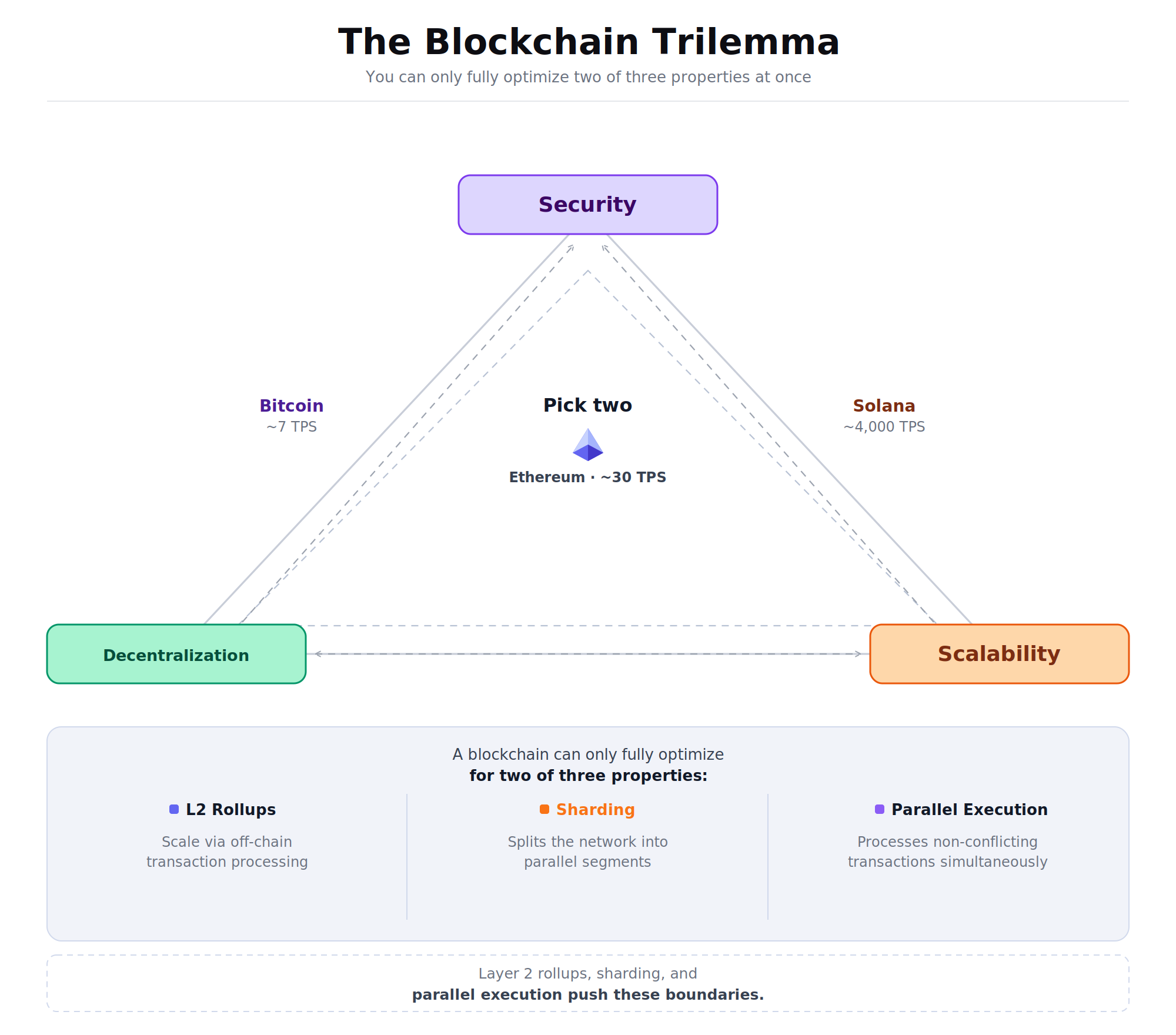
The blockchain trilemma, popularized by Ethereum co-founder Vitalik Buterin, states that a blockchain can optimize for at most two of three properties simultaneously: decentralization, security, and scalability.
Decentralization means many independent participants can operate nodes and participate in consensus without prohibitive hardware requirements. Security means the network can resist attacks from well-funded adversaries trying to rewrite history, censor transactions, or halt the chain. Scalability means the network can process a high volume of transactions quickly and cheaply.
Bitcoin maximizes decentralization and security but sacrifices scalability. Anyone with modest hardware can run a full node, and the network has never been successfully attacked, but throughput is limited to roughly 7 transactions per second. Ethereum balances all three but leans toward decentralization and security, processing approximately 30 TPS on L1 with plans to scale through rollups rather than increasing base layer throughput. Solana prioritizes performance and security, achieving approximately 4,000 TPS in practice, but requires high-end hardware to run a validator, which limits the number of participants and concentrates the validator set.
Why the Tradeoffs Exist
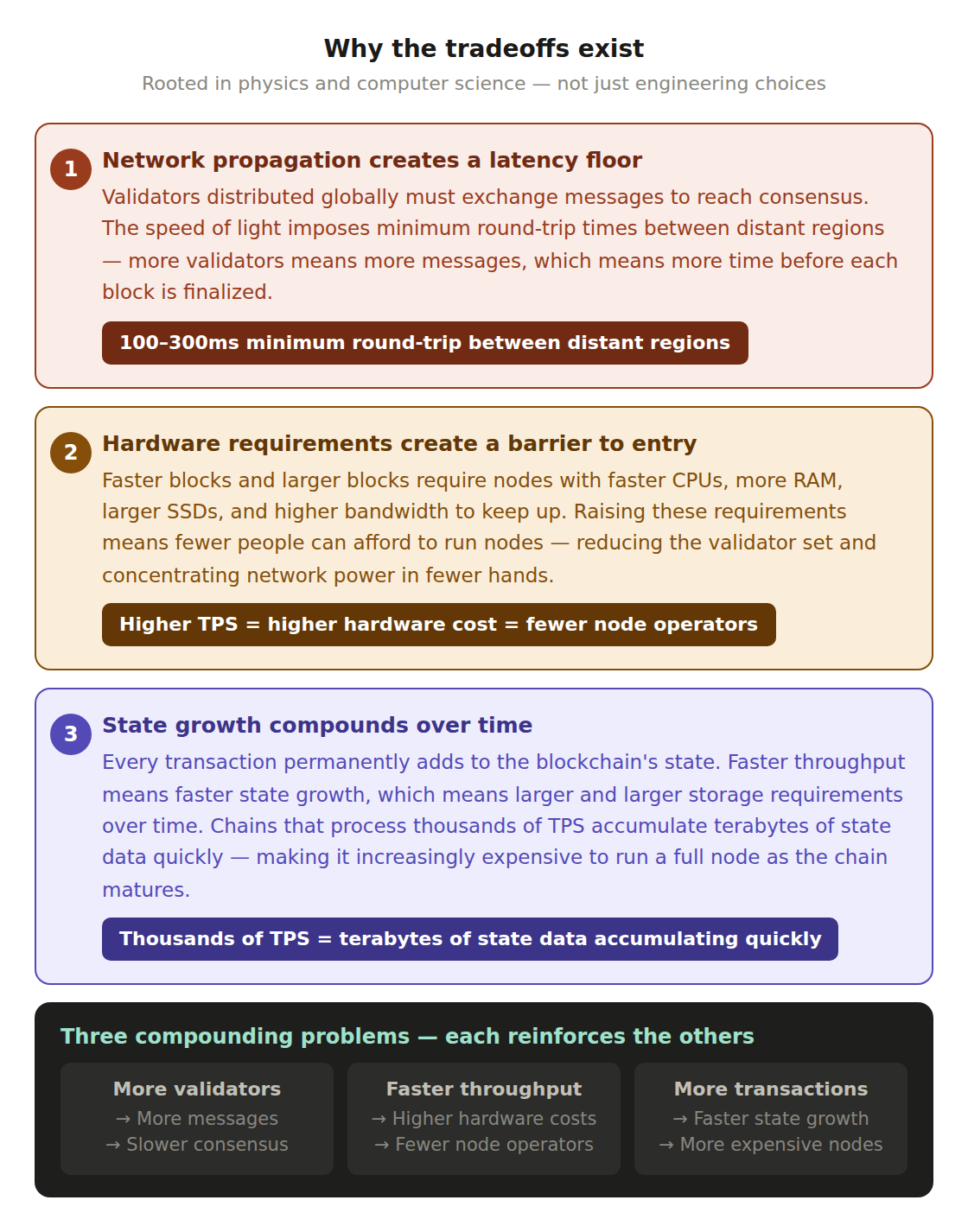
The tradeoffs are rooted in physics and computer science, not just engineering choices. Network propagation time creates a floor on consensus latency. Validators distributed globally must exchange messages, and the speed of light imposes minimum round-trip times of 100-300ms between distant regions. More validators means more messages, and more messages means more time.
Hardware requirements create a barrier to entry. If the chain produces blocks faster or includes more data per block, nodes need faster CPUs, more RAM, larger SSDs, and higher bandwidth to keep up. Raising these requirements means fewer people can afford to run nodes, reducing the validator set and concentrating the network.
State growth compounds over time. Every transaction adds to the blockchain's state. Faster throughput means faster state growth, which means larger storage requirements. Chains that process thousands of TPS accumulate terabytes of state data quickly, making it increasingly expensive to run a full node.
Strategies Pushing the Boundaries
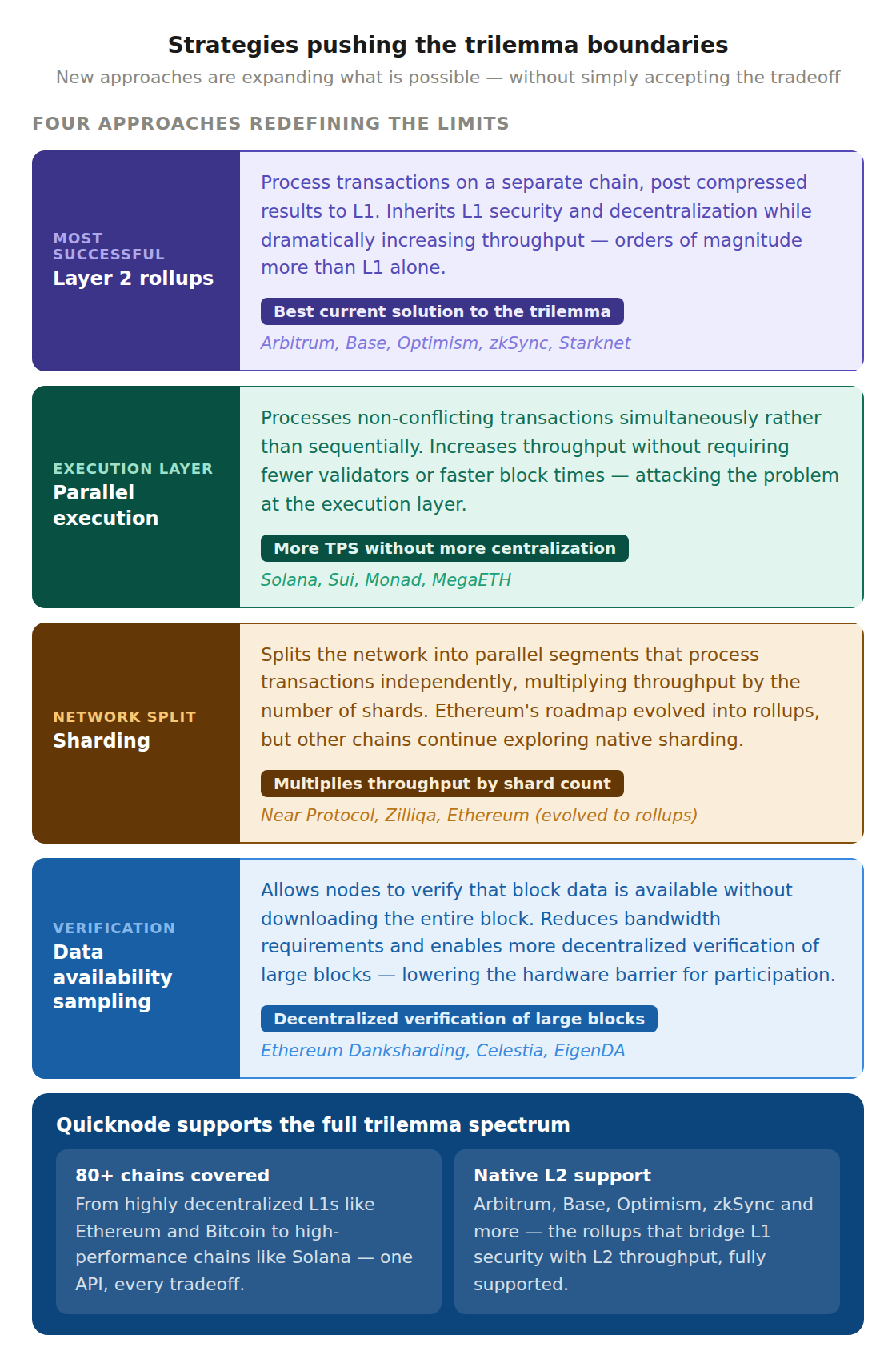
Layer 2 rollups are the most successful strategy for breaking the trilemma. By processing transactions on a separate chain and posting compressed results to L1, rollups inherit the security and decentralization of the base layer while dramatically increasing throughput. Ethereum's L2 ecosystem (Arbitrum, Base, Optimism, zkSync) processes orders of magnitude more transactions than L1 alone.
Parallel execution, used by Solana, Sui, Monad, and MegaETH, processes non-conflicting transactions simultaneously rather than sequentially, increasing throughput without increasing block time or requiring fewer validators.
Sharding splits the network into parallel segments that process transactions independently, multiplying throughput by the number of shards. Ethereum's original sharding roadmap evolved into the rollup-centric approach, but other chains continue exploring native sharding.
Data availability sampling allows nodes to verify that block data is available without downloading the entire block, reducing bandwidth requirements and enabling more decentralized verification of large blocks.
How Quicknode Fits In
Quicknode supports the full spectrum of trilemma tradeoffs by providing infrastructure across 80+ chains, from highly decentralized L1s like Ethereum and Bitcoin to high-performance chains like Solana, and the L2 rollups that bridge both worlds. Whether you are building on a chain that prioritizes decentralization or one that prioritizes throughput, Quicknode's Core API delivers low-latency, reliable access. For L2-specific use cases, Quicknode provides native RPC support for Arbitrum, Base, Optimism, zkSync, and other leading rollups.
How do the major chains compare on the trilemma?
The table below summarizes where leading networks sit on the decentralization, security, and scalability spectrum. For a deeper look at how validator counts shape this, see validator concentration.
Chain
Leans toward
Approximate throughput
Node accessibility
Bitcoin
Decentralization and security
About 7 TPS
Runs on modest hardware
Ethereum L1
Decentralization and security
About 30 TPS
Consumer hardware, scales via rollups
Solana
Performance and security
Thousands of TPS
High-end hardware required
Ethereum plus rollups
All three, via Layer 2
Thousands of TPS combined
L1 stays accessible, L2 adds scale
Can you have both decentralization and performance?
Not at the base layer with today's technology, which is the core of the trilemma. The practical answer is to separate the layers: keep a highly decentralized and secure Layer 1 for settlement, and push execution to rollups and other Layer 2 systems that inherit L1 security while delivering high throughput. This is why Ethereum chose a rollup-centric roadmap rather than simply raising L1 throughput.
Frequently Asked Questions
What is the blockchain trilemma?
The blockchain trilemma is the idea that a blockchain can fully optimize at most two of three properties at once: decentralization, security, and scalability. Improving one usually comes at the expense of another.
Why does more decentralization reduce performance?
More validators means more messages must be exchanged to reach consensus, and global distribution adds network latency. Both increase the time and overhead per block, which lowers throughput compared with a small, tightly coupled validator set.
Which matters more, decentralization or performance?
It depends on the use case. Settlement of high-value assets favors decentralization and security, while consumer apps and high-frequency trading favor performance. Many teams get both by settling on a decentralized L1 and executing on a fast L2.
How do Layer 2s help with the trilemma?
Layer 2 rollups execute transactions off-chain and post compressed data back to a decentralized Layer 1. Users get high throughput and low fees while still inheriting the security and decentralization of the base chain, which sidesteps the base-layer tradeoff.
Is the trilemma a hard law?
It is a practical constraint rather than a proven theorem. Techniques like parallel execution, sharding, data availability sampling, and rollups keep pushing the boundaries, improving throughput and latency without abandoning decentralization.