Answers>Learn about decentralization tradeoffs>Validator concentration explained
Validator concentration explained
// Tags
validator concentrationstaking centralization
TL;DR: Validator concentration describes how stake or mining power is distributed among network participants. When a small number of entities control a disproportionate share of stake, the network is concentrated. When many validators hold similar amounts, the network has healthy distribution. High concentration increases censorship risk, threatens network liveness if major validators go offline, and raises the possibility of collusion. The degree of concentration varies significantly across chains: Ethereum has a Nakamoto coefficient of approximately 30, Solana approximately 20, and BNB Chain approximately 7. The causes include economies of scale, delegation preferences, liquid staking protocols, and exchange staking. Mitigation requires protocol-level incentives, stake caps, and ecosystem awareness.
The Simple Explanation
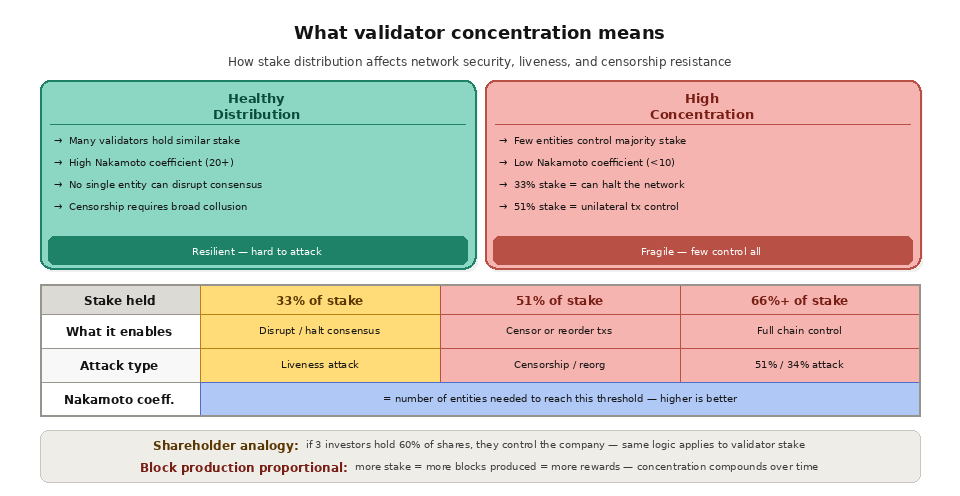
In a Proof of Stake blockchain, validators put up capital (stake) as collateral to earn the right to produce blocks and earn rewards. The more stake a validator controls, the more blocks they produce and the more influence they have over the network. If one entity controls 33% of the total stake, they can potentially disrupt consensus. If they control 51%, they can unilaterally decide which transactions get included.
Think of it like a shareholder vote. If ownership is spread across thousands of small shareholders, no single shareholder can dictate outcomes. If three institutional investors hold a combined 60% of shares, they effectively control the com
pany regardless of what the other shareholders want. Validator concentration is the blockchain equivalent of ownership concentration.
How Concentration Is Measured
The Nakamoto coefficient is the primary metric for measuring validator concentration. It represents the minimum number of entities that would need to collude to control more than 33% of the network's consensus weight. A higher coefficient means more entities are needed to compromise the network, indicating healthier distribution.
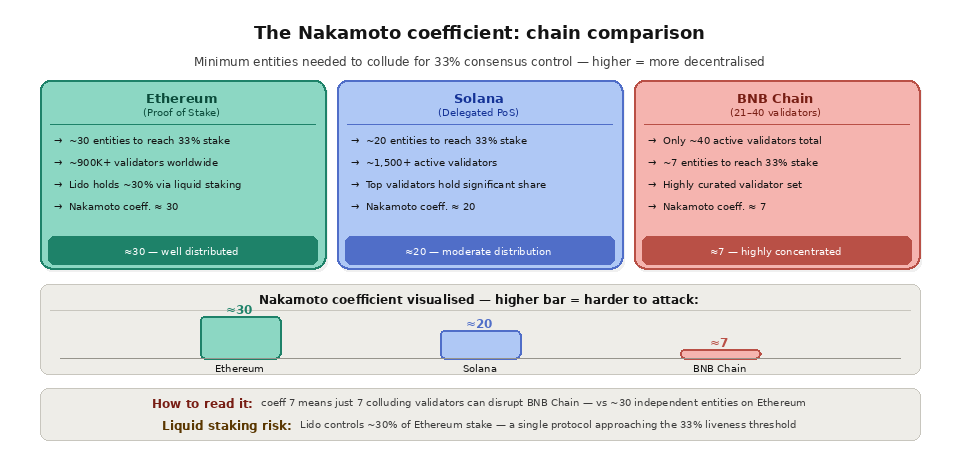
As of recent data, Ethereum's Nakamoto coefficient is approximately 30, meaning roughly 30 independent staking entities would need to collude to control a third of the stake. Solana's is approximately 20. BNB Chain's is approximately 7, reflecting its more concentrated validator set with only 40 active validators.
Beyond the Nakamoto coefficient, concentration can be measured by the stake share of the top 3, top 10, and top 20 validators, the geographic distribution of validators, the distribution across hosting providers, and the percentage of stake controlled through liquid staking protocols versus independent validators.
Why Concentration Is Dangerous
Censorship becomes feasible when a small number of validators control enough stake to selectively exclude transactions. If the top 5 validators control 40% of stake and agree to censor transactions from specific addresses, those transactions will experience significant delays even if other validators are willing to include them.
On Ethereum, concerns about censorship have been raised around OFAC-compliant block builders and relays that filter sanctioned addresses.
Liveness risk increases when large validators experience downtime. If a single entity staking 10% of the network goes offline, the effective participation rate drops significantly. If several large validators go down simultaneously (due to a shared infrastructure failure, for example), the network may not be able to reach the consensus threshold needed to produce blocks.
Collusion risk is the worst case. If enough concentrated validators coordinate, they could potentially reorder transactions to extract MEV, censor specific users or applications, or in extreme cases, halt the chain or execute a double-spend attack.
Causes of Concentration
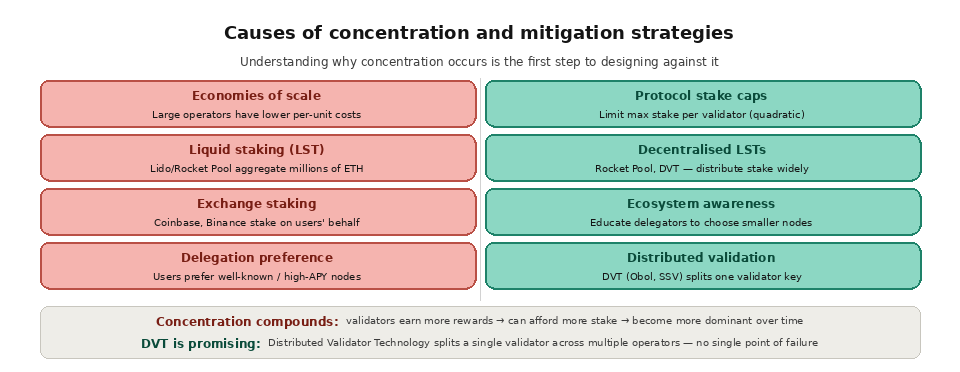
Economies of scale favor large operators. Running validator infrastructure at scale is cheaper per unit of stake than running a single validator. Large operators can afford better hardware, redundant setups, and dedicated operations teams, leading to better uptime and more consistent rewards.
Delegation preferences drive concentration. On chains where stakers delegate to validators, most stake flows to the largest, most visible, and highest-reputation validators. Smaller validators struggle to attract delegation even if their performance is comparable, creating a self-reinforcing cycle.
Liquid staking protocols like Lido have emerged as significant concentration vectors. On Ethereum, Lido controls approximately 28-30% of all staked ETH through a network of node operators. While Lido distributes stake across multiple operators internally, it represents a single governance entity and a single smart contract risk.
Exchange staking concentrates stake because centralized exchanges offer one-click staking to millions of users. When users stake through Coinbase, Binance, or Kraken, the exchange runs the validators and controls the stake, even though millions of individual users provided the capital.
Mitigation Strategies
Protocol-level incentives can encourage distribution. Some chains implement anti-correlation penalties that punish validators more heavily when failures are correlated (suggesting shared infrastructure), incentivizing independent operations. Ethereum's approach of reducing rewards for validators that attest in sync with large groups creates economic pressure toward diversity.
Stake caps limit how much any single validator can stake. While not common on major PoS chains, some networks impose maximum stake limits per validator to prevent concentration.
Community awareness and education help stakers understand the importance of delegating to smaller, independent validators rather than defaulting to the largest ones.
What is the Nakamoto coefficient?
The Nakamoto coefficient is the most widely used measure of validator concentration. It counts the smallest number of independent entities that would have to collude to control more than one third of a network's consensus weight, which is the threshold at which they can disrupt consensus. A higher number means more parties are needed to attack or stall the chain, which signals healthier decentralization. A low number means a handful of validators effectively hold the keys to the network.
What is the difference between a concentrated and a well-distributed network?
The contrast between a concentrated network and a well-distributed one shows up across several risk dimensions at once. The table below summarizes how the two profiles differ and uses real chains as reference points.
Aspect
Concentrated network
Well-distributed network
Nakamoto coefficient
Low, often single digits
High, often dozens
Censorship risk
Higher
Lower
Liveness under outage
Fragile
Resilient
Collusion risk
Elevated
Minimal
Reference example
BNB Smart Chain (about 7)
Ethereum (about 30)
How does validator concentration compare across major blockchains?
Concentration varies widely between networks, driven largely by how many validators each chain supports and how stake flows to them. The table below lists approximate Nakamoto coefficients for three widely used Proof of Stake networks. Because each blockchain node set is structured differently, treat these as directional figures rather than precise ones.
Blockchain
Approximate Nakamoto coefficient
What it reflects
Ethereum
About 30
Many independent staking entities
Solana
About 20
Large but more concentrated validator set
BNB Smart Chain
About 7
Only around 40 active validators
How does validator concentration affect liveness and uptime?
Concentration is not only a censorship concern, it is an availability concern. When a large share of stake sits behind one operator or one hosting provider, a single outage can knock a meaningful fraction of the network offline at once. If enough stake drops, the chain can miss the participation threshold it needs to finalize blocks, and in the worst case it can suffer a chain halt. This is why high availability and diverse infrastructure matter as much as raw stake distribution.
Why do high-performance chains tend to be more concentrated?
There is a recurring tension between speed and distribution. Chains that push for very high throughput often demand powerful, expensive validator hardware, which prices out smaller operators and pushes stake toward a few well-funded ones. That is the heart of the decentralization vs performance tradeoff: the same design choices that raise capacity can quietly shrink the validator set and increase concentration.
Frequently Asked Questions
What is a good Nakamoto coefficient?
There is no universal pass mark, but higher is better. A coefficient in the single digits means a few entities could collude to disrupt the chain, while a coefficient in the dozens means an attack would require coordinating many independent parties. Compare a chain's number against its peers rather than judging it in isolation.
Does liquid staking increase validator concentration?
It can. A liquid staking protocol spreads stake across many node operators internally, but it still represents a single governance entity and a single smart-contract dependency, so a large protocol effectively concentrates influence even when the underlying operators look diverse.
Does validator concentration affect finality?
Yes. Finality requires a supermajority of stake to attest to blocks, so if concentrated validators go offline or refuse to attest, the chain can struggle to reach finality, leaving recent blocks reversible for longer than usual.
Why does infrastructure diversity matter for concentration?
Even validators that look independent can fail together if they run in the same cloud region or on the same hosting provider. Spreading validators across providers and geographies is a form of infrastructure redundancy that reduces the chance of one correlated outage taking a large share of stake offline at once.
Can validator concentration be fixed?
It can be reduced but rarely eliminated. Protocol incentives that penalize correlated failures, stake caps, and stakers consciously delegating to smaller operators all push toward better distribution. Because economies of scale never fully disappear, keeping concentration low is an ongoing effort rather than a one-time fix.
How Quicknode Fits In
Quicknode contributes to infrastructure decentralization by operating nodes across multiple cloud and bare-metal providers in 14+ regions globally. By distributing blockchain infrastructure across diverse providers and geographies, Quicknode reduces the risk of correlated failures that concentrated infrastructure creates. For teams building staking tools, dashboards, or delegation interfaces, Quicknode's Core API provides the RPC access needed to query validator states, stake distributions, and network health metrics across supported chains.