Answers>Learn about wallets & identity>Hot wallets vs cold wallets
Hot wallets vs cold wallets
// Tags
hot walletcold wallethardware wallet
TL;DR: Hot wallets are software applications that store private keys on internet-connected devices, offering convenience and quick access for daily transactions. Cold wallets store private keys offline, typically on hardware devices, providing significantly stronger security against remote attacks. The tradeoff is straightforward: hot wallets prioritize usability at the cost of exposure to online threats, while cold wallets prioritize security at the cost of convenience. Most security-conscious crypto users use both: a hot wallet for everyday spending and dapp interactions, and a cold wallet for long-term storage of significant holdings.
The Simple Explanation
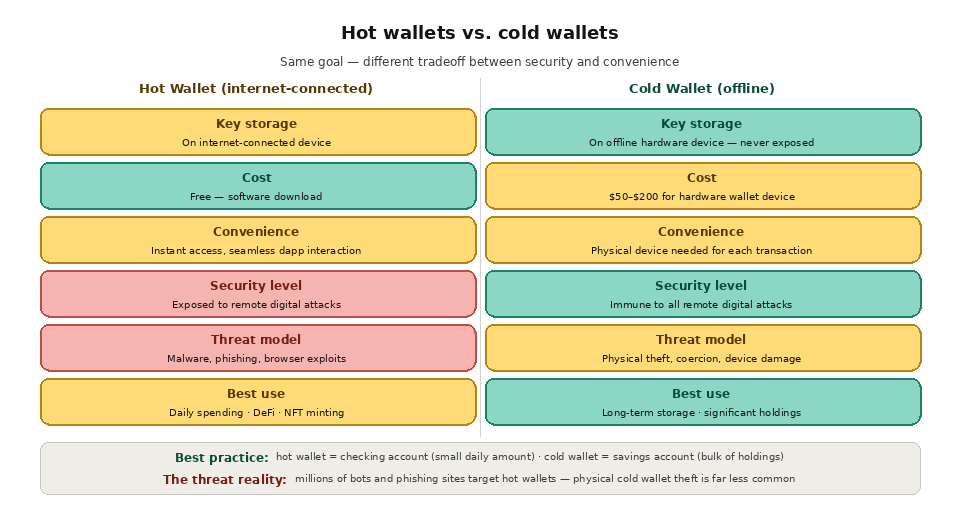
The "hot" and "cold" distinction refers to whether the device holding your private keys is connected to the internet. A hot wallet is always online, like cash in your pocket: easy to spend but exposed to pickpockets. A cold wallet is offline, like cash in a home safe: harder to access but much harder for anyone else to steal.
This distinction matters because private keys are the ultimate proof of ownership on a blockchain. If an attacker obtains your private key, they can send your entire balance to their own address in a single irreversible transaction. The primary attack vector for stealing private keys is the internet: malware that scans your device for key files, phishing sites that trick you into entering your seed phrase, and browser vulnerabilities that expose data from wallet extensions. A cold wallet eliminates this entire category of risk by keeping the key on a device that never touches the internet.
How Do Hot and Cold Wallets Compare at a Glance?
Both wallet types protect the same thing, your private keys, but they make opposite tradeoffs between access and security. The table below summarizes the practical differences before we dig into each type. If you are new to the topic, our overview of what a
crypto wallet
is provides helpful background.
Factor
Hot wallet
Cold wallet
Internet connection
Always online
Offline by default
Best for
Daily transactions and dapps
Long-term storage
Primary risk
Remote attacks: malware, phishing
Physical theft or loss
Typical cost
Usually free
$50 to $200 for hardware
Convenience
High
Lower, extra steps to sign
Examples
MetaMask, Phantom, Trust Wallet
Ledger, Trezor
Neither option is strictly better. The right choice depends on how much value you hold and how often you transact, which we cover below.
Hot Wallets in Detail
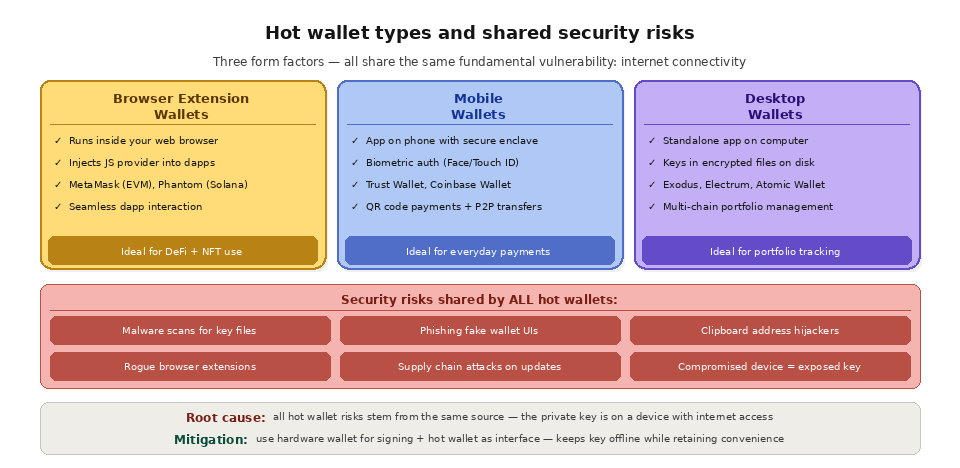
Hot wallets are the most widely used wallets in crypto because they are free, easy to install, and enable seamless interaction with decentralized applications. When you connect MetaMask to Uniswap, sign a transaction in Phantom to mint an NFT, or use Coinbase Wallet to participate in a DAO vote, you are using a hot wallet.
Browser extension wallets like MetaMask (Ethereum and EVM chains) and Phantom (Solana) integrate directly into your web browser. When you visit a dapp, the wallet injects a JavaScript provider into the page, allowing the dapp to request transaction signatures. You review and approve each transaction in the wallet's popup interface. This tight browser integration makes dapp interaction nearly frictionless, which is why extension wallets dominate the DeFi and NFT user experience.
Mobile wallets like Trust Wallet, Coinbase Wallet, and Rainbow run as apps on your phone. They store the private key in the device's secure enclave (a hardware-isolated area of the phone's processor), provide biometric authentication (fingerprint or face ID) for transaction approval, and enable QR code scanning for wallet-to-wallet transfers. Mobile wallets are particularly popular for peer-to-peer payments and for interacting with mobile-native crypto applications.
Desktop wallets like Exodus and Electrum run as standalone applications on your computer. They offer broader feature sets than browser extensions, including multi-chain portfolio management, built-in exchange features, and detailed transaction history. Desktop wallets store keys in encrypted files on your hard drive.
The security risks common to all hot wallets stem from their internet connectivity. Malware can scan your device for wallet key files or seed phrase backups. Phishing attacks create fake wallet interfaces that capture your seed phrase. Clipboard hijackers replace cryptocurrency addresses you copy with the attacker's address. Rogue browser extensions can read data from legitimate wallet extensions. Supply chain attacks can compromise wallet software updates. Even a well-secured hot wallet is only as secure as the device it runs on.
Cold Wallets in Detail
Cold wallets keep private keys on a device that is never directly connected to the internet, eliminating the entire class of remote digital attacks.
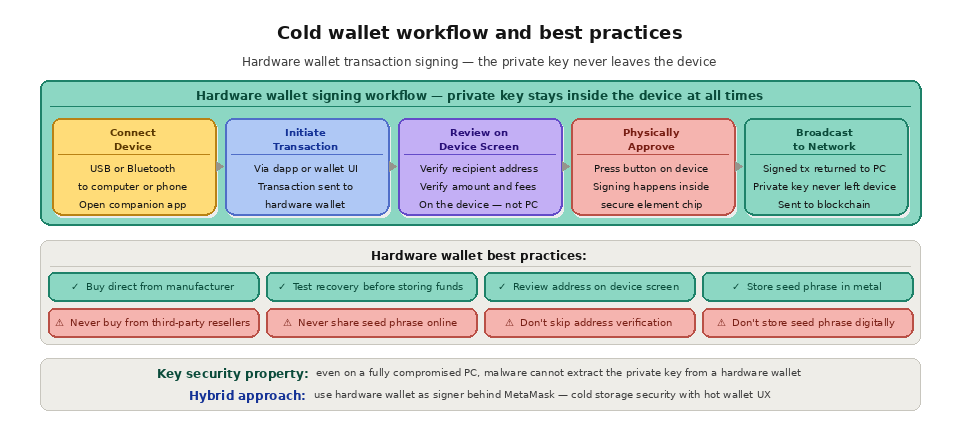
Hardware wallets from Ledger and Trezor are the standard cold wallet solution. These are small, purpose-built devices with a secure element (a tamper-resistant chip designed to protect cryptographic keys) and a small screen for transaction review. The workflow for using a hardware wallet involves connecting the device to your computer or phone via USB or Bluetooth, initiating a transaction through a companion app or dapp, reviewing the transaction details on the hardware wallet's screen, and physically pressing a button on the device to approve.
The key security property is that the private key is generated and stored inside the hardware wallet's secure element and never leaves it. When you approve a transaction, the signing happens on the device itself. The signed transaction (not the key) is sent back to the computer for broadcast. Even if your computer is completely compromised with malware, the attacker cannot extract the private key from the hardware wallet.
Hardware wallets typically cost between $50 and $200 depending on the model and features. Ledger's Nano S Plus and Nano X and Trezor's Model T and Model One are the most popular options. Both support hundreds of cryptocurrencies and integrate with popular wallet interfaces like MetaMask (Ledger can be used as a hardware signer behind MetaMask, combining cold storage security with browser extension convenience).
Metal seed phrase backups are a complementary cold storage measure. Instead of writing your seed phrase on paper (which can be damaged by water or fire), you stamp it into stainless steel plates. Products like Cryptosteel, Billfodl, and Blockplate are designed specifically for this purpose. A metal backup protects against physical disasters while keeping the seed phrase completely offline.
Security Comparison
The threat models for hot and cold wallets are fundamentally different. Hot wallets are vulnerable to remote digital attacks: malware, phishing, browser exploits, and compromised software. Cold wallets are vulnerable to physical attacks: theft of the device, coercion (someone forcing you to unlock it), supply chain tampering (buying a pre-compromised device), and physical damage.
For most users, the remote digital threat landscape is far more dangerous than the physical threat landscape. There are millions of bots, phishing sites, and malware variants targeting crypto wallets. Physical theft of a hardware wallet is far less common and also less effective (the attacker
still needs your PIN to use it, and the device can be wiped after a number of incorrect attempts).
Can a Cold Wallet Be Hacked?
A cold wallet removes the internet as an attack surface, but it is not invulnerable. The realistic threats are physical or human rather than remote. Supply chain tampering is the main concern: a device bought from a third-party reseller could ship with a pre-set seed phrase or modified firmware, which is why you should always buy direct from the manufacturer. Blind signing is another risk, where you approve a transaction whose details you cannot fully read on the small device screen. Strong key management habits, verifying addresses on the device, and keeping firmware updated close most of these gaps.
Coercion and physical theft remain edge cases. A thief still needs your PIN, and most hardware wallets wipe themselves after a set number of failed attempts. For high-value holdings, some users add a passphrase (a 25th word) so that even a stolen and unlocked device does not reveal the main account.
Best Practices
The most widely recommended approach is to use both wallet types for their respective strengths. Keep a hot wallet loaded with a small amount for daily DeFi interactions, NFT minting, and dapp usage. Think of it like a checking account. Store the majority of your holdings in a cold wallet. Think of it like a savings account or a safe deposit box. Only transfer from cold to hot when you need to.
Additional security practices include: buy hardware wallets directly from the manufacturer's website, never from third-party resellers who might tamper with the device. Test your recovery seed by restoring the wallet on a secondary device before storing significant funds. Review and revoke unnecessary token approvals on your hot wallet regularly, because old approvals can be exploited if a previously trusted contract is compromised. Never share your seed phrase with anyone, and be deeply skeptical of any website or person asking for it.
How Do You Choose Between a Hot and Cold Wallet?
The simplest rule is to match the wallet to the job. Use a hot wallet for the funds you actively spend, and a cold wallet for the savings you want to protect. The table below maps common situations to a recommended setup.
Use case
Recommended wallet
Why
Daily DeFi and NFT activity
Hot wallet
Fast signing and direct dapp connections
Holding savings for months or years
Cold wallet
Keys stay offline and away from remote attacks
Large balances with shared control
Multisig setup
No single key can move funds alone
Receiving payments only
Hot or watch-only wallet
You can share a receive address without exposing keys
If you build applications on chains like Ethereum, you will often support both wallet types so users can connect a hot wallet for convenience or a hardware signer for security.
What Is a Multisig Wallet, and Is It Hot or Cold?
A multisignature (multisig) wallet requires more than one private key to authorize a transaction, for example two of three approved keys. Multisig sits across the hot and cold split rather than inside it: you can store the signing keys on a mix of hot and cold devices. This removes the single point of failure that affects ordinary wallets, since compromising one key is not enough to move funds. Many teams and DAOs use multisig for treasuries, and smart contract wallets extend the idea with programmable rules like spending limits and social recovery, an approach closely tied to account abstraction.
How Quicknode Supports Wallet Infrastructure
Whether you are building a hot wallet, integrating hardware wallet signing, or developing a custodial platform, your application needs reliable, low-latency access to blockchain data. Quicknode's Core API provides the RPC endpoints that wallet applications depend on for balance queries, transaction broadcasting, gas estimation, and block monitoring across 80+ chains. Quicknode's enhanced API methods simplify common wallet operations, reducing the number of individual RPC calls needed to display a user's complete portfolio. For wallet developers building multi-chain experiences, Quicknode's unified infrastructure means you do not need to manage separate node providers for each chain your wallet supports.
Frequently Asked Questions
Is a hot wallet safe enough for small amounts?
Yes, for everyday spending. A reputable hot wallet is reasonable for small balances you can afford to lose, as long as you avoid phishing links and review every transaction before signing. Keep large holdings in cold storage.
Do I need a cold wallet if I only hold a little crypto?
Not necessarily. If your balance is small and you transact often, a well-secured hot wallet may be enough. A cold wallet becomes worth the cost once the value you would lose exceeds the price of the hardware.
Can I use a hardware wallet with MetaMask?
Yes. A Ledger or Trezor can act as the signer behind MetaMask, so you get the familiar browser interface while your private key stays on the hardware device and never touches your computer.
What happens if I lose my cold wallet?
Your funds are safe as long as you have your recovery seed phrase. You can restore the wallet on a new device using that phrase, which is why a secure, offline backup of the seed phrase is essential.
Are exchange accounts the same as hot wallets?
No. On an exchange, the platform holds the private keys, so you do not control the funds directly. A self-custodial hot wallet means you hold the keys and the responsibility. Both connect to the internet, but only self-custody gives you direct control. Developers can query balances and broadcast transactions across many networks with the Core API.