Answers>Learn about wallets & identity>How key management works
How key management works
// Tags
key managementseed phraseprivate key
TL;DR: Key management is the practice of securely generating, storing, using, and backing up the cryptographic keys that control access to blockchain assets. A private key is a random 256-bit number that gives its holder complete, irreversible control over the funds at its associated address. Seed phrases encode private keys as 12 or 24 human-readable words, enabling backup and recovery. Hierarchical deterministic (HD) wallets use a single seed phrase to generate an unlimited number of addresses across multiple chains. For individuals, secure key management means proper seed phrase storage and hardware wallet usage. For teams and institutions, it means multi-signature wallets and Multi-Party Computation (MPC) solutions that distribute key control across multiple parties.
The Simple Explanation
Every blockchain address is controlled by a private key. Whoever holds the private key can sign transactions, transfer assets, and interact with smart contracts from that address. There is no password reset. There is no account recovery team. There is no "forgot my key" option. If you lose your private key, your funds are permanently inaccessible. If someone else obtains your private key, they can take everything instantly and irreversibly.
This is what makes key management the single most important security discipline in crypto. The entire security model of blockchain ownership comes down to one question: who has the key?
Private Keys and Public Keys
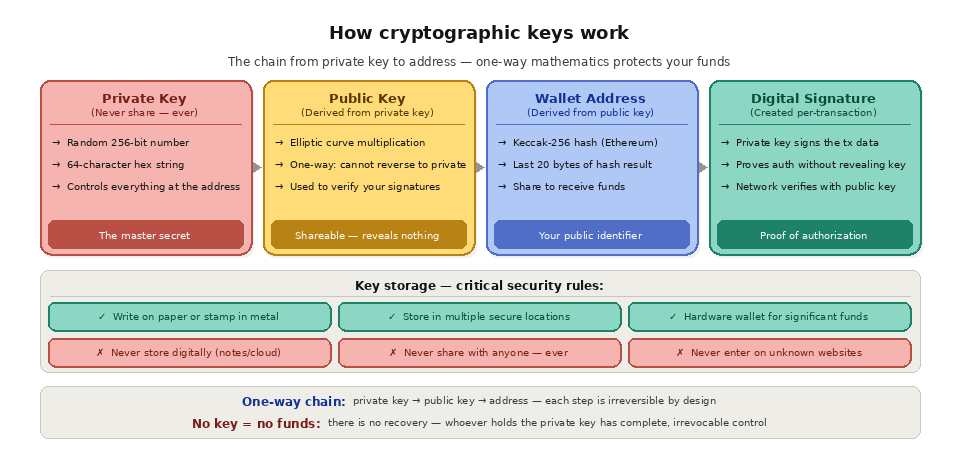
A private key is a randomly generated number between 1 and approximately 1.16 x 10^77 (the order of the secp256k1 elliptic curve used by Bitcoin, Ethereum, and most blockchains). In practice, it is a 256-bit (32-byte) value, typically represented as a 64-character hexadecimal string.
The public key is derived from the private key through elliptic curve multiplication, a one-way mathematical operation. You can compute the public key from the private key, but you cannot reverse the process to derive the private key from the public key. This asymmetry is the foundation of blockchain security.
The wallet address is derived from the public key through a hashing process. On Ethereum, the address is the last 20 bytes of the Keccak-256 hash of the public key. On Bitcoin, the address is derived through a different hashing scheme (SHA-256 followed by RIPEMD-160). The address is what you share with others to receive funds. It is mathematically linked to your private key but reveals nothing about it.
When you sign a transaction, your wallet uses the private key to produce a digital signature. The signature proves that the holder of the private key authorized the transaction, without revealing the private key itself. Anyone on the network can verify the signature using the public key, but no one can forge a valid signature without the private key.
Seed Phrases (Mnemonic Phrases)
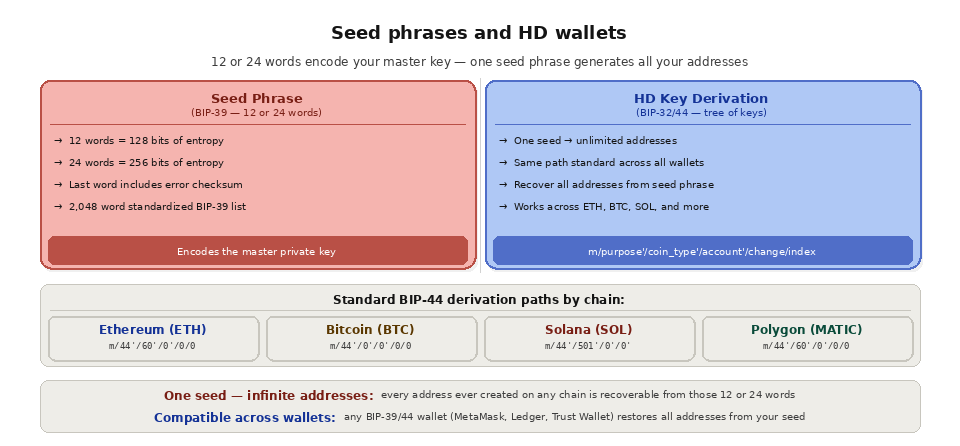
Raw private keys are long, unreadable strings of hexadecimal characters. Seed phrases solve this usability problem by encoding the key material as a sequence of 12 or 24 common English words, following the BIP-39 standard. The words come from a standardized list of 2,048 words, and the specific sequence encodes the entropy (randomness) used to generate the master private key.
A 12-word seed phrase encodes 128 bits of entropy. A 24-word seed phrase encodes 256 bits. The last word includes a checksum that helps detect transcription errors. From this entropy, the wallet derives a master private key using PBKDF2 key stretching with 2,048 iterations, making brute-force attacks against the seed phrase computationally infeasible.
What Is the Difference Between a Private Key and a Seed Phrase?
People often use these terms interchangeably, but they are not the same. A private key controls one address and is a raw 256-bit number. A seed phrase is a human-readable backup, usually 12 or 24 words, that encodes the master secret from which many private keys are derived. In other words, a single seed phrase can regenerate every private key in your crypto wallet. This is why protecting the seed phrase matters even more than protecting any individual private key: lose the seed phrase and you lose the ability to recover every derived address.
Hierarchical Deterministic (HD) Wallets
Modern wallets do not generate a single private key. They use the seed phrase to derive a tree of keys through a system called Hierarchical Deterministic (HD) key generation, defined by BIP-32 and BIP-44.
The master private key generated from the seed phrase serves as the root of a key tree. Each branch of the tree is identified by a derivation path, a series of indices that specify how to traverse the tree. The standard derivation path format is m/purpose'/coin_type'/account'/change/address_index. For example, the first Ethereum address is derived at m/44'/60'/0'/0/0, and the second at m/44'/60'/0'/0/1.
This hierarchical structure means a single seed phrase can generate an unlimited number of addresses across any blockchain. Your Ethereum addresses, Bitcoin addresses, Solana addresses, and addresses on any other supported chain can all be derived from the same 12 or 24 words. If you restore your seed phrase in any BIP-39/BIP-44 compatible wallet, all of your addresses are automatically recovered.
Storing Keys Securely
For individuals, the most critical decision is how to store the seed phrase.
Write it on paper and store it in a secure location. This is the baseline recommendation. Use permanent ink on acid-free paper, store it in a waterproof container, and keep it in a location you control (not a cloud-synced note, not a photo on your phone, not a text file on your computer). Consider storing copies in multiple secure locations (a home safe and a bank safe deposit box, for example) to protect against single-location disasters.
Stamp it in metal for fire and water resistance. Stainless steel seed phrase storage products are designed to withstand house fires, floods, and other physical disasters that would destroy paper. For holdings worth more than a few thousand dollars, metal backup is a worthwhile investment.
Never store your seed phrase digitally. Not in a notes app, not in a screenshot, not in a password manager, not in an email draft, not in cloud storage. Any digital storage that can be accessed over the internet is a potential attack vector. Malware, cloud breaches, compromised password managers, and synced photo libraries have all been used to steal seed phrases.
What Are the Main Ways to Store Crypto Keys?
Storage methods trade off security against convenience. The table below compares the common options so you can match an approach to the value you are protecting.
Method
Security
Convenience
Best for
Paper backup
Medium
Low
Small holdings, baseline backup
Metal backup
High
Low
Disaster-resistant seed storage
Hardware wallet
High
Medium
Active holdings kept offline
Multisig wallet
Very high
Low
Teams, DAOs, treasuries
MPC service
Very high
High
Institutions and custodians
Many people combine methods. For example, the split between a hot wallet for daily use and cold storage for savings is covered in our guide to hot wallets vs cold wallets.
What Happens If You Lose Your Seed Phrase?
If you lose your seed phrase and do not have your private keys stored elsewhere, the funds are unrecoverable. No company, support team, or developer can restore access, because no one else holds the key. This is the cost of self-custody: you get full control, but also full responsibility. The defense is redundancy. Keep more than one backup in separate secure locations so a single fire, flood, or theft does not wipe out your only copy. If a backup is ever exposed, move your funds to a new wallet generated from a fresh seed phrase immediately.
Multi-Signature Wallets
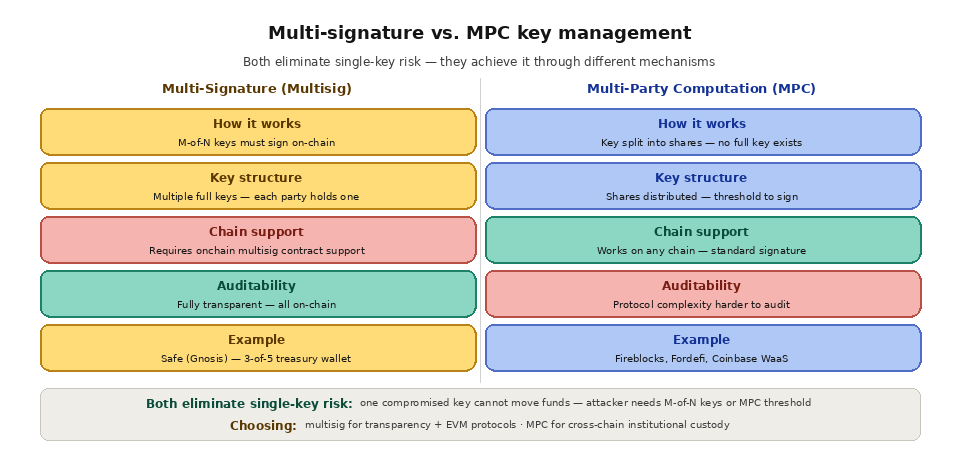
For teams, organizations, and high-value individual holdings, a single key controlling all assets is an unacceptable single point of failure. Multi-signature (multisig) wallets require multiple independent keys to approve a transaction.
Safe (formerly Gnosis Safe) is the most widely used multisig wallet on Ethereum and EVM chains. A Safe wallet is configured with a set of owner addresses and a threshold (for example, 3-of-5, meaning any three of five designated owners must approve a transaction for it to execute). No single owner can unilaterally move funds. If one key is compromised, the attacker cannot steal anything because they still need the other required signatures. Multisig wallets are standard for DAO treasuries, protocol-owned funds, company wallets, and any high-value holding where the risk of a single compromised or lost key is too great. The tradeoff is operational complexity: every transaction requires coordination among multiple signers, which adds time and process overhead.
Multi-Party Computation (MPC)
MPC is an alternative to multisig that splits a single private key into multiple shares distributed across different parties or devices. No single party ever holds the complete key. When a transaction needs to be signed, the parties engage in a cryptographic protocol that produces a valid signature without any party revealing their key share to the others.
Services like Fireblocks, Fordefi, and Coinbase's WaaS (Wallet-as-a-Service) use MPC to provide institutional-grade key management. The advantage over multisig is that MPC produces a standard single signature, which means it works with any blockchain (including those that do not support multisig natively) and does not require any special onchain infrastructure. The disadvantage is that MPC systems are more complex to implement and audit, and they introduce trust assumptions about the MPC software and infrastructure.
How Do Custodial and Non-Custodial Wallets Differ?
The deciding question for key management is who holds the keys. With a custodial wallet, a third party such as an exchange holds the keys on your behalf. With a non-custodial wallet, you hold the keys yourself. The table below summarizes the tradeoffs.
Aspect
Custodial
Non-custodial
Who holds the keys
The provider
You
Recovery if you forget login
Provider can help
Only your seed phrase recovers it
Counterparty risk
Provider can freeze or fail
None
Best for
Beginners, active trading
Self-sovereign holders, builders
Newer designs blur this line. Account abstraction and smart contract wallets add features like social recovery and spending limits, giving non-custodial users some of the safety nets that custodial accounts traditionally offered.
How Quicknode Supports Key Management Infrastructure
Quicknode does not store or manage private keys. It provides the blockchain access layer that key management systems depend on. Multisig wallets, MPC solutions, and hardware wallet interfaces all need reliable RPC endpoints to query chain state, estimate gas, and submit signed transactions. Quicknode's Core API provides this access across 80+ chains with low latency and high reliability. For institutional teams running MPC infrastructure or multisig operations, Quicknode's Dedicated Clusters provide the isolated, guaranteed-uptime infrastructure that high-value key management workflows demand.
Frequently Asked Questions
Can a lost private key ever be recovered?
No. If you lose the private key and have no seed phrase or other backup, the associated funds are permanently inaccessible. There is no reset mechanism on a blockchain, which is why backups are essential.
Is a seed phrase the same across all my wallets?
Each wallet you create generates its own seed phrase. That single phrase can derive many addresses across multiple chains, but it only controls the wallet it was created for. Never reuse or share a seed phrase between unrelated wallets.
Are hardware wallets necessary for good key management?
Not strictly, but they are strongly recommended once your holdings are meaningful. A hardware wallet keeps the private key offline and signs transactions on the device, which protects you from most remote attacks.
What is the difference between multisig and MPC?
Multisig requires multiple on-chain signatures to approve a transaction, while MPC splits one key into shares and produces a single standard signature off-chain. Multisig is transparent on-chain; MPC works on any chain and hides the multi-party structure.
How do developers query keys and balances safely?
Applications never need the private key to read data. They use RPC endpoints, such as the Core API, to query balances and broadcast already-signed transactions, keeping signing isolated in the wallet.