Answers>Learn about wallets & identity>What is account abstraction?
What is account abstraction?
// Tags
account abstractionERC-4337
TL;DR: Account abstraction is a blockchain upgrade that replaces the rigid, single-key account model with programmable smart contract wallets that support custom verification logic. Traditional externally owned accounts (EOAs) are controlled by a single private key: lose it and you lose everything, expose it and everything can be stolen. Account abstraction lets smart contracts function as user accounts, enabling features like social recovery (friends can help you regain access), multi-signature authorization, batched transactions, gas sponsorship (someone else pays your fees), session keys (limited-permission keys for specific actions), and spending limits. The ERC-4337 standard defines how these smart contract wallets work on Ethereum and EVM-compatible chains without requiring changes to the core protocol.
The Simple Explanation
Using a blockchain today is like having a bank account where the only security is a single password with no recovery option. If you forget the password, your money is gone forever. If someone guesses it, they take everything. There is no "forgot password" button, no customer service, no two-factor authentication, no spending limits. Every transaction is authorized by a single cryptographic key, and that is the entire security model.
Account abstraction changes this by making accounts programmable. Instead of a single key controlling everything, a smart contract controls the account and can implement whatever security and authentication logic the developer wants. Want to require two out of three keys to approve a transaction? You can. Want to let trusted friends vote to recover your account if you lose your key? You can. Want to set a daily spending limit that only allows small transactions without extra approval? You can. Want to let a game approve transactions on your behalf for one hour without re-asking for permission every time? You can.
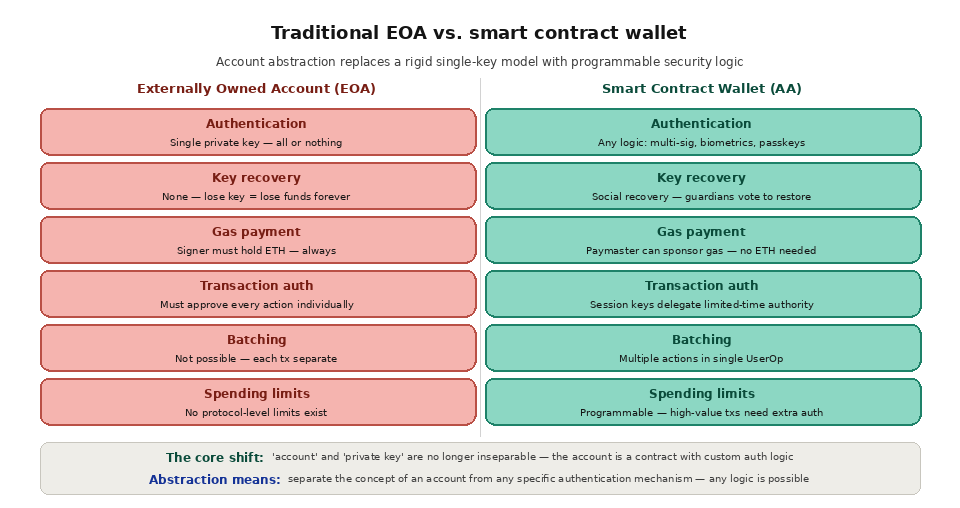
The "abstraction" in the name refers to separating the concept of an account from a specific authentication mechanism. Today, "account" and "private key" are inseparable. With account abstraction, the account is a smart contract, and the authentication logic is whatever the contract developer builds.
The Problem with Traditional Accounts
Ethereum (and most EVM-compatible chains) has two types of accounts. Externally Owned Accounts (EOAs) are controlled by a private key and are what most users interact with through MetaMask, Phantom, or any standard wallet. Contract Accounts are smart contracts that hold code and can only be triggered by transactions from EOAs or other contracts.
EOAs have several fundamental limitations that account abstraction addresses. There is no key recovery. If you lose your private key or seed phrase, there is no recovery mechanism built into the protocol. Your funds are locked forever. Every user interaction with blockchain requires them to hold the native token (ETH on Ethereum) to pay gas fees, which creates a terrible onboarding experience for new users who just want to try a dapp but do not own any crypto yet.
Every transaction requires manual approval. There is no way to delegate limited authority to a dapp. If you are playing a blockchain game, you must approve every in-game action individually, creating a frustrating user experience. Transactions cannot be batched natively. Approving a token and then swapping it requires two separate transactions with two separate signatures and two separate gas payments.
These limitations are among the primary reasons blockchain applications feel clunky compared to traditional software. Account abstraction eliminates them.
How ERC-4337 Works
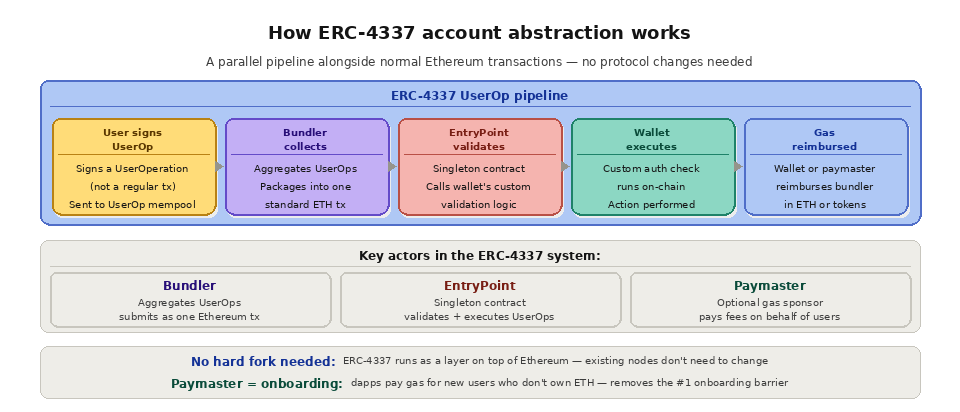
ERC-4337 is the standard that brings account abstraction to Ethereum and EVM chains without requiring a hard fork or protocol-level change. It introduces a parallel transaction pipeline that runs alongside the existing one.
The smart contract wallet is the user's account. Instead of an EOA, the user's funds and assets are held by a smart contract that defines its own validation logic. The contract can require a single signature, multiple signatures, a biometric check passed from a trusted enclave, or any other condition the developer programs.
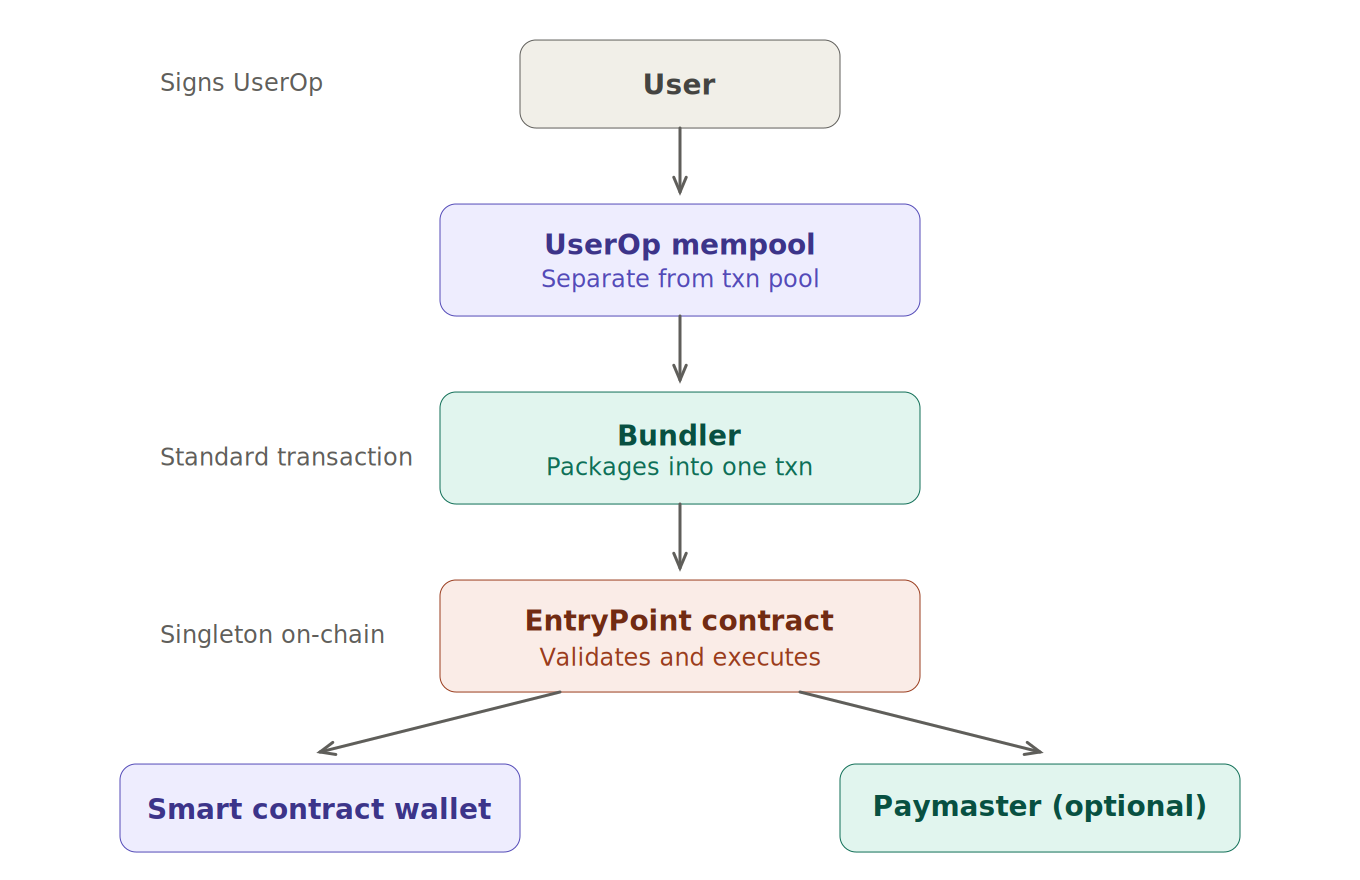
User operations (UserOps) replace traditional transactions. Instead of signing a transaction directly, the user signs a UserOp, which is a data structure describing the action they want to take. The UserOp is sent to a separate mempool (the UserOp mempool), not the standard transaction mempool.
Bundlers are nodes that collect UserOps from the UserOp mempool, package them into a single standard Ethereum transaction, and submit that transaction to the network. The bundler pays the gas for the bundle transaction and is reimbursed by the smart contract wallets (or their paymasters) during execution. Bundlers are similar to block builders in the MEV supply chain: they aggregate user intents and submit them to the chain efficiently.
The EntryPoint contract is a singleton smart contract deployed on every EVM chain that coordinates the execution of UserOps. When a bundler submits a bundle, the EntryPoint contract processes each UserOp by calling the destination smart contract wallet's validation function, checking that the wallet approves the operation, executing the operation, and handling gas reimbursement.
Paymasters are optional smart contracts that can sponsor gas fees for UserOps. A dapp developer can deploy a paymaster that pays gas for their users, eliminating the requirement for users to hold ETH. This is transformative for onboarding: a new user can interact with a dapp without ever buying cryptocurrency, because the dapp covers the transaction costs.
What Account Abstraction Enables
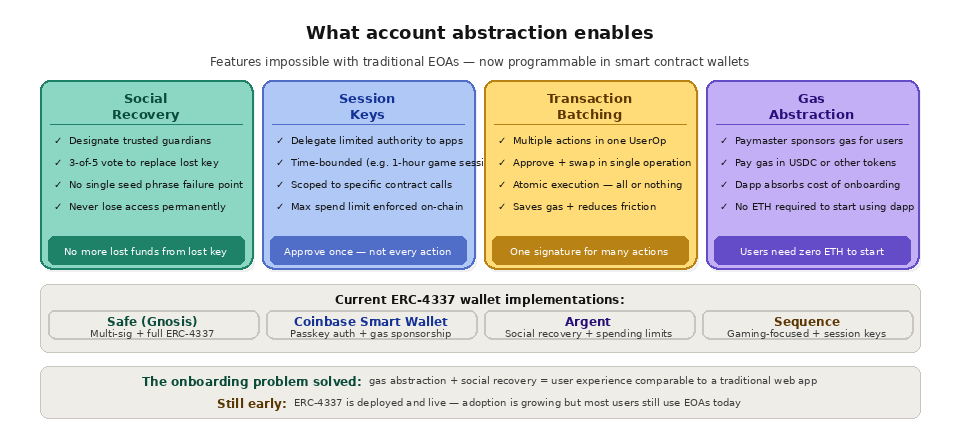
Social recovery allows users to designate "guardians" (trusted friends, family members, or institutions) who can collectively approve a key change if the user loses access. The wallet's smart contract requires a threshold of guardian approvals (for example, 3 out of 5) to replace the signing key with a new one. This eliminates the catastrophic risk of a single lost seed phrase.
Session keys allow users to grant temporary, limited-permission keys to applications. Instead of approving every transaction in a blockchain game individually, you can create a session key that allows the game to submit transactions on your behalf for a defined period (one hour, one gaming session) with specific constraints (only calls to the game's contract, maximum spend of 0.1 ETH). When the session expires, the key becomes useless.
Transaction batching lets users approve multiple actions in a single operation. The classic example is the ERC-20 approve-and-swap flow, which currently requires two separate transactions. With account abstraction, the smart contract wallet can batch both into a single UserOp: approve the token and execute the swap atomically, saving gas and reducing friction.
Gas abstraction through paymasters allows applications to pay gas on behalf of their users, or to accept gas payment in tokens other than ETH. A stablecoin application could let users pay gas in USDC. A gaming platform could absorb gas costs entirely as a cost of user acquisition. This removes one of the biggest barriers to mainstream blockchain adoption.
Multi-signature and custom authorization allows wallets to require multiple approvals for high-value transactions, implement spending limits that trigger additional security checks above a threshold, or use any combination of authentication factors (signatures, biometrics, hardware tokens, time locks).
Current Implementations
Several wallet providers have built on the ERC-4337 standard. Safe (formerly Gnosis Safe) is the most widely used smart contract wallet, securing over $100 billion in assets. Originally designed for multi-sig treasury management, Safe has expanded to support the full ERC-4337 UserOp flow. Coinbase Smart Wallet uses account abstraction to provide a simplified onboarding experience with passkey-based authentication and gas sponsorship. Argent has built an account abstraction wallet with social recovery, daily spending limits, and guardian-based security. Sequence provides an account abstraction wallet focused on gaming, with session keys and gas sponsorship designed for in-game transactions.
How Quicknode Supports Account Abstraction
Building and operating account abstraction wallets requires robust blockchain infrastructure. Quicknode's Core API provides the RPC access that bundlers, paymasters, and smart contract wallets need to submit and monitor UserOps across EVM chains. Low-latency endpoints ensure that UserOps are processed quickly and that wallet applications can display up-to-date state. Quicknode's Marketplace includes bundler and paymaster integrations that simplify AA wallet development. For teams building custom AA infrastructure, Quicknode's Streams enables real-time monitoring of UserOp execution, EntryPoint events, and wallet state changes.
EOA vs smart contract account: what is the difference?
Account abstraction turns your crypto wallet from a single-key externally owned account (EOA) into a programmable smart contract account. The table below shows what changes.
Dimension
Externally owned account (EOA)
Smart contract account
Controlled by
A single private key
Programmable contract logic
Recovery
None, lose the key and funds are gone
Social recovery and guardians possible
Gas
User must hold the native token
Can be sponsored by a paymaster or paid in other tokens
Batching
One action per transaction
Multiple actions in a single UserOp
Permissions
All or nothing
Session keys, spending limits, multi-sig
Examples
MetaMask, most standard wallets
Safe, Coinbase Smart Wallet, Argent
Is account abstraction available on Ethereum today?
Yes. ERC-4337 went live on Ethereum mainnet in March 2023 without a hard fork, since it works entirely through smart contracts and a separate UserOp mempool processed by bundlers. More recently, EIP-7702 lets existing EOAs temporarily take on smart-account features, bringing account abstraction benefits to the wallets people already use. Bundlers behave much like block builders in the MEV supply chain, aggregating user intents before submission.
Frequently Asked Questions
What is account abstraction in simple terms?
Account abstraction makes a blockchain account programmable. Instead of a single private key controlling everything, a smart contract controls the account and can add features like recovery, spending limits, batching, and sponsored gas.
What is ERC-4337?
ERC-4337 is the Ethereum standard that enables account abstraction without changing the core protocol. It introduces UserOps, bundlers, a singleton EntryPoint contract, and optional paymasters, all of which run through standard RPC endpoints.
What is a paymaster?
A paymaster is an optional smart contract that sponsors gas fees for users, or lets them pay gas in tokens other than the native coin. It is what allows a new user to interact with a dapp without first buying ETH.
Can I recover an account abstraction wallet if I lose my key?
Often yes. Smart contract wallets can implement social recovery, where designated guardians approve a key change, which removes the single-seed-phrase failure that plagues traditional wallets. See how key management works for more.
Do I need ETH to use an account abstraction wallet?
Not necessarily. If the application deploys a paymaster, it can cover your gas or let you pay in a stablecoin, so you can transact without holding the chain's native token.