The Economics of Prediction Markets Explained
The Economics of Prediction Markets Explained
How prediction markets turn information into prices through incentives, liquidity, resolution, payouts, and market design.

Meet us in Miami: SOL Lounge at SibosInvite-only, Sept 29–30 at Hotel Greystone. Sessions, happy hours, and 1:1 time with Quicknode.
Request your spotThe Economics of Prediction Markets Explained
How prediction markets turn information into prices through incentives, liquidity, resolution, payouts, and market design.
SOC 2 Type II Certified · ISO 27001
September 29, 2026 — 15 min read
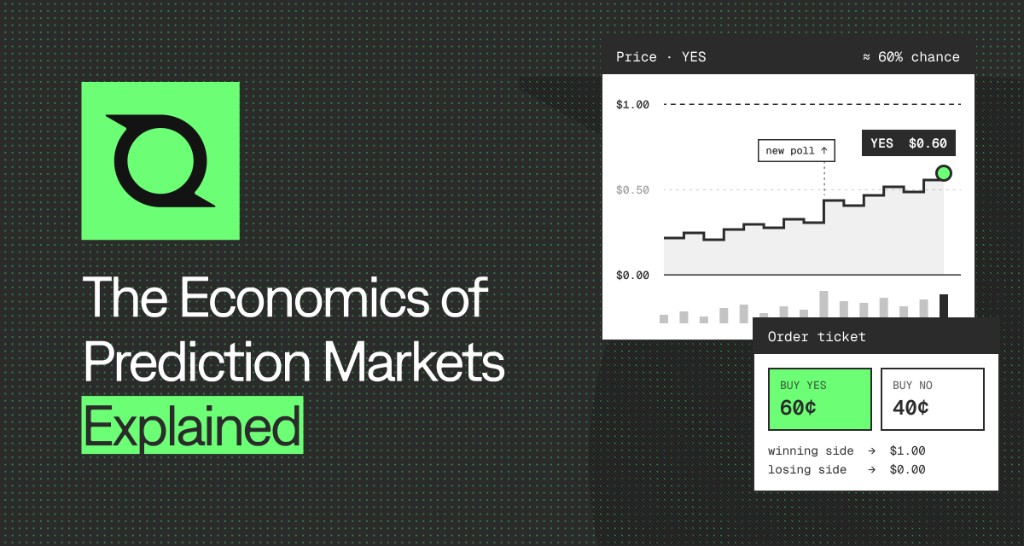
The 2024 US presidential election had billions watching. Most waited for a name to see whether their candidate had won.
Others watched something else: the price of who would win and how much they could make if they were right.
Welcome to prediction markets: the "put your money where your mouth is" thesis in action.
Election markets saw billions of dollars flow in from traders expressing their beliefs with a price: a candidate trading at 60 cents implied a ~60% chance of winning.
But where did that 60% come from?
It came from people trading against one another, each with different information, incentives, capital, and risk appetite.
Today, let's explore the economic engine behind these prediction markets.
Prediction markets start with disagreement and end with one winner.
Participants hold different information, think about the same event differently, or simply assign different odds. The market gives those differences a price.
Now, let's play out an election prediction market that pays $1 if a candidate wins and $0 if the candidate loses.
The contract currently trades at $0.60. That means the market requires $0.60 to buy a claim that pays $1 if the candidate wins and $0 if they lose.
Trader | Belief in winning | How $0.60 looks | Move |
|---|---|---|---|
A | 70% | Cheap | Buys YES |
B | 50% | Overpriced | Buys NO at $0.40 |
As more participants buy and sell, their orders compete.
Buyers push prices higher when they see value.
Sellers push them lower when they do not.
New information, like a poll or a debate stumble, changes those calculations, so prices move with it.
The resulting price is the price at which the market can currently match buyers and sellers. We call it the marginal price of disagreement.
In a perfect world, a $0.60 price can be read as: the candidate has a 60% chance of winning.
That holds when the only thing traders care about is their belief in one outcome of an event.
But in the real world, several forces can bend traders' beliefs, and with them the price, away from the true underlying probability.
What bends the price | How it shows up | Effect |
|---|---|---|
Low liquidity | One order can move the market several cents | Price movement can be manipulated with volume |
Fees & trading costs | Kalshi's fee peaks at 1.75¢ per contract at a 50¢ price | A trader who believes 51% won't buy at 50¢, so small edges never reach the price |
Time | A 90¢ contract that settles in 18 months earns about 7% a year if it wins, versus about 3.5% at 95¢ | Long-dated contracts must compete with returns available elsewhere |
Information asymmetry | Better-informed traders enter selectively | Information may reach the price slowly or unevenly |
Market constraints | Position limits, geography, or capital restrict trading | Traders who spot a mispricing may lack the access or capital to correct it |
Price is observable, but probability needs to be inferred. How good that inference becomes depends partly on the people putting capital behind it.
So who is playing the game?
Every price is the culmination of different players' beliefs, reasons, and goals. More importantly, their incentives differ too.
Participant | Why they trade | What they contribute |
|---|---|---|
Informed traders | Profit from information or analysis they believe the market has missed | Move prices toward truer odds |
Speculators | Take a view on whether the current price is wrong | Add trading activity and competing beliefs |
Hedgers | Offset exposure to an event elsewhere | Bring demand driven by real-world risk |
Arbitrageurs | Exploit inconsistent prices across related contracts or markets | Pull prices back toward economic consistency |
Market makers / LPs | Earn spreads, fees, or incentives for supplying liquidity | Keep capital available on both sides of the market |
Did you know?
Arbitrageurs took about $40 million out of Polymarket between April 2024 and April 2025.
These participants don't need the same beliefs, or even the same reason for trading, for the market to work.
If it's so random, what makes information worth putting money behind in the first place?
Every participant in the market expects some return. Is it all about dollars? There are several reasons information becomes a tradable position.
The most direct incentive is profit. It's simple math: belief minus price minus fees.
But trading profit is only one part of the incentive system. As we saw, there are different participants, and the market pays each of them different incentives.
Incentive | Who earns it | What it encourages |
|---|---|---|
Trading profit | Informed traders, speculators | Finding and trading on mispriced information |
Arbitrage profit | Arbitrageurs | Correcting inconsistent prices across contracts or markets |
Spread / maker rebates | Market makers | Keeping buy and sell quotes available |
Liquidity rewards | LPs, market makers | Adding depth and reducing the cost of trading |
Yield on collateral | Capital providers, position holders | Reducing the opportunity cost of locked capital |
Volume incentives (airdrops) | Traders | Boosting trading activity and, with it, liquidity |
Incentives and rewards, more or different, do not automatically produce better predictions.
Liquidity programs can deepen a market without adding information.
Volume incentives like airdrops can increase trading without improving the price.
On the other hand, money and profit don't explain every trade.
A public scoreboard, or the attachment of belief to money, can also bring participants into the same market for entirely non-monetary reasons.
Motive | How it shows up |
|---|---|
Identity and ideology | Expressing strong support for something a trader is loyal to For example, an athlete, a team, or a culture. |
Status and reputation | Public profit leaderboards on Polymarket |
Curiosity and learning | Small stakes on topics a trader follows closely, simply to test knowledge or passion |
Entertainment | Participating even without an edge, just to compete with friends |
Prediction markets need these kinds of players too, because they attract more passion-first, informed participation, which pushes markets toward accuracy.
Did you know?
A 2004 study found that NewsFutures, a play-money market, predicted NFL games as well as TradeSports, which traded real money.
Remember: Reputation too can do the work that cash usually does.
So, incentives (monetary and otherwise) bring participants to the market. But none of that matters if there's no liquidity in the market to trade with and against.
Liquidity is the money waiting on the other side of a trade.
When liquidity is scarce, even good information can struggle to enter the market because entering or exiting a position costs too much.
Three measures matter here:
Spread: The gap between the best available buy and sell prices
Depth: How much can be traded near the current price
Slippage: How far the average execution price moves during a trade
Consider a contract trading around $0.60. A trader believes it should trade at $0.70 and wants to buy $10,000 worth.
Deep market: The $10,000 order executes around $0.60 or $0.61, so the information can enter the price.
Thin market: The same order pushes execution toward $0.68 or $0.70, where much of the expected edge disappears in the trade itself.
This creates a feedback loop: real liquidity is a must for information to reach its truest price.
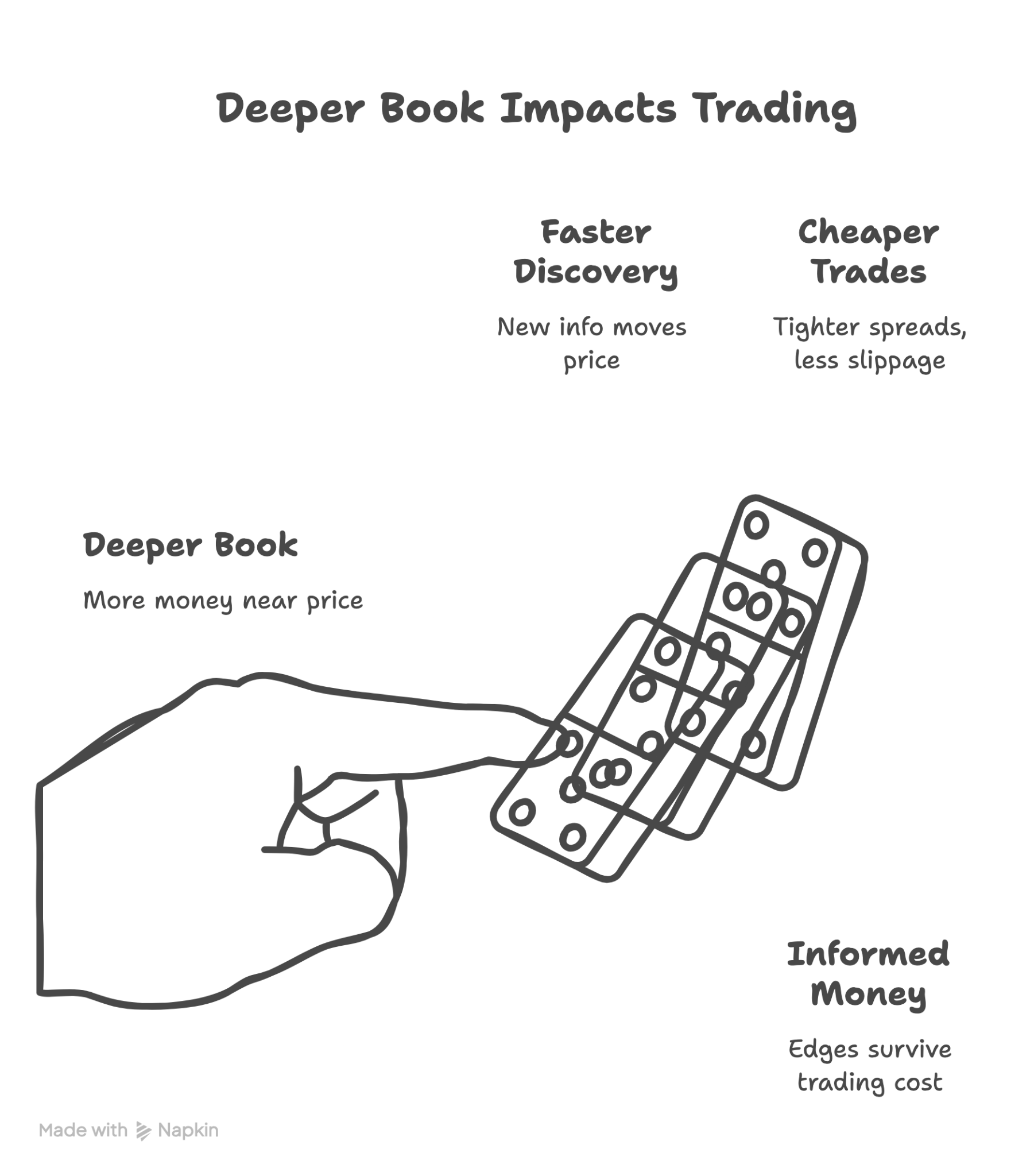
The reverse also holds. Thin markets > discourage larger informed positions > leave more room for stale prices > make individual trades look more informative.
Now, the liquidity has to come from somewhere.
Liquidity is not free. Someone has to commit capital and stand ready to trade when everyone else wants to buy or sell.
That job falls mainly to market makers and liquidity providers (LPs). Their business works only if what they earn covers what they risk.
Economic risk | What it means in practice | How the LP / maker loses |
|---|---|---|
Inventory risk | The maker accumulates more YES than NO, or vice versa | Price moves against the one-sided position |
Smartness risk | Better-informed traders trade against stale quotes | Maker sells at $0.60 just before information moves the contract to $0.70 |
Price / volatility risk | Prices move faster than quotes or pools can adjust | Existing inventory loses value before it can be rebalanced |
Capital opportunity cost | Capital stays committed to providing liquidity | Returns fail to beat what the same capital could earn elsewhere |
This creates a basic tension: the traders most valuable for price discovery can also be the most expensive to trade against.
Market design also decides how that burden gets distributed.
In an order book, participants or professional market makers post bids and asks using their own capital.
An AMM makes liquidity continuously available through a pool and a pricing rule, shifting the cost and risk toward the capital backing that pool.
Subsidies, maker rebates, and liquidity rewards can help de-risk market-making.
But they also cost money, which brings back the same question from incentives: whether the market is attracting useful information or simply paying for activity.
Did you know?
Makers don't always come out ahead. On Kalshi, they lose 10% on average.
Liquidity is a paid economic function for prediction markets.
The tighter and deeper a market needs to be, the more someone must bear the capital cost and trading risk required to keep it that way.
This also explains why high volume and high liquidity are not the same thing.
Volume measures how much has traded.
Liquidity measures how easily the next trade can happen without moving the price sharply.
And that matters because prediction markets are ultimately trying to extract information.
Now, all this committed capital is waiting for one moment: settlement.
Incentives, market makers, committed capital, and continuous liquidity can all fail if the question is vague or the resolver is unreliable.
Every trade rests on one promise: the contract will pay according to what actually happened.
That promise makes or breaks any prediction market.
Resolution starts with wording. A market therefore needs to define its:
Question
Resolution criteria
Data source
Resolver
Dispute process
Final payout
Each of these choices moves money at settlement.
And of course, the more room these steps leave for interpretation, the more resolution risk traders carry. Different markets handle this differently.
Model | Who decides | How it works | Tradeoff |
|---|---|---|---|
Exchange rulebook (Kalshi, Polymarket US) | The exchange | Each contract names its rules and data source. After expiry, the exchange applies them. | Traders trust the exchange to interpret and apply its own rules consistently |
Optimistic oracle (UMA, on Polymarket's global venue) | A proposer first, then token holders if disputed | A proposer posts a $750 bond. If no one challenges within 2 hours, the outcome stands. Disputes go to a UMA token vote. | Large holders can swing the vote |
Bonded deployer (Hyperliquid HIP-4) | The market's deployer | A deployer stakes capital, creates markets from approved templates, and submits settlements. Validators can slash the stake for bad wording, a wrong outcome, or a failure to settle. | Breaks down if settling incorrectly is worth more than the fixed stake |
And even perfect resolution leaves one more economic question: how much capital must remain locked up to earn that payout?
Most spot prediction markets use fully collateralized contracts.
Every YES and NO pair locks $1 of collateral until settlement.
A YES buyer at $0.60 contributes $0.60, and the corresponding NO side contributes $0.40.
The winning contract eventually redeems for $1.
There's no leverage at play, and hence no default risk. But it comes with a cost: capital stays tied to the prediction.
Assume a YES contract priced at $0.90. If correct, it returns $1, for a maximum gain of $0.10.
But time changes the economics.
If the market resolves in:
1 month: ~250% annualized
1 year: ~11%
2 years: ~5.4% annualized
The actual profit remains 10 cents per contract in every case. What changes is how long the 90 cents stays committed to earning it.
Think about this before placing bets on the 2028 election.
Jokes aside, prediction market platforms are building solutions to this.
Prediction market platforms are working out ways to reduce the cost of waiting:
Lever | How it frees capital | Cost or risk |
|---|---|---|
Interest on positions | Kalshi pays 3.25% a year on cash and open positions | Lasts only while interest rates stay up |
Holding rewards | Polymarket pays 3.25% a year on positions in selected long-dated markets | Paid from Polymarket's own funds, so the venue can cut it |
Cross-margin | Hyperliquid HIP-4 lets outcome contracts share an account with perpetual futures | Brings leverage back: a contract that drops to $0 can drag down other positions in the same account |
Selling early | A trader exits before settlement and puts the cash to work elsewhere | Costs the spread, and thin markets make that expensive |
Apart from these, there are a few risks traders should keep in mind:
Payout timing (~2 hours to days) adds to the delay.
Cashing out stablecoin settlements carries risk.
Taken together, these costs and risks set a higher bar for prediction markets.
A market needs traders, liquidity, collateral, and a credible settlement process just to produce one usable forecast.
So why build a market at all when a poll or survey can simply ask people what they think?
Prediction markets earn their complexity when trading adds something that asking cannot. With money involved, participants aren't just guessing. They're deciding whether their belief is strong enough, at the current price, to put something at stake.
Method | What it asks | Cost to take part | Does being right pay? |
|---|---|---|---|
Polls and surveys | Who will you vote for? What do you plan to do? | None | No |
Expert and superforecaster panels | What do you expect, and how sure are you? | Time (experts get paid) | Yes, in reputation and track record |
Scoring platforms | What probability do you assign? | Time | Yes, in points and reputation |
Prediction markets | What will you pay for $1 if it happens? | Capital at risk | Yes, in money |
This is the trade-off.
Prediction markets demand more from participants than the alternatives: capital, risk, and enough conviction to trade.
In return, there are incentives to be won.
Prediction markets are the most useful when:
Information is dispersed | No single expert or dataset has the full picture. |
|---|---|
Information changes quickly | Traders can react without waiting for the next polling or forecasting round. |
Participants disagree enough to trade | Different beliefs create both sides of the market. |
The outcome is clear and verifiable | A contract needs an objective way to settle. |
Enough liquidity exists | Good information matters little if acting on it moves the price too far. |
There is value in hedging | Participants can use the same market to manage exposure, not just forecast. |
When these conditions are weak or absent, simpler mechanisms can work just as well or better.
So, what's next?
Prediction markets are starting to look more like financial infrastructure built around uncertainty.
Three shifts matter:
More markets: Permissionless creation can make markets viable for narrower questions, from economic releases to product launches.
More capital efficiency: Yield-bearing collateral, shared margin, and faster settlement can reduce the cost of holding long-dated positions.
More composability: Market prices can become inputs for other contracts, trading strategies, hedges, or financial products.
The last shift changes the economics most.
Prediction markets will become more useful as they connect and as failures become less isolated. Markets need to make information cheaper to express, capital cheaper to commit, and prices useful elsewhere.
Regardless, the 2028 election will draw the same billions of viewers, if not more, and a larger share of them will watch for that number. If we can improve today's infrastructure to serve those billions better, it will all be worth it.
Partly. The payout works like a bet: $1 if right, $0 if wrong. Two things set a prediction market apart:
Traders bet against each other rather than against a bookmaker.
The price updates with every trade, so it doubles as a public forecast.
Only briefly, and only in small markets.
In a busy market, pushing the price away from fair value invites informed traders to bet the other way, and the manipulator pays for it.
Liquidity makes it cheaper to buy or sell without moving the price sharply. More depth and tighter spreads let information enter prices with less slippage.
It depends on the platform.
Regulated exchanges like Kalshi settle each contract using written rules and a named data source.
Polymarket's global site uses UMA, where anyone can propose an outcome and disputes go to a token-holder vote.
Hyperliquid's HIP-4 makes market creators stake 500,000 HYPE, which can be taken if they settle wrongly.
No. Low liquidity, trading fees, locked capital, market constraints, and resolution risk can push a contract's price away from the underlying probability.
Once the outcome is resolved, winning contracts typically redeem according to their payout rules, while losing contracts expire worthless.
No. Volume measures how much has traded, not how accurate the price is.
Yes, and regulators now prosecute it. In April 2026, US authorities charged an Army soldier with using classified details of the Maduro operation to bet on Polymarket.
Founded in 2017, Quicknode deploys institutional-grade blockchain infrastructure for developers and enterprises. With 99.99% uptime and support for 79+ chains, teams build and scale onchain applications without compromise.
The latest engineering insights, product updates, and web3 news delivered straight to your inbox.