Feature Fridays: LokiCode
Feature Fridays: LokiCode
Loki.code is a comprehensive smart contract deployment management tool that streamlines the process for Web3 teams, enabling easy compilation, deployment, and interaction with smart contracts through a user-friendly interface.

March 1, 2024 — 4 min read
Welcome back to Feature Fridays! This week, we delve into the innovative realm of web3 development tools with the spotlight on Loki.code, guided by the insights of Fabio, the Chief Design Officer and a pivotal figure in the company's journey.
Fabio brings a rich background in web3, having contributed to various projects and crafted UI/UX solutions across the spectrum, including the notable Cryptofonts project. His deep involvement in the web3 space since 2015 and his vision for simplifying complex processes have been instrumental in shaping Loki.code. The platform emerges as a beacon for Web3 teams, offering an intuitive environment for smart contract compilation, deployment, and interaction.
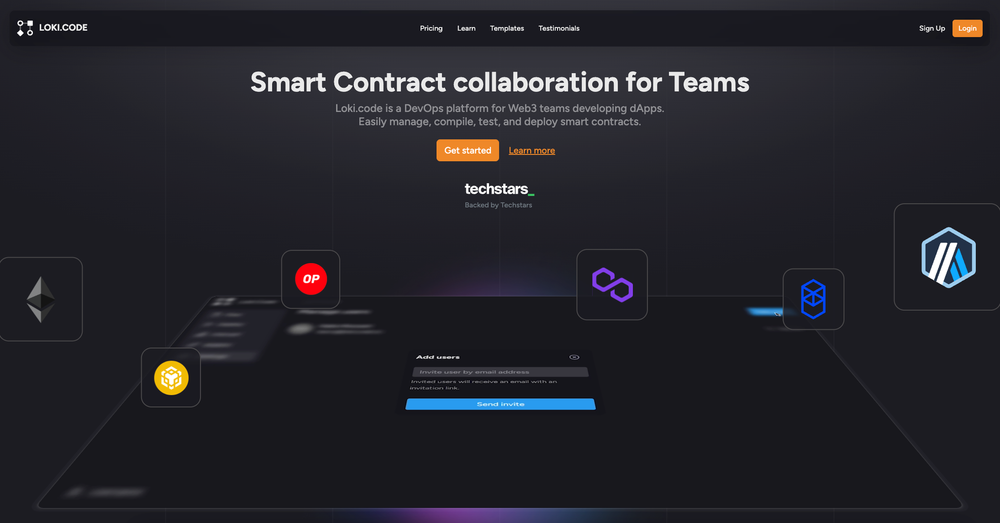
Check out Lokicode
Q & A with LokiCode 👇
Could you introduce yourself by sharing your name, prior experience, and current role within your company? Additionally, please briefly explain your company's mission and what it offers to its customers.
Hi, I’m Fabio the Chief Design Officer at Loki.code.
I have been in the web3 space since 2015, working across different projects and developing UI/UX solutions for various firms in the past (even outside of crypto). One of my most successful solo projects is Cryptofonts, an open-source collection of cryptocurrency icons and web fonts, also offering a free token info API used by multiple people across web3.
Loki.code is a smart contract deployment management tool for Web3 teams powered by a user-friendly and smooth UI/UX. With Loki.code Web3 teams can easily compile, deploy, and interact with smart contracts from one platform. We are focused on the most critical stages of dApp development, helping teams go to Production as swiftly and securely as possible.
How has your company grown and changed since its inception, and what do you have planned for its future?
We initially started as a visual programming language for Solidity to help less technical people to get into web3 and the creation of dApps, but it turned out to be something not many non-technical users were interested in, let alone the security implications of this approach.
We then pivoted to a more dev-focused tool, especially around the collaboration between the different personas of a web3 team, and that’s how we came to be. Our company was fortunate enough to have been accepted amongst 11 other companies into Techstars Web3 accelerator. From here, we plan to continue releasing new features centered around enhancing this collaboration, such as a playground environment similar to Postman that allows non-technical personas to test smart contract functions.
💡Feature Fridays: Every Friday, we'll highlight some of the best startups in the blockchain space and feature them on Quicknode's blog and Twitter account. Click here to apply!
What inspired you to develop LokiCode, and how did you conceive it?
As a team, we all have been involved in Web3 in different capacities, but what gave us the idea was a combination of early user interviews we made for our visual programming language and our path through the Techstars Web3 accelerator, which led us to meet other web3 teams and see how they were working.
Also, more than 80% of web3 teams are decentralized and work remotely, giving us the confidence that a collaborative web3 DevOps tool is the answer to many problems teams have been facing.
My team comprises 5 cofounders, and we all come from different backgrounds. We are all fairly technical, but some are more technical than others.
Can you provide insight into LokiCode’s progress by sharing any metrics or milestones indicating its traction?
We have been in closed beta for the past few months, working closely with some of our early adopters, but it was great to see the amount of interested people had in our project. We currently have more than 150 people signed up for the private beta and multiple teams trialing our solution. Seeing the amount of interest is great, which is a sign that the current tooling landscape is not so great and can be vastly improved.
Can you provide insight into the target market for LokiCode and what types of clients you work with?
Our main customers are web3 teams developing smart contracts and dApps in any capacity. Still, we are also open to individuals who want to leverage some of the functionalities of our platform. Loki.code is really for everyone working in Web3.
How does your company utilize Quicknode, and what benefits does it bring to your business operations?
Through a planned partnership with Quicknode, Loki.code will offer custom RPCs, enhancing flexibility and supporting automated testing across EVM chains. This move will significantly benefit teams as they transition from staging to production.
Start Building now
Start Building with QuicknodeAbout Quicknode
Founded in 2017, Quicknode deploys institutional-grade blockchain infrastructure for developers and enterprises. With 99.99% uptime and support for 80+ chains, teams build and scale onchain applications without compromise.
Stay updated
The latest engineering insights, product updates, and web3 news delivered straight to your inbox.