Hyperliquid Funding Rates: Formula, Fees, and Trading Strategies
Hyperliquid Funding Rates: Formula, Fees, and Trading Strategies
Learn how Hyperliquid funding rates work, how payments are calculated, and what they mean for trading costs, leverage, and strategies.

November 2, 2026 — 8 min read
Green or red. That's how most traders track performance on Hyperliquid perpetual markets. Funding adds a third (mostly invisible) line.
Funding determines whether traders pay or receive money for holding a position.
A trade can move in the right direction while funding quietly eats into the gains. Or the market can barely move while funding payments keep adding up.
The longer a position stays open, the more those payments matter.
This guide explains how Hyperliquid calculates funding rates, what drives them, and how traders can account for them when managing positions.
What Are Hyperliquid Funding Rates?
Hyperliquid funding rates are an incentive that keeps perpetual contract prices close to the underlying asset's reference price.
The mechanism works through periodic payments between traders holding long and short perpetual futures positions.
Why Perpetual Futures Need Funding
Traditional futures contracts have an expiry date. As expiry approaches, their prices converge with the underlying asset's price.
Perpetual futures have no expiry date, so nothing forces their price back to spot. That convergence needs another incentive.
Funding is that incentive: an economic pressure that keeps the two prices aligned. It makes holding one side of the market more expensive when perpetual contracts trade at a premium or discount to their reference price.
That pressure can run in either direction.
Positive and Negative Funding: Who Pays Whom?
The direction of funding depends on whether the rate is positive or negative:
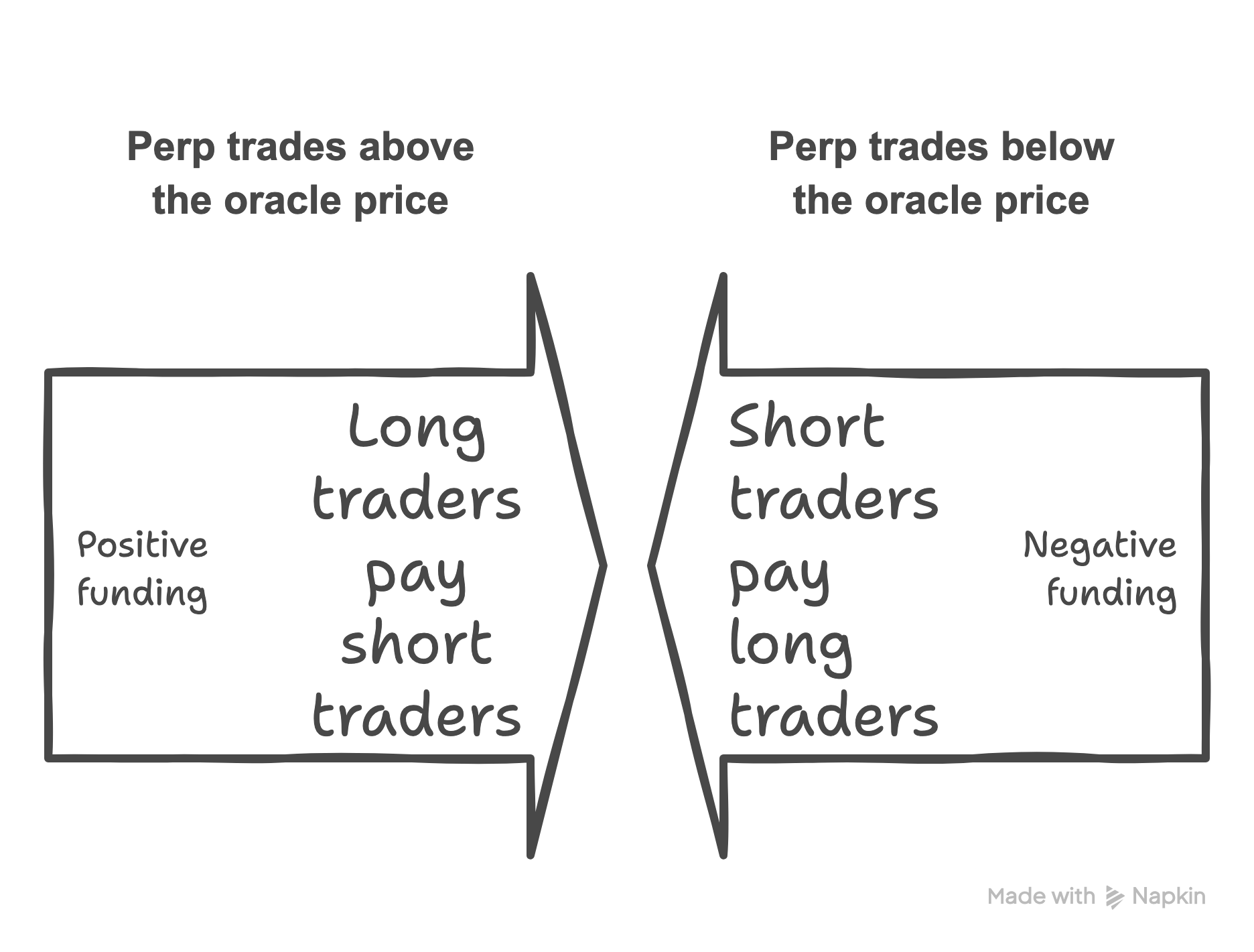
Funding payments flow directly between traders. They aren't a source of revenue for Hyperliquid, which collects no fees on them.
What Drives Funding Rates Higher or Lower?
Funding rates respond to the difference between perpetual futures prices and their reference prices.
Strong demand for long exposure can push perpetual prices higher, increasing positive funding. Strong demand for short exposure can push prices lower, reducing funding or turning it negative.
Order book liquidity also matters. Thin order books can amplify price differences and produce sharp changes in funding rates.
These changes reflect conditions in the perpetual market. They don't predict where prices will move next.
That covers why funding exists and what moves it. Next is how Hyperliquid turns those market conditions into a rate.
How Does Hyperliquid Calculate Funding Rates?
Hyperliquid calculates funding using two components:
Premium index (P): the percentage difference between perpetual market pricing and the oracle price, measured using impact bid and ask prices.
Interest rate (I): a fixed rate of 0.01% per eight hours for standard perpetual markets.
Impact bid and ask prices are the average execution prices of a fixed-size order on each side of the book: 20,000 USDC for BTC and ETH, and 6,000 USDC for other standard markets. The oracle price is derived from spot prices across major exchanges.
Hyperliquid samples the premium every five seconds and averages the readings over the hour.
The formula also uses a clamp function, which restricts the difference between the interest rate and the premium index to a range of −0.05% to +0.05%.
Hyperliquid Funding Rate Formula
The formula brings these components together:
Funding rate = P + clamp(I − P, −0.05%, +0.05%)
Here, P is the premium index and I is the fixed 0.01% interest rate.
The formula produces an eight-hour rate. Hyperliquid divides the result by eight to get the hourly funding rate. A positive rate means longs pay shorts.
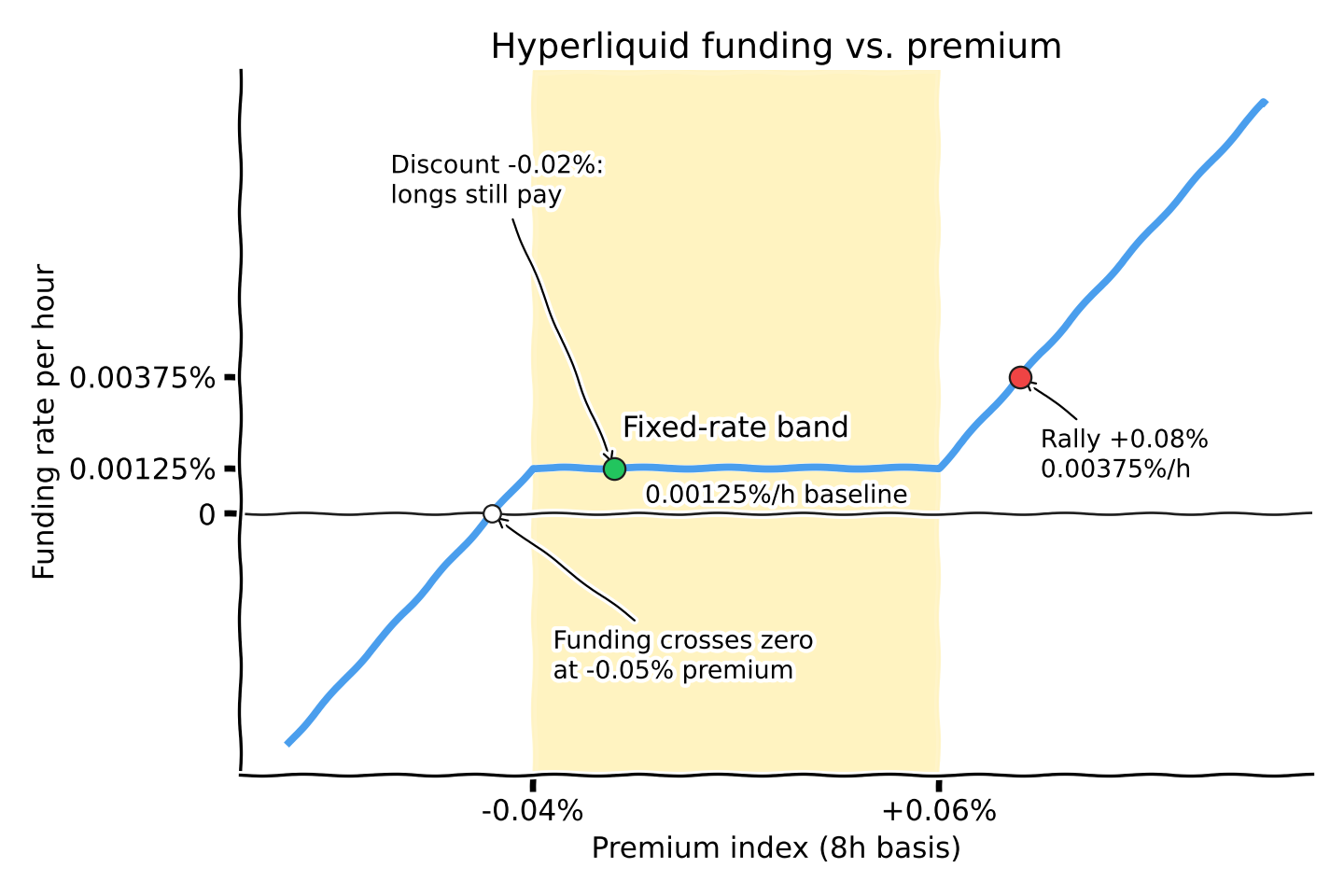
Inside the fixed-rate band, where the premium is between −0.04% and +0.06%, funding stays at 0.00125% per hour.
Outside the band, the eight-hour rate follows two rules:
Above +0.06%: Funding = P − 0.05%
Below −0.04%: Funding = P + 0.05%
Hyperliquid divides either result by eight for hourly settlement. Funding turns negative only when the premium falls below −0.05%.
Example: Funding Rate Calculation for BTC Perpetuals
Assume Bitcoin rallies and buying pressure pushes BTC perpetuals above the oracle price. The average premium index reaches +0.08% over the hour.
Funding rate:
= 0.08% + clamp(0.01% − 0.08%, −0.05%, +0.05%)
= 0.08% − 0.05%
= 0.03% per eight hours, or 0.00375% per hour
So a BTC long position worth $100,000 at the oracle price pays $3.75 at settlement, and the short side receives the payment.
If the average premium falls to +0.03% the next hour, funding returns to 0.00125% per hour and the next payment falls to $1.25.
That covers the math. Next is what funding means for traders day to day.
How Do Funding Rates Affect Traders' Positions?
Funding changes the economics of holding a trade. The impact depends on which side pays, how long the position stays open, and how much margin supports it.
Funding Can Change the Profitability of a Trade
A long position paying positive funding needs enough price appreciation to cover those payments and trading fees.
For a short position receiving the same funding, payments can offset losses or add to profits.
But a favorable funding rate offers little protection against a sharp move in the underlying asset.
Funding also changes over time. A position opened when funding is cheap can become expensive to hold if the premium rises.
Leverage Makes Funding More Significant
Hyperliquid calculates funding on the position's full notional value at the oracle price, regardless of leverage.
Take a $100,000 long at 0.005% per hour. It pays $5 an hour, or $120 a day.
At 1x, that $120 a day is 0.12% of the $100,000 backing the position
At 10x, the margin is $10,000, and the same $120 is 1.2% of it
Funding payments reduce account equity and can bring a leveraged position closer to liquidation. Receiving funding adds to equity.
So how can a trader put funding rates to use?
How to Use Hyperliquid Funding Rates in Trading
Two observations come up often:
High funding rates can signal a crowded trade
A negative rate can make the opposite side look attractive
Both are reasonable, but acting on either without checking price action, open interest, and historical funding can be an expensive mistake.
Is the Current Funding Rate High or Low?
Hyperliquid displays the current funding rate on its trading interface, and historical rates are available through its funding history data.

Traders can also compare funding rates across major exchanges on Hyperliquid's Funding Comparison page.
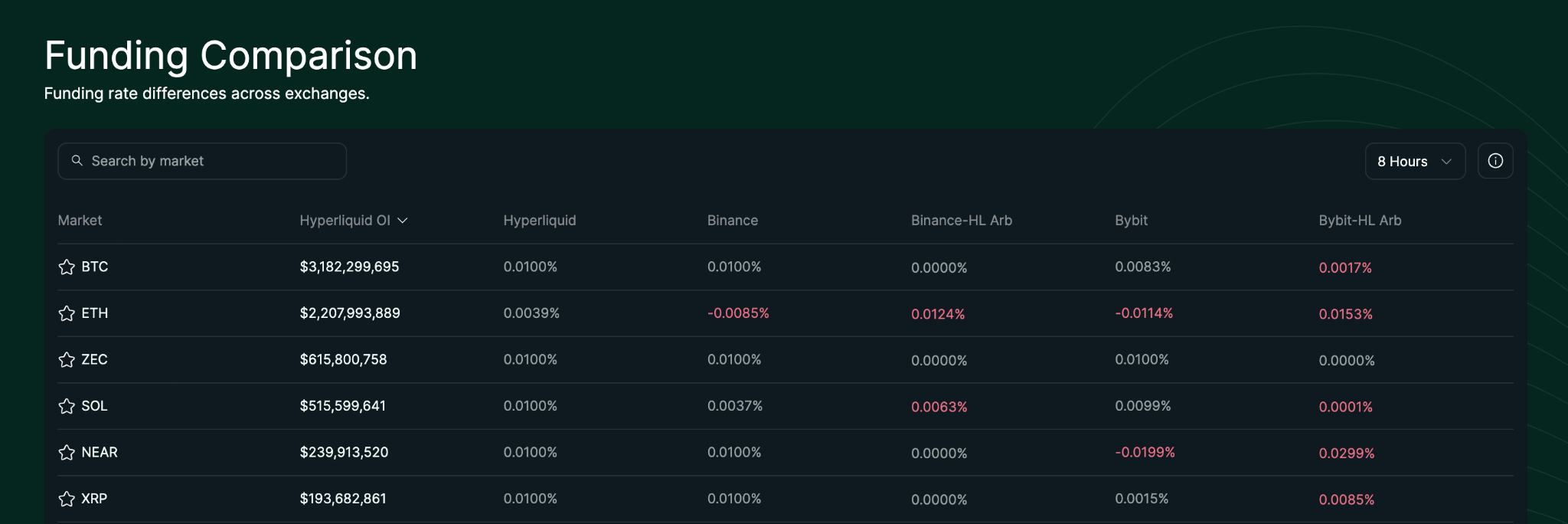
Compare rates for the same asset over time on a consistent hourly basis. A 0.01% hourly rate looks small, but it annualizes to 87.6% if sustained.
What Does Funding Say About Market Positioning?
High positive funding often signals strong demand for long exposure. Deeply negative funding can indicate crowded short positions.
Funding becomes more informative alongside price and open interest:
Rising price, rising open interest, and positive funding: new long exposure may be building
Falling price, rising open interest, and negative funding: new short exposure may be building
Neither setup guarantees a reversal. Crowded positions can stay crowded while prices keep trending.
Is Funding Arbitrage Worth the Risk?
Traders can try to collect funding by holding the receiving side of a perpetual contract while hedging price exposure elsewhere.
For example, a short perpetual position receiving positive funding can be paired with an equivalent spot holding. The hedge reduces directional exposure while funding provides potential income:
When funding is positive, the short receives payments from longs.
The spot holding offsets the short's exposure to price movements, leaving funding as a potential source of return.
The displayed funding rate isn't the realized return. Trading fees, changes in the spot-perp basis, funding reversals, slippage, and liquidation risk all affect the outcome.
FAQs on Hyperliquid Funding Rates
Does Hyperliquid charge funding even if a trade is losing money?
Yes. Funding depends on the position's size and the applicable funding rate, regardless of unrealized profit or loss. A losing position can still pay funding.
Can funding turn negative while BTC is going up?
Yes. Funding reflects the premium between perpetual market pricing and the oracle price, not the direction of BTC's price. BTC can rise while its perpetual trades at a deep enough discount to the oracle price (a premium below −0.05%) to produce negative funding.
How much funding will a position pay per day?
Multiply position size × oracle price × the hourly rate × 24, assuming the rate holds steady. A $100,000 position at the 0.00125% baseline pays $30 a day.
Where can historical funding rates be found?
Hyperliquid's public Info API returns them: fundingHistory for a market, and userFunding for a wallet's payments.
Rates are returned as decimals, so 0.0000125 means 0.00125%.
Can funding payments trigger liquidation on Hyperliquid?
Yes. Funding payments reduce account equity and can push a leveraged position below its maintenance margin requirement. Liquidation risk can rise even without a significant adverse price move.
About Quicknode
Founded in 2017, Quicknode deploys institutional-grade blockchain infrastructure for developers and enterprises. With 99.99% uptime and support for 76+ chains, teams build and scale onchain applications without compromise.
Stay updated
The latest engineering insights, product updates, and web3 news delivered straight to your inbox.