Milliseconds Matter: The Fastest Solana RPC Provider, Verified
Milliseconds Matter: The Fastest Solana RPC Provider, Verified
Solana is fast by design, but your RPC provider shouldn’t be the bottleneck. See how Quicknode delivers 2 to 3x lower latency than other RPCs.

August 14, 2025 — 5 min read
Solana is fast by design, but your RPC provider shouldn’t be the bottleneck. That’s why Quicknode set out to become the fastest Solana RPC provider, and now we’ve proven it. With QuickLee, our real-time benchmarking tool, developers can see for themselves: Quicknode delivers 2–3x lower latency than top alternatives, across the globe. Here’s how we built performance you can feel and measure.
👉 View the live Solana QuickLee dashboard here.
Why Latency Matters on Solana
Solana is designed for speed. Its high throughput and low fees make it a leading choice for DeFi, gaming, and consumer applications. But speed at the protocol level is only half the story. For developers, the responsiveness of RPC endpoints determines how quickly dApps can read data, submit transactions, and deliver real-time experiences to users.
Milliseconds matter. A few hundred milliseconds can be the difference between winning an arbitrage opportunity or missing it, between a smooth game interaction and a laggy one. That’s why we knew that “good enough” wasn’t good enough for Solana developers.
All Providers (P95)Network: Solana • Metric: P95 latency • Date: August 21, 2025
Provider | P95 Latency (ms) | Network | Observed |
|---|---|---|---|
quicknode | 49.9ms | Solana | 2025-08-21 |
triton | 99.9ms | Solana | 2025-08-21 |
Solana P95 latency, August 21, 2025 (lower is better).
We Weren’t Satisfied, So We Built Better
When we first benchmarked our Solana global latencies on QuickLee, we saw strong results in many regions, but not consistently at the Quicknode standard, which we define as being best-in-industry at a global scale.
For Solana builders to have the best read and write experience, Quicknode had to level up:
Our team engaged with users directly to understand how Quicknode can help; we heard you needed it to be
fast, and we delivered.
Users around the world are learning how fast Solana can be with the right provider; we have ensured we are globally deployed where it matters most, putting nodes closer to you, no matter where you are.
To ensure we maintain our standards, we test relentlessly—not just once, but continuously—and continue to fine-tune our testing to remove bias and focus on what the Solana community needs.
After rounds of iteration, measurement, and fine-tuning, Solana response times are now where they should be: fast, reliable, and transparent worldwide.
Under the Hood: Engineering for Milliseconds
Our Solana latency gains were achieved from many small, compounding improvements across the stack, which required concerted effort to optimize placement, shorten routes, optimize OS/hardware decisions, and fine-tune validator configurations.
What the data shows (last 7 days ending Aug 14, 2025):
Quicknode’s global p95 latency is 57.4 ms (global = average of each region’s p95). The next-closest provider measured 117ms, about 2x higher p95, with most large providers sitting between ~200-300 ms (3-5x slower).
Put the work where it belongs (Core / Branch / Edge)
Latency-sensitive methods live at the Edge, close to demand, backed by locally connected Branch clusters which keep hot data regional and absorb spikes. Core hubs handle ledger-heavy backfills where throughput matters more than single-digit millisecond latency. This removes I/O contention and shortens request paths.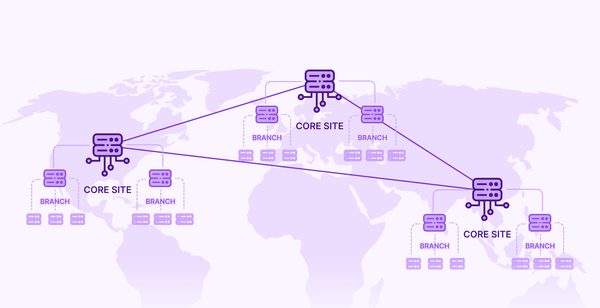
Shorten the wire, and exit bad nodes quickly
With Quicknode, we ensure we run at least two data centers per key region with multiple upstream connections. Traffic is routed to minimize latency, maximize uptime and throughput, not just static geography. When a node shows signs of degradation, routes fail forward instantly to prevent overloading backends.Choose hardware for consistent ‘tails’, not max peaks
Following months of iterative testing, we systematically evaluated NVMe, RAM topology, CPU characteristics, and chassis specifically for Solana workloads, building for stable latency at scale. Every server is fine-tuned down to the kernel and network drivers, optimizing for core utilization and safeguarding against heat saturation.Make Solana‑aware configuration choices
On Agave 2.x, we developed and leveraged dynamic-method-generation benchmark tools to emulate real-world and threshold testing supporting all current methods. Our test suite incorporates advanced AI heuristics, system monitoring, and comprehensive data analytics to enable fine-tuning for common methods (e.g., AccountsDB) and specific use cases to protect p95 latency during bursts.Own the request path
Why this matters:
Quicknode ensures you get not only low averages but tight p95s during congestion and maintenance events. “Fast once” is easy, but predictably fast is what makes DeFi, gaming, and consumer apps feel real-time.
Proof, Not Promises
You don’t have to take our word for it; check the numbers yourself.
With QuickLee, all latency results are publicly available, updated continuously, and comparable across providers. Here’s the dedicated Solana dashboard:
What you’ll see:
Regularly 2-3x faster than top competitors
Consistent low-latency performance compared to alternatives
Transparency by default, because performance claims should be verifiable
What This Means for Solana Developers
For developers building on Solana with Quicknode:
Your users will experience faster, smoother interactions
Your dApps can compete in latency-sensitive markets like DeFi
You’ll know you’re building on the most transparent, benchmarked infrastructure available
Quicknode exists to give builders the best tools and infrastructure to succeed. By bringing Solana up to our global performance standard, we’re reaffirming that commitment, because when you’re building the future, every millisecond counts.
Try It Yourself
Curious to see how your stack performs? Explore QuickLee and compare us to other providers:
• QuickLee Overview
• QuickLee Solana Dashboard
We’ll keep raising the bar—and keep publishing the proof.
Start Building now
Start Building with QuicknodeAbout Quicknode
Founded in 2017, Quicknode deploys institutional-grade blockchain infrastructure for developers and enterprises. With 99.99% uptime and support for 80+ chains, teams build and scale onchain applications without compromise.
Stay updated
The latest engineering insights, product updates, and web3 news delivered straight to your inbox.