Tokenized Deposits vs Stablecoins: Differences, Economics, Use Cases
Tokenized Deposits vs Stablecoins: Differences, Economics, Use Cases
Tokenized deposits vs stablecoins explained: how they work, who issues them, key risks, economics, and real-world use cases.

October 23, 2026 — 10 min read
In 2009, Bitcoin's first block carried a headline about a bank bailout. It raised a question about money and trust: what if transferring value didn't require a bank in the middle?
Bitcoin's price action, however, made everyday payments difficult. Stablecoins filled this gap as a way to use digital dollars or euros without the usual bank-payment rails.
Today, banks are entering the same market. Tokenized deposits bring existing bank money onto digital ledgers, with the bank still owing the deposit.
So, are they the same? That's exactly what this piece deciphers, comparing how they work, their economics, use cases, and more.
What Are Tokenized Deposits and Stablecoins?
Tokenized deposits are commercial bank deposits represented as digital tokens and recorded on a blockchain or shared ledger.
The issuing bank owes the customer the same money as before. Tokenization, however, changes how the deposit is recorded and transferred.
Stablecoins are digital assets designed to maintain a stable price (usually $1 or €1). Issuers back this value with reserves, collateral, or other price-stabilization mechanisms.
Let's understand the fundamentals of both forms of money:
Tokenized deposit | Stablecoin | |
|---|---|---|
Issuer | A licensed bank | A licensed non-bank issuer or a bank subsidiary |
Legal claim | A deposit: the bank owes the holder | A redemption claim on the issuer |
Backing | The bank's balance sheet | Reserve assets: often cash and short-term government securities |
Redemption | From the bank, at par, under account terms | Directly for institutional customers Most retail holders sell on an exchange instead |
Transferability | Between approved clients | Across supported wallets and blockchains |
Main risk | Bank runs, operational failures, and similar risks above the insurance limit | Reserve liquidity and depegs No deposit insurance |
Both instruments move money and value using digital ledgers, but:
Tokenized deposits keep the deposit relationship inside the banking system.
Stablecoins allow value to circulate onchain while their issuance and on/off ramps still depend on banks.
The differences become clearer when money starts moving. Let's understand the movement and the workflow next.
Why Tokenized Deposits?
Banks already move trillions electronically, so why tokenize deposits?
The friction lies in how banks keep records and settle. Tokenized deposits target three gaps:
Fragmented records: A shared ledger gives institutions one synchronized record, reducing reconciliation.
Delayed settlement: Same-bank transfers settle on the ledger, and cross-bank transfers speed up with interoperable networks and assets.
Disconnected transactions: Programmable payments can be tied to asset delivery, so both sides complete or neither does.
For businesses, the value lies in faster movement of funds, fewer manual processes, and the ability to automate complex transactions.
But tokenization alone cannot guarantee these benefits. Interbank settlement still needs central bank money or an equivalent arrangement.
How Tokenized Deposits Work
The infographic below illustrates the lifecycle:
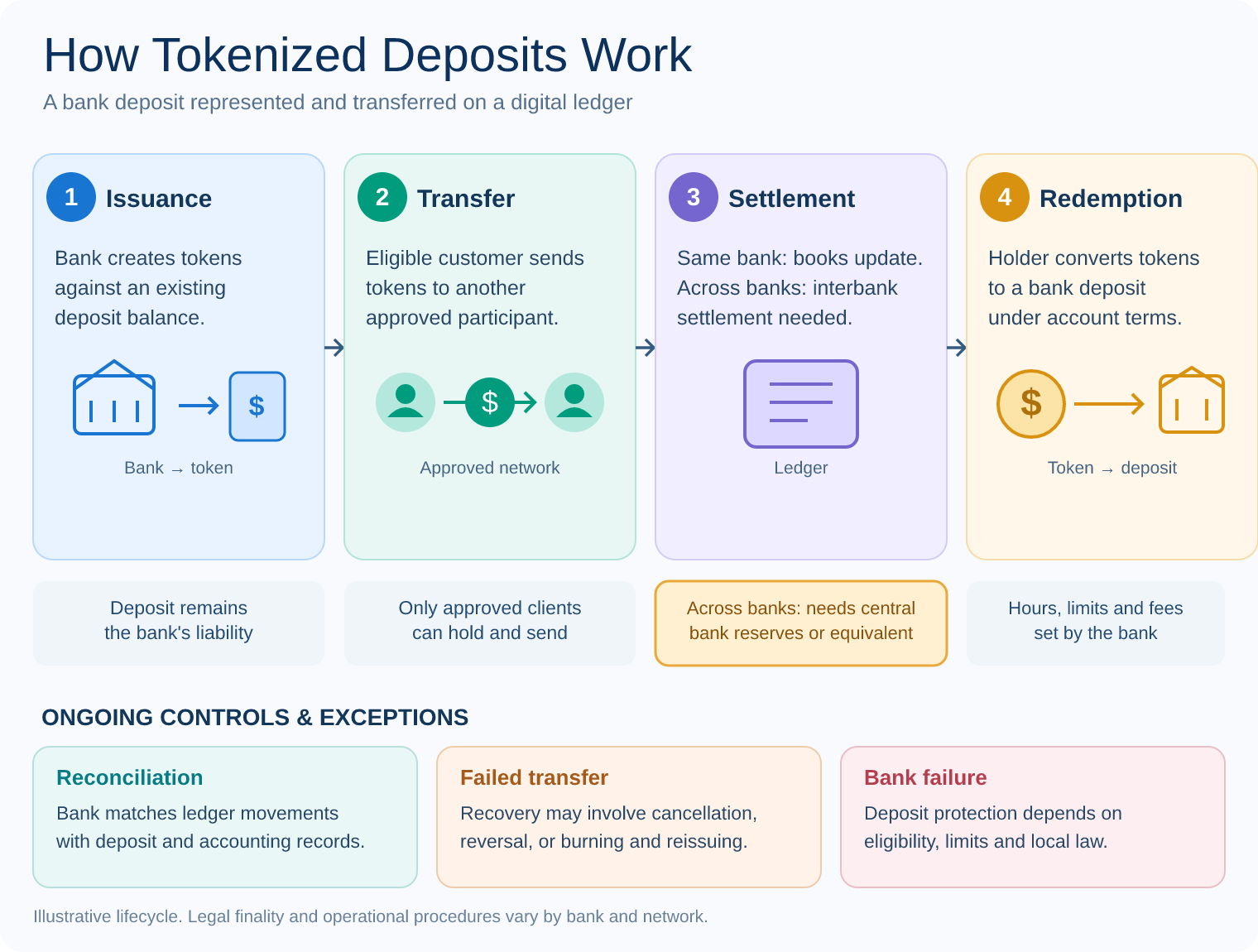
Now, let's move to stablecoins and how they work.
Why Stablecoins?
Banks already move money digitally, so why did stablecoins take off?
The friction lies in access and timing. A bank payment needs an account on each side and runs on the banks' schedule.
Stablecoins target three gaps:
Closed access: Anyone with a wallet can hold and send them, with no bank account involved.
Closed hours: Transfers settle onchain in seconds to minutes, any day of the week.
Fragmented network: The token sits on the same ledger as exchanges, lending protocols, and tokenized assets.
That fit explains the scale: about $302 billion worth of stablecoins are circulating as of October 2026.
Did you know?
There are more than 10 types of stablecoins beyond just USDT and USDC, each serving a unique purpose.
How Stablecoins Work
The infographic illustrates the four-stage lifecycle:
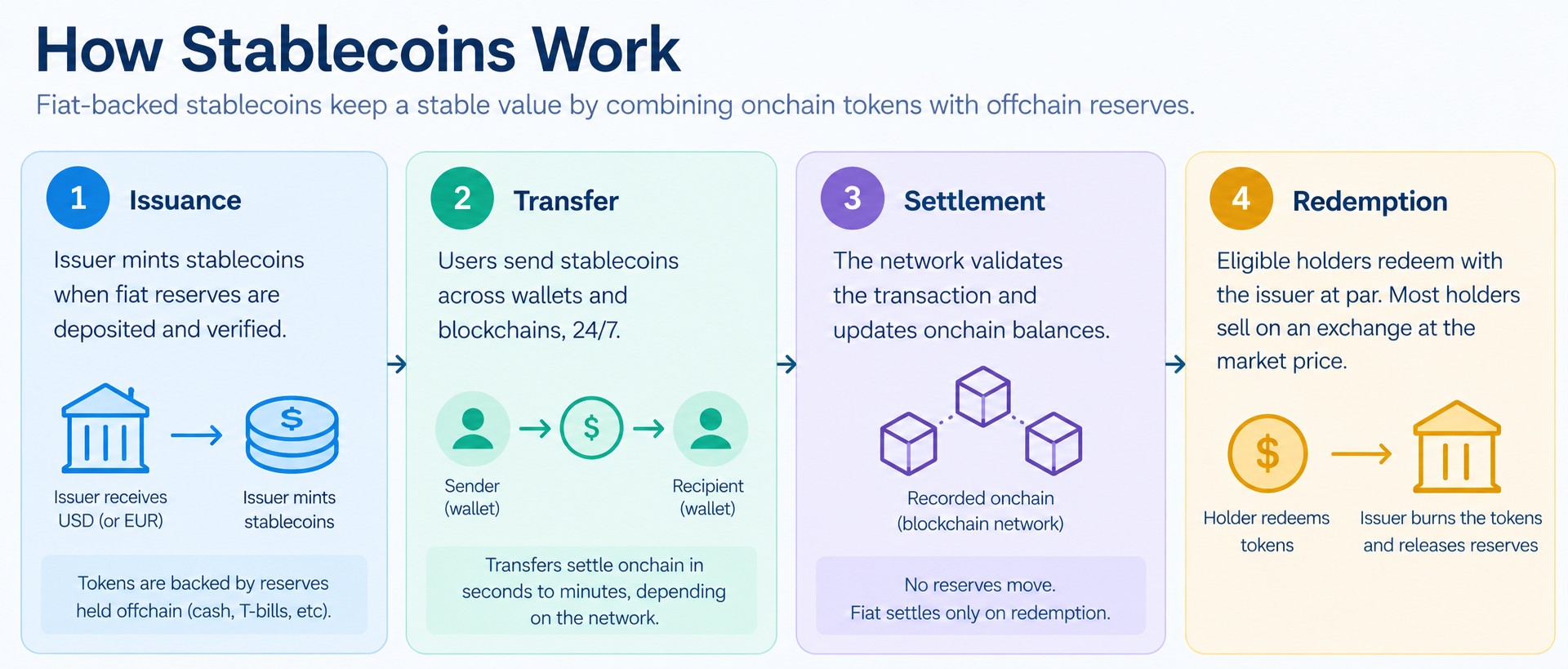
Outside tokenized deposits and stablecoins, a few other forms of digital money are slowly emerging.
Tokenized Deposits, Stablecoins, CBDCs, and Other Digital Money
Tokenized deposits and stablecoins are part of a larger category of digital money. The key differences lie in who issues them, what legal claim they represent, and what protections apply.
Instrument | What it represents | Issuer | Protection | Key distinction |
|---|---|---|---|---|
Conventional bank deposit | A claim against a commercial bank | Commercial bank | Eligible deposits insured up to national limits | Recorded on the bank's existing ledger |
Tokenized deposit | A bank deposit represented by a digital token | Commercial bank | Deposit insurance may apply, depending on legal structure and jurisdiction | Preserves the deposit claim while enabling token-based transfers |
Fiat-backed stablecoin | A digital token backed by reserves, with redemption rights determined by law and issuer terms | Bank or non-bank issuer | Generally no deposit insurance. Reserve requirements and holder protections vary | Circulates onchain. Direct redemption may be restricted to eligible holders |
E-money | Electronically stored monetary value and a claim on its issuer | Licensed e-money institution or bank | Customer funds subject to safeguarding rules. Generally no deposit insurance for non-bank e-money | Typically redeemable at par. Can also be tokenized |
Tokenized money-market fund | Ownership or beneficial interest in a fund holding short-term assets | Investment fund, managed by an asset manager | No deposit insurance. Fund value can fall | Investment exposure. Value and redemption depend on fund assets and terms |
CBDC | A digital claim on a central bank | Central bank | No commercial-bank credit risk. Operational and other risks remain | Central bank money for retail or wholesale use, depending on design |
Three distinctions matter:
Commercial bank vs central bank money: Bank deposits carry commercial-bank credit risk. CBDCs are direct central bank liabilities.
Money vs investment: Tokenized money-market funds represent investment holdings. Their value can fluctuate, unlike deposits, which are redeemable at par.
Digital vs tokenized: Bank deposits and e-money are already digital. Tokenization changes how claims are represented, transferred, and programmed.
These categories can overlap. Under the EU's MiCA framework, fiat-backed stablecoins referencing a single official currency qualify as e-money tokens.
Now that we've got that out of the way, let's get back to stablecoins and tokenized deposits.
The Business and Economics Case Behind Stablecoins and Tokenized Deposits
Both instruments promise faster payments, fewer intermediaries, and programmable transactions. But the economics differ because banks earn money from deposits, while stablecoin issuers typically earn money from the assets backing their tokens.
How Stablecoin Issuers Make Money
Fiat-backed stablecoin issuers receive dollars when eligible customers mint tokens, then invest those reserves in assets like short-term government securities or T-bills.
Consider $1 billion in circulating stablecoins backed by reserves earning 4% annually:
Reserve income: $40 million per year before expenses.
Costs: Custody, compliance, distribution, operations, and revenue-sharing arrangements.
Net earnings: The income remaining after those costs.
Most stablecoins pay holders no interest. This allows issuers to retain much of the yield generated by their reserves.
Adoption of Stablecoins
Metric | Figure | What it tells us |
|---|---|---|
Circulating supply | ~$300 billion (October 2026) | Stablecoins have established a substantial market for digital dollars |
Adjusted annual transfer volume | Goods, services, payroll, and remittances | |
Active wallets | 316 million in 2025 | Broad wallet activity, although wallets are not unique people |
Business-to-business payments | ~$226 billion a year | The largest slice of real payments |
Bonus: Why exactly do people use stablecoins? Explore stablecoin adoption across major economies, backed by real-world examples and regulation.
How Tokenized Deposits Make Money for Banks
Banks already earn income from deposits by lending or investing funds while paying depositors a lower rate.
Tokenization does not create a new pool of money or automatically generate additional yield. Its business case lies in retaining deposits and improving how they move.
Three benefits matter:
Deposit retention: Banks can offer programmable, 24/7 payment capabilities without pushing customers toward non-bank stablecoins.
Lower operating costs: Shared records and automated settlement can reduce reconciliation, payment processing, and manual intervention.
New services: Banks can support conditional payments, tokenized asset settlement, and automated treasury operations.
The tradeoff is infrastructure cost. Banks must build or integrate token networks, maintain compliance controls, and connect token movements to their existing accounting systems.
Tokenized Deposits: Banks and Initiatives in 2026
Bank / initiative | Status | Primer |
|---|---|---|
JPMorgan: JPM Coin (JPMD) | Live | USD deposit token for institutional clients. Launched on Base in November 2025 and extended to Ethereum on October 19, 2026. |
Citi: Token Services | Live | Institutional payments and 24/7 liquidity management, live in seven markets. Japan and the UAE are the most recent additions. |
HSBC: Tokenised Deposit Service | Live | Corporate treasury and 24/7 liquidity transfers for eligible institutional clients in Hong Kong, Singapore, Luxembourg, the UK, the US, and the UAE. |
Swift + participating banks | Early live pilot | Swift's ledger matches and nets cross-bank obligations while each bank records deposits on its own system. |
Stablecoins have reached global scale, while tokenized deposits are gaining traction among banks and institutional clients. Yet neither has replaced conventional payment infrastructure. Why?
What's Holding Back Adoption in 2026?
Moving tokens is relatively easy. Making them work across banks, blockchains, currencies, and legal systems is harder. Five challenges remain:
1. Interoperability
Stablecoin liquidity is spread across blockchains. Tokenized deposits operate largely within individual bank networks.
Moving value between these systems still requires bridges, intermediaries, or settlement arrangements.
2. Regulatory Fragmentation
Rules for issuance, reserves, redemption, and settlement differ across jurisdictions. A token accepted in one market may face restrictions in another.
3. Liquidity and Redemption
Onchain transfers can settle in seconds, but converting tokens into bank money depends on available liquidity, issuer terms, and banking hours.
4. Security and Operational Risk
Smart-contract vulnerabilities, compromised wallets, integration failures, and network outages can interrupt transfers or cause losses.
Tokenization introduces new operational risks alongside existing financial risks.
5. Network Effects and Costs
Faster settlement offers limited value when counterparties cannot receive the token.
Banks and businesses must also justify integration, compliance, custody, and conversion costs.
The central challenge is connecting token-based money to the financial systems businesses already use.
So, can these solutions be used today?
How to Choose Between Tokenized Deposits and Stablecoins: A Starting Point
Simply put, stablecoins fit open, wallet-to-wallet reach, and tokenized deposits fit regulated, bank-to-bank movement with a bank's claim behind it.
The choice comes down to three questions: Who needs to receive the money? Where will it move? What legal protections matter?
Situation | Start with | Why |
|---|---|---|
Paying a counterparty's wallet on a supported chain | Stablecoins | Any wallet on the chain can receive it, at any hour |
Paying clients of banks in the same network | Tokenized deposits | Keeps the bank deposit claim, including insurance up to the limit |
Reaching DeFi and onchain applications | Stablecoins | Exchanges, lending protocols, and wallets already integrate them |
Corporate treasury moves within one bank's network | Tokenized deposits | Automates liquidity transfers at any hour inside bank arrangements |
Cross-border supplier payments | Stablecoins if the supplier already holds them, otherwise existing rails or a bank network | Conversion at each end can absorb the savings |
Neither is automatically the cheaper or safer option.
Stablecoin payments introduce issuer, liquidity, and redemption risks.
Tokenized deposits retain commercial bank risk and depend on participating institutions.
For many businesses, conventional bank transfers will remain sufficient. Tokenization becomes useful when existing payment rails cannot meet a specific requirement for access, availability, or automation.
So, what's next?
Stablecoins vs Tokenized Deposits: The Bottom Line
Stablecoins and tokenized deposits address different needs in the movement of digital money.
Stablecoins prioritize reach: they allow value to circulate across supported wallets, blockchains, and apps without requiring a bank to process every transfer.
Tokenized deposits prioritize banking integration: they bring programmable transfers to existing bank deposits while preserving the relationship between banks and depositors.
Neither eliminates financial intermediaries, credit risk, or the need for regulation. Both depend on reliable settlement, liquidity, and legal protections.
The likely outcome is coexistence. Stablecoins can serve open onchain markets and cross-border payments, while tokenized deposits support institutional payments and bank-based treasury operations.
The question is less about which instrument replaces the other and more about which form of money fits a particular transaction.
About Quicknode
Founded in 2017, Quicknode deploys institutional-grade blockchain infrastructure for developers and enterprises. With 99.99% uptime and support for 76+ chains, teams build and scale onchain applications without compromise.
Stay updated
The latest engineering insights, product updates, and web3 news delivered straight to your inbox.