What Enterprise Means at Quicknode
What Enterprise Means at Quicknode
Higher limits, tighter controls, and an engineer who knows your workload.

November 12, 2026 — 3 min read
Your workload can fit within its limits and still need Enterprise. Central sign-in, an audit trail, or a contractual uptime commitment can matter as much as capacity.
At Quicknode, Enterprise covers three kinds of capabilities:
Enterprise features: available only on the Enterprise plan
Higher allowances: capabilities on paid plans, with higher or custom limits on Enterprise
Scoped services: services Quicknode agrees to separately for your workload
An Engineer Who Knows Your Workload
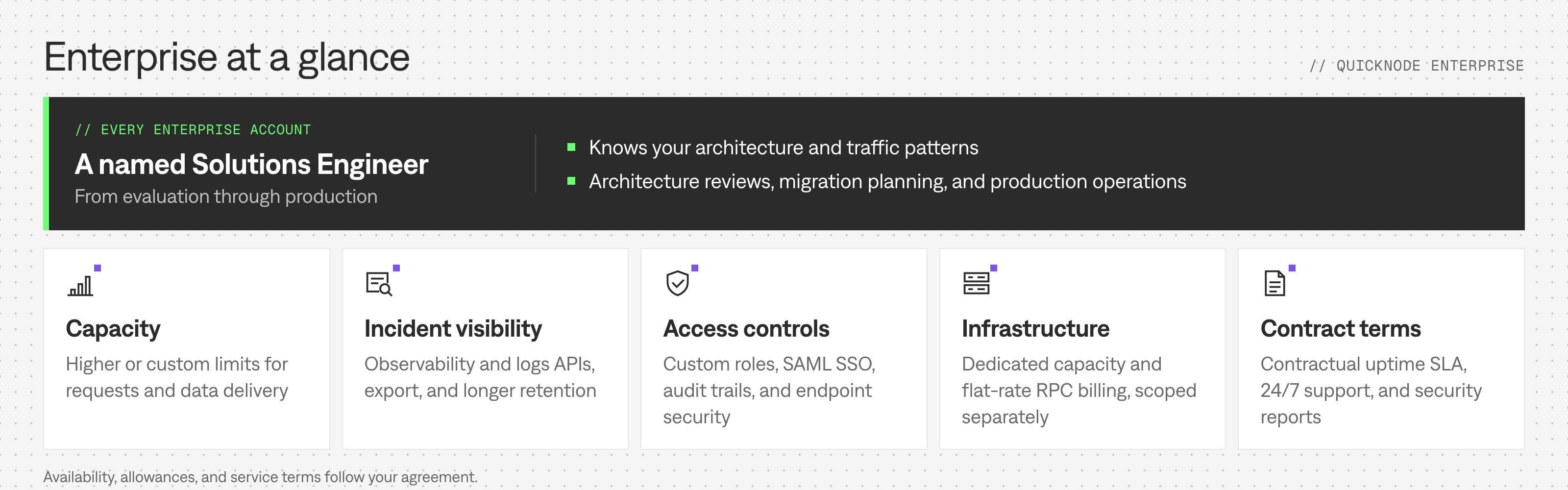
Enterprise accounts get a named Solutions Engineer who works with your team from evaluation through production. They help you choose the right infrastructure, review architecture, plan migrations, investigate issues, and tune usage with your workload in context. You agree on the scope and cadence with Quicknode.
“What makes Quicknode stand out is their support. The team is responsive, knowledgeable, and easy to get hold of when something needs attention.”
Daniel Harris, Solana Engineering Lead, 0x (read the case study)
Higher Allowances: Same Products, More Room
Every limit counts something different: API credits, requests per second, endpoints, platform API calls, Streams destinations, Webhooks, gRPC, and IPFS. Raising one does not raise the others.
Enterprise raises these limits or sets custom allowances for your workload. It also extends Observability history and endpoint log retention. Measure what you need in each limit’s unit, and discuss the allowance with Quicknode. The pricing page compares plans.
Enterprise Features: Visibility and Control
Enterprise adds ways to investigate incidents, control account access, and restrict endpoint traffic:
Trace incidents in your own tools: Observability API, endpoint logs API, Prometheus Exporter, and CSV and JSON export
Give each team only the access it needs: custom roles and SAML SSO
Know who changed what: Activity Logs and member-change emails
Accept only expected traffic: request filters, endpoint mTLS, and the IP custom header
You configure most of these yourself. A few, such as Activity Logs, are switched on by request.
Scoped Services: Agreed per Workload
Quicknode scopes infrastructure options and service commitments to your workload:
Isolation: Dedicated Clusters, or Hybrid Dedicated gRPC on Solana
Predictable cost: Enterprise Flat Rate RPS, a fixed monthly RPC price for steady traffic, without a single-region restriction
Large backfills: Enterprise backfilling for Streams
Privacy: Stealth Mode, logging suppression for sensitive activity on shared and dedicated infrastructure
Procurement and security: uptime SLA, dedicated 24/7 support, volume pricing, early chain access, and SOC 1 Type 2, SOC 2 Type 2, and ISO 27001 reports
An Enterprise plan does not include all of these by default. Ask for the terms your workload needs.
Start From the Need
List the capacity, access, incident response, and support requirements your workload needs to meet. Check what each plan includes, and bring the remaining requirements to Quicknode.
The Quicknode Enterprise Plan guide maps each need to a capability, with setup links. To discuss a workload, contact sales.
About Quicknode
Founded in 2017, Quicknode deploys institutional-grade blockchain infrastructure for developers and enterprises. With 99.99% uptime and support for 76+ chains, teams build and scale onchain applications without compromise.
Stay updated
The latest engineering insights, product updates, and web3 news delivered straight to your inbox.