Answers>Learn about blockchain data streaming>Common blockchain streaming use cases
Common blockchain streaming use cases
// Tags
blockchain streaming use cases
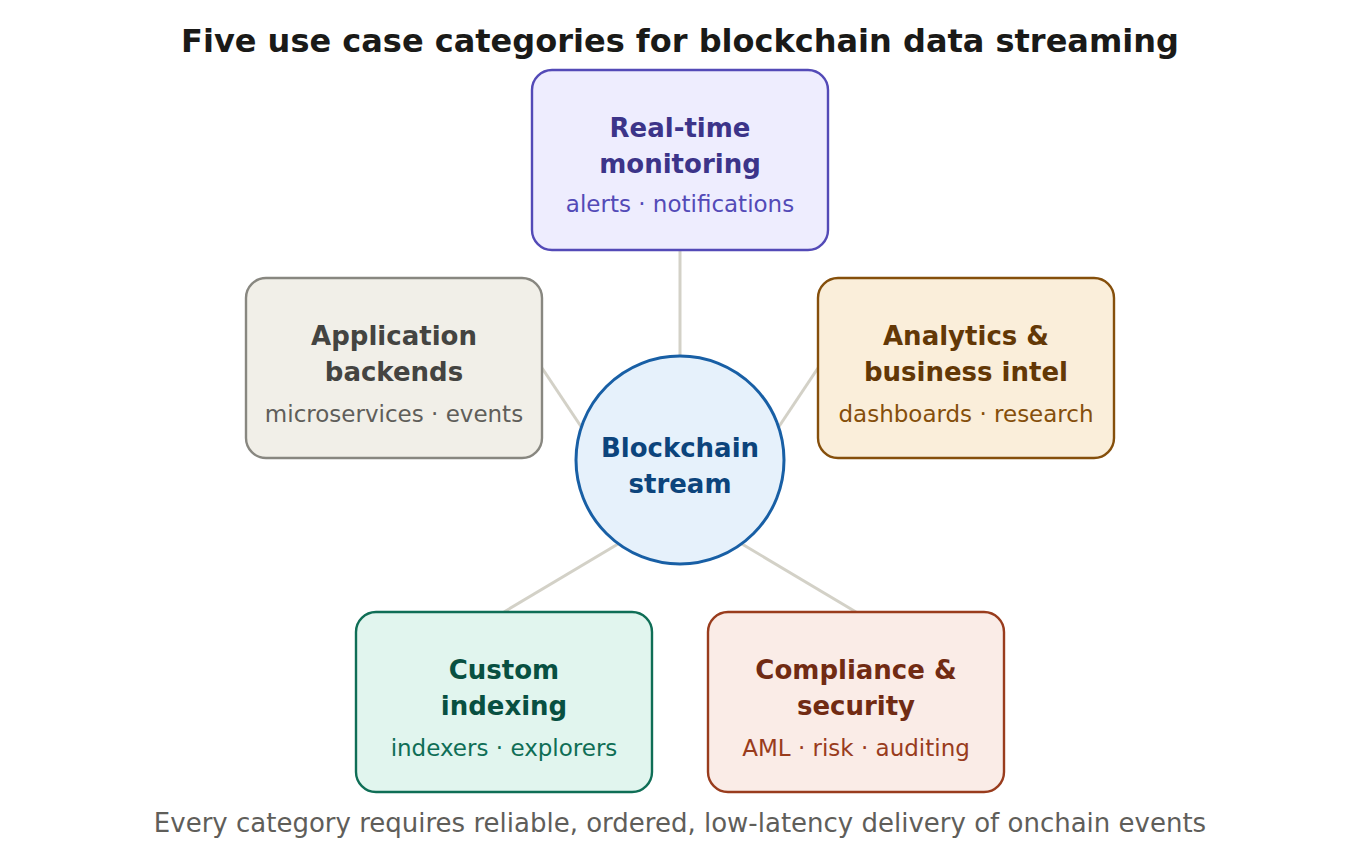
TL;DR: Blockchain data streaming powers a wide range of production applications, from real-time wallet monitoring and DeFi dashboards to compliance systems, custom indexers, and analytics platforms. Any application that needs to react to onchain events as they happen, maintain a synchronized database of blockchain data, or process high volumes of historical records benefits from a push-based streaming architecture. The most common use cases fall into five categories: real-time monitoring, data indexing, analytics and business intelligence, compliance and security, and application backends.
The Simple Explanation
Streaming is not a product category. It is an infrastructure pattern. A streaming data pipeline delivers blockchain data to your systems automatically as it is produced, replacing the manual, repetitive work of polling RPC endpoints and stitching together data from multiple sources. The value of streaming becomes clear when you look at the applications it enables and the problems it solves for each.
Every use case described below shares a common requirement: the application needs blockchain data delivered reliably, in order, without gaps, and with minimal latency. The specifics of what data is needed, how it is filtered, and where it is sent vary by use case, but the underlying infrastructure pattern is the same.
What is blockchain data streaming?
Blockchain data streaming is an infrastructure pattern that pushes onchain data to your systems as it is produced, instead of you repeatedly pulling it. A streaming pipeline delivers blocks, transactions, logs, and traces in order and without gaps, so your application can react to events within seconds. For a deeper definition, see what blockchain data streaming is and how it compares to
Is streaming better than polling for blockchain data?
Polling repeatedly asks an RPC endpoint whether anything changed, while streaming pushes changes to you the moment they occur. For most production use cases that need reliability and low latency, streaming wins. The table compares the two approaches.
Factor
Polling
Streaming
Data flow
You pull on a schedule
Provider pushes on each event
Latency
Limited by poll interval
Near real-time
Missed events
Possible during failures or rate limits
Guaranteed delivery, no gaps
RPC load
High and repetitive
Lower and filtered
Best for
Simple, low-frequency checks
Monitoring, indexing, and analytics at scale
Real-Time Monitoring and Alerting
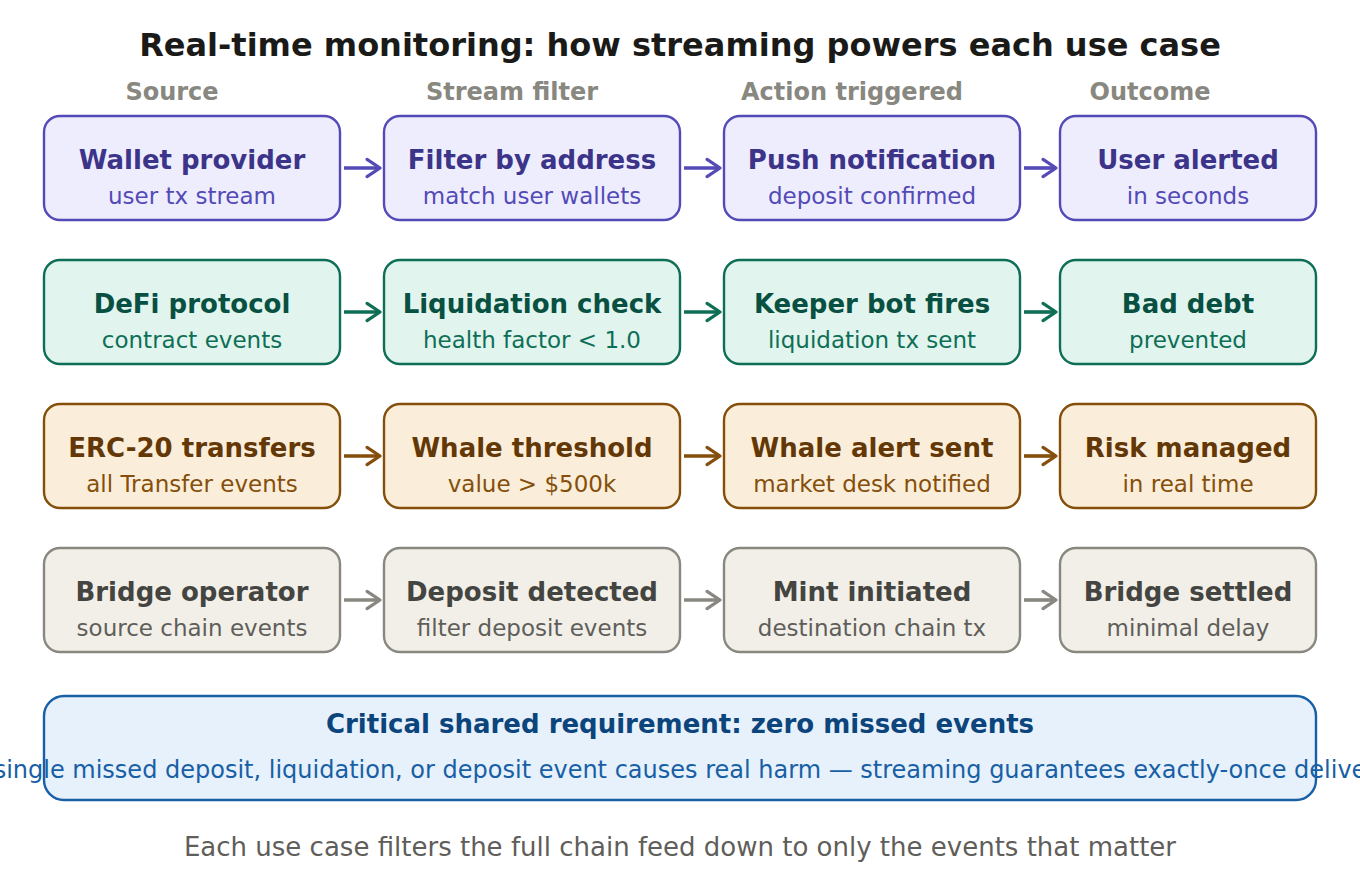
The most immediate use case for streaming is watching the blockchain for specific events and reacting to them in real time. A wallet provider streams transaction data filtered to its users' addresses, enabling instant push notifications when a user receives a deposit or when a pending transaction confirms. A DeFi protocol streams its own contract events to detect when positions approach liquidation thresholds, triggering automated keeper bots or user alerts within seconds. A bridge operator streams deposit events on the source chain to initiate corresponding mints on the destination chain with minimal delay.
These monitoring use cases share a critical requirement: zero missed events. If the system misses a single deposit event, a user does not get notified. If it misses a liquidation threshold event, a position goes unliquidated and the protocol takes bad debt. Polling-based architectures risk missing events during connection failures, rate limit hits, or processing delays. Streaming with guaranteed delivery ensures every relevant event reaches its destination exactly once.
Token tracking is another common monitoring application. Exchanges and market makers stream Transfer events from ERC-20 contracts to track token movements between wallets, detect large transfers (whale alerts), and update internal accounting systems. NFT platforms stream Transfer events from ERC-721 and ERC-1155 contracts to update ownership records, trigger marketplace listings, and maintain provenance histories. In both cases, the streaming filter reduces the data volume from "every transaction on the chain" to "only the events involving contracts and addresses I care about," making the downstream processing manageable.
Custom Indexing and Database Synchronization
Streaming is the foundation of every modern blockchain indexer. An indexer needs a reliable, ordered feed of block data that it can process into structured database records. The streaming pipeline handles data extraction and delivery, while the indexer handles transformation and loading. This separation of concerns means the indexer developer focuses exclusively on business logic (how to decode events, what tables to write to, what derived metrics to compute) rather than infrastructure concerns (how to connect to nodes, handle retries, detect reorgs, manage rate limits).
Portfolio tracking services use streaming to maintain a synchronized database of token balances, transaction histories, and position values across multiple chains for every user. Instead of querying the blockchain on demand when a user opens the app (which would be slow and expensive), the service pre-indexes all relevant data via streaming so the app can serve queries from its own database with sub-second response times.
Block explorers are perhaps the most comprehensive indexing use case. Services like Etherscan process every block on every supported chain, decode every transaction, index every event log, and store everything in a queryable database. Building a block explorer from scratch requires a data pipeline that can handle the full volume of the chain in real time while also backfilling the complete history. Streaming provides both capabilities through a single interface.
Analytics and Business Intelligence
Analytics platforms use streaming to build real-time and historical datasets for business intelligence. A DeFi protocol's growth team might stream all Swap events from its DEX contracts to a data warehouse, then build dashboards showing trading volume by pair, unique traders per day, fee revenue trends, and liquidity utilization rates. These dashboards combine real-time data (today's volume so far) with historical data (last 90 days of trends) in a unified view.
Research firms stream blockchain data to power quantitative analysis: MEV extraction patterns, gas price dynamics, validator behavior, cross-chain capital flows, and protocol adoption metrics. The streaming pipeline delivers raw data to the research infrastructure, where data scientists transform, analyze, and model it using familiar tools like SQL, Python, and BI platforms. By streaming filtered data (only the events and transaction types relevant to the research question), the pipeline minimizes storage and processing costs.
On-chain attribution is a growing analytics use case. Marketing teams at crypto projects stream transaction data to attribute onchain activity (swaps, mints, deposits) back to specific acquisition channels or campaigns. By matching wallet addresses to campaign touchpoints, teams can measure the ROI of their growth efforts with onchain precision.
Compliance, Security, and Risk
Compliance teams at exchanges, custodians, and financial institutions use streaming to monitor wallet activity for suspicious patterns in real time. Anti-money laundering (AML) systems stream transaction data and apply rule-based or ML-driven detection models to flag transactions that match known risk patterns: large transfers to mixing services, rapid movement of funds across multiple wallets, interactions with sanctioned addresses, or unusual transaction timing.
Security monitoring is closely related. Smart contract auditors and protocol security teams stream contract events and trace data to detect exploit attempts as they happen. When an attacker begins draining a pool or exploiting a reentrancy vulnerability, real-time streaming enables the security team to detect the attack within blocks and potentially intervene (by pausing the contract or front-running the attacker's remaining transactions) before the damage is complete.
Insurance protocols stream claims-relevant data to automate policy evaluations. A DeFi insurance product might stream price oracle updates and protocol TVL changes to determine when a coverage event has been triggered, initiating the claims process automatically without manual review.
Application Backends and Microservices
Many Web3 applications use streaming as the backbone of their backend architecture. Instead of each microservice independently querying the blockchain (duplicating RPC calls and risking inconsistent data), a central streaming pipeline feeds a shared event bus or message queue. Individual services subscribe to the events they care about and process them independently. This event-driven architecture scales cleanly, maintains data consistency, and reduces overall RPC usage.
Gaming applications stream game-relevant contract events (item mints, trades, battle outcomes) to update game state in near real-time. Social protocols stream content-posting events to populate feeds. Payments infrastructure streams settlement transactions to update ledger balances. In each case, the streaming pipeline replaces what would otherwise be a fragile web of polling loops and WebSocket connections with a single, reliable data source.
What are the most common blockchain streaming use cases?
Streaming use cases cluster into five categories. The table summarizes each one, the data it typically needs, and a representative example. Indexing and analytics in particular depend on it, as covered in what blockchain indexing is.
Category
What it needs
Example
Real-time monitoring
Filtered events and logs
Wallet deposit notifications
Custom indexing
Ordered blocks and receipts
Portfolio tracker database
Analytics and BI
Filtered events to a warehouse
DEX volume dashboards
Compliance and security
Transaction and trace data
AML and exploit detection
Application backends
Webhook event delivery
Event-driven microservices
Can streaming deliver both real-time and historical data?
Yes. The same pipeline that streams new blocks in real time can also backfill complete history, so you can populate a database with past data and then keep it current without switching tools. This is why teams often pair streaming with a one-time backfill, a distinction explained in real-time vs historical blockchain data and how to access historical blockchain data.
How Quicknode Streams Powers These Use Cases
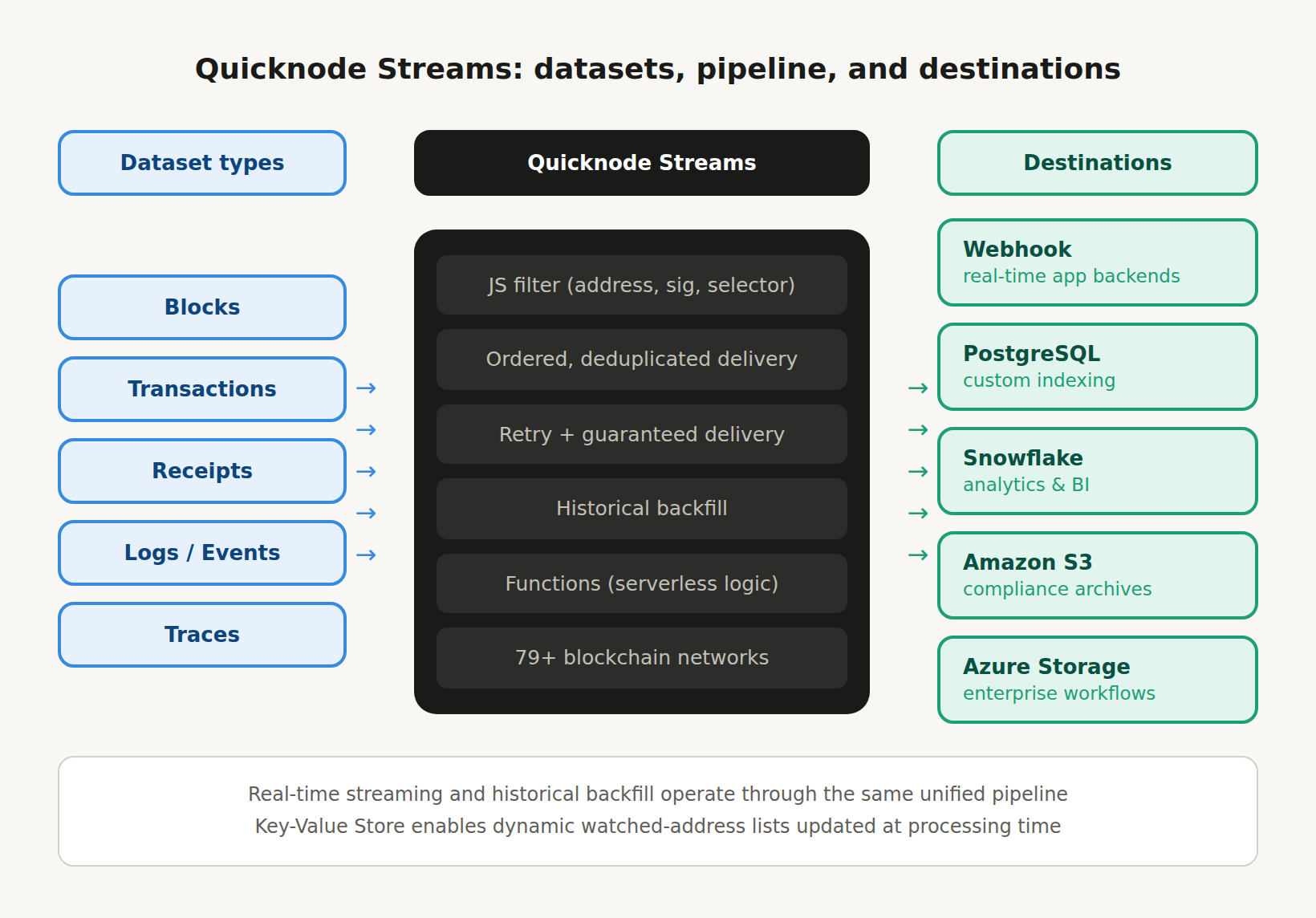
Quicknode Streams supports all of the use cases described above through a configurable, push-based data pipeline. JavaScript filters allow you to match on specific addresses, event signatures, function selectors, or any other transaction property, ensuring your destination only receives the data relevant to your use case. Multiple dataset types (blocks, transactions, receipts, logs, traces) cover the spectrum from lightweight event monitoring to comprehensive full-chain indexing. Delivery to webhooks enables real-time application backends, while delivery to PostgreSQL, Snowflake, Amazon S3, and Azure Storage supports analytics, indexing, and compliance workflows.
Streams integrates with Quicknode Functions for serverless processing on top of streaming data, enabling enrichment, aggregation, notification dispatch, and other business logic without deploying additional infrastructure. The Key-Value Store allows streams to reference and update external state (like watched address lists) during processing, supporting dynamic monitoring use cases that evolve over time. Historical backfills and real-time streaming operate through the same pipeline, so every use case benefits from a unified architecture that handles both past and present data.
What is the difference between streaming and an RPC endpoint?
An RPC endpoint answers individual requests when you ask. Streaming continuously pushes a filtered feed of new data to your destination. Many applications use both: RPC for on-demand queries and streaming for continuous data. See how RPC requests work.
Do I need streaming to build an indexer?
You need a reliable, ordered feed of block data, which is exactly what streaming provides. It handles extraction, ordering, retries, and reorg handling so your indexer can focus on decoding events and writing records.
What data can you stream from a blockchain?
Common datasets include blocks, transactions, receipts, event logs, and traces. Filters let you narrow the feed to specific addresses, event signatures, or function selectors so you only receive what you need.
Can streaming detect MEV or exploits?
Yes. Security teams stream contract events and trace data to detect exploit attempts within blocks, and researchers stream data to study patterns like MEV. See what MEV is in blockchain.
Where can streamed data be delivered?
Typical destinations include webhooks for application backends and databases or storage like PostgreSQL, Snowflake, Amazon S3, and Azure Storage for analytics, indexing, and compliance.