Answers>Learn about Layer 2s & rollups>What is a sequencer?
What is a sequencer?
// Tags
sequencer blockchainrollup sequencer
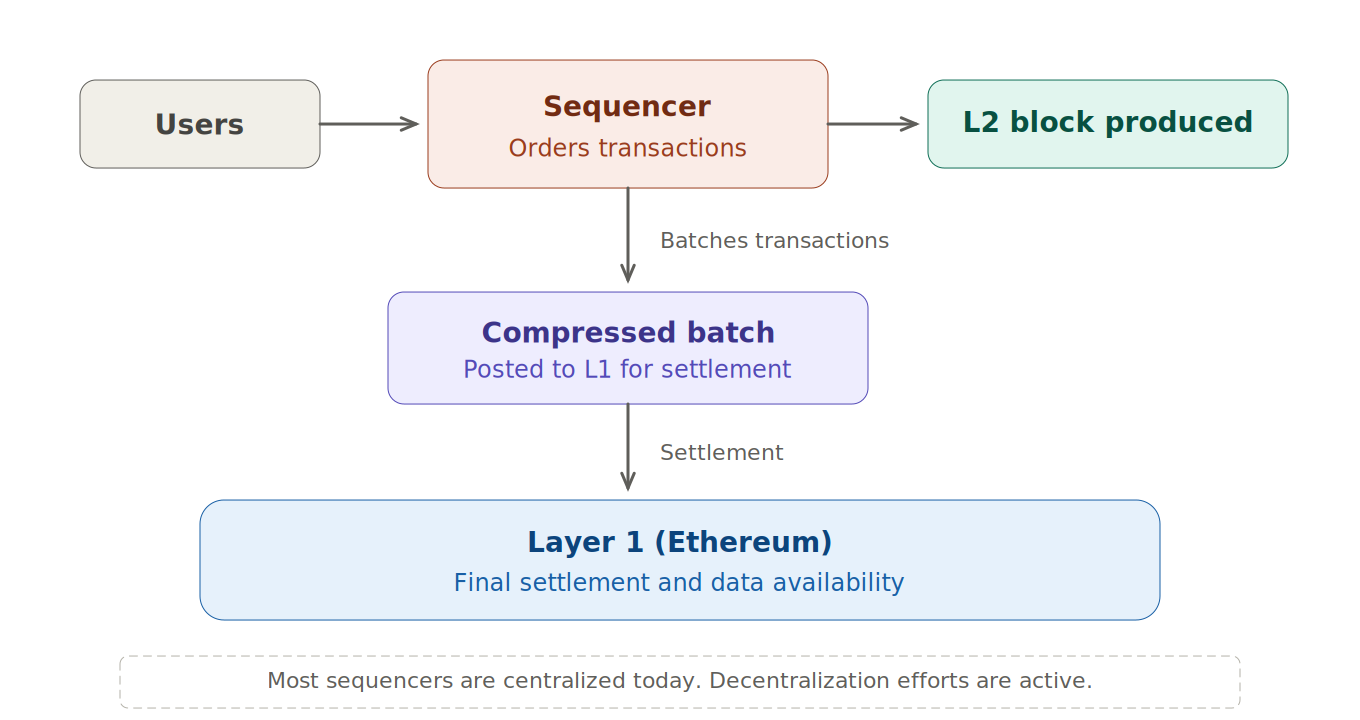
TL;DR: A sequencer is the entity responsible for ordering and executing transactions on a Layer 2 rollup. When users submit transactions to an L2, the sequencer receives them, determines their execution order, produces L2 blocks, and submits compressed batches to Layer 1 for final settlement. Most major rollups currently operate centralized sequencers: Offchain Labs runs Arbitrum's, Optimism Foundation runs Optimism's, and Coinbase runs Base's. While centralized sequencers provide fast, consistent performance, they introduce risks around censorship, MEV capture, and single points of failure. The ecosystem is actively developing shared sequencing, sequencer auctions, and distributed sequencer networks to decentralize this critical component.
The Simple Explanation
If a rollup is a law office that processes cases and files summaries at the courthouse, the sequencer is the office manager who decides what order to process the cases in, assigns them to the right departments, and handles the filing. The office manager is essential for keeping operations running smoothly, but having one person in that role means they have a lot of power over what gets processed and when.
On a Layer 2, the sequencer is the first point of contact for every transaction. When you submit a swap, a transfer, or a smart contract interaction on an L2, your transaction goes to the sequencer. The sequencer decides where your transaction sits in the queue, executes it, includes it in an L2 block, and eventually batches that block with others for submission to L1. The sequencer's ordering decision is what determines the final state of the L2.
How Sequencers Work
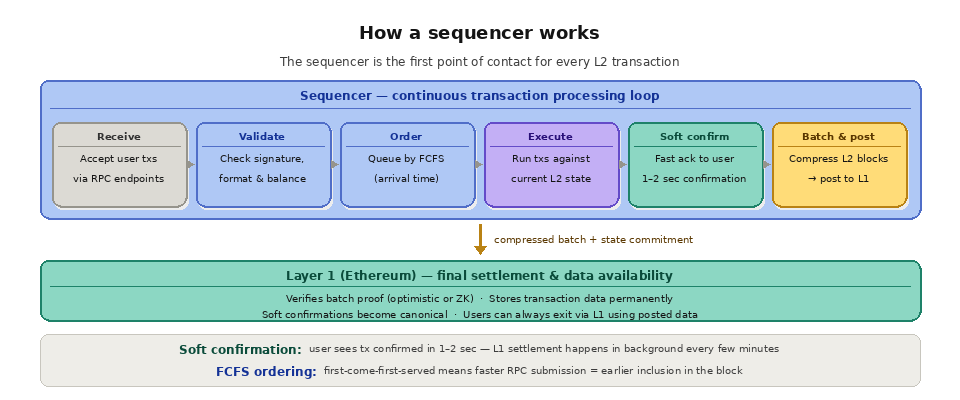
The sequencer operates in a continuous loop. It receives incoming transactions from users, typically through RPC endpoints. It validates that each transaction is properly formatted, has a valid signature, and the sender has sufficient balance. It determines the execution order, usually first-come-first-served (FCFS) based on arrival time, though the sequencer has discretion over ordering. It executes the ordered transactions against the current L2 state, producing a new L2 block. It provides users with a "soft confirmation," a fast acknowledgment that their transaction has been included in the L2 block. Periodically, it compresses multiple L2 blocks into a batch and posts the batch to L1 for final settlement.
The soft confirmation is what gives L2s their speed. Users see their transaction confirmed in 1-2 seconds (or less on some L2s) because the sequencer processes and confirms it immediately without waiting for L1 settlement. The L1 posting happens in the background, typically every few minutes, and provides the final, canonical settlement that inherits L1 security.
The Centralization Problem
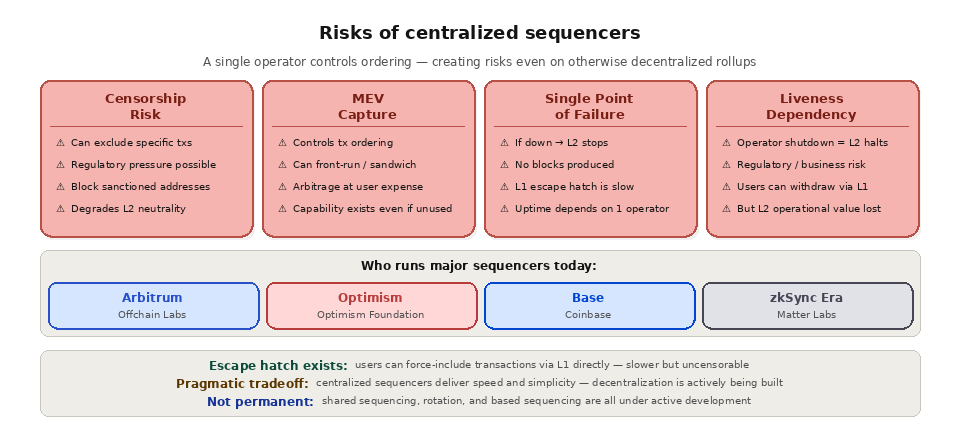
The centralized sequencer model used by most rollups today is a pragmatic engineering choice. A single, well-operated sequencer delivers consistent block times, predictable ordering, and low latency. It is simpler to build, operate, and debug than a decentralized alternative. But it introduces several concerns.
Censorship risk exists because a centralized sequencer can choose to exclude specific transactions. If the entity running the sequencer is subject to regulatory pressure, they might be compelled to block transactions from sanctioned addresses or involving specific protocols. Users are not permanently trapped (they can force-include transactions via L1, which is slower but uncensorable), but selective censorship at the sequencer level degrades the L2's neutrality.
MEV capture is possible because the sequencer controls transaction ordering. In theory, a centralized sequencer could reorder transactions to extract MEV (front-running, sandwich attacks, arbitrage) at the expense of users. In practice, most L2 sequencers order transactions on a FCFS basis and do not actively extract MEV, but the capability exists.
Single point of failure means that if the sequencer goes down, the L2 stops producing blocks. Users cannot transact on the L2 until the sequencer comes back online. While L1 forced inclusion provides an escape hatch, it is slower and more expensive than normal L2 operation.
Liveness depends entirely on the sequencer operator. If the operator decides to stop running the sequencer (due to business failure, regulatory action, or any other reason), the L2 stops functioning as a fast chain. Users can still withdraw to L1 using the data posted on-chain, but the L2's operational value is lost.
Decentralization Efforts
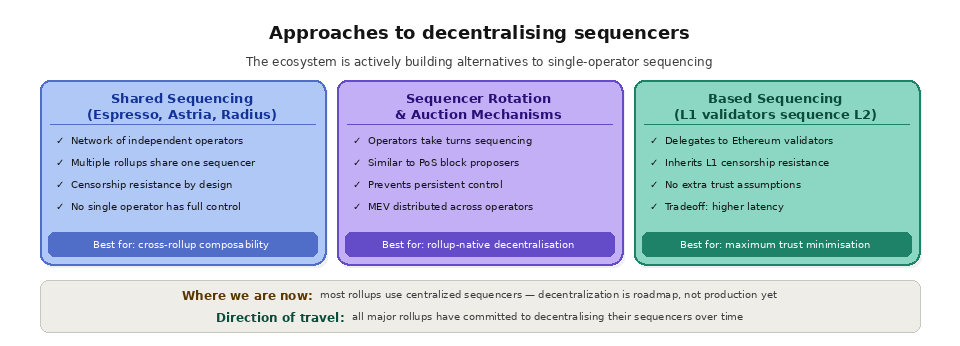
The rollup ecosystem is actively working to decentralize sequencers through several approaches.
Shared sequencing networks (like Espresso, Astria, and Radius) aim to provide a decentralized sequencer service that multiple rollups can share. Instead of each rollup running its own centralized sequencer, a network of independent operators takes turns sequencing transactions, providing censorship resistance and liveness guarantees.
Sequencer rotation mechanisms assign sequencing duties to different operators on a rotating basis, similar to how PoS validators take turns proposing blocks. This prevents any single operator from maintaining persistent control over ordering.
Based sequencing delegates sequencing to the L1 validators themselves, leveraging Ethereum's existing decentralized validator set to order L2 transactions. This inherits L1's censorship resistance but may introduce higher latency.
How Quicknode Fits In
Quicknode provides the RPC infrastructure that applications use to submit transactions to L2 sequencers and read the resulting state. Low-latency RPC access is especially important for L2s where sequencers process transactions on a FCFS basis, because faster submission means earlier inclusion. Quicknode's Core API supports all major L2 networks with globally distributed endpoints, and Quicknode Streams provides real-time data streaming from L2 chains for monitoring sequencer behavior, batch postings, and L1 settlement events.
Centralized vs decentralized sequencers
Most rollups run a single centralized sequencer today, but the ecosystem is moving toward decentralized models. The table below compares the two approaches.
Centralized sequencer
Decentralized or shared sequencer
Who orders transactions
A single operator such as Offchain Labs, OP Foundation, or Coinbase
A rotating set or network of independent operators
Censorship resistance
Weak, the operator can exclude transactions
Strong, no single party controls ordering
Liveness
Single point of failure
Survives individual operator downtime
Latency
Very low and consistent
Slightly higher due to coordination
Examples
Arbitrum, Optimism, Base today
Espresso, Astria, Radius, based sequencing
Can you bypass a sequencer?
Yes. Rollups include a force inclusion mechanism that lets users submit transactions directly to Layer 1 when the sequencer censors or ignores them. This is slower and more expensive than normal Layer 2 submission, but it guarantees that no centralized sequencer can permanently block a user. It is the escape hatch that keeps a rollup trust-minimized even while its sequencer is centralized.
Frequently Asked Questions
What does a sequencer do?
A sequencer receives transactions submitted to a Layer 2, decides their execution order, produces L2 blocks, gives users a fast soft confirmation, and periodically posts compressed batches to Layer 1 for final settlement.
Are rollup sequencers centralized?
Most are today. Arbitrum, Optimism, and Base each run a single operator-controlled sequencer. This delivers low, consistent latency but creates censorship, liveness, and single-point-of-failure risks that decentralization efforts aim to remove.
What is a shared sequencer?
A shared sequencer is a decentralized network of operators that orders transactions for multiple rollups at once. Projects like Espresso, Astria, and Radius provide censorship resistance and liveness that a single centralized sequencer cannot.
Can a sequencer reorder my transaction for MEV?
In principle yes, because the sequencer controls ordering it could front-run or sandwich transactions to capture MEV. In practice most rollups order on a first-come-first-served basis and do not extract MEV, but the capability is one reason decentralized sequencing matters.
What happens if the sequencer goes offline?
The L2 stops producing new blocks until the sequencer restarts. Funds remain safe because all data is posted to Layer 1, and users can force-withdraw through L1, but normal fast L2 activity pauses during the outage.