Answers>Learn about Layer 2s & rollups>What is a rollup?
What is a rollup?
// Tags
what is a rollupblockchain rollup
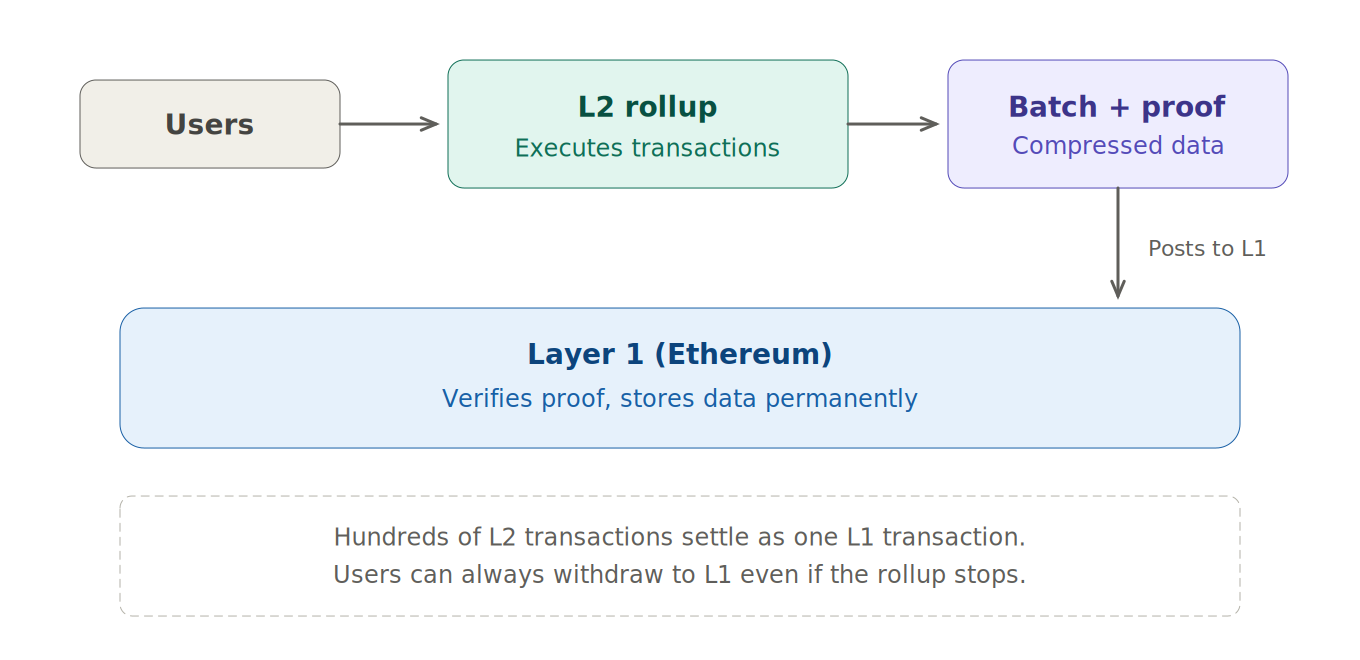
TL;DR: A rollup is a Layer 2 scaling solution that executes transactions on a separate chain and then "rolls up" hundreds or thousands of them into a single compressed batch that is submitted to Layer 1 for verification and permanent storage. The rollup handles the heavy lifting of transaction execution, while the L1 provides security by verifying proofs and storing transaction data. This architecture delivers dramatically higher throughput and lower fees while inheriting the security guarantees of the underlying L1. The two main types are optimistic rollups (which assume transactions are valid unless challenged) and ZK rollups (which provide cryptographic proofs of correctness).
The Simple Explanation
Think of a rollup like a teacher grading exams. Instead of the principal (L1) grading every single exam individually, the teacher (rollup) grades them all, compiles the results into a summary report, and submits the report to the principal for verification. The principal checks that the report is accurate (either by trusting the teacher unless someone objects, or by verifying a mathematical proof), then files it as the official record. The principal only needs to review one summary instead of hundreds of individual exams, dramatically reducing the workload.
In blockchain terms, users submit transactions to the rollup. The rollup executes them, computes the resulting state changes, compresses everything into a batch, and posts the batch to L1 along with either a fraud proof mechanism (optimistic) or a validity proof (ZK). The L1 verifies the batch and stores it permanently. One L1 transaction now represents hundreds or thousands of L2 transactions.
How Rollups Work Under the Hood
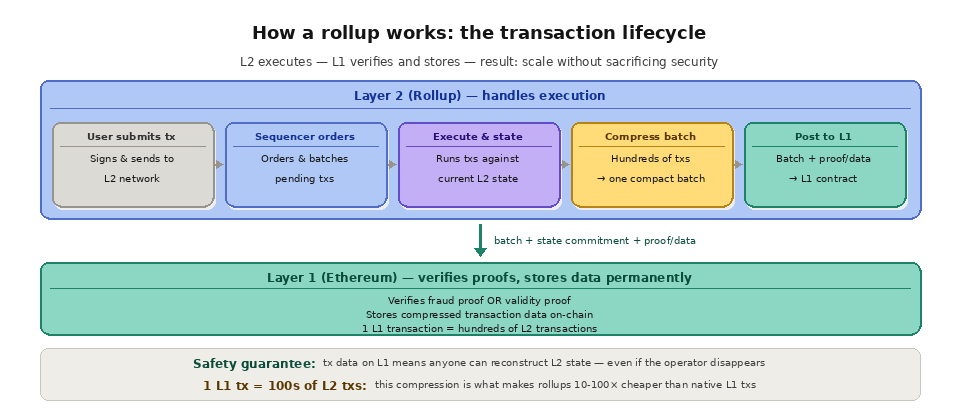
The rollup lifecycle follows a clear sequence. Users submit transactions to the L2 network, where they are picked up by the rollup's sequencer. The sequencer orders the transactions, executes them against the current state, and produces L2 blocks. Periodically, the sequencer compresses a batch of L2 blocks into a compact representation and posts it to the L1 chain.
The batch posted to L1 contains two critical components: the transaction data (or a compressed version of it) and a state commitment (the claimed result of executing those transactions). The transaction data is essential because it allows anyone to independently reconstruct the L2 state. This is the safety guarantee: even if the rollup operator disappears, anyone can read the data from L1 and compute the correct state.
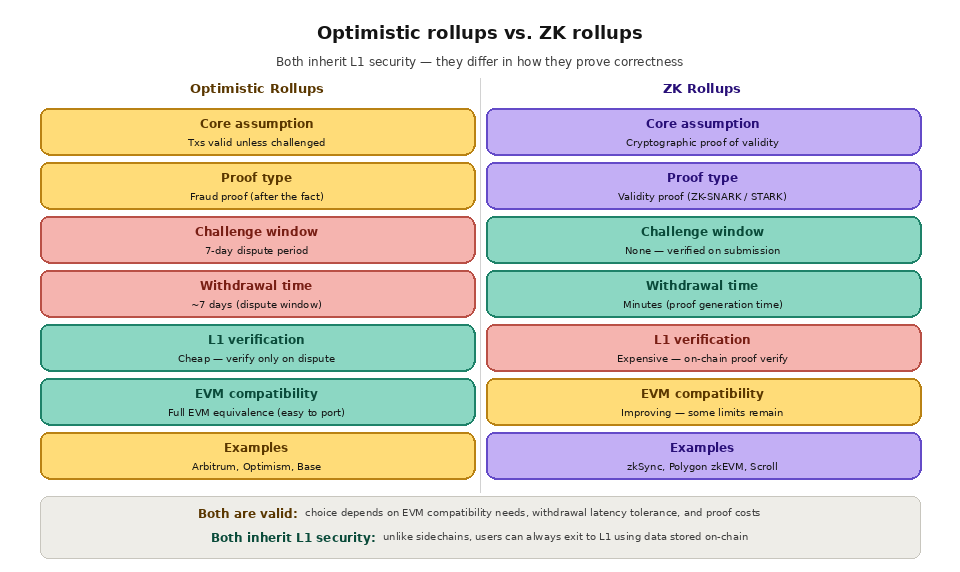
For optimistic rollups, the state commitment is assumed correct unless someone challenges it during a dispute period (typically 7 days). If a challenger proves the commitment is wrong by submitting a fraud proof, the incorrect batch is reverted. For ZK rollups, the state commitment is accompanied by a validity proof, a cryptographic proof that the state transition was computed correctly. The L1 smart contract verifies this proof on-chain, providing immediate mathematical certainty.
Why Rollups Are the Dominant Scaling Strategy
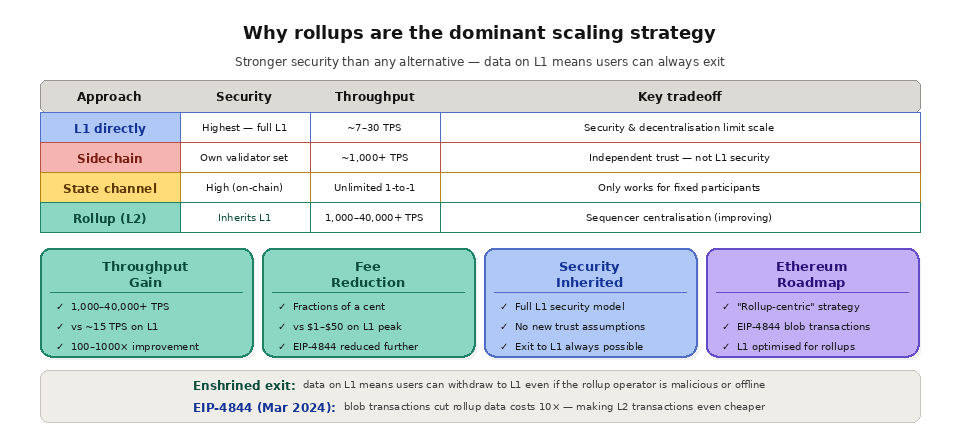
Rollups have become the dominant L2 architecture because they provide the strongest security guarantees of any scaling approach. Unlike sidechains, which have their own independent validator sets, rollups inherit their security entirely from L1. The transaction data posted to L1 means users can always exit to L1, even if the rollup operator is malicious or offline. This "enshrined exit" property is what makes rollups trustworthy for high-value applications.
Ethereum's roadmap has explicitly adopted a "rollup-centric" scaling strategy. Rather than increasing L1 throughput directly (which would compromise decentralization), Ethereum is optimizing L1 to be the best possible data availability and settlement layer for rollups. EIP-4844 (Proto-Danksharding), deployed in March 2024, introduced blob transactions that dramatically reduced the cost of posting data to L1, making rollup transactions even cheaper.
How Quicknode Supports Rollups
Quicknode provides native infrastructure for all major rollup networks, including Arbitrum, Optimism, Base, zkSync, StarkNet, Scroll, and Polygon zkEVM. Each rollup is accessible through Quicknode's standard RPC interface with full and archive data access. Quicknode Streams supports real-time and historical data streaming from rollup networks, enabling developers to build the same data pipelines and indexing infrastructure on L2 that they use on L1.
Optimistic vs ZK rollups: what is the difference?
The two dominant rollup designs differ in how they convince Layer 1 that their batches are valid. Optimistic rollups assume validity and allow challenges, while ZK rollups prove validity up front. See our deeper comparison of optimistic vs ZK rollups for details.
Dimension
Optimistic rollup
ZK rollup
Validity model
Assumed valid unless a fraud proof challenges it
Every batch ships with a validity proof
Withdrawal to L1
Slow, after a dispute window of about 7 days
Fast, once the proof is verified
Proving cost
Low, proofs only generated during disputes
Higher, a proof is generated for every batch
EVM compatibility
Mature and straightforward
Improving quickly with zkEVMs
Examples
Arbitrum, Optimism, Base
zkSync, StarkNet, Scroll, Polygon zkEVM
How is a rollup different from a sidechain?
A rollup posts its transaction data and state commitments to Layer 1 and inherits L1 security, so users can always exit even if the operator misbehaves. A sidechain runs its own independent consensus and validator set, so its security is only as strong as that separate network. This is why rollups are considered Layer 2 solutions while sidechains are not. The sequencer that orders rollup transactions is also constrained by L1, unlike a sidechain validator set.
Are rollups secure?
Yes, when they post data to Layer 1. Because the transaction data lives on L1, anyone can reconstruct the rollup state and force a withdrawal, which is the property that makes rollups trust-minimized. The main caveats are centralized sequencers and, for optimistic rollups, the delay before a withdrawal reaches finality on L1.
Frequently Asked Questions
What is a rollup in simple terms?
A rollup is a Layer 2 chain that executes many transactions off the main chain, compresses them into a single batch, and posts that batch to Layer 1. Users get faster, cheaper transactions while still relying on L1 for security and data availability.
What are the two main types of rollups?
Optimistic rollups, which assume batches are valid unless challenged with a fraud proof, and ZK rollups, which attach a cryptographic validity proof to every batch. Optimistic rollups are simpler and more EVM-compatible today, while ZK rollups offer faster finality and withdrawals.
Why does Ethereum rely on rollups?
Ethereum adopted a rollup-centric roadmap because scaling Layer 1 directly would weaken decentralization. Instead, Ethereum optimizes itself as a data availability and settlement layer, and rollups handle execution. EIP-4844 blob transactions made posting rollup data far cheaper.
How long do rollup withdrawals take?
ZK rollup withdrawals can complete in minutes to hours once the validity proof is verified on Layer 1. Optimistic rollup withdrawals typically take about 7 days because of the fraud-proof challenge window, although third-party bridges can offer faster exits for a fee.
Which networks are rollups?
Major rollups include Arbitrum, Optimism, and Base (optimistic) and zkSync, StarkNet, Scroll, and Polygon zkEVM (ZK). All of them settle to Ethereum and are accessible through standard RPC infrastructure.