Answers>Learn about Layer 2s & rollups>What is a Layer 2 blockchain?
What is a Layer 2 blockchain?
// Tags
Layer 2 blockchainL2what is L2
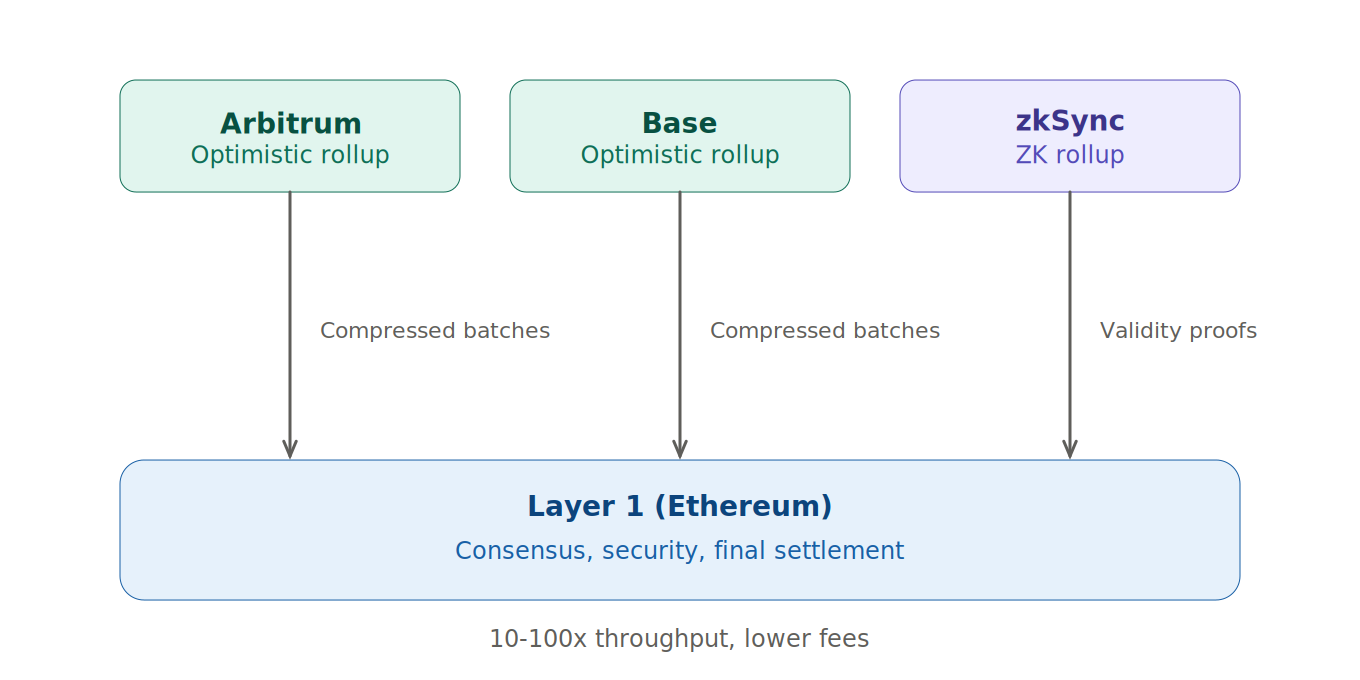
TL;DR: A Layer 2 (L2) blockchain is a separate network that operates on top of a Layer 1 chain like Ethereum, inheriting its security while dramatically improving scalability. L1 networks have limited capacity (Ethereum processes roughly 30 transactions per second), so L2s execute transactions off the main chain and periodically settle compressed results back to L1. This architecture delivers 10-100x greater throughput and significantly lower fees. The most prevalent type of L2 is the rollup, including optimistic rollups (Arbitrum, Optimism, Base) and zero-knowledge rollups (zkSync, StarkNet). Layer 2 scaling has become the dominant strategy for expanding blockchain capacity without sacrificing the security and decentralization of the base layer.
The Simple Explanation
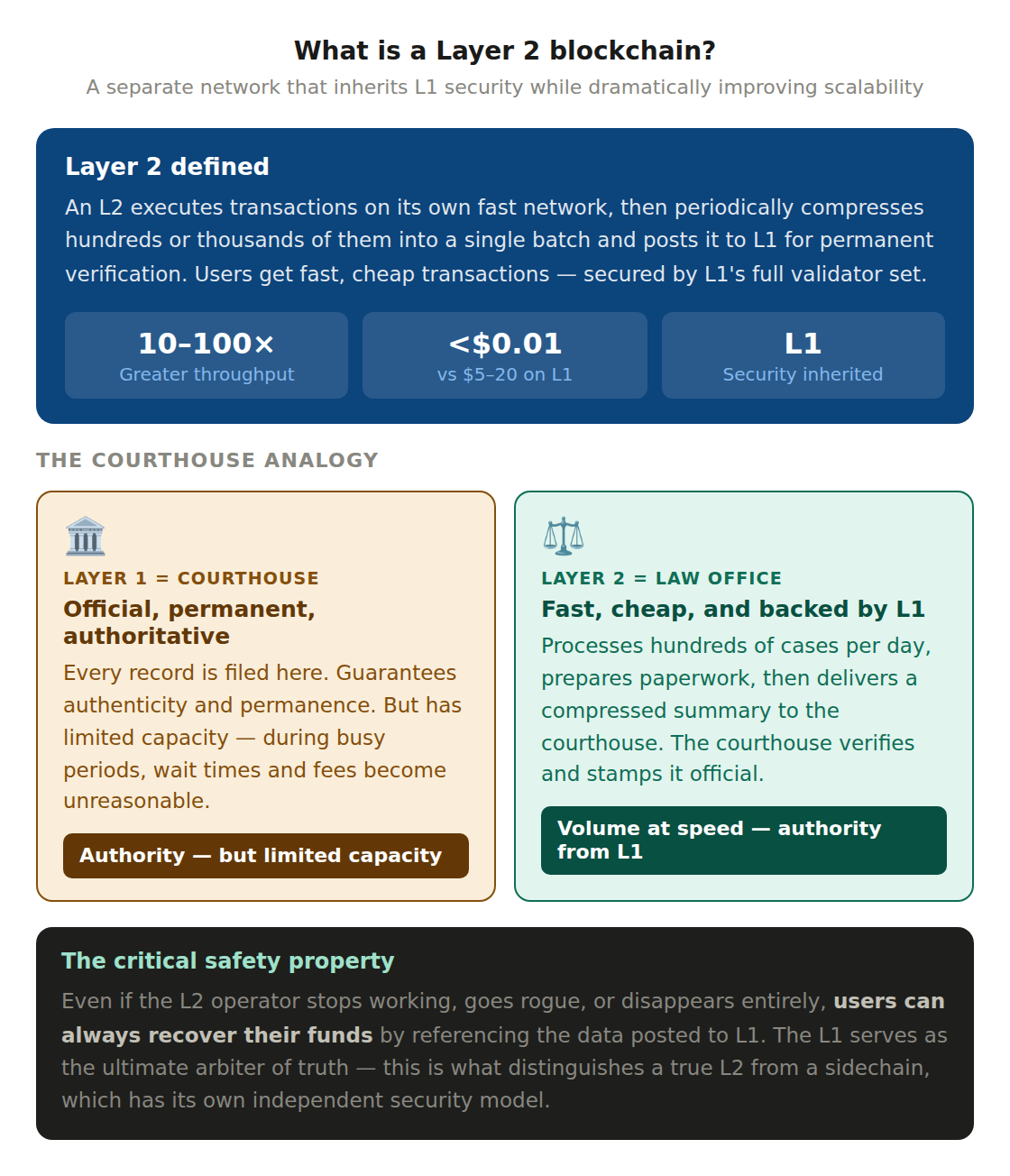
Think of a Layer 1 blockchain like a courthouse. Every official record gets filed there, and the courthouse guarantees the records are authentic and permanent. But the courthouse has limited capacity. It can only process so many filings per day, and during busy periods, the wait time and filing fees become unreasonable.
A Layer 2 is like a law office that operates outside the courthouse but files its final records there. The law office processes hundreds of cases per day (much faster than the courthouse), prepares all the paperwork, and periodically delivers a compressed summary of its completed work to the courthouse for official recording. The courthouse verifies the summary is correct and stamps it as official. The law office handles the volume; the courthouse provides the authority.
In blockchain terms, the L2 processes transactions quickly and cheaply on its own network. Periodically, it compresses hundreds or thousands of those transactions into a single batch and posts it to the L1, where it is verified and stored permanently. Users get fast, cheap transactions on the L2 while their data is ultimately secured by the L1's full validator set.
How Layer 2s Work
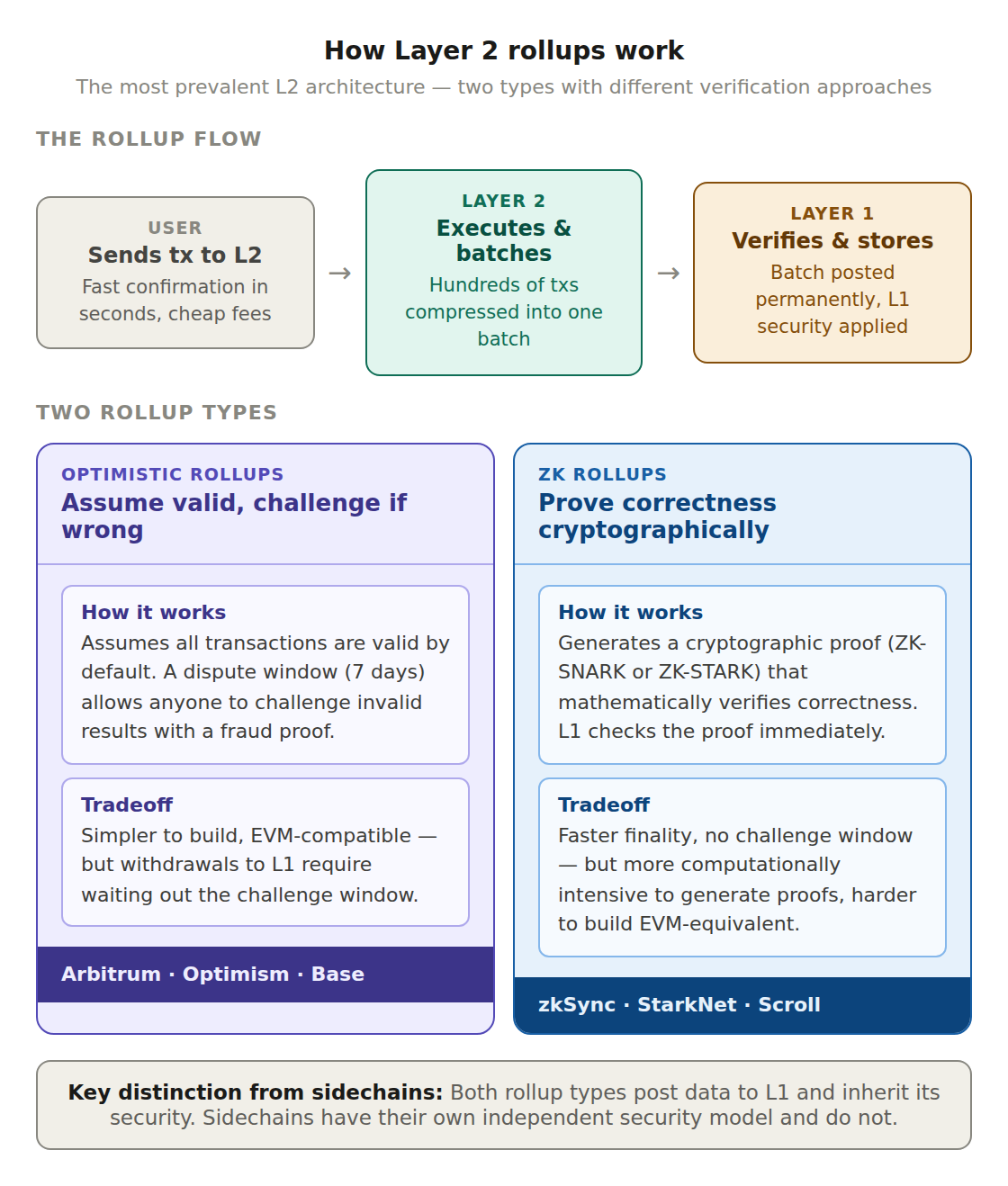
The core mechanism of a Layer 2 is execution separation. The L2 executes transactions on its own chain, using its own block production infrastructure. Users interact with the L2 as if it were an independent blockchain: they send transactions, interact with smart contracts, and see confirmations in seconds. The key difference is that the L2 does not maintain its own independent security. Instead, it regularly posts proofs or compressed data back to the L1, anchoring its state to the L1's security guarantees.
This posting creates a critical safety property: even if the L2 operator stops working, goes rogue, or disappears entirely, users can always recover their funds by referencing the data posted to L1. The L1 serves as the ultimate arbiter of truth. This is what distinguishes a true L2 from a sidechain, which has its own independent security model and does not inherit security from L1.
The most common L2 architecture is the rollup, which comes in two varieties. Optimistic rollups (Arbitrum, Optimism, Base) assume transactions are valid by default and only verify them if someone challenges the result during a dispute window. ZK rollups (zkSync, StarkNet, Scroll) generate cryptographic proofs that mathematically verify correctness, which L1 checks immediately.
Why Layer 2s Matter
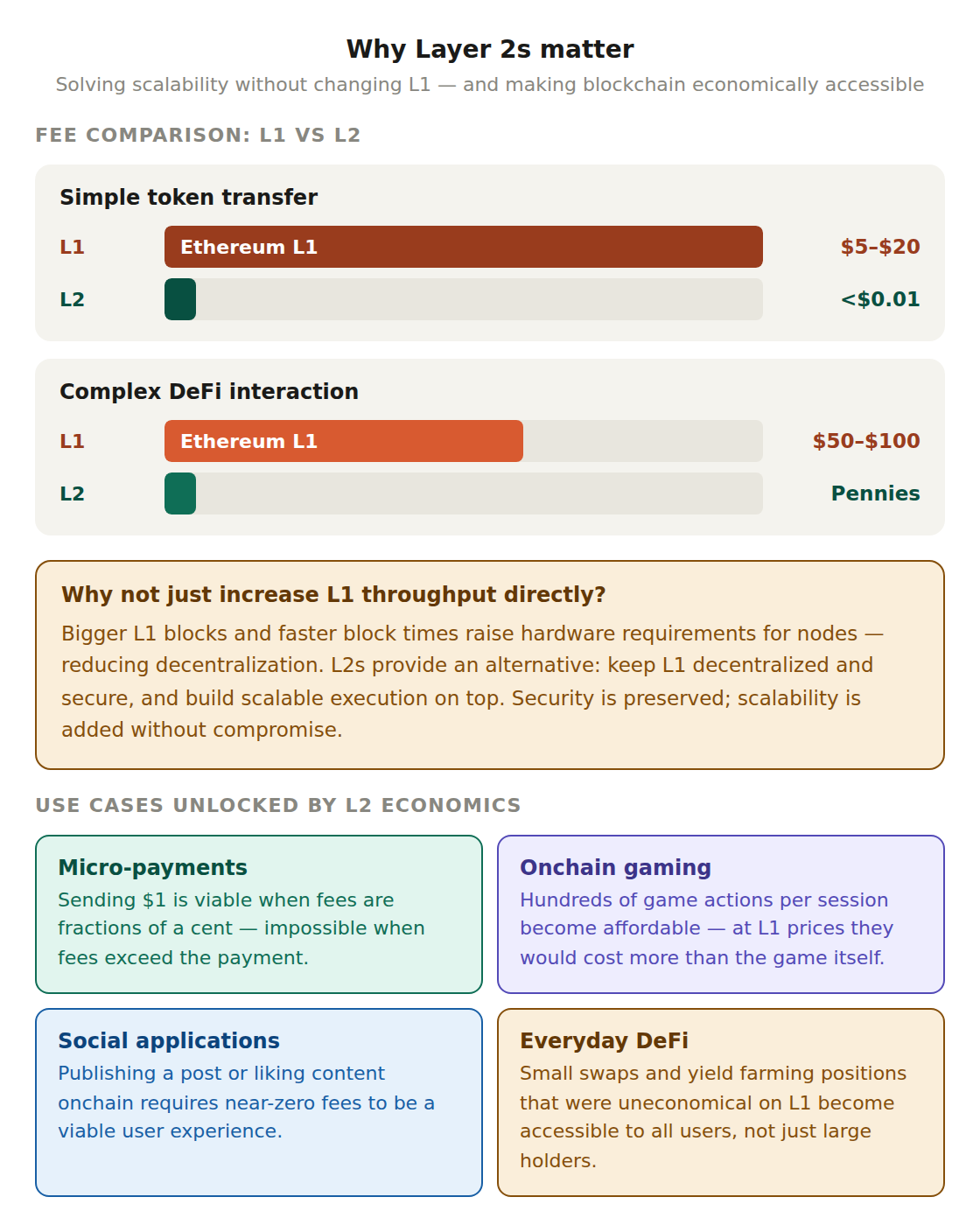
Layer 2s solve the scalability problem without requiring changes to L1. Increasing Ethereum's L1 throughput directly (bigger blocks, faster block times) would raise hardware requirements for nodes, reducing decentralization. L2s provide an alternative: keep L1 decentralized and secure, and build scalable execution on top.
The economic impact is significant. A simple token transfer that costs $5-20 on Ethereum L1 during congestion typically costs less than $0.01 on an L2. Complex DeFi interactions that cost $50-100 on L1 cost pennies on L2. This fee reduction makes blockchain usable for everyday transactions, micro-payments, gaming, and social applications that would be prohibitively expensive on L1.
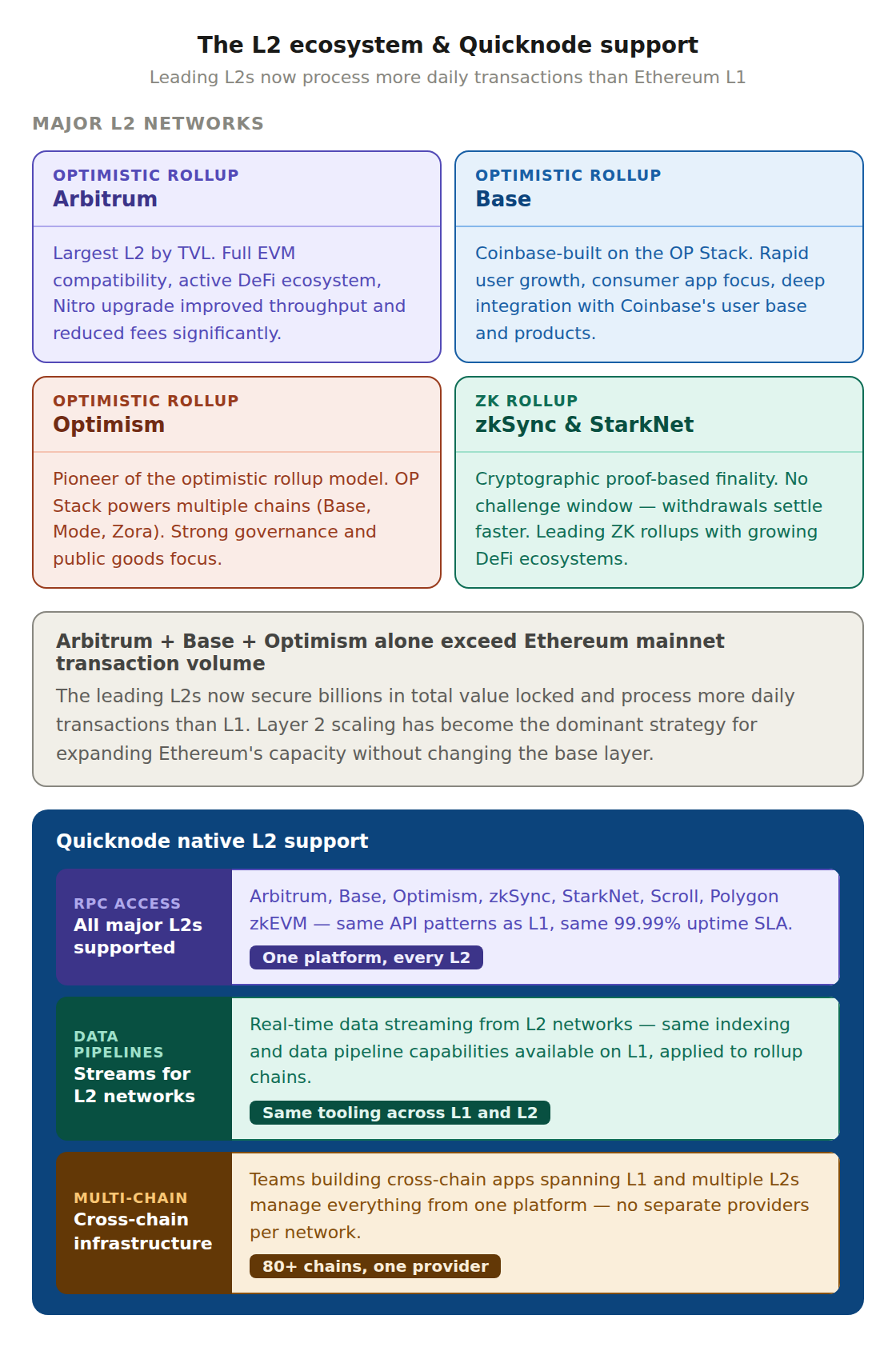
The leading L2s now process more transactions per day than Ethereum L1 and secure billions of dollars in total value locked. Arbitrum, Base, and Optimism alone handle a combined transaction volume that exceeds Ethereum mainnet.
What is the difference between Layer 1 and Layer 2?
Layer 1 is the base blockchain that provides security and final settlement, while Layer 2 is a faster execution network built on top of it. The table below contrasts the two layers across the dimensions that matter most to builders and users.
Aspect
Layer 1
Layer 2
Role
Base settlement layer
Execution layer on top of L1
Security
Its own validator set
Inherited from L1
Throughput
Limited, about 30 TPS on Ethereum
10 to 100 times higher
Fees
Higher
Much lower
Examples
Ethereum, Bitcoin
Arbitrum, Optimism, Base
In short, the blockchain at Layer 1 acts as the trust anchor, and the Layer 2 borrows that trust while doing the heavy lifting of execution. This division of labor is what lets a network scale without weakening its base layer.
What are the main types of Layer 2 scaling solutions?
Not all Layer 2s work the same way. They differ in how they prove that off-chain activity is valid and where they store transaction data. The table below summarizes the most common designs.
Type
How it secures funds
Examples
Main tradeoff
Optimistic rollup
Fraud proofs with a challenge window
Arbitrum, Optimism, Base
Slower withdrawals to L1
ZK rollup
Validity proofs verified on L1
zkSync, StarkNet, Scroll
Proof generation is compute-heavy
Validium
Validity proofs, off-chain data
StarkEx-based apps
Weaker data availability
State channel
Off-chain signed updates
Payment channels
Limited to fixed participants
Rollups dominate today. For a deeper look at how they batch and settle transactions, see what is a rollup, and for the two leading proof models compare optimistic vs ZK rollups.
How do Layer 2 transaction fees work?
An L2 fee has two parts: a small execution fee paid on the L2 itself, and a share of the cost to post batched data back to L1. Because hundreds of transactions share a single L1 batch, the per-transaction cost drops sharply. When the base layer is busy, L2 fees can rise too, since posting data competes for L1 block space. This is why blockchain congestion on L1 still influences L2 pricing, and why throughput and latency both shape the user experience.
Is a Layer 2 as secure as Layer 1?
A well-designed rollup inherits L1 security for the integrity of its data, because anyone can reconstruct L2 state from the data posted to L1. The main differences are around liveness and timing. Most L2s rely on a single sequencer to order transactions, which is a centralization point, and withdrawals to L1 may wait for a challenge window or proof to settle. Understanding the sequencer role and L2 finality helps you judge how settled an L2 transaction really is.
Frequently Asked Questions
Is Layer 2 a separate blockchain?
Yes and no. An L2 runs its own execution environment and produces its own blocks, so it behaves like a separate chain, but it does not stand alone. It anchors its state to a Layer 1 by posting data or proofs there, which is what lets it borrow the base layer's security.
Why are Layer 2 transactions cheaper?
L2s batch many transactions together and post a single compressed summary to L1, so the expensive L1 settlement cost is shared across hundreds of transactions. Execution happens on cheaper L2 infrastructure, which is why a transfer that costs dollars on L1 can cost a fraction of a cent on L2.
Is a Layer 2 the same as a sidechain?
No. A sidechain has its own independent security model and validator set, so funds depend on the sidechain's own security. A true L2 inherits security from L1 by posting data there, meaning users can recover funds from L1 even if the L2 operator disappears.
What are the most popular Layer 2 networks?
The largest Ethereum L2s by activity and value include Arbitrum, Base, and Optimism among optimistic rollups, and zkSync, StarkNet, and Scroll among ZK rollups. Together they process more transactions per day than Ethereum mainnet.
Can I use the same wallet on a Layer 2?
Usually yes. EVM-compatible L2s like Arbitrum, Base, and Optimism use the same address format as Ethereum, so a standard wallet works once you add the L2 network and point it at an RPC endpoint for that chain.
How Quicknode Supports Layer 2s
Quicknode provides native RPC support for all major Layer 2 networks, including Arbitrum, Base, Optimism, zkSync, StarkNet, Scroll, Polygon zkEVM, and others. Developers access L2s through the same platform and API patterns they use for L1, with the same 99.99% uptime SLAs and globally distributed infrastructure. Quicknode Streams supports real-time data streaming from L2 networks, enabling the same indexing and data pipeline capabilities available on L1. For teams building cross-chain applications that span L1 and multiple L2s, Quicknode's multi-chain platform eliminates the need to manage separate infrastructure providers for each network.