
🤖 NEW: Quicknode AI Cookbook 10 tested recipes for AI coding agents.
See recipesSOC 2 Type II Certified · ISO 27001
Sponsored Transactions on Hedera, in Production
Sponsored Transactions on Hedera are live on Quicknode. Pay gas for your users with native paymaster support in the Hiero relay.
May 19, 2026 — 5 min read
Consumer apps die at the gas step. Users sign up, reach the wallet prompt, see "approve gas fee," and leave. For years, onchain teams have worked around this with custom relayers, offchain signers, and fragile in-house infrastructure that's costly to build and harder to run.
Quicknode and Hedera are removing that step. Hedera built native paymaster support into its JSON-RPC relay, and Quicknode runs it in production. It's the first production deployment of Hedera's multi-paymaster relay feature, which shipped in Hiero JSON-RPC Relay v0.75.
"Consumer apps don't fail because of the chain, they fail at the gas prompt. Every team building on Hedera has come in asking the same question: how do we get the wallet out of the user's way? Sponsored transactions on Quicknode are the answer."
Dmitry Shklovsky, Co-Founder, Quicknode
Sponsored Transactions let you pay gas for your users from a funded HBAR wallet, against a whitelist of contracts you control. No bundler infrastructure. No custom relayer. No off-chain signing service.
It runs on Hedera's native paymaster support in the Hiero JSON-RPC Relay, deployed and operated by Quicknode across mainnet and testnet. You bring the HBAR. We run the relay.
Hedera processes transactions in 3 seconds with fixed, predictable fees. The chain itself is already a good fit for consumer applications. Gas sponsorship was the missing piece.
On EVM chains, account abstraction gets the same result through ERC-4337: bundlers, paymasters, and smart contract wallets. Hedera takes a different path and builds sponsorship directly into the JSON-RPC relay. There's no bundler, no EntryPoint contract, and no UserOps. Just standard EVM transactions, with someone else paying the gas.
No Gas Prompts for End Users: Users sign transactions without holding HBAR. They never see a gas prompt, never bridge, and never top up.
Per-Contract Whitelisting: You control which contracts get sponsored. Per-contract whitelist, per-account spending caps, no general-purpose gas drain.
Fully Managed Relay: Quicknode runs the relay, applies the whitelist, and submits signed transactions to Hedera.
BitGo Custody: Your sponsor wallet stays in your BitGo custody. Quicknode never holds the keys to your HBAR account.
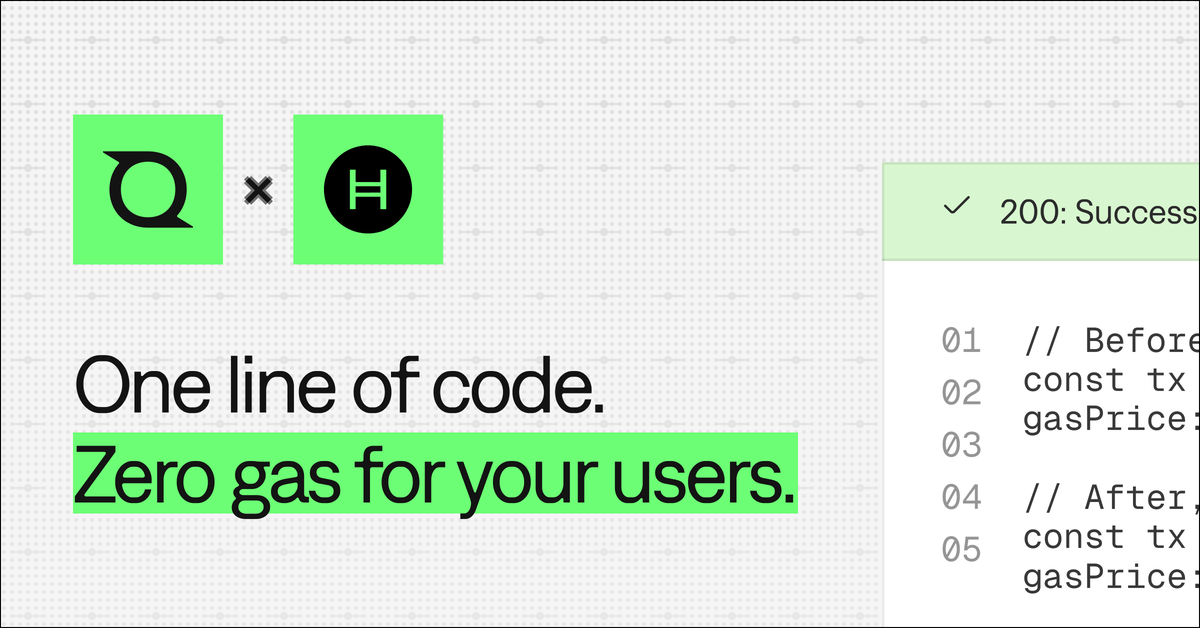
One-Line Integration: No SDK migration, no new wallet flow, no new signing pattern. Set gasPrice: 0 and the relay handles the rest.
Mainnet and Testnet Support: Available across both networks with low-latency routing from Quicknode's global infrastructure.
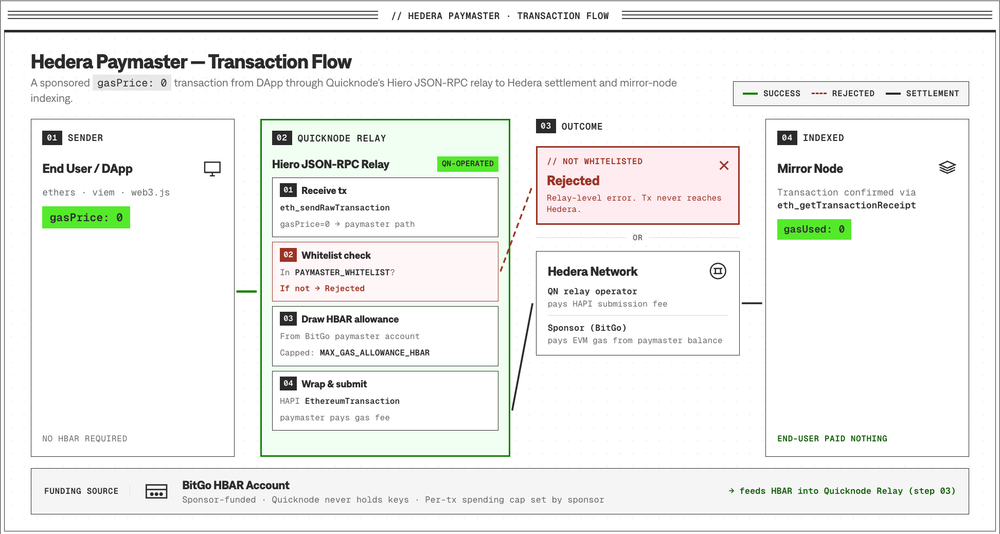
Three components do the work, with custody you control:
Your Sponsor-Funded HBAR Account: Custodied in BitGo. You top it up and set the spending cap. Quicknode never holds the keys to your sponsor wallet.
The Quicknode-Operated Hiero JSON-RPC Relay: Matches each incoming transaction against the contracts you've whitelisted and draws the gas fee from your BitGo-custodied HBAR account.
Hedera Settlement: The network settles the transaction with the gas paid by your wallet, not the end user's.
If you already build on Hedera EVM, integration is a one-line change:
// Before
const tx = await contract.mint(tokenId, { gasPrice: ethers.parseUnits("1", "gwei") })

// After, paymaster pays
const tx = await contract.mint(tokenId, { gasPrice: 0 })
Setting gasPrice to 0 is the signal. The relay checks that your contract is on the whitelist, takes the gas fee from your BitGo-custodied HBAR account, and submits the transaction. It works with standard ethers, Viem, or web3.js code, with one parameter changed.
"Hedera's paymaster support in the Hiero JSON-RPC Relay lets production teams sponsor gas at scale without running their own relayer infrastructure. Quicknode is the first major RPC provider to expose it as a managed, productized offering, and we're seeing real demand from teams who don't want to run that layer themselves."
Kiran Pachhai, Developer Advocate, Hashgraph
Branded NFT Drops: Large-IP brands running seasonal mint campaigns where end users mint without ever touching HBAR.
Consumer Onboarding Flows: Apps abstracting the wallet experience entirely behind email or social login.
Marketplace Transactions: Secondary trades where the marketplace operator sponsors gas to remove friction.
Agentic Payment Flows: Automated systems and AI agents transacting at machine speed without managing gas balances.
What these have in common: teams building for users who aren't crypto natives, and who need the chain to disappear from the experience. It's the same trend driving account abstraction on EVM and gasless transactions on Solana through Kora. Quicknode now offers the same building block on Hedera, fully managed.
Enterprise SLAs: 99.99% uptime SLA on enterprise plans, backed by Quicknode's globally distributed infrastructure.
Fast Onboarding: Under 1 business day to whitelist a new contract or activate Sponsored Transactions on a new account.
Spending Controls: Per-account HBAR allowance caps so no single contract can drain your wallet.
Custody You Control: Sponsor wallet custodied in BitGo. You hold the keys, Quicknode never touches your HBAR account credentials.
Unified Dashboard: Manage Hedera alongside your other blockchain endpoints and Marketplace add-ons in a single interface.
Hedera Sponsored Transactions are available on Quicknode enterprise plans. If gas friction is hurting conversion for your consumer app, NFT drop, or other onchain product, this is the fastest way to remove it.
Founded in 2017, Quicknode deploys institutional-grade blockchain infrastructure for developers and enterprises. With 99.99% uptime and support for 75+ chains, teams build and scale onchain applications without compromise.
The latest engineering insights, product updates, and web3 news delivered straight to your inbox.