TL;DR: Blockchain finality is the point at which a transaction is considered permanently confirmed and cannot be reversed, altered, or removed from the ledger. Different blockchains achieve finality in different ways and at different speeds, ranging from seconds to minutes. Understanding finality is critical for developers building applications where the timing of confirmed transactions directly impacts user experience, security, and funds.
The Simple Explanation
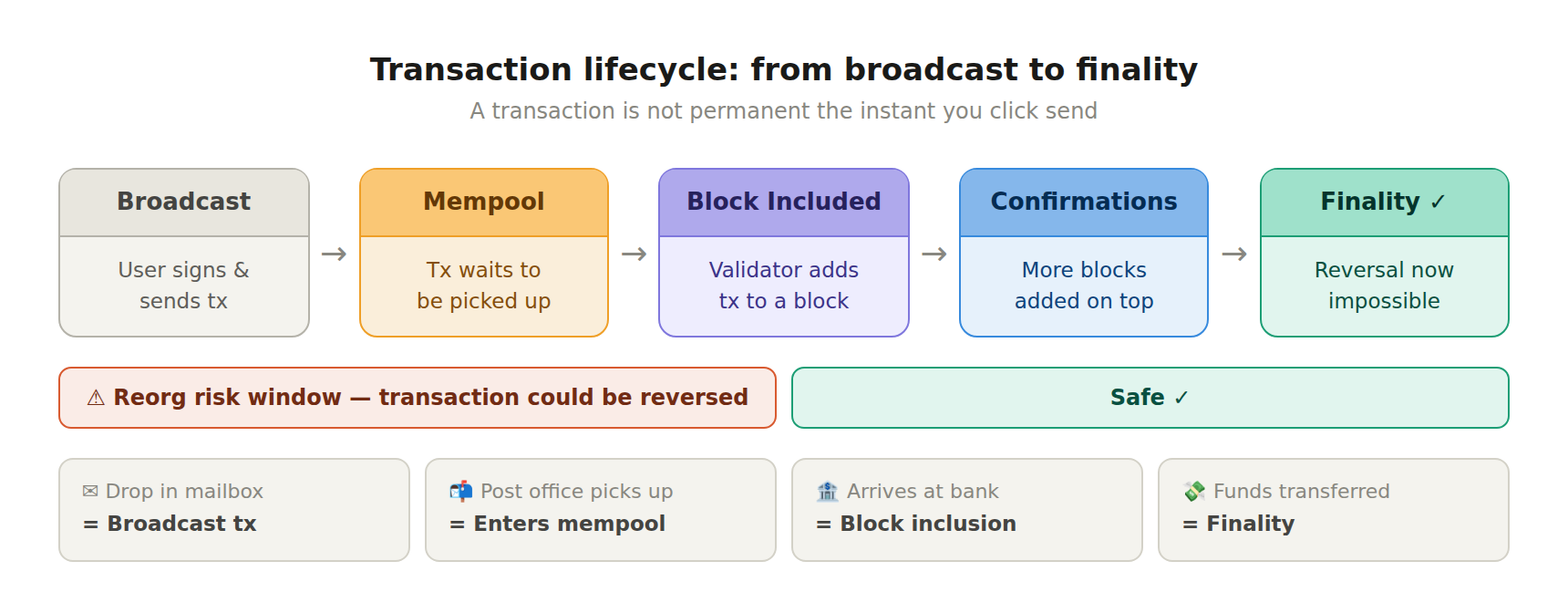
When you send a transaction on a blockchain, it does not become permanent the instant you click "send." The transaction enters the network, gets picked up by a validator or miner, and is included in a block. But even after it appears in a block, there is usually a window of time where the transaction could theoretically be reversed if the network reorganizes (known as a reorg). Finality is the moment that window closes.
Think of it like mailing a check. Dropping the check in the mailbox is like broadcasting your transaction. The post office picking it up is like the transaction entering the mempool. The check arriving at the bank is like block inclusion. But the payment is not truly final until the bank processes it and the funds are irreversibly transferred. Blockchain finality is that last step: the point where reversal becomes practically or mathematically impossible.
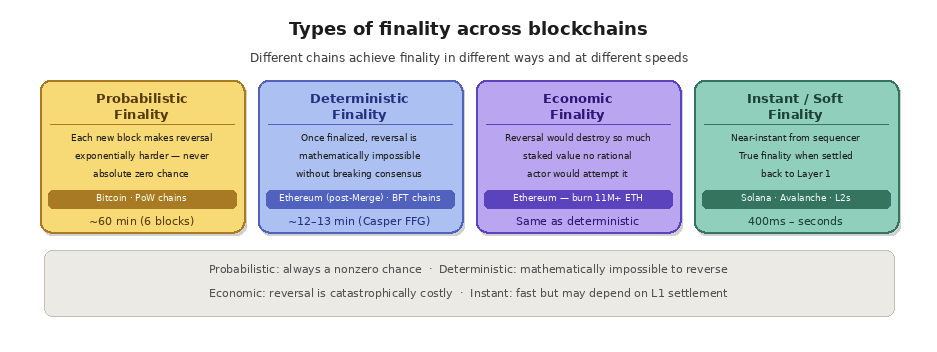
Different blockchains define this differently. Bitcoin uses probabilistic finality, where each additional block added on top of your transaction makes reversal exponentially harder. After six confirmations (roughly 60 minutes), a Bitcoin transaction is considered secure enough for most purposes. Ethereum, since its transition to Proof of Stake, achieves finality through a process called Casper FFG, where validator committees vote to finalize checkpoints roughly every 12-13 minutes. Once finalized, reversing those transactions would require attackers to burn at least one-third of all staked ETH, making it economically catastrophic. Solana achieves single-slot finality in roughly 400 milliseconds through its combination of Proof of History and Proof of Stake, with plans to push this below 150 milliseconds with the upcoming Alpenglow protocol upgrade.
Finality is produced by a blockchain's consensus mechanism. In Proof of Work, finality is probabilistic: miners extend the longest chain, and each added block makes reversing earlier blocks exponentially more expensive. In Proof of Stake and Byzantine Fault Tolerant (BFT) systems, validators attest to or vote on blocks, and once a supermajority (typically two-thirds of staked value) agrees, the block is finalized and reversing it would require destroying a catastrophic amount of stake. The consensus design is what determines whether a chain offers probabilistic, deterministic, or economic finality, and how quickly it gets there.
Types of Finality
There are several categories of finality that developers should understand. Probabilistic finality means a transaction becomes more secure with each new block added on top of it, but technically there is always a nonzero chance of reversal. Bitcoin and other Proof of Work chains use this model. The probability of reversal drops exponentially with each confirmation, but it never reaches absolute zero.
Deterministic (or absolute) finality means that once a transaction is finalized, it is mathematically impossible to reverse without breaking the consensus protocol itself. Proof of Stake chains like Ethereum (post-Merge) and many BFT-based chains achieve this. Once enough validators attest to a block and it reaches a finality checkpoint, it is permanent.
Economic finality is a closely related concept. Even on chains with deterministic finality, the real guarantee is economic: reversing a finalized transaction would require destroying so much staked value that no rational actor would attempt it. On Ethereum, this means burning over 11 million ETH (one-third of total staked ETH) to revert a finalized block.
Instant finality is what some newer chains and Layer 2 solutions aim for. Chains like Avalanche use a consensus mechanism where validators repeatedly sample each other's preferences and converge on a decision in seconds. Some Layer 2 rollups achieve near-instant "soft" finality from the sequencer's perspective, but true finality depends on when the rollup's proofs or data are settled back to Layer 1.
Probabilistic vs. deterministic finality
Finality models fall into two broad camps. Probabilistic finality grows stronger with each new block but never reaches absolute certainty, while deterministic finality guarantees irreversibility the moment a block is finalized by the consensus protocol. The table below summarizes the key differences.
Probabilistic finality
Deterministic finality
Consensus
Proof of Work
Proof of Stake or BFT
Reversal risk
Drops exponentially, never zero
Mathematically impossible once finalized
Confirmation
Wait for multiple blocks
Single finalization checkpoint
Example chains
Bitcoin, Litecoin, Dogecoin
Ethereum, Avalanche, BNB Smart Chain
Trade-off
Simple, slower certainty
Faster certainty, more complex consensus
What is Time to Finality (TTF)?
Time to Finality (TTF) is the total time from when a user submits a transaction until the network guarantees it cannot be reversed. It is measured from signing and broadcast through to the consensus checkpoint that makes the transaction permanent. TTF is the practical number developers care about, because it dictates how long a merchant, exchange, or bridge should wait before treating a transaction as settled. Lower TTF means faster, more responsive applications, but the right threshold to wait for depends on how much value is at stake.
Finality across major blockchains
Different chains reach finality through different consensus designs and at very different speeds. The table below summarizes how the most widely used networks settle transactions.
Blockchain
Consensus
Finality type
Approximate time to finality
Bitcoin
Proof of Work
Probabilistic
About 60 minutes (6 confirmations)
Ethereum
Proof of Stake (Casper FFG)
Deterministic and economic
About 12 to 13 minutes (2 epochs)
Solana
Proof of History and Proof of Stake
Optimistic, single-slot
Seconds today, targeting about 150 ms with Alpenglow
Avalanche
Snowman and Avalanche consensus
Deterministic
About 1 to 2 seconds
BNB Smart Chain
Proof of Staked Authority with fast finality
Deterministic
About 2 to 3 seconds
These numbers are approximate and evolve with protocol upgrades. Always confirm current finality guarantees against each network's official documentation before relying on them in production.
Quicknode provides both latest and finalized block data with low-latency RPC across Ethereum, Solana, BNB Smart Chain, and many other networks. For step-by-step tutorials on building with finalized data, see the Quicknode Builders Guide.
Finality vs. immutability
Finality and immutability are often used interchangeably, but they describe different things. Immutability means data, once written to the ledger, cannot be edited. Finality means the network has agreed that a transaction is permanent and will not be reorganized out of the chain. A block can be immutable in the sense that its contents are fixed, yet still be reversible if it gets orphaned during a reorg before finality. Finality is the guarantee that closes that window.
Why Finality Matters for Developers
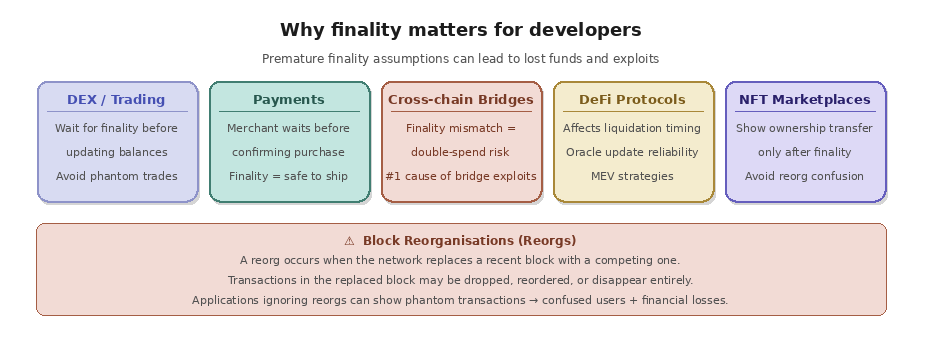
Finality directly impacts how you build your application. If you are building a decentralized exchange, you need to know when a trade is truly settled before updating balances. If you are building a bridge between two chains, premature finality assumptions can lead to double-spend attacks where a user withdraws funds on the destination chain before their deposit is truly confirmed on the source chain.
For payment applications, finality determines how long a merchant should wait before confirming a purchase. For DeFi protocols, it affects liquidation timing, oracle update reliability, and MEV (maximal extractable value) strategies. For NFT marketplaces, it determines when ownership transfers are safe to display. For cross-chain bridges, finality mismatches between source and destination chains are one of the leading causes of bridge exploits.
Block reorganizations (reorgs) are the practical consequence of weak finality. A reorg occurs when the network replaces a recently added block with a different one, usually because two validators produced competing blocks at similar times and the network needed to resolve the conflict. Transactions in the replaced block may be dropped or reordered. Applications that do not account for reorgs can show phantom transactions that later disappear, leading to confused users and potential financial losses.
How Quicknode Handles Finality
Quicknode's infrastructure is designed with finality awareness built in. Quicknode Streams delivers blockchain data in finality order with built-in reorg handling, ensuring your application receives consistent, reliable data even during network reorganizations. Instead of polling for block confirmations and manually tracking reorgs, Streams guarantees exactly-once delivery of finalized blocks, receipts, and traces. This makes it significantly easier to build applications that depend on confirmed state rather than optimistic assumptions.
Quicknode's Core API also provides access to both latest and finalized block data across supported networks, letting you choose the confirmation level appropriate for your use case. Whether you need the speed of latest block data for a responsive UI or the security of finalized data for settling transactions, Quicknode gives you the flexibility to build accordingly.
For event-driven applications, Quicknode Webhooks can notify your backend the moment new blocks are finalized or a reorg occurs, so you can react to confirmed state without constant polling.
It ranges from sub-second on chains like Avalanche and Solana to roughly 12 to 13 minutes for full finality on Ethereum and about an hour for six-confirmation security on Bitcoin. The right amount of time to wait depends on how much value the transaction carries.
Is blockchain finality the same as immutability?
No. Immutability means data cannot be edited once written, while finality means the network guarantees a transaction will not be reversed or reorganized out of the chain. A block can be immutable yet still reversible before it reaches finality.
Which blockchain has the fastest finality?
Among major networks, Avalanche, BNB Smart Chain, and Solana settle in seconds or less. Solana's upcoming Alpenglow upgrade targets finality of roughly 150 milliseconds.
What is a reorg and how does it relate to finality?
A reorg, or reorganization, occurs when the network replaces a recently added block with a competing one. Finality is the point after which reorgs can no longer affect a transaction, which is why applications should wait for finality before treating funds as settled.
Why does finality matter for developers?
Finality determines when balances, trades, bridge transfers, and ownership changes are safe to act on. Misjudging it is a leading cause of cross-chain bridge exploits and double-spend attacks, so understanding each chain's finality guarantees is essential for building secure applications.