Answers>Learn about blockchain basics>How do smart contracts work?
How do smart contracts work?
// Tags
what is a smart contractsmart contracts explained
TL;DR: A smart contract is a self-executing program stored on a blockchain that automatically enforces the terms of an agreement when predefined conditions are met. No middlemen, no manual oversight. Once deployed, the code runs exactly as written, every time, for anyone who interacts with it.
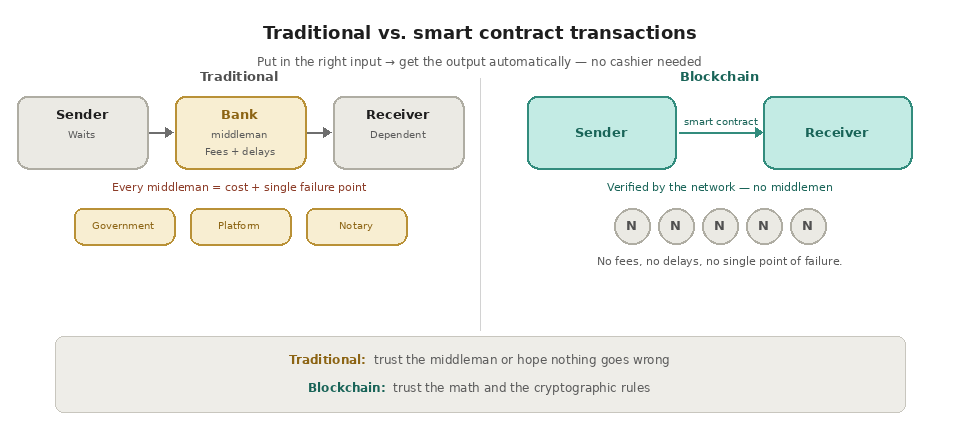
Think of a smart contract like a vending machine. You put in the right amount of money, press a button, and the machine gives you what you selected. There is no cashier deciding whether to honor the transaction. The rules are built into the machine itself.
Smart contracts work the same way, except they live on a blockchain. A developer writes a set of rules in code, deploys that code to the network, and from that point forward, anyone can interact with it. The contract holds assets, checks conditions, and executes actions without requiring a human to approve anything. If the conditions are met, the contract fires. If they are not, it does nothing. There is no gray area.
This is what makes smart contracts fundamentally different from traditional legal agreements. A paper contract says "Party A will pay Party B $1,000 when the shipment arrives." Enforcing that requires lawyers, courts, and trust. A smart contract encodes that same logic into a program that executes automatically when an oracle confirms delivery. The blockchain guarantees the execution is tamper-proof, transparent, and irreversible.
How Smart Contracts Work Under the Hood
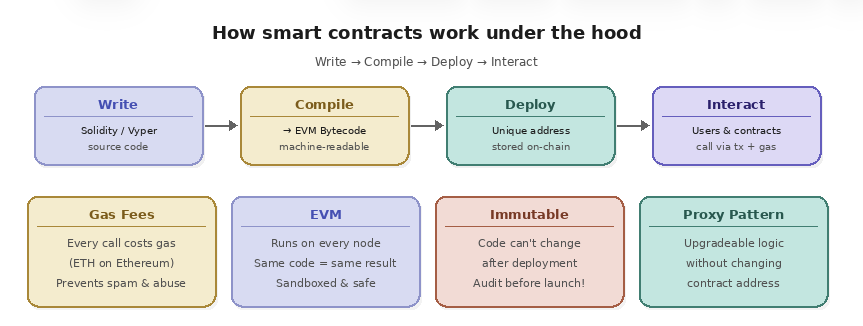
Smart contracts on Ethereum and other EVM-compatible chains are written primarily in Solidity, a programming language designed specifically for the Ethereum Virtual Machine (EVM). The EVM is a sandboxed execution environment that runs on every node in the network, ensuring that every participant processes the same code and arrives at the same result.
When a developer writes a smart contract, it gets compiled into bytecode that the EVM can understand. Deploying the contract means sending a special transaction to the network that stores this bytecode at a unique address on the blockchain. From that point on, the contract has its own address, can hold funds, and can be called by users or other contracts.
Every interaction with a smart contract costs gas, which is a fee paid in the network's native token (ETH on Ethereum, for example). Gas exists to prevent abuse. Since every node in the network must execute every smart contract call, computation needs to be metered. Simple operations like transferring a token cost less gas than complex operations like swapping assets through a decentralized exchange. The user initiating the transaction pays the gas fee, and validators earn it as compensation for processing the work.
Once a smart contract is deployed, it is immutable by default. The code cannot be changed, which is both a feature and a limitation. Immutability means users can trust the code will behave consistently, but it also means bugs cannot be patched after deployment. This is why smart contract auditing is a critical step before launch, and why developers sometimes use upgradeable proxy patterns that allow them to point the contract at updated logic without changing the original deployment.
What Smart Contracts Enable
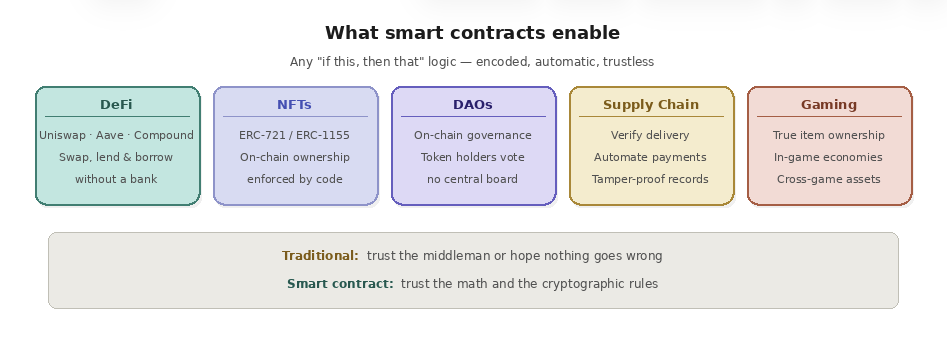
Smart contracts are the foundation of nearly everything happening in Web3. Decentralized finance (DeFi) protocols like Uniswap, Aave, and Compound are built entirely on smart contracts. When you swap tokens on a decentralized exchange, you are not trusting a company to facilitate the trade. You are interacting with a smart contract that holds liquidity pools and executes trades according to a mathematical formula. The rules are public. The execution is verifiable. The contract treats every user the same.
NFTs are another major use case. When you mint or transfer an NFT, a smart contract (typically following the ERC-721 or ERC-1155 standard) manages ownership records. The contract knows who owns which token and enforces the rules for transferring it. DAOs use smart contracts to manage governance, allowing token holders to propose and vote on decisions without a centralized board of directors.
Beyond DeFi and NFTs, smart contracts power supply chain verification, insurance automation, gaming economies, real-world asset tokenization, and cross-chain bridging. Any process that follows "if this, then that" logic can potentially be encoded into a smart contract and executed without intermediaries.
Getting Started as a Developer
Building with smart contracts starts with writing Solidity (or Vyper for Python-leaning developers), testing your code in a local environment, and deploying to a testnet before going to mainnet. Frameworks like Hardhat and Foundry provide the tooling you need to compile, test, and deploy contracts efficiently.
To deploy and interact with smart contracts, you need access to a blockchain node through an RPC endpoint. Running your own node is resource-intensive and complex, which is why most developers use infrastructure providers. Quicknode gives you instant RPC access to 80+ blockchain networks, so you can deploy your first contract in minutes rather than spending days setting up node infrastructure. Quicknode also provides tools like Streams for real-time contract event monitoring and the Quicknode SDK for streamlined blockchain interaction.
How do smart contracts differ from traditional contracts?
Both a smart contract and a traditional contract define the terms of an agreement, but they enforce those terms in completely different ways. A traditional contract relies on courts and intermediaries to interpret it, while a smart contract enforces itself in code on the underlying blockchain the moment its conditions are met. The table below breaks down the practical differences.
Aspect
Smart contract
Traditional contract
Enforcement
Automatic, executed by code
Manual, via courts and lawyers
Intermediaries
None required
Banks, brokers, notaries, lawyers
Settlement time
Seconds to minutes
Days to weeks
Transparency
Public and auditable on-chain
Private between parties
Cost
Network gas fees only
Legal and administrative fees
Reversibility
Irreversible once executed
Can be amended or disputed
Which blockchains support smart contracts?
Smart contracts are not limited to Ethereum. Most modern Layer 1 chains and Layer 2 networks run a virtual machine that can execute contract code, though they differ in language and performance. If you are deciding where to deploy, the table below compares a few popular smart contract platforms.
Blockchain
Primary language
Execution environment
Ethereum
Solidity, Vyper
EVM
Polygon
Solidity, Vyper
EVM
Arbitrum
Solidity, Vyper
EVM
Solana
Rust, C
Sealevel (SVM)
Avalanche
Solidity
EVM (C-Chain)
BNB Chain
Solidity
EVM
Because so many chains share the EVM, a contract written for Ethereum can often be redeployed to other EVM networks with only minor changes. To reach any of these networks your application connects through an RPC endpoint, and Quicknode exposes more than 80 chains behind a single API.
What are the risks of using smart contracts?
Smart contracts remove human intermediaries, but they introduce their own risks. Because deployed code is immutable, a bug cannot simply be patched, and an exploit can drain funds before anyone reacts. Logic errors, reentrancy attacks, and weak access control have caused some of the largest losses in crypto.
Contracts also depend on outside data. An oracle that feeds a wrong price can trigger incorrect executions, and a compromised admin key can let an attacker upgrade a proxy to malicious logic. This is why audits, formal verification, and careful key management matter so much. If your application holds user funds, protect its keys with the same care you would give a crypto wallet.
How much does it cost to run a smart contract?
There are two costs to plan for: deployment and usage. Deploying a contract is a one-time transaction whose gas cost scales with the size of the bytecode. After that, every function call that changes on-chain state costs gas, while read-only calls are free. Fees rise and fall with network demand, which is why teams move high-volume applications to cheaper chains or Layer 2s. Understanding how RPC requests work helps you estimate and optimize these costs as your usage grows.
Frequently Asked Questions
Are smart contracts legally binding?
Smart contracts reliably enforce their coded logic, but whether they count as a legal contract depends on jurisdiction. Many teams pair on-chain execution with a traditional legal wrapper, so the code handles settlement while the paperwork handles enforceability in court.
Can a smart contract be changed after deployment?
Not directly. The deployed bytecode is immutable. Teams that need upgradeability use proxy patterns that keep a stable address while pointing to new logic contracts, but this adds trust assumptions because whoever controls the upgrade can change behavior.
What language are smart contracts written in?
On Ethereum and other EVM chains the dominant language is Solidity, with Vyper as a Python-style alternative. Solana contracts, called programs, are usually written in Rust. The chain you deploy to determines the toolchain you use.
What is the difference between a smart contract and a dApp?
A smart contract is the on-chain logic. A dApp, or decentralized application, is the full product, including a user interface and a backend that reads from and writes to one or more smart contracts through a blockchain node.
Do all blockchains support smart contracts?
No. Some chains, like Bitcoin in its base layer, support only limited scripting. Programmable smart contracts are the defining feature of chains like Ethereum, Solana, and most EVM Layer 2s, which is why those networks host the bulk of DeFi and NFT activity.