Answers>Learn about MEV & transaction ordering>What is MEV in blockchain?
What is MEV in blockchain?
// Tags
MEV blockchainmaximal extractable value
TL;DR: Maximal Extractable Value (MEV) is the profit that block producers and specialized actors called searchers can capture by strategically including, excluding, or reordering transactions within a block. MEV arises because pending transactions are visible in the public mempool before they are confirmed, and the entity assembling a block has full control over the order of transactions inside it. Common MEV strategies include arbitrage between decentralized exchanges, liquidations in lending protocols, and sandwich attacks that exploit ordinary users' trades. MEV has become a defining economic force in blockchain networks, reshaping how blocks are built, how transactions are ordered, and how much value end users actually receive from their onchain activity.
The Simple Explanation
When you submit a transaction on a blockchain, it does not go straight into a block. It enters the mempool, a public waiting room where every pending transaction sits until a block producer picks it up. The critical detail is that the mempool is visible to everyone. Anyone monitoring the network can see your transaction before it is confirmed: what you are doing, which contract you are calling, how much you are swapping, and what price you expect.
Block producers (validators on Proof of Stake chains, miners on Proof of Work chains) get to decide which transactions from the mempool go into the next block and in what order. That ordering power is enormously valuable. If a validator sees a large swap about to move the price of a token on a decentralized exchange, they (or a specialized bot acting on their behalf) can insert their own transaction right before it to buy at the lower price, let the user's swap push the price up, and then sell immediately after for a profit. The user gets a worse price. The MEV extractor pockets the difference.
This is not a bug in any single protocol. It is a structural feature of how blockchains work. Wherever there is a public mempool, transaction ordering discretion, and financial activity happening onchain, MEV exists. The total MEV extracted across major blockchains is estimated in the billions of dollars since Ethereum's early DeFi days, and the number continues to grow as onchain activity increases.
How MEV Extraction Works
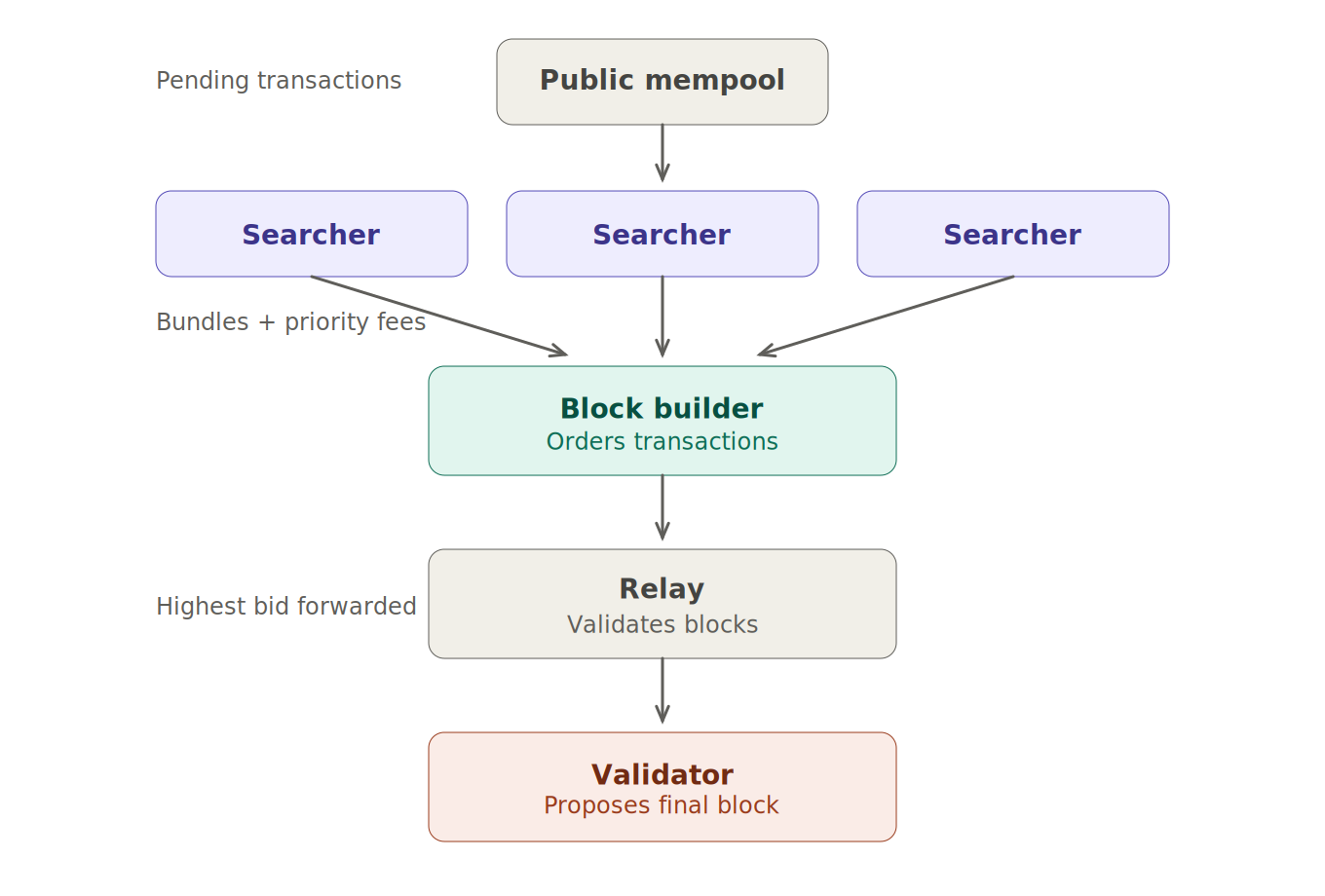
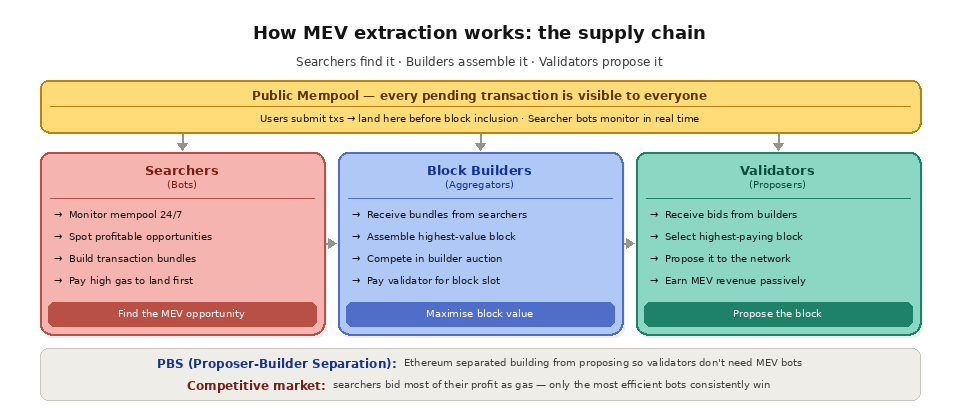
MEV extraction involves a supply chain of specialized participants, each playing a distinct role in identifying and capturing value from transaction ordering.
Searchers are the frontline operators. They run bots that monitor the mempool and onchain state in real time, looking for profitable opportunities. When a searcher identifies an opportunity, such as a price discrepancy between two DEX pools or a lending position that has become undercollateralized, they construct a transaction (or bundle of transactions) designed to capture that profit. Searchers compete intensely with each other, often paying most of their expected profit as gas fees or priority fees to ensure their transaction lands in the right position within the block.
Block builders are entities that assemble the contents of a block. In Ethereum's current architecture under Proposer-Builder Separation (PBS), builders receive transaction bundles from searchers and construct a complete block that maximizes total value. Builders compete in an auction to have their block selected by the validator. The winning builder's block is the one that pays the validator the highest fee, which means the builder must extract enough MEV to cover that payment while still retaining profit.
Validators (or proposers) are the network participants who have the final say over which block gets added to the chain. Under PBS, validators do not build the block themselves. Instead, they receive bids from multiple builders and select the highest-paying block. This separation was designed to prevent validators from needing to run sophisticated MEV extraction software themselves, but it also means validators earn a share of MEV revenue passively through builder payments.
This three-layer supply chain (searchers find opportunities, builders assemble blocks, validators propose them) has become the dominant model for block production on Ethereum. It is a competitive, high-speed market where milliseconds and gas price precision determine who captures value and who misses out.
Common MEV Strategies
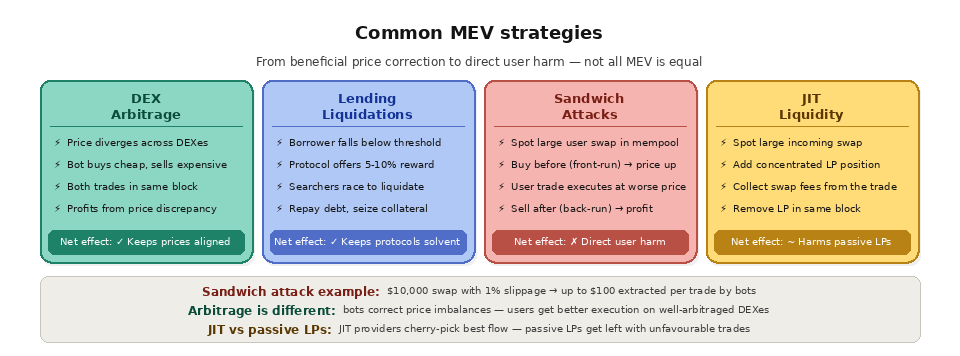
DEX arbitrage is the most common and arguably the most benign form of MEV. When the price of a token diverges between two decentralized exchanges (for example, ETH is trading at $3,000 on Uniswap but $3,005 on SushiSwap), an arbitrage bot buys on the cheaper exchange and sells on the more expensive one in the same block, pocketing the difference. Arbitrage is generally considered beneficial to the ecosystem because it keeps prices consistent across markets. Without arbitrageurs, DEX prices would drift apart, giving users worse execution on their trades.
Liquidations occur in lending protocols like Aave and Compound when a borrower's collateral falls below the required threshold. The protocol offers a reward (typically 5-10% of the liquidated collateral) to anyone who repays the borrower's debt and seizes the collateral. MEV searchers compete aggressively to be the first to execute these liquidations, paying high priority fees to front-run other liquidators. Like arbitrage, liquidations serve an important protocol function by maintaining solvency, but the competitive extraction process can push gas prices up for everyone.
Sandwich attacks are the most harmful MEV strategy for ordinary users. Here is how they work: a searcher detects a large swap transaction sitting in the mempool. They submit a buy order immediately before the victim's trade (front-running), which pushes the price up. The victim's trade then executes at a worse price than expected. The searcher then submits a sell order immediately after (back-running), profiting from the price movement the victim's trade created. The victim ends up paying more than they should have, and the searcher captures the difference. Sandwich attacks extract value directly from users, offer no benefit to the ecosystem, and are the primary reason MEV has a negative reputation among regular blockchain users.
Just-in-time (JIT) liquidity is a more advanced MEV strategy specific to concentrated liquidity DEXes like Uniswap V3. When a searcher sees a large incoming swap, they add a tightly concentrated liquidity position in the exact price range the swap will execute in, collect trading fees from the swap, and remove the liquidity in the same block. The swap executer gets slightly better execution (more liquidity means less slippage), but the JIT provider captures fees that would have otherwise gone to passive liquidity providers.
Strategy
How it works
Effect on users
DEX arbitrage
Buys low on one DEX and sells high on another in one block
Neutral to positive, keeps prices aligned
Liquidations
Repays unhealthy loans to claim a collateral reward
Neutral, keeps lending protocols solvent
Sandwich attack
Front runs and back runs a pending swap
Harmful, the user gets a worse price
JIT liquidity
Adds and removes concentrated liquidity around a swap
Mixed, can improve execution but takes fees from passive providers
Why MEV Matters for Developers and Users
MEV is not an abstract economic concept. It has direct, measurable consequences for anyone interacting with a blockchain.
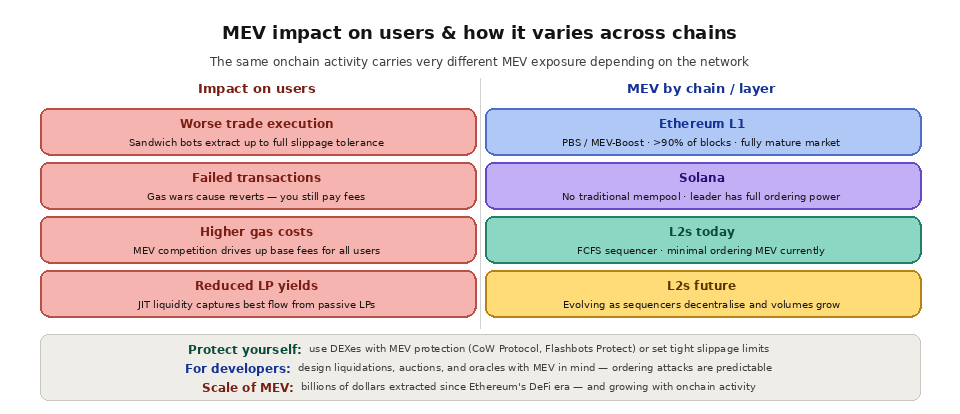
For end users, MEV primarily manifests as worse trade execution. When you submit a swap on a DEX with a 1% slippage tolerance, sandwich bots can extract up to that entire 1% from your trade. On a $10,000 swap, that is $100 extracted from your pocket. Users also experience failed transactions when MEV bots compete for the same opportunity and drive gas prices up, causing transactions with insufficient gas to revert (while still costing gas fees).
For DeFi developers, MEV shapes protocol design decisions. Protocols must consider how their smart contract interactions can be exploited through transaction ordering. Oracle update mechanisms, liquidation processes, auction designs, and governance voting all have MEV implications. Building MEV-aware protocols means designing systems that minimize the value extractable through ordering manipulation or that redistribute extracted value back to users.
For the network itself, MEV drives block space demand in ways that affect all participants. Priority gas auctions during high-MEV periods increase transaction costs for everyone, not just the parties involved in the MEV opportunity. The concentration of MEV extraction among a small number of sophisticated builders raises centralization concerns, as economies of scale in MEV extraction create barriers to entry for new block builders.
MEV Across Different Chains
MEV dynamics vary significantly across blockchain networks. On Ethereum, the PBS infrastructure with Flashbots MEV-Boost has formalized the MEV supply chain, with over 90% of blocks built through this system. Solana's architecture creates a different MEV landscape because it does not have a traditional mempool. Validators receive transactions directly, and the leader-based block production model means the current leader has exclusive ordering power for their slot. This reduces some forms of MEV (like traditional front-running) but creates others (like the ability for the leader to insert their own transactions).
Layer 2 networks like Arbitrum, Base, and Optimism have a centralized sequencer that controls transaction ordering, which means MEV on L2s is captured (or not) at the sequencer's discretion. Most L2 sequencers currently order transactions on a first-come-first-served basis, reducing ordering-based MEV compared to L1. However, as L2 volumes grow and sequencer decentralization efforts advance, MEV dynamics on L2s are expected to evolve significantly.
Network type
Mempool
Ordering control
MEV profile
Ethereum L1
Public mempool
Builders and validators via PBS
Mature, formalized through MEV-Boost
Solana
No public mempool
Current slot leader
Less front running, leader based extraction
Layer 2 rollups
Private sequencer queue
Centralized sequencer
Mostly first come first served today
How Quicknode Helps Developers Navigate MEV
Understanding and responding to MEV requires fast, reliable access to blockchain data. Quicknode's Core API provides the low-latency RPC access that MEV-aware applications need to monitor mempool activity, estimate gas prices accurately, and submit transactions with precise timing. Response times 2.5x faster than competitors mean your application sees onchain state changes sooner, which is critical when MEV bots are competing for the same block space.
Quicknode Streams enables real-time monitoring of smart contract events, transaction patterns, and block data that can help developers detect MEV activity affecting their protocols. By streaming filtered event data to your backend with guaranteed delivery and finality-order processing, Streams provides the data foundation for building MEV detection dashboards, user protection mechanisms, and protocol analytics. For developers building trading applications or DeFi protocols where MEV directly impacts user outcomes, Quicknode's infrastructure ensures your systems have the speed and reliability needed to compete in an MEV-aware world.
Is all MEV harmful?
No. MEV covers a wide range of behavior, and not all of it hurts users. Arbitrage keeps prices aligned across exchanges and liquidations keep lending markets solvent, so both are widely seen as healthy. The harmful end of the spectrum is predatory extraction like sandwich attacks, where value is taken directly from a user with no benefit in return. The core driver in every case is transaction ordering, which is why the line between good and bad MEV comes down to who is affected and how.
How can you protect your transactions from MEV?
The most effective defense is to keep your transaction out of the public mempool until it is confirmed. Private order flow services and protected RPC endpoints route your trade so searchers cannot see and front run it. Setting tight slippage limits and splitting very large swaps into smaller pieces also reduces how much a bot can extract. A deeper look at MEV mitigation strategies covers the trade-offs of each approach.
The endpoint you use matters too. Sending transactions through a private or protected RPC endpoint hides them from the public mempool, which removes the visibility that most extraction relies on in the first place.
Why does MEV exist in the first place?
MEV exists because two things are always true on a public blockchain: pending transactions are visible before they confirm, and whoever assembles the block decides the order. Put those together with real financial value moving onchain and profit from ordering becomes inevitable. For a fuller breakdown of the root causes, see why MEV exists.
Frequently Asked Questions
Is MEV illegal?
No. MEV is a built in consequence of how public blockchains order transactions, not a crime. Some forms like arbitrage are healthy, while predatory forms like sandwich attacks are widely viewed as harmful even though they break no law.
What is the difference between MEV and gas fees?
Gas fees are the standard payment for including a transaction. MEV is extra value captured from the ordering of transactions, on top of gas fees and block rewards. Searchers often pay high gas fees specifically to win an MEV opportunity.
How do I avoid a sandwich attack?
Use tight slippage settings, route trades through private or protected order flow, and split very large swaps into smaller pieces. Many wallets now send trades through protected endpoints by default.
Does MEV exist on Solana and Layer 2 networks?
Yes, though it looks different. Solana has no public mempool, so the current leader controls ordering for its slot. On most rollups a single sequencer orders transactions, which changes the MEV profile compared to Ethereum mainnet.
Can MEV ever benefit users?
Yes. Arbitrage keeps prices aligned across markets and liquidations keep lending protocols solvent. These are necessary functions, and on a healthy Layer 2 blockchain they can run with far less harm to ordinary traders.