Alternative Stablecoins: Why Build Beyond USDC and USDT?
Alternative Stablecoins: Why Build Beyond USDC and USDT?
Explore 5 categories of stablecoins beyond USDC and USDT. Learn why they exist, how they operate, and when building a stablecoin makes sense.

October 1, 2026 — 12 min read
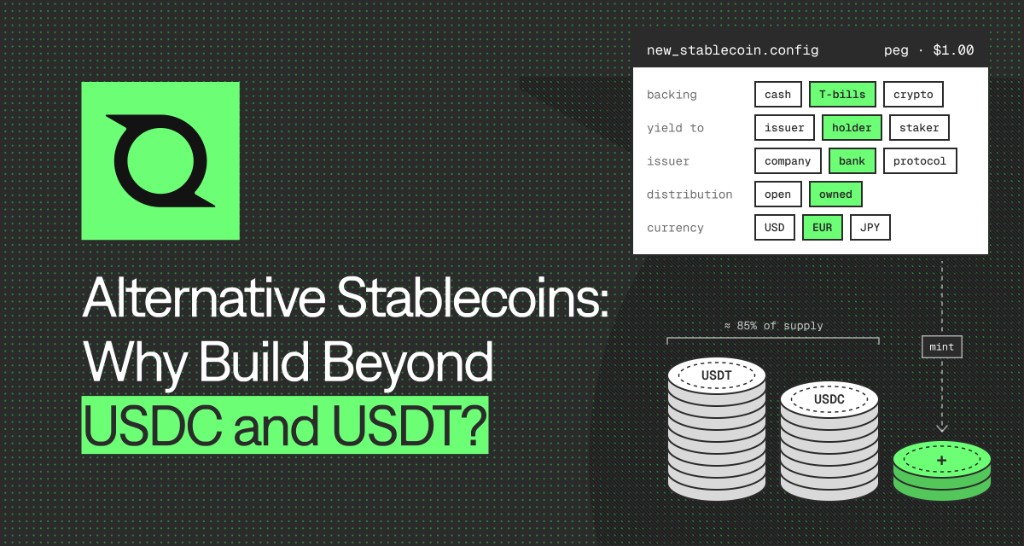
USDT and USDC hold ~85% of a $300 billion stablecoin market as of September 2026. Yet new stablecoins, or digital dollars, seem to keep launching.
PayPal distributes PYUSD. Ripple issues RLUSD. Ethena and Aave each run their own.
Why, if USDT and USDC already work, create alternative stablecoins?
Because today, the role of stablecoins is expanding beyond merely holding a $1 value.
This piece explores why alternative stablecoins exist, what value they add, and whether it's worth building one from scratch or integrating USDC/USDT is the right call.
How USDT and USDC Became the Default Stablecoins
USDT and USDC delivered on the stablecoin promise: move $1 of value across crypto, DeFi markets, and blockchains, and to and from traditional markets.
They won the way payment networks do: by being accepted everywhere, which has created a growth and retention flywheel.
Liquidity, Distribution, and Network Effects
USDT and USDC have an infrastructure head start: the more places they work, the more useful and liquid they become.
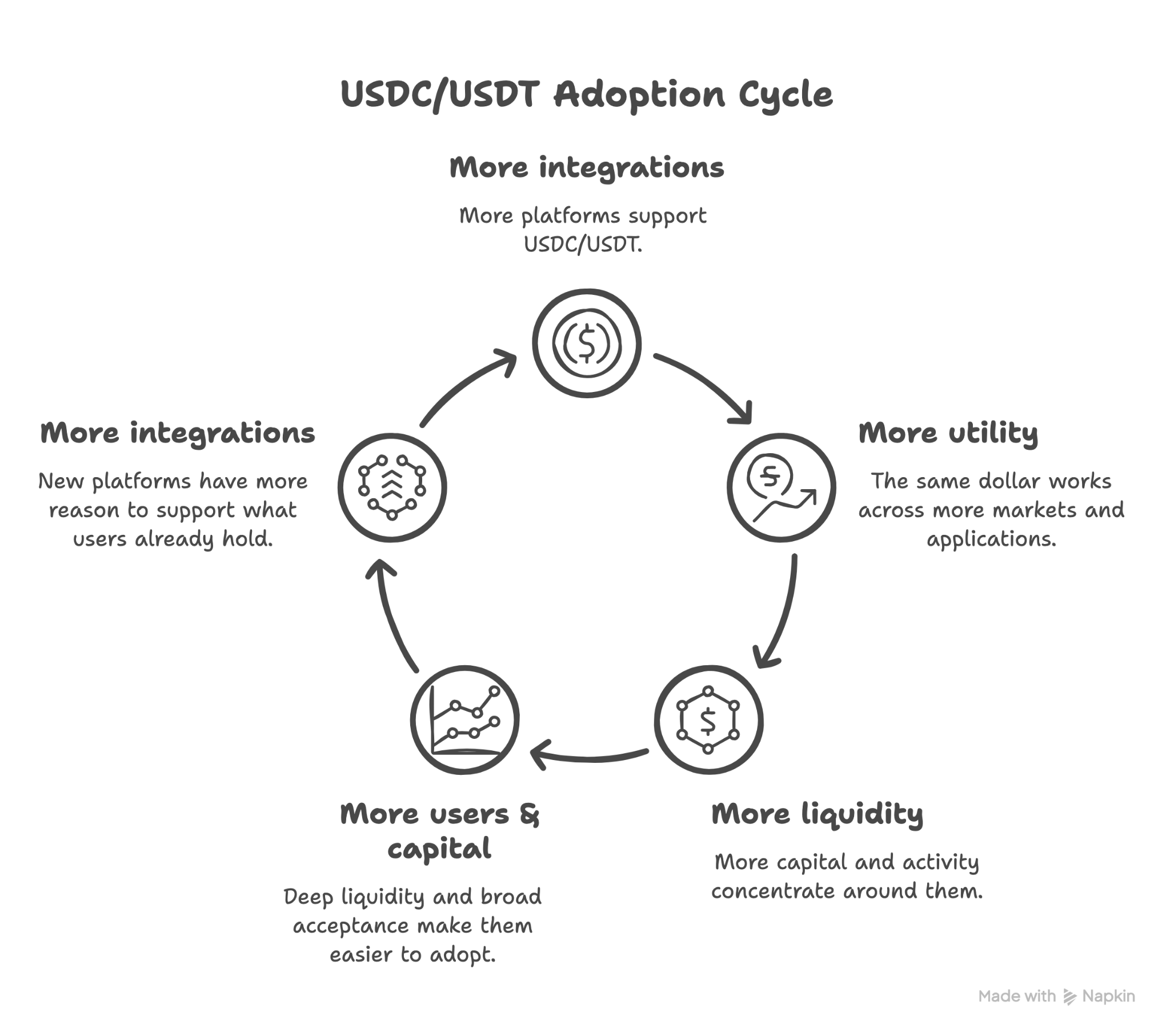
For a new stablecoin, breaking into this cycle means bootstrapping the liquidity, integrations, and distribution that USDT and USDC already have.
Bonus read: A deep dive into how USDC is becoming the internet's native currency.
Beyond all this hard legwork, why would anyone build another stablecoin?
If USDC and USDT Already Work, Why Make Another Stablecoin?
Because $1 is only one part of the stablecoin mechanism.
Stablecoins also determine:
Who earns: Does reserve or collateral income go to the issuer, holder, or protocol?
Who distributes: Who controls access to the wallets, merchants, exchanges, and users?
Who issues: Which company, bank, or protocol stands behind the money?
What it represents: A dollar, euro, or another currency?
What backs it: Cash, Treasuries, crypto collateral, or a trading strategy?
USDT and USDC make these choices for broad, general-purpose use.
Alternative stablecoins optimize one or more of these choices to get a specific job done.
Did you know?
Just as alternative stablecoins optimize for specific jobs, there are also stablechains: purpose-built blockchains for stablecoin payments.
Five Reasons to Build Purpose-Specific Alternative Stablecoins
Alternative stablecoin type | Question it answers |
|---|---|
Yield-bearing | Can stablecoin capital keep earning? |
Payments & distribution | Can money reach users and merchants more effectively? |
Institutional settlement | Can stablecoins fit institutional, regulatory, and legal requirements? |
Local currency or non-dollar | Why should onchain money always be dollars? |
DeFi-native |
These categories can sometimes overlap because a stablecoin can optimize for more than one job.
Still, it's important to know why each type of alternative stablecoin exists.
Now, let's go through the alternative stablecoin categories one by one.
Did you know?
There are five major types of stablecoins based purely on their way of maintaining price stability.
Yield-Bearing Stablecoins
Holding USDT or USDC generally means the holder doesn't receive the yield generated by the backing assets, such as T-bills.
Yield-bearing stablecoins change who captures that return.
Where the Yield Comes From
There are two established ways stablecoins generate yield:
Where the yield comes from only tells you what risks the stablecoin carries. It doesn't tell you who receives it.
Who Captures the Stablecoin Yield?
Stablecoin-generated yield can move in three directions:
Issuer: Reserve income becomes issuer revenue, as with USDC and USDT.
Holder: The token appreciates or rebases as yield accrues. USDY, for example, appreciates against the dollar as its Treasury backing earns interest.
Separate yield token: The stablecoin stays at $1, while a separate token or product captures the return.
Sky and Ethena split it this way.
Now, is yield enough of a reason to opt in?
Where Do Yield-Bearing Stablecoins Make Sense?
Yield-bearing stablecoins make sense when onchain capital sits idle for long periods.
Consider three questions:
Is the capital meant to sit rather than move? Yield matters more for treasuries and savings than for individual wallets.
Is the yield worth the added risk? Treasury yield and strategy-generated yield are very different propositions.
Does the capital need to stay liquid? Lockups, staking, or separate yield tokens can reduce its usefulness as money.
For a payments balance, USDC or USDT may do the job. For $10 million sitting in an onchain treasury for 6 months, yield-bearing stablecoins are a godsend.
Looking for automated stablecoin yield?
Here's an overview of the best USDC yield platforms in 2026.
That brings up the opposite problem: what if the priority is moving money rather than earning on it?
Payments Stablecoins
Payments stablecoins optimize for distribution. At its core, the stablecoin is the same: a $1 peg, fiat reserves, and issuer-managed redemption.
Distribution changes everything: the issuing company owns the checkout, wallets, merchant acceptance, payouts, cards, and fiat rails.
PayPal's PYUSD shows the model. The stablecoin plugs into PayPal and Venmo, giving an existing payments network its own digital dollar.
When Distribution Is the Product
PayPal already had 400 million accounts. PYUSD gave those accounts a dollar that lives inside PayPal and Venmo, funded by the reserve yield PayPal keeps.
This ownership gives the issuer more control over settlement, integrations, and reserve economics. Existing customer distribution can also solve part of the cold-start problem that new stablecoins face.
The stablecoin becomes one component of a larger payments product. But why build instead of integrate?
Why Issue a Stablecoin Instead of Integrating Existing Solutions?
The decision comes down to whether owning the money layer creates enough value to justify maintaining it.
Integrate USDC/USDT when | Issue a stablecoin when |
|---|---|
Existing liquidity matters most | Existing distribution can create circulation |
Stablecoin economics are secondary | Reserve economics matter at scale |
Interoperability is the priority | Control over issuance and redemption matters |
Stablecoin infrastructure isn't core | The token strengthens the payments product |
A wallet would never need its own dollar. A payments network serving millions of users and merchants across fiat rails, on the other hand, would see value in an alternative payments stablecoin.
Retail distribution works, but can stablecoins also work with traditional banks and financial institutions?
Institutional Stablecoins
Institutional stablecoins promise to solve a specific use case: making onchain money usable inside regulated financial systems. But why?
Why Institutions Need Stablecoins
Institutions rarely need another way to send $1 from point A to point B.
But the way this money currently travels is riddled with friction: multiple parties, each with their own rules, time delays, and costs.
Stablecoins effectively shrink this to atoms by:
Moving value 24/7 between exchanges, custodians, and counterparties without waiting on bank hours
Sending cross-border payments without routing through correspondent banks
Settling onchain and programmably, so tokenized assets and cash clear on the same rail
But institutions can't adopt onchain dollars on speed alone. So, what makes a stablecoin eligible?
What Institutions Need From Stablecoins
Institutions need clarity on who issued that dollar, what backs it, how it can be redeemed, and which rules govern it. But there's nuance in what each of those means.
Requirement | Question institutions need answered |
|---|---|
Issuer | Which legal entity issues the token and owes redemption? |
Reserves | What backs each $1, and where are those assets held? |
Redemption | Can approved holders reliably redeem 1:1 for fiat? |
Custody | Can existing institutional custodians support it? |
Compliance |
Not every stablecoin answers these questions the same way. This is why "regulated stablecoin" is a vague category.
RLUSD answers those questions at the issuer:
Standard Custody & Trust Company, a New York-chartered Ripple subsidiary, issues the token.
It holds segregated cash-and-Treasury reserves with BNY.
It publishes monthly attestations under NYDFS stablecoin rules.
USDG answers them by network:
Paxos issues it from MAS- and MiCA-licensed entities.
Robinhood, Kraken, Mastercard, and other Global Dollar Network partners can hold and distribute it, since issuance compliance already sits with Paxos.
Next, we go local and see whether there's a market for stablecoins that aren't USD-denominated.
Non-Dollar and Regional Stablecoins
USDC and USDT solve the dollar problem, literally. They don't solve the euro or yen problem.
Imagine a European company that collects revenue, pays salaries, and reports in euros suddenly needing to hold USDC/USDT. This introduces USD/EUR exposure into a business that never needed it. And every time the business settles in USDC, it eats an FX conversion at both ends.
Making the Case for Locally Denominated Stablecoins
Use case | Why a local stablecoin helps |
|---|---|
Payments | Price and settle in the currency customers already use |
Payments & payroll | Money moves in the currency already used for pricing and wages |
Business treasury | Keep onchain cash aligned with liabilities |
Cross-border trade | Exchange currencies onchain without making USD the settlement asset |
Local DeFi |
So why aren't we seeing a ton of non-USD stablecoins?
The Status Quo of Non-USD Stablecoins
The decision comes down to currency fit vs liquidity, and so far, liquidity has won. Dollar-pegged stablecoins account for the overwhelming majority of stablecoins.
Even the euro, the clearest alternative, remains small.
The regulated euro stablecoin market stood at around $674 million in 2026, despite growing 128% over the previous year.
Pound, yen, and peso coins exist (Tether's GBPt, JPYC, MXNt), but in negligible amounts.
For comparison, USDC alone exceeds ~$75 billion. With USD liquidity this deep, most businesses stick with US dollar stablecoins.
Local coins only make sense when the benefit of matching the local currency outweighs the cost of poorer liquidity and acceptance.
So far, that isn't the case.
Bonus: Read how seven countries are using and adopting stablecoins in their lives and businesses.
Next, let's move away from institutions and countries, and back to the origins of stablecoins: cryptocurrency and DeFi markets.
DeFi-Native Stablecoins
For a DeFi protocol, integrating USDC is easier than creating a stablecoin. But integration means paying Circle or Tether a toll.
That's a toll on every dollar borrowed and every dollar earning yield. And even then, there's a risk that Circle or Tether chooses to freeze funds.
DeFi-native stablecoins remove the toll booth: the protocol mints its own money against its own collateral, and keeps what that money earns.
Why Protocols Want to Own the Money Layer
With a native stablecoin, the protocol gains control over:
Issuance: How much stablecoin can be minted, and against what collateral.
Monetary parameters: Borrowing rates, incentives, and other stability mechanisms.
Economics: The protocol captures revenue from issuing and maintaining its stablecoin.
Risk: The protocol also owns the peg, collateral, and liquidation risks.
With Aave's GHO, borrowers mint GHO against collateral supplied to Aave. The interest they pay flows to the Aave ecosystem rather than to Circle or Tether.
However, it's not the only way out.
Different Mechanisms of DeFi-Native Stablecoins
DeFi-native stablecoins are the same product, a $1-denominated stablecoin, but protocols make different choices about collateral, peg management, and economics.
Protocol | Stablecoin | Collateral model | Stability mechanism | Protocol economics |
|---|---|---|---|---|
Sky | Crypto and real-world assets | Collateralized borrowing, rates, and peg tools |
Each design moves risk somewhere else.
A collateralized stablecoin depends on collateral values and liquidations.
A synthetic dollar can reduce direct exposure to collateral price movements through hedging, but adds funding-rate, exchange, and counterparty dependencies.
No DeFi-native architecture is risk-free. Owning the money layer means choosing which risks the protocol is willing to own along with it.
That same trade-off appears across every alternative stablecoin category.
What Are Alternative Stablecoins Trading Off?
Every choice in the last five sections bought something: yield, distribution, compliance, currency fit, or protocol revenue. None of it was free.
Risk and the Cost of Specialization
Category | What it gains | What it gives up |
|---|---|---|
Yield-bearing | Return on idle capital | Liquidity, redemption speed, exposure to funding or rate risk |
Payments | Owned distribution, float revenue | Liquidity depth, cross-platform acceptance |
Institutional |
As we can see, the cost of specialization isn't uniform. The risks change, but one constraint affects almost every alternative stablecoin: liquidity.
Liquidity vs Specialization
Liquidity is the one thing every alternative stablecoin has to rebuild from zero. Here's a story that shows why.
The Story of Hyperliquid's USDH
Hyperliquid launched USDH in September 2025 to keep reserve yield onchain instead of leaking it to Circle. Note that Hyperliquid is the chain that had every reason to own its money layer. The native dollar never won the book: by mid-2026, USDH held a few tens of millions of dollars against billions in USDC.
The protocol then sunset USDH and turned back to USDC. And that's the tax on specialization.
A yield-bearing stablecoin, a payments coin, a DeFi-native stablecoin: each solves a real problem for a real user. None of them arrive with liquidity.
They have to earn it, trade by trade, integration by integration, while USDC and USDT keep compounding an advantage they built years ago.
That leaves one final question: when does building a stablecoin make sense despite that disadvantage?
When Does Building an Alternative Stablecoin Make Sense?
Building an alternative stablecoin only makes sense when owning the stablecoin solves a problem that integration cannot.
A simple test:
Question | What needs to be true |
|---|---|
Is there a distinct job? | The stablecoin solves more than moving $1 |
Can USDC/USDT already do it? | Integration leaves an important constraint unsolved |
Is there an existing user base? | Users or merchants already have a reason to adopt it on day one |
Is there an existing regulatory relationship? | A charter, license, or custodian relationship that USDT/USDC doesn't already provide |
Are the economics meaningful? |
If, and only if, the answers are strong, pursue building a purpose-specific alternative stablecoin. Otherwise, integration is simpler.
But, how do we build?
What's Next: Regulations Might Increasingly Shape Stablecoin Categories
Regulation is still defining what each stablecoin can be. Rules around reserves, yield, redemption, and eligible issuers do more than determine compliance.
They influence which stablecoin architectures are viable in the first place.
The US GENIUS Act, enacted in 2025, prohibits payment stablecoin issuers from paying interest directly to holders. This matters for how yield products get structured around payment stablecoins.
Europe shows the same force from another direction. MiCA's rules have given rise to MiCA-compliant euro stablecoins, which are growing steadily.
So there's no single answer for which stablecoin types will survive. Similarly, the line between integrating existing stablecoins and building alternative stablecoins won't have a single answer either.
About Quicknode
Founded in 2017, Quicknode deploys institutional-grade blockchain infrastructure for developers and enterprises. With 99.99% uptime and support for 75+ chains, teams build and scale onchain applications without compromise.
Stay updated
The latest engineering insights, product updates, and web3 news delivered straight to your inbox.