TL;DR: Running a node means operating a computer that participates in a blockchain network by downloading, validating, and relaying transactions and blocks. It gives you direct, trustless access to blockchain data without relying on any third party. While running your own node offers maximum sovereignty and privacy, it comes with real costs in hardware, maintenance, and operational complexity that most developers and teams choose to offload to infrastructure providers.
The Simple Explanation
At its core, running a node means installing blockchain client software on a machine, connecting it to the peer-to-peer network, and letting it sync the full history of the chain. Once synced, your node independently verifies every new block and transaction according to the network's consensus rules. It does not trust other nodes. It checks everything for itself.
This is the fundamental promise of blockchain: "Don't trust, verify." When you run your own node, you are not taking anyone's word for the state of the chain. Your machine downloads the raw data, executes the transactions, and arrives at the same state as every other honest node in the network. If someone tries to feed your node an invalid block or a fraudulent transaction, your software rejects it automatically.
Running a node also means your application has a direct, private connection to the blockchain. When you query a wallet balance or submit a transaction through your own node, that request does not pass through any third-party server. No one can log your queries, throttle your access, or censor your transactions. You are a first-class participant in the network.

What Running a Node Actually Involves
The reality of running a node goes well beyond installing software. On Ethereum, a full node requires two separate client programs running simultaneously: an execution client (like Geth, Nethermind, or Erigon) and a consensus client (like Prysm, Lighthouse, or Teku). These two clients communicate with each other through an authenticated connection, and both must stay synced and healthy for the node to function properly.
Hardware requirements vary by chain but are not trivial. An Ethereum full node needs a multi-core CPU, at least 16GB of RAM, a fast SSD with 1TB or more of free space, and a reliable internet connection with at least 25 Mbps bandwidth. Archive nodes need 12TB+ of SSD storage. Solana nodes are even more demanding, requiring high-end CPUs, 512GB of RAM, and NVMe drives to keep up with the chain's throughput. Bitcoin nodes are comparatively lightweight but still need hundreds of gigabytes of storage.
Initial sync is the first hurdle. Depending on the chain and your hardware, syncing from genesis can take anywhere from hours (for newer chains) to days or even weeks (for Ethereum archive nodes). During sync, the node is downloading and verifying millions of blocks, which puts sustained load on your CPU, disk, and network. If the process is interrupted by a crash, power outage, or network issue, you may need to restart or repair the sync.
Once synced, ongoing maintenance is constant. Client software releases updates regularly, sometimes with critical security patches that need to be applied quickly. Blockchain hard forks require you to update your client before a specific block height or risk falling off the canonical chain. Disk usage grows continuously as new blocks are added, so you need to monitor storage and plan for expansion. If your node falls out of sync for any reason, you need to diagnose the issue and resync, which can take hours or days depending on how far behind it fell.

Why People Run Their Own Nodes
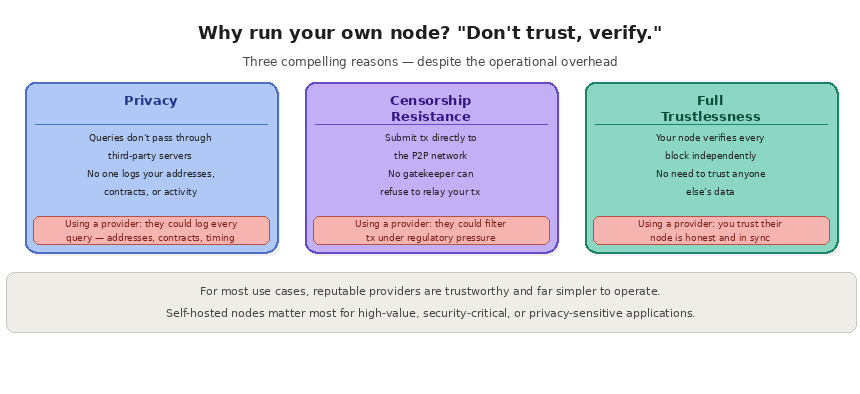
Despite the operational overhead, there are compelling reasons to run your own node. Privacy is a major one. When you use a third-party RPC provider, every query you make (balance checks, transaction submissions, smart contract calls) passes through their servers. They could theoretically log which addresses you are querying, what contracts you are interacting with, and when. Running your own node eliminates that exposure entirely.
Censorship resistance is another. If you depend on a third party to submit your transactions, that third party could refuse to relay them. This is not a theoretical concern. Validators and relayers have been known to filter transactions based on regulatory pressure. When you run your own node, you submit transactions directly to the peer-to-peer network, bypassing any potential gatekeepers.
Full trustlessness is the third reason. Using someone else's node means trusting that their node is honest, properly synced, and returning accurate data. For most use cases and reputable providers, this trust is well-placed. But for high-value or security-critical applications, eliminating that trust assumption entirely can be worth the operational cost.
What types of blockchain nodes can you run?
"Running a node" can mean several different things depending on how much data the node keeps and what role it plays. The most common types are summarized below, and you can go deeper in our overview of what a blockchain node is.
Node type | What it stores | Typical use |
|---|---|---|
Full node | Recent state plus all blocks | Validating and serving current data |
Archive node | Full historical state at every block | Historical queries and analytics |
Light node | Block headers only | Lightweight wallets and devices |
What are the hardware requirements to run a node?
Requirements differ sharply by chain and by whether you run a full or archive node. The table below shows rough baselines so you can size hardware before you start.
Chain | Storage (full) | RAM | Notes |
|---|---|---|---|
Ethereum | 1 to 2 TB SSD | 16 to 32 GB | Archive needs 12 TB or more |
Bitcoin | Several hundred GB SSD | 8 GB or more | Lightweight relative to others |
Solana |
Across every chain, the split between full and archive nodes drives most of the cost. The difference is explained in full node vs archive node. If you would rather skip the hardware entirely, a managed endpoint for a chain like Ethereum or Bitcoin gives you the same access without operating the box.
How long does it take to sync a blockchain node?
Sync time ranges from a few hours on newer chains to days or even weeks for an Ethereum archive node, depending on hardware and network speed. The node has to download and re-verify millions of blocks, so a fast NVMe drive and good bandwidth matter more than raw CPU. Throughout the process you also need to watch sync progress and disk usage, which is where monitoring blockchain infrastructure becomes essential.
Is it cheaper to run your own node or use a provider?
For a single hobby node, self-hosting can be cheap. For production workloads, the math usually favors a provider once you add redundant hardware, bandwidth, monitoring, on-call staff, and the engineering time to keep node reliability and high availability where users expect them. A managed RPC endpoint turns a large fixed operational cost into predictable usage-based pricing.
Frequently Asked Questions
Do you need to run a node to use a blockchain?
No. Most developers and users access chains through a managed RPC provider and never run a node themselves. Running your own node is mainly about privacy, censorship resistance, and full trustlessness.
Do all nodes earn rewards?
No. Only validator nodes that stake collateral earn protocol rewards. Full, archive, and light nodes that are not validators help secure and serve the network but do not earn staking rewards on their own.
What is the difference between a full node and an archive node?
A full node keeps recent state and can validate the chain, while an archive node retains the complete historical state at every block. Archive nodes need far more storage and are used for deep historical queries.
Can you run a blockchain node in the cloud?
Yes. Many operators run nodes on cloud or bare-metal servers for uptime and bandwidth. The tradeoff is ongoing operational cost and the need to manage updates, sync, and failover yourself.
How much maintenance does a node require?
Ongoing. You must apply client updates, prepare for hard forks, expand storage as the chain grows, and resync if the node falls behind. This continuous upkeep is why many teams offload it to a provider.
Why Most Developers Use Node Providers
For the vast majority of developers and teams, the tradeoffs of running your own node do not make sense. Building a production application requires your node to be available 24/7 with low latency, across potentially multiple chains, with both full and archive data access. Achieving that level of reliability with self-hosted infrastructure requires redundant hardware, monitoring, alerting, failover systems, and a team with blockchain operations expertise.
This is the problem that Quicknode was built to solve. Quicknode operates a globally distributed network of blockchain nodes across 80+ chains, with a 99.99% uptime SLA and API response times 2.5x faster than competitors on average. When you create a Quicknode endpoint, you get instant RPC and WebSocket access to a professionally managed node without touching any hardware or software. Quicknode handles all client updates, hard forks, disk management, and sync issues so you can focus entirely on building your application. For teams that need the isolation and control of dedicated infrastructure without the operational burden, Quicknode's Dedicated Clusters provide private, redundant node backends with guaranteed performance.
Further Reading
How to Install and Run a Geth Node - Quicknode Guide
Ethereum Full Node vs. Archive Node - Quicknode Guide
Introduction to Quicknode Products
Quicknode Core API
